|
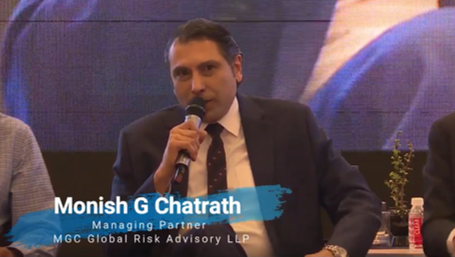
At the recently concluded annual conclave of the IIA in New Delhi, our Managing Partner was invited to present his views on "Future Boardrooms | Challenges and Strategies", where he had shared the panel with industry experts (Sumant Chadha, Sridar Iyengar, Richard Rekhy and Pradeep Chaturvedi).
While the key take aways from this discussion are set out in the ensuing paragraphs, snippets from his views on the role of board of directors ('boards' or 'directors) relating to risk management can be viewed at (CLICK HERE).
Directors have legal, moral and ethical responsibilities in the context of facilitating enterprise-wide risk management in companies.
| |
|
Legal responsibilities
- Section 134 (3) (n), Companies Act 2013 | The directors’ report should include a statement on the development and implementation of a risk management policy including identification of elements of risk that may threaten the existence of the Company.
- Section 177 (4) (vii), Companies Act 2013 | The terms of reference for an audit committee should include the evaluation of risk management systems of the company.
- Schedule IV read with section 149(8)¸ Companies Act 2013 | Independent directors should satisfy themselves on the integrity of financial information and ensure that internal financial controls & systems of risk management are robust and defensible.
In addition, clause 49 of the listing agreement has specified requirements relating to disclosures from the board on risk management. Listed companies need to have procedures to inform their board about their risk assessment and minimization procedures. These procedures need to be periodically reviewed to ensure that the executive management controls risks through the means of a properly defined framework. The management needs to place a report certified by the compliance officer of the company, before the entire board every quarter documenting the business risks faced by the company, measures to address and minimize such risks and any limitations to the risk-taking capacity of the corporation. This document needs to be formally approved by the board.
The listing obligations & disclosure requirements (‘LODR’), which have been amended over the years (with the latest being LODR 2022, which the market regulator SEBI has published vide its notification No. SEBI/LAD-NRO/GN/2022/103 on November 14, 2022), requires a holistic approach to risk management, to improve corporate governance standards of listed companies in India.
| |
|
Moral responsibilities
Boards need to assess the risk appetite and tolerance zones (guidance for which is specified in COSO 2017), while setting the tone at the top (guidance for which can be found as best practices in UK’s Combined Code on Corporate Governance) and factor risk management initiatives as a critical ingredient of their organizational strategy.
Directors should satisfy themselves on (a) the adequacy and consistency of the risk management policies and procedures and their alignment with the company’s strategy and risk appetite; (b) whether these policies and procedures are functioning as directed; & (c) necessary steps to foster an enterprise-wide culture, which supports appropriate risk awareness, escalation channels and addresses risk-taking beyond the company’s determined risk appetite.
| |
|
Ethical responsibilities
Directors should be able to challenge the management and the promoters constructively, proactively and diligently on the company's risk mitigation strategies. The board should encourage dialogues on aspects relating to ethical conduct, specially in areas of change management, incident management, whistle blowing and related party transactions. While allocating risk management responsibilities to the audit committee, they should also bear in mind that such responsibilities should not in any way compromise the audit committee’s independence or objectivity. In such cases, the establishment of separate risk committees may be the right solution, depending on the company’s specific circumstances, nature, size and complexity of business.
The board should seek to dispel the fear of competitive (dis)advantage while disclosing information regarding a company’s principal risks, in order to enhance shareholder confidence through greater transparency in the area of risk management.
| |
|
Finally
Both the regulations and practical considerations continue to support the proposition that the board is not expected to participate in the day-to-day affairs of an organization, and consequently is not required to be involved in actual day-to-day risk management. Through its oversight role, the board needs to ensure that risk management processes are designed to be executed throughout the organization, in line with its corporate strategy.
Enterprise-wide risk management should not be viewed as an impediment to the conduct of business or as a mere supplement to an organization’s overall compliance program. This should be deeply imbedded as a key component of an organization’s strategy, culture and business operations.
We trust you found this thought leadership insightful and look forward to your feedback.
Best regards
Markets Teams
MGC Global Risk Advisory
| |
|
About MGC Global Risk Advisory
Recognized as one of the '10 most promising risk advisory services firms' in 2017, as the 'Company of the Year' in 2018 &, 2019' (both in the category of risk advisory services), one of the 'Top Exceptional Companies to Work For’ in 2020, amongst the ‘Top 25 Customer Centric Companies’ in 2020 and 'The Consultant of the year' in 2021 (in the category of risk advisory services); MGC Global is an independent member firm of the US$ 4.6 billion, Atlanta headquartered - Allinial Global.
MGC Global provides services in the areas of internal audits, enterprise wide risk management, control assessments (SOC, IFCR & SOX), process re-engineering, governance frameworks, IT risk advisory, GDPR, VAPT, ISO readiness, cyber security, CxO transformation and forensic services. Our Firm has the capabilities to service its clients through its offices in Bengaluru, Mumbai, NCR; and has service arrangements in all major cities in India.
| |
|
About Allinial Global
Allinial Global (formerly PKF North America) is currently the world's second-largest member-based association (with collective revenues of approximately USD 4.6 billion) that has dedicated itself to the success of independent accounting and consulting firms since its founding in 1969. It currently has member firms in 99 countries, who have over 26,000 professional staff and over 4,000 partners operating from 688 offices across the globe.
Allinial Global provides its member firms with a broad array of resources and support that benefit both its member firms and their clients in the key impact areas of learning and development, human resources, international outreach, technical support, knowledge-sharing platforms through its specialized communities of practice, marketing resources, information technology and best practices in practice management.
| | | | |