|
Dear Reader,
What can destroy the value of a world-class mine without changing a single gram of its reserves?
A government changes the terms under which it can operate. A critical permit is delayed. A safety incident halts production. A cyberattack disrupts operational systems. An environmental liability emerges that the original investment case did not adequately capture.
Each may appear to be a separate problem. Yet any one of them can disrupt production, increase costs, delay cash flows or change the economics of an investment.
The challenge facing mining companies is no longer simply to find, finance and extract valuable resources. It is to establish whether the organization can deliver the returns it has committed in an environment of changing regulatory, geopolitical, operational and technological risks.
For CxOs and stakeholders in the mining sector, the critical question is not merely what an asset is worth today, but how much of that value the organization can realistically protect and realize tomorrow.
| | |
Value extends beyond geology. Approvals, operating integrity, technology resilience and environmental obligations increasingly determine whether an asset can deliver its projected returns.
Risks are interconnected. An operational incident or regulatory change can cascade into financial losses, contractual disputes and impaired asset value.
Risk intelligence changes decisions. Boards need evidence that critical controls work, material exposures are understood and management actions are clearly assigned.
| | |
More capital, fewer bets
Buying has become faster than building. That raises the price of quality and the cost of misjudging it.
| | | $ 93. 7B
Global mining M&A value in 2025, the highest since 2012 and 23% above 2024 | 522
Deals in 2025, against 532 in 2024. Value rose while volume held broadly flat. | ~29 years
Average time from discovery to production for US mines, the second-longest of any country in a study of 268 mines | | | |
Capital is concentrating in fewer, larger investments, while long development cycles and rising execution complexity increase the consequences of getting an investment decision wrong.
The issue for investors is not simply whether an asset is attractive. It is whether its operating assumptions, approval pathway, cost estimates and critical controls provide a credible basis for the returns being projected.
| | WHY THE STAKES ARE RISING | | |
Four pressures are increasing the cost of misjudging mining investments
| | |
47%
Cost escalation
Increase in BHP's estimated investment for Stage 1 of its Jansen potash project, from $5.7 billion to $8.4 billion.
Risk: Cost escalation can materially weaken projected investment returns.
Source: BHP, Jan 20, 2026
| |  | |
~13.4%
Declining grades
Gold head grades have fallen about 13.4% since 2010 and copper grades about 7.6%, so more rock must be moved and processed for every metric ton of metal.
Risk: Unit costs rise even when output holds, eroding assumed margins.
Source: S&P Global, Dec 2023 and updated by MGC Global's market research
| | |
~246,000
Scarce skills
New workers Canada's mining industry may need to recruit over the decade to 2035, to meet demand and replace departing employees. Its workforce is projected to reach about 242,400 by 2035 under the baseline scenario.
Risk: Skills shortages can weaken safety, controls and project delivery.
Source: MiHR, Jun 2026
| | | |
-9%
Tighter capital
Investment in critical minerals fell 9% in 2025 as price volatility weighed on spending decisions.
Risk: Projects with weaker risk evidence face slower and costlier financing.
Source: IEA, 2026
| | |
Policy is now a line in the valuation
Five developments reshaping the economics of mining assets: what each could mean and how leaders should respond.
| | | | | |
EU carbon border adjustment
The definitive regime began on January 1, 2026. Importers will purchase CBAM certificates from February 2027 to cover the embedded emissions of applicable imports.
Risk implication: Carbon intensity becomes a direct cost on iron ore pellets and steel bound for Europe.
Leadership action: Measure and disclose product-level emissions.
| | | | | |
EU Critical Raw Materials Act
106 strategic projects designated across three selection rounds since March 2025, including a second round of EU projects approved in October 2026. Permitting timelines for strategic extraction projects are capped at 27 months.
Risk implication: Faster approvals elsewhere can shift capital and reprice slower jurisdictions.
Leadership action: Benchmark permitting against the fastest pathway.
| | | | | |
China's critical mineral export controls
China suspended its October 2025 rare earth controls until November 10, 2026. In September 2026 the US-China trade arrangement was extended to January 10, 2027, but a formal new date for the suspension has not been published.
Risk implication: Short, rolling extensions leave input supply exposed to sudden change.
Leadership action: Map exposure and test contingency plans.
| | | | | |
State capital in mining
Public financing commitments for critical minerals more than quadrupled between 2023 and 2025 to about $65 billion. Washington has also taken equity stakes in miners, including MP Materials and Lithium Americas.
Risk implication: State shareholders can bring offtake conditions, governance rights and closer scrutiny.
Leadership action: Scrutinize conditions attached to state capital.
| | | | | |
Mali and Barrick
A dispute that shut the Loulo-Gounkoto complex for much of 2025 ended with a settlement of about $437 million. Production resumed in 2026 under a renewed permit.
Risk implication: Fiscal disputes can halt production and hold back revenue for months.
Leadership action: Price fiscal stability into asset value.
| | |
Four shifts that now decide what an asset is worth
How policy, operating conditions and markets change the underlying risk profile of an asset.
| | |
01
STAGE Valuation · Structuring
Governments have become counterparties
Canada cleared the $54 billion Anglo American-Teck merger only after binding investment commitments. China, the last approval outstanding, is reported to want copper supply assurances. Approval is no longer a date in the timetable. It is a negotiation whose conditions can bind an asset for years. From Africa to Latin America, host governments are revisiting fiscal terms, state participation and export rules for assets already in production.
Ask: Have we priced the approval or only scheduled it?
| | | |
02
STAGE Screening · Diligence
Terms can change while
the ore does not
Cobre Panamá, operated by First Quantum, produced about 1% of global copper before its 2023 shutdown. A government commission has recommended formal negotiations on a potential restart under a new legal framework, with revenues intended to fund environmental rehabilitation, long-term monitoring and an orderly closure. The proposal remains subject to government consideration and its final terms and economics have not been determined. The orebody has not changed. The legal basis for its cash flows may.
Ask: Which assumptions depend on a government's continued consent?
| | |
03
STAGE Diligence · Structuring
Operating integrity is
now a deal term
A mud rush at Freeport's Grasberg mine in September 2025 halted operations and led to force majeure. Freeport now expects to approach full capacity only by the end of 2027, more than two years after the incident. A single incident can reshape production, contracts and value for years.
Ask: Is our operating track record documented well enough to support value in a transaction?
| | | |
04
STAGE Valuation · Integration
Product quality meets
low-carbon steel
DR-grade ore is a small share of supply today. BloombergNEF expects a shortfall of 15 Mt a year by 2030, widening to 133 Mt by 2040, as direct reduction plants multiply. Product chemistry is becoming a risk factor alongside volume and cost.
Ask: Does our product suit the steelmaking routes ahead?
| | THE MGC GLOBAL PERSPECTIVE | | |
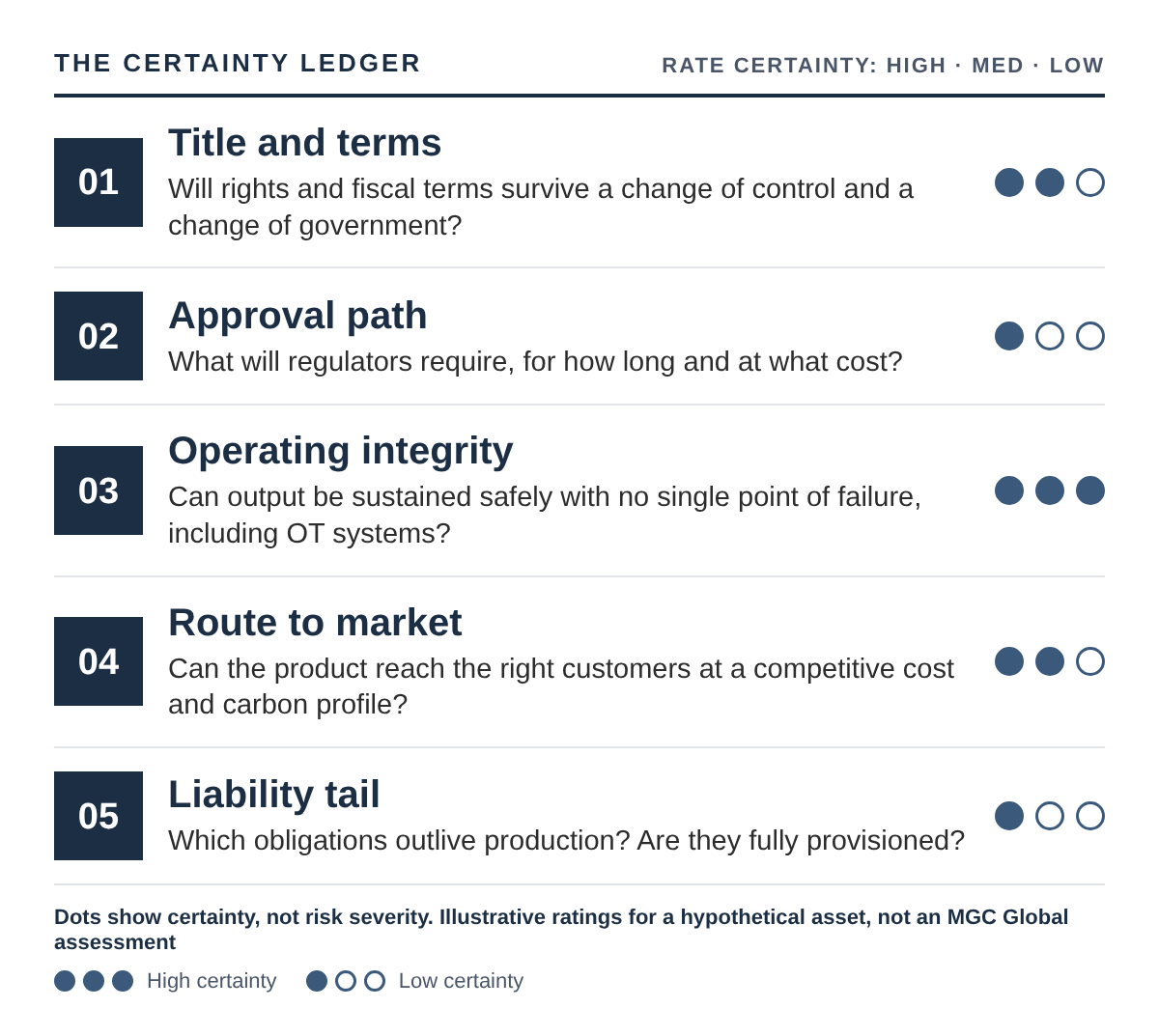
The certainty ledger
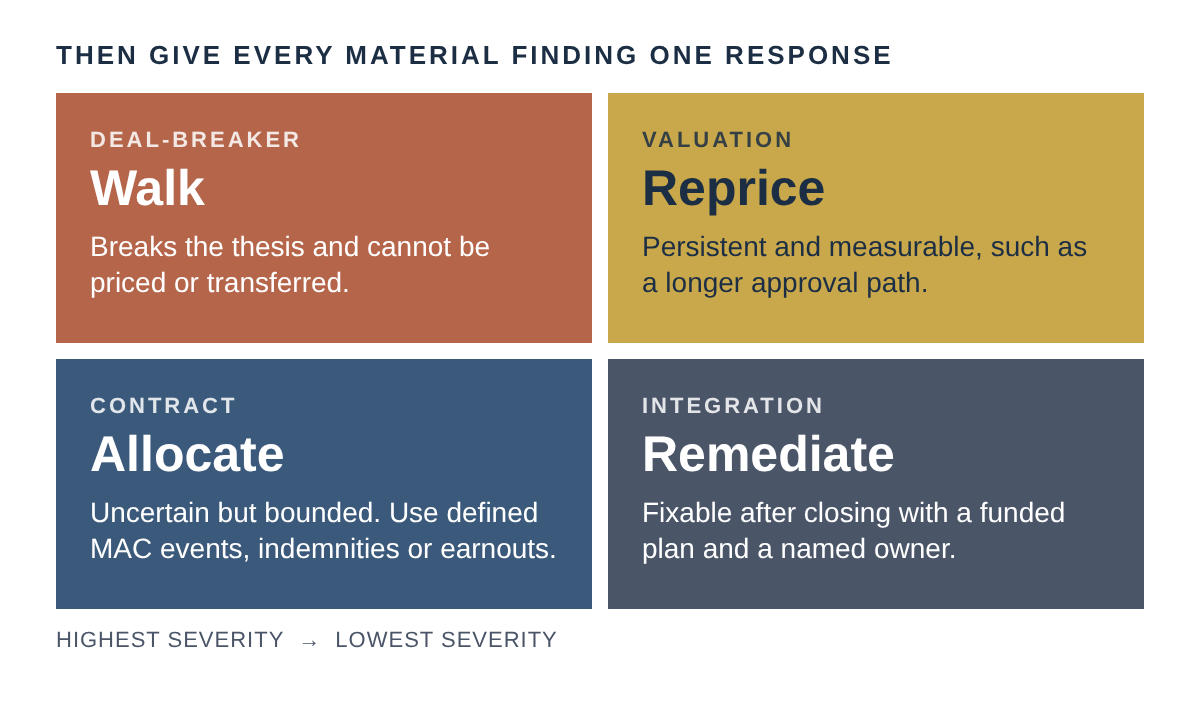
Identifying a risk is only the starting point. The real test is whether its potential impact is understood, the relevant controls are effective and management has made a clear decision about how the exposure will be addressed. The Certainty Ledger brings five critical dimensions into one assessment, linking material findings to an explicit management response.
| | |
Every material finding should have an accountable owner, supporting evidence, a defined response and a target date.
The objective is not to eliminate uncertainty, but to make it visible, measurable and actionable before it becomes a loss.
| | Five moves before the next transaction | | | | | Require investment papers to show which critical controls have been tested and who owns each material exposure. | | | | | Model approval delays, cost overruns and fiscal change as costed scenarios. Commission independent challenge of capex estimates before approval. | | | | | Bring risk, cybersecurity and operational specialists in before the term sheet. Allocate identified risks through price, indemnities or earnouts. | | Risk and operations leaders | | | Test whether safety, OT cybersecurity and business continuity controls actually work, not just whether they exist. | | Owners of mines and captive assets | | | Assemble evidence of operating performance, incident management and control effectiveness 12 to 18 months before any sale or strategic review. | | |
IN CLOSING
Certainty is becoming the new grade.
In mining, geological potential creates opportunity. The ability to realize that potential depends on much more: regulatory permissions, operating integrity, technology resilience, effective governance and the management of financial and environmental obligations.
For boards, investors and operators, the imperative is to understand how these risks interact, assess whether critical controls are effective and ensure that material exposures influence investment and operating decisions.
At MGC Global, we believe risk intelligence must inform decisions before capital is committed, throughout operations and as strategic choices evolve. Effective risk management is not an obstacle to growth. It protects value, strengthens resilience and enables more informed investment decisions.
The question is no longer simply whether an asset is attractive. It is whether the risks that could undermine its value are understood, evidenced and managed.
To exchange perspectives on the risk implications for your mining portfolio, write to contactus@mgcglobal.co.in
| | |
Best regards,
Markets Team
MGC Global Risk Advisory
| | |
MGC Global Risk Advisory
MGC Global Risk Advisory (‘MGC Global’ or ‘the firm’) is a specialist risk advisory services firm, widely regarded as one of the leading practices in its domain and consistently recognized by multiple forums and industry bodies for the value and impact it delivers to its stakeholders. A member of Allinial Global, the world’s first-largest association of independent accounting and consulting firms, MGC Global brings global perspective with deep local expertise.
MGC Global's service portfolio encompasses enterprise-wide risk management, controls assessments, process optimization, internal audits, fraud and forensic investigations, as well as a comprehensive suite of IT risk advisory services (including cyber risk management, business continuity, data privacy, ISO readiness & compliance and virtual DPO & CISO-as-a-service). The firm also provides comprehensive ESG advisory services, facilitates financial transformation through streamlined reporting and offers virtual-controller-as-a-service, as well as accounting advisory support. Its HR risk advisory practice encompasses organizational structuring, policies and manuals, rightsizing, balanced scorecards and cultural development.
| | | |
About Allinial Global
Allinial Global (formerly PKF North America) is currently the first-largest member-based association.
With collective revenues to the tune of approximately US$ 9.25B+, Allinial Global has dedicated itself to the success of independent accounting and consulting firms since its founding in 1969. It currently has member firms in over 113 countries, who have over 48,598 professional staff and over 4,067 partners operating from nearly 1,203 offices across the globe. Allinial Global provides its member firms with a broad array of resources and support that benefit both its member firms and their clients in the key impact areas of learning & development, human resources, international outreach, technical support, knowledge-sharing through its specialized communities of practice, information technology and practice management.
| | | | |