Elmo Peeler Note-for-Note Piano Transcriptions | | | |
Greetings!
Today is the first day of November and time again for my monthly newsletter, to keep you informed of recent transcriptions and other news of the last month.
| | | | |
I've just finished transcribing the piano part in a song that has intrigued me since it was a #1 hit, winning a Grammy Award for Best Rock and Roll Record of 1963 - "Deep Purple" by Nino Tempo & April Stevens - a truly great track played by the Wrecking Crew.
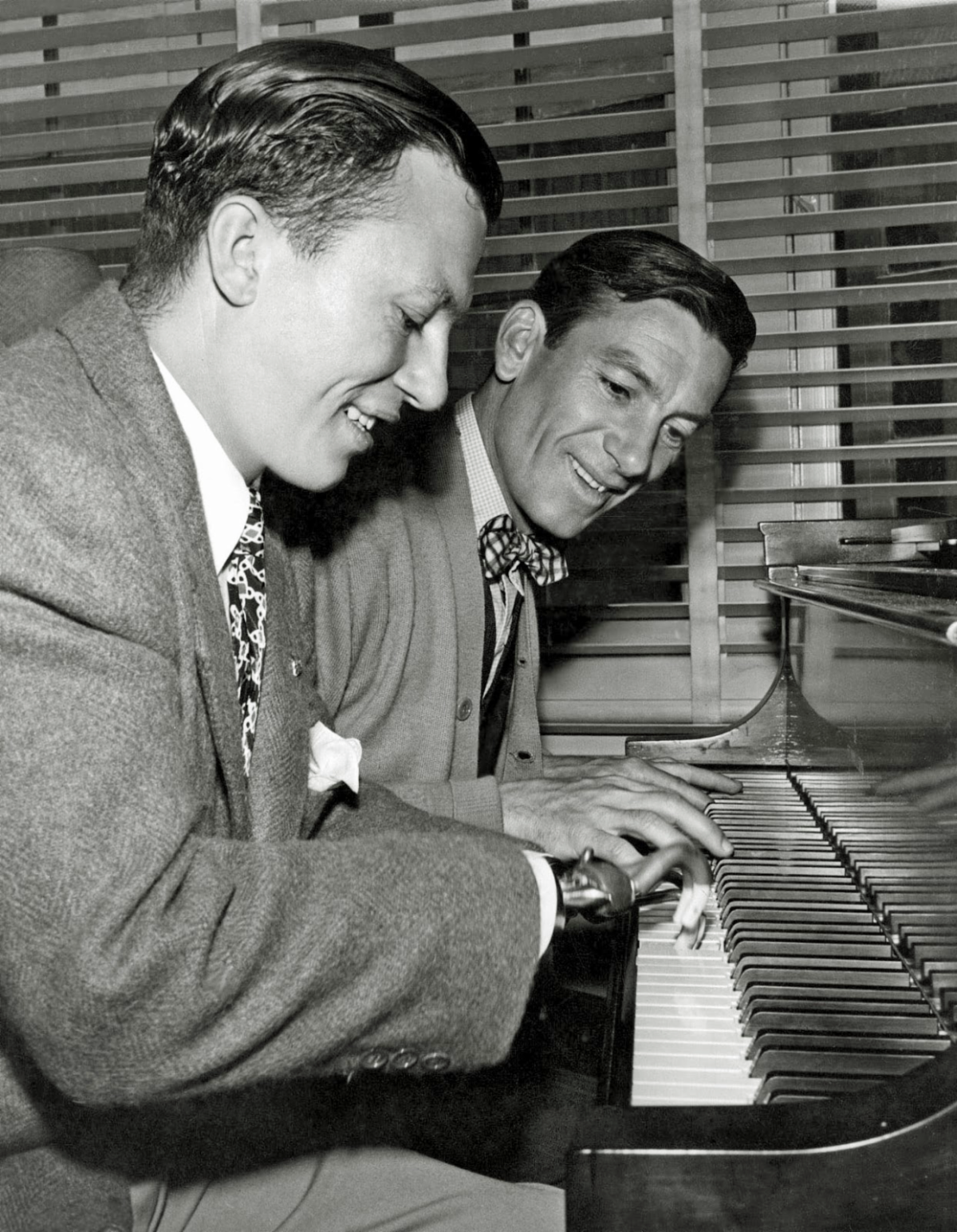
My other brand-new transcription this month is a very special one - it's a performance from one of the greatest movies ever made (9 Oscars), by two truly extraordinary men - Hoagy Carmichael and Harold Russell.
The movie is director William Wyler's 1946 classic, The Best Years of Our Lives, which was nominated for eleven Academy Awards and won nine, two of which were awarded to Harold Russell - a truly
| | |
exceptional individual who overcame the loss of both his hands during World War 2, and went on to live an amazing life of service to his country and to his fellow man.
Hoagy Carmichael was one of the most successful songwriters of the 20th century, composing "Stardust", "Up a Lazy River", "Georgia on My Mind" (the Ray Charles classic), and hundreds of others.
Also new this month is an exercise that will help you to add more rhythm to your playing.
BTW, to make sure that my email doesn't end up in your Spam folder, please add me to your Contact list and/or mark my email as "Not Spam".
Note that every Title Heading is clickable.
Elmo Peeler
| |
ALL of the Sheet Music listed on my website has been personally transcribed by me, and guaranteed to be note-for-note perfect.
Whether you:
- have a cover band and want to get your keyboard parts exactly correct,
- are a professional who wants to study the styles of rock's greatest keyboard players, or
- are a hobbyist that wants to learn how to play pop/rock and great piano music,
...these note-for-note transcriptions will prove extremely helpful.
| | |
In the News! - Hoagy Carmichael & Harold Russell
One of the 20th Century's Best Songwriters with One of America's Greatest Men
| | |
Hoagland Howard ("Hoagy") Carmichael was born in Bloomington, Indiana, in 1899. His father worked as a horse-drawn taxi driver and later as an electrician, and his mother, a versatile pianist, played musical accompaniment at local nickelodeons and silent movie theaters and private parties to earn extra income.
Hoagy lived most of his early years in Bloomington and in Indianapolis. When he was 11, the Carmichaels moved to Missoula, Montana.
Carmichael's mother taught him to sing and play the piano at an early age. With the exception of some piano lessons with Reginald DuValle, a local bandleader, Carmichael had no other musical training.
The family moved back to Indianapolis when Carmichael was 17.
For musical inspiration, Carmichael would listen to prominent ragtime pianists Hank Wells and Hube Hanna.
At 18, Hoagy supplemented his family's meager income by doing manual jobs in building construction, at a bicycle chain factory, and in a meat slaughterhouse.
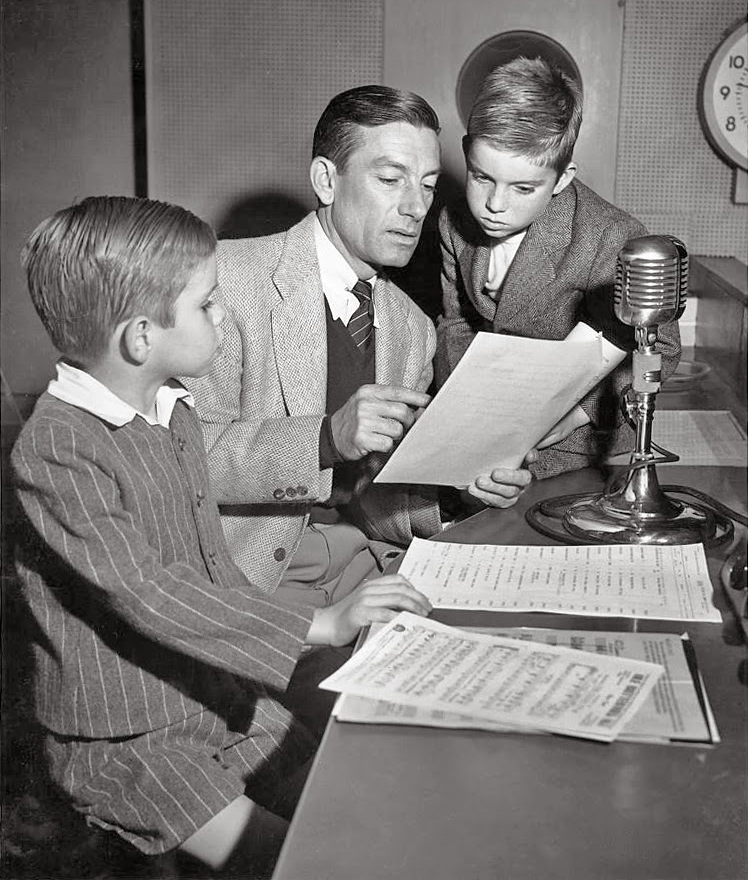
| | Randy, Hoagy Carmichael & Hoagy Bix at his radio show in 1947 | | |
This bleak time was partially relieved by piano duets with his mother and by his friendship with DuValle, who taught him piano-jazz improvisation. In 1918 Carmichael earned $5 (~$110 in today's dollars) playing at a college fraternity dance at nearby Indiana University, the beginning of his professional musical career.
That same year the death of his three-year-old sister (during the Spanish flu pandemic) affected him deeply. He later wrote "My sister Joanne - the victim of poverty. We couldn't afford a good doctor or good attention, and that's when I vowed I would never be broke again in my lifetime."
Around 1922, Carmichael met cornetist Leon ("Bix") Beiderbecke, who introduced him to Louis Armstrong, with whom Carmichael would later collaborate. Carmichael reflected in a letter to his wife in the early 1930s that he was going to see Armstrong to learn about the "purty notes." He was also inspired by Beiderbecke's impressionistic and classical music ideas.
Carmichael's first recorded song, initially titled "Free Wheeling," was written for Beiderbecke, whose band, The Wolverines, recorded it as "Riverboat Shuffle" in 1924. The song became a jazz staple. In 1925 "Hitch's Happy Harmonists" recorded an instrumental rendition of Hoagy's "Washboard Blues", the earliest recording in which Carmichael performed his own songs, including an improvised piano solo.
That same year he earned a bachelor of arts degree, plus a law degree in 1926, at nearby Indiana University at Bloomington while playing the piano around Indiana and Ohio with his recently organized band, "Carmichael's Collegians".
After graduating from law school in 1926, Carmichael moved to Florida, where he worked as a legal clerk in a West Palm Beach legal firm, but returned to Indiana in 1927 after failing the Florida bar exam. He joined an Indianapolis law firm and passed the Indiana bar, but devoted most of his energies to music.
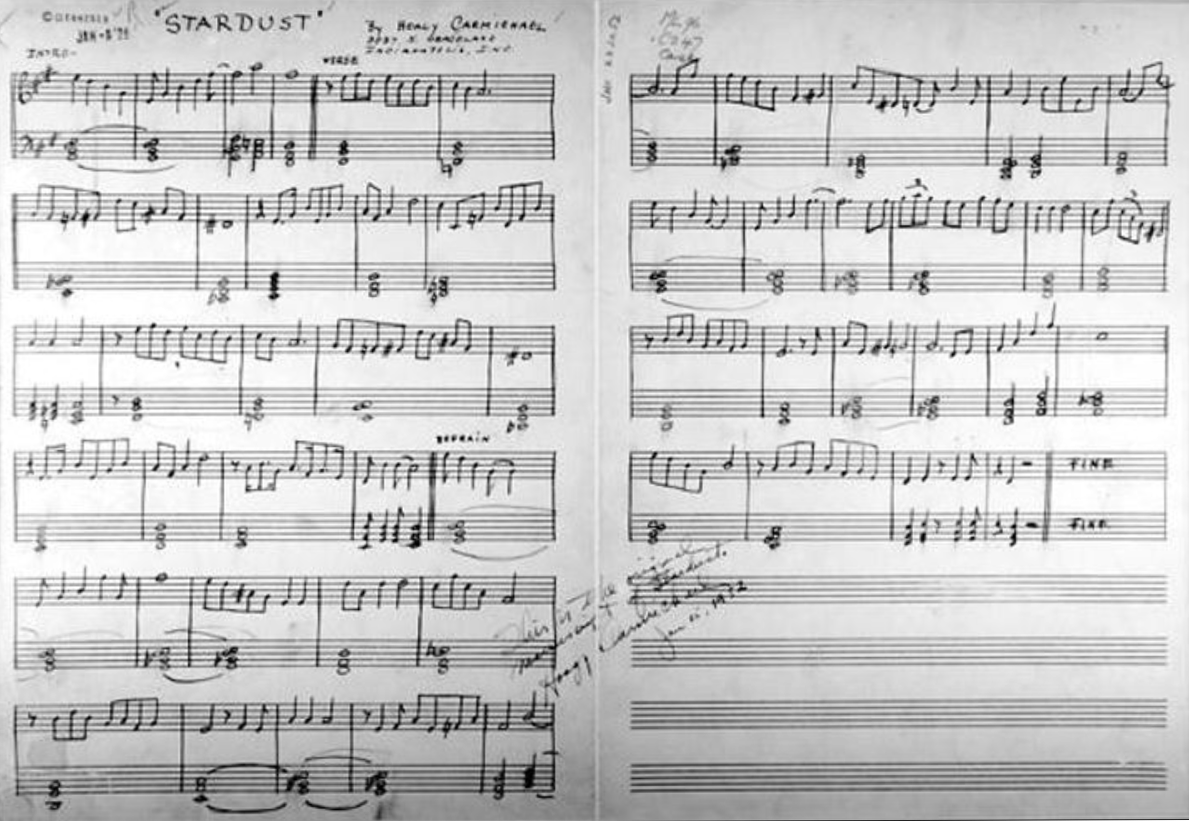
| | The original manuscript of "Stardust", signed by Hoagy Carmichael | | |
Hoagy had discovered his method of songwriting, which he described later: "You don't write melodies, you find them… If you find the beginning of a good song, and if your fingers do not stray, the melody should come out of hiding in a short time."
Carmichael composed around 650 songs, including fifty that achieved hit-record status during his long career. In his early days as a songwriter in Indiana (1924–1929), he wrote and performed in the Hot Jazz improvisational style, popular with jazz dance bands.
During his later years in California (1936–1981), his songs were predominately instrumentals. Nearly four dozen were written expressly for, or were incorporated into, motion pictures.
| | |
Hoagy made hundreds of recordings. In 1927 he recorded "Star Dust," one of his most famous songs, playing the piano solo himself. It became a hit, the first of many for Carmichael - a standard of the Great American Songbook, recorded by hundreds of artists, including Artie Shaw, Nat King Cole, Ella Fitzgerald, Frank Sinatra, Willie Nelson & Wynton Marsalis. That same year he received more recognition after Paul Whiteman and his orchestra recorded "Washboard Blues", with Carmichael singing and playing the piano.
In 1929, after realizing that he preferred making music and had no aptitude for or interest in becoming a lawyer (he was sacked from his job at the law firm), Carmichael moved to New York City, where he worked for a brokerage firm during the weekdays and spent his evenings composing music.
Hoagy met Duke Ellington's agent and sheet music publisher, Irving Mills, and hired him to set up recording dates. Carmichael's first major song with his own lyrics was "Rockin' Chair," recorded by Louis Armstrong and Mildred Bailey, and eventually with his own hand-picked studio band (featuring Beiderbecke, Bubber Miley, Benny Goodman, Tommy Dorsey, Bud Freeman, Eddie Lang, Joe Venuti & Gene Krupa) in 1930.
After the 1929 stock market crash, Carmichael's hard-earned savings declined substantially. Fortunately, Louis Armstrong had recorded "Rockin' Chair", giving Carmichael a badly needed financial and career boost. The song became one of Carmichael's jazz standards.
In 1930 Carmichael composed and recorded "Georgia on My Mind", with lyrics by his friend Stuart Gorrell. After hearing Hoagy play the newly composed melody at a party, Gorrell stayed up all night with him working on the song and ended up writing lyrics for it. Gorrell became a banker and never wrote another lyric in his life. The song became another jazz and pop standard, especially after World War II.
That same year Carmichael also co-wrote, arranged and recorded "Up a Lazy River". In 1932 he began working as a songwriter for Southern Music Company, the first music firm to occupy the new Brill Building, which became a famous New York City songwriting mecca.
In 1933 he began a long-lasting collaboration with lyricist Johnny Mercer on "Lazybones," which became a hit, selling more than 350,000 sheet music copies in three months. They wrote nearly three dozen songs.
Hoagy also began to emerge as a solo singer-performer, first at parties, then professionally. He described his unique, laconic voice as sounding "the way a shaggy dog looks... I have Wabash fog and sycamore twigs in my throat."
In 1935 he began composing songs for a division of Warner Brothers, establishing his connection with Hollywood. "Moonburn," the first song Carmichael wrote for a motion picture, was sung by Bing Crosby (who was born with perfect pitch) in Paramount Pictures' film Anything Goes in 1936.
That same year he married and moved to California, hoping to find more work in the film industry. It worked - in 1937 he signed a contract with Paramount Pictures for $1,000 a week ($23,000 in today's money).
Carmichael also found work as a character actor in Hollywood. His on-screen debut occurred in 1937 in Topper, with Cary Grant. Carmichael portrayed a piano player, performing his song "Old Man Moon" in the film. The effort led to other character actor roles in the 1940s, including some true classics.
Throughout the 1940s he maintained a strong personal and professional relationship with Johnny Mercer. In 1941 their continuing collaboration led to "Skylark," considered one of Carmichael's greatest songs. Bing Crosby recorded it almost immediately in January 1942. Since then many others have recorded it, including Glenn Miller, Dinah Shore, Aretha Franklin and Bette Midler.
In 1942 the growing Carmichael family moved into the former mansion of chewing-gum heir William P. Wrigley Jr. in Holmby Hills, Los Angeles.
Carmichael's 1942 song "I'm a Cranky Old Yank" was listed in the 1967 edition of the Guinness Book of Records under the title "I'm a Cranky Old Yank in a Clanky Old Tank on the Streets of Yokohama with My Honolulu Mama Doin' Those Beat-o, Beat-o Flat-On-My-Seat-o, Hirohito Blues" as the longest song title.
Carmichael appeared as an actor in 14 motion pictures, performing at least one of his songs in each. He described his on-screen persona as the "hound-dog-faced old musical philosopher noodling on the honky-tonk piano, saying to a tart with a heart of gold: 'He'll be back, honey. He's all man.'"
| | |
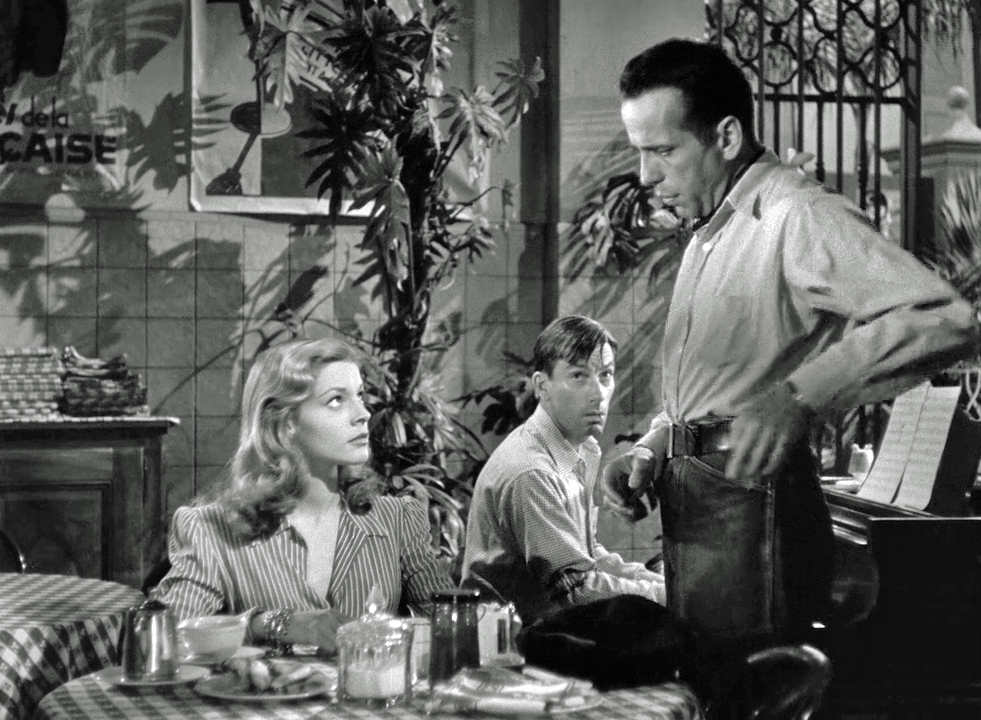
In 1944 Hoagy appeared in Ernest Hemingway's To Have and Have Not, opposite Humphrey Bogart and Lauren Bacall. As the hotel bar pianist, he sang "Hong Kong Blues" and "The Rhumba Jumps," and played piano as Bacall sang "How Little We Know."
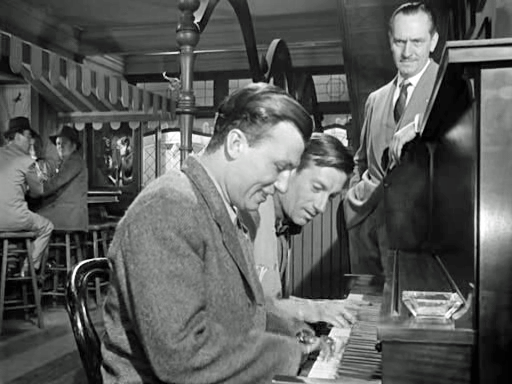
In the multi (9)-Academy Award-winning film The Best Years of Our Lives (1946) with Dana Andrews, Myrna Loy and Fredric March, he teaches a disabled veteran (Harold Russell) with metal prostheses to play "Chopsticks," and also performs "Lazy River."
Carmichael's career as a recording artist peaked in the mid-1940s when he recorded, acted and performed in motion pictures and hosted variety shows on the radio. He also sang in live shows across the United States.
Carmichael was an incessant composer, working on a song for days or even weeks until it was perfect.
| | |
Lauren Bacall, Hoagy Carmichael & Humphrey Bogart
in To Have and Have Not (1944)
| | |
“He had [music] pouring out of him. He couldn’t stop and didn’t want to stop,” said his son Hoagy Bix about his father’s continuous songwriting.
His perfectionism extended to his clothes, grooming, and eating. Once the work was done, however, Carmichael would cut loose - relax, play golf, drink, and indulge in the Hollywood high life. Carmichael also found time to write his first autobiography, The Stardust Road, published in 1946.
Between 1944 and 1948, Carmichael became a well-known radio personality and hosted three musical-variety programs. Musicians included Pee Wee Hunt and Joe Venuti.
In 1951 Hoagy finally received an Oscar for Best Original Song from Bing Crosby’s performance of "In the Cool, Cool, Cool of the Evening" featured in Paramount’s Here Comes the Groom.
And in 1959 he was a regular cast member in the first season of NBC's western TV series Laramie (1959–63), playing the character role of Jonesy the ranch hand.
In 1960 Ray Charles' classic rendition of "Georgia on My Mind" was a major hit (Charles received Grammys both for Best Male Vocal and Best Popular Single that year).
In 1961, Carmichael was featured in an episode of The Flintstones titled "The Hit Songwriters." Jerry Lee Lewis recorded "Hong Kong Blues" during his final Sun sessions in 1963. Beatles guitarist George Harrison released covers of "Baltimore Oriole" and "Hong Kong Blues" in early 1981.
In the mid-1960s royalties on his standards were earning Carmichael over $300,000 a year ($3,000,000 in today's money). Carmichael's second memoir, Sometimes I Wonder: The Story of Hoagy Carmichael, was published in 1965.
By 1967 his new songs were unsuccessful and his musical career came to a close. Carmichael took up other interests in retirement, including golf, coin collecting, and enjoying his two homes, one in Los Angeles and the other in Rancho Mirage, California.
Carmichael received several honors from the music industry in his later years. He was inducted into the USA's Songwriters Hall of Fame in 1971, along with Duke Ellington.
On his 80th birthday, Carmichael was reflective, observing, "I'm a bit disappointed in myself. I know I could have accomplished a hell of a lot more... I could write anything any time I wanted to. But I let other things get in the way.... I've been floating around in the breeze."
He died of a heart attack at the Eisenhower Medical Center in Rancho Mirage, California, in 1981, at age 82.
My new Hoagy Carmichael transcription:
"Chopsticks" - Hoagy Carmichael & Harold Russell, piano - NEW!
| | |
Harold Russell & Hoagy Carmichael rehearsing for
"The Best Years of Our Lives" (1946)
| | |
Harold Russell was born in 1914 in Nova Scotia, Canada, and moved to Massachusetts with his family in 1921, after his father's death in 1920.
At the time of the December 7, 1941 attack on Pearl Harbor, Russell was 27, living in Cambridge, Massachusetts, and working at a food market. In his 1949 autobiography Victory in My Hands he wrote that he rushed to enlist in the United States Army because he considered himself a failure.
On D-Day (June 6, 1944) while he was an Army instructor teaching demolition work with the U.S. 13th Airborne Division at Camp Mackall, North Carolina, a defective fuse detonated TNT explosives that he was handling. He lost both hands and was given two hooks to serve as hands.
After his recovery, while attending Boston University, Russell was featured in Diary of a Sergeant, an Army film about rehabilitating war veterans. When film director William Wyler saw that film, he cast him in The Best Years of Our Lives (1946) with Fredric March, Dana Andrews and Hoagy Carmichael.
Russell played the role of a Navy sailor who lost both hands during the war and won the Academy Award for Best Supporting Actor.
| | |
He was also awarded an honorary Oscar for ''bringing aid and comfort to disabled veterans through the medium of motion pictures.'' The special award had been created because the board of governors wanted to salute Russell, a non-professional actor, but assumed that he had little chance for a competitive win. It was the only time in Oscar history that the academy awarded two Oscars for the same performance.
Wyler called it "the finest performance I have ever seen on the screen.'' Upon completion of the film, Russell returned to school at Wyler's urging and earned a business degree from Boston University.
Speaking with the Los Angeles Times in 1996, Russell recalled: "Wyler told me I should go back to college because there wasn't much call for a guy with no hands in the motion picture industry. I figured he was right. [In the handful of roles I've taken since then,] I always play a disabled veteran. And this is what Wyler said—'After a while they're going to run out of ideas' - and he was absolutely right. How many times can you play the same role?"
| | |
Russell became active in AMVETS, serving three terms as National Commander. He was first elected in 1949 and was elected to his third term in 1960.
As head of AMVETS, Russell wrote to President Truman in 1951 supporting Truman's decision to dismiss General Douglas MacArthur during the Korean War. Russell's telegram to Truman cited MacArthur's "repeated insubordination in violation of basic American principles governing civil versus military authority." His telegram asserted that those were "obvious grounds" to relieve MacArthur.
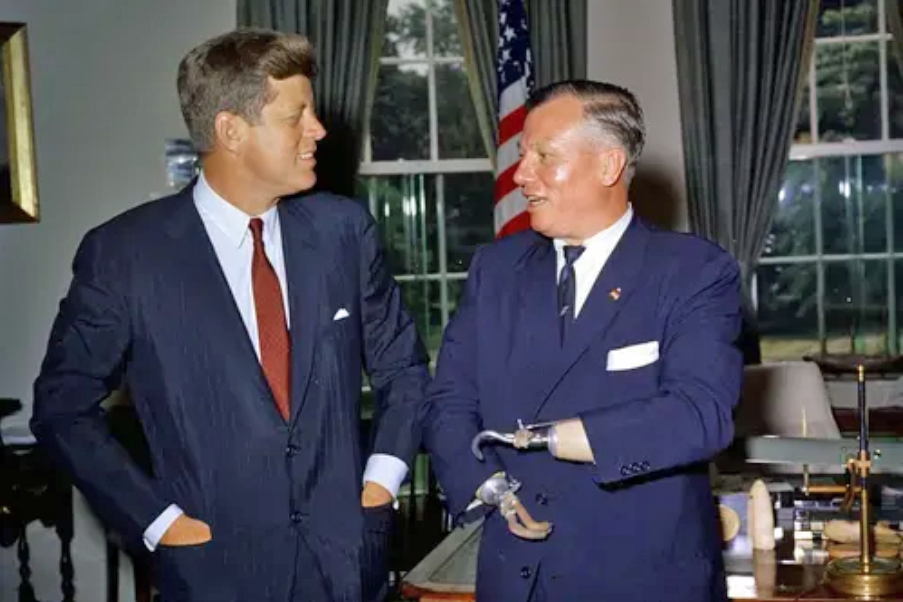
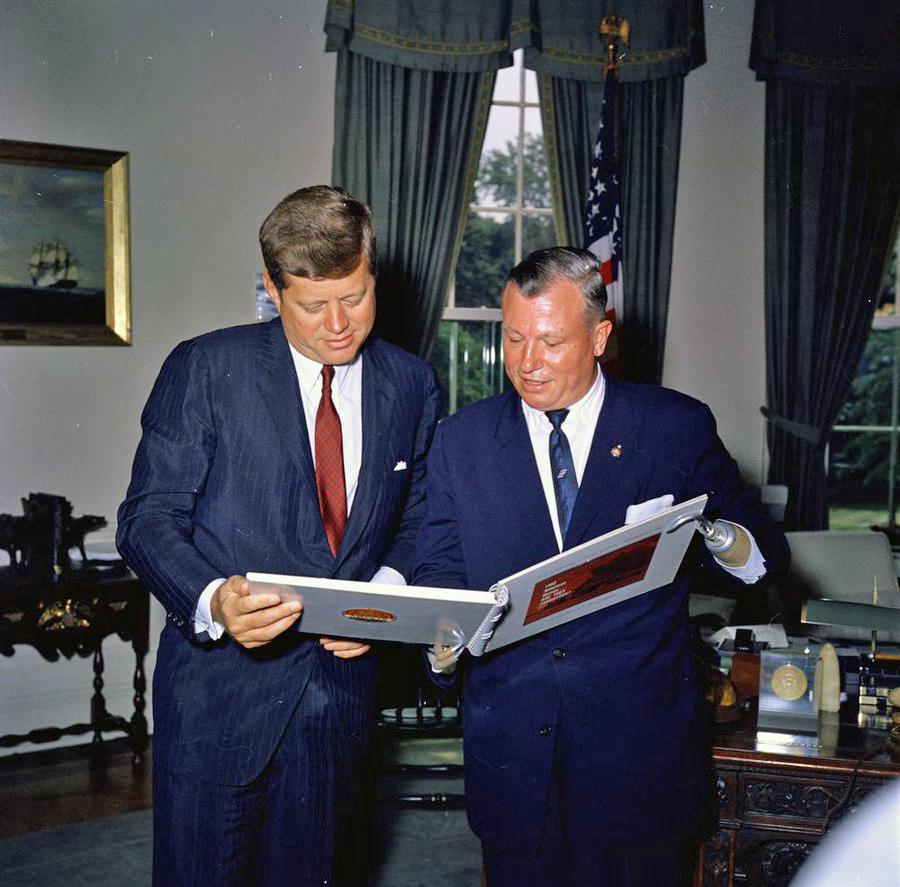
In 1961 President John F. Kennedy appointed Harold as Vice Chairman of the President's Committee on Employment of the Handicapped. This appointment recognized Russell's advocacy for disabled veterans and built upon his unique role as an Oscar-winning actor who had also lost his hands in service during World War II.
In 1964 President Johnson appointed Harold as chairman of the committee, where he served until the late 1980s.
| | |
John F. Kennedy & Harold Russell
August 9, 1961
| | |
He was also vice-president of the World Veterans Fund, Inc., the fundraising branch of the World Veterans Federation. In 1965, Russell received the Golden Plate Award of the American Academy of Achievement.
He appeared in only two films after his debut, Inside Moves (1980) and Dogtown (1997). In the 1980s he also appeared on TV in Trapper John, M.D. and China Beach.
And authored two autobiographies, Victory in My Hands (1949) and The Best Years of My Life (1981).
In 1992 Harold consigned his Oscar for Best Supporting Actor to Herman Darvick Autograph Auctions, and sold it to a private collector for $60,500. He defended his action by saying that he needed money for his wife's medical expenses. He did not sell the special Oscar. After his death, the unidentified collector was identified as Lew Wasserman, a studio executive (head of Universal), who then donated it back to the Academy.
In 2002 Harold Russell died in his sleep 15 days after his 88th birthday at a nursing home in Needham, Massachusetts.
This remarkable man's advice to others was "it's not what you lost but what you have left and how you use it that counts".
| | |
November's New Piano Transcriptions - "Deep Purple" by Nino Tempo & April Stevens - Grammy Award for Best Rock & Roll Record of 1963
Hoagy Carmichael & Harold Russell playing a Great Version of Chopsticks
from the 1946 classic movie The Best Years of Our Lives
| | |
"Deep Purple" won the Grammy Award for Best Rock and Roll Record of 1963. It had a unique hauntingly beautiful vocal track with April speaking the lyrics as Nino sings them.
Underpinning the great vocals was an excellent rhythm track played by members of Los Angeles' Wrecking Crew - Glenn Campbell on guitar, Earl Palmer on drums and Ray Johnson on piano.
Nino told Ray, "No fills. Just roll the piano." And roll it, he did, magnificently. Ray (brother of Plas Johnson, legendary jazz saxophonist) was born and raised in New Orleans. And that New Orleans feel and 'sound', with just the right chromatically-altered notes, is alive and well in this outstanding piano part.
This is a note-for-note transcription of the entire piano part - all 87 measures. If you've ever listened to this great recording, you've probably wondered what exactly is the pianist doing to achieve that great feel. It's a wonderful study in playing just the right notes with a perfect rolling feel.
To my ear it's one of the very best piano parts in any pop/rock record - a magical track.
| | |
Harold Russell & Hoagy Carmichael playing "Chopsticks" in
"The Best Years of Our Lives" (1946)
| | |
My other new transcription is a very special performance of "Chopsticks", from the 9-Oscar 1946 movie, The Days of Our Lives.
Performed by Hoagy Carmichael, one of the most gifted songwriters to ever place his hands on the keyboard, and Harold Russell, who only had hooks for hands (because of a WW2 injury).
It's a very clever 58-bar arrangement of "Chopsticks" with both parts using chromatic note choices, and Hoagy even throwing in fancy altered-chord substitutions in one phrase.
And Harold's part also throws in some fun high-register glissandi, utilizing the Left Hand crossing over the Right Hand.
| | This is the most fun version of "Chopsticks" I've ever heard. Considering that it was probably Hoagy Carmichael's own arrangement of it, it's no wonder. | | |
November's New Exercise - 'Pushes', Right Hand Thumb Rhythm & Left Hand Coordination
Make Your Playing More Rhythmic
| | |
This exercise will help you to gain facility in three areas:
1) 'Pushes' - advancing a chord by half a beat, to add rhythm
2) Using the Right Hand thumb as an additional rhythm instrument
3) Adding a heartbeat rhythm into the Left Hand, which requires a little coordination between the hands
It has six sections:
1) a 2-bar phrase with only Right Hand quarter-notes, except for two 'pushes'. This demonstrates the basic rhythm.
| | | |
2) the same 2-bar phrase but with a heartbeat rhythm in the Left Hand.
3) the same as the previous 2-bar phrase but with the Right Hand thumb playing four 8th-notes, to add more rhythm.
4) an 8-bar phrase that uses all three techniques (pushes, RH thumb & LH heartbeat rhythm).
5) the same 8-bar phrase but with an added note on top of the RH chords, changing them from triads to 4-note chords.
6) an 8-bar phrase with triads using all three techniques in a different chord progression.
This exercise should help you learn to play more rhythmically using three techniques: pushes, RH thumb rhythm and LH heartbeat.
BTW, if you need other good, effective technical exercises, please check out all of the 120
exercises available.)
| | |
Gospel Corner - Say 'Amen' Somebody
The Hangout Place for Gospel Classics
| | |
You don't have to be from the Deep South to love Gospel piano, nor do you need to belong to any particular religion. All you have to have is a love for wonderful old-time, swinging, uplifting piano-playing.
Leon Russell, Billy Preston, Richard Tee and Ray Charles, some of the greatest keyboard players ever, loved the style and infused their own performances with Gospel licks and rhythms.
Inspired by the wonderful playing of the portly Associate Pastor/Musical Director of my childhood's Baptist Church deep in the piney woods of Mississippi, in recent years I've transcribed and/or arranged a few Gospel classics.
This little corner of my newsletter is where I'll keep you informed of my latest efforts to share that old-time Gospel sound.
Here are my Gospel transcriptions and/or arrangements, plus some exercises:
Full-blown Gospel:
The Doobie Brothers - "World Gone Crazy" (Piano Intro) (click here to hear it)
Billy Preston & The Beatles - "Without a Song" (click here to hear it)
"I'll Fly Away" - arranged by Elmo Peeler (click here to hear it)
"Leaning on the Everlasting Arms" - arranged by Elmo Peeler (click here to hear it)
"Amazing Grace" - as played by Ethel Caffie-Austin (click here to hear it)
"Victory in Jesus" - as played by The Gaithers (click here to hear it)
Heavily Gospel Influenced:
Richard Tee - Transform Phrase No.1 (from Contemporary Piano video)
Richard Tee - First Piece (from Contemporary Piano video)
Floyd Cramer - "One Day at a Time (Sweet Jesus)"
Don Henley - "You Don't Miss Your Water"
Mavis Staples - "Hard Times Come Again No More"
Van Morrison - "Benediction"
Richard Tee - "Happy Birthday" (version 1)
Richard Tee - "Happy Birthday" (version 2)
Jeff Beck Group (Nicky Hopkins) - "Girl from Mill Valley"
Plum Nellie - "A Love Like Yours"
Plum Nellie - "That Lucky Old Sun"
Bill Payne (of Little Feat) - "The Ballad of Davy Crockett"
Lari White (Bill Payne on piano) - "Lead Me Not"
Ray Charles - "Sweet Sixteen Bars"
Billy Preston - "Will It Go Round in Circles" - Gospel-style Intro by Billy Preston
The Rolling Stones (Billy Preston on piano) - "Shine a Light"
Delaney & Bonnie (Leon Russell) - "Faded Love"
Leon Russell - "She Belongs to Me"
Don Henley - "You Don't Miss Your Water"
Moderately Gospel Influenced:
Bob Dylan & Clydie King - "Abraham, Martin and John"
Billy Vera & the Beaters - "At This Moment"
Bob Dylan - "Piano Mood" - Gospel-style piano improvisation
Delaney & Bonnie (Leon Russell) - "Don't Deceive Me"
Jackson Browne (Craig Doerge on piano) - "Rock Me on the Water"
Jerry Lee Lewis - "When the Saints Go Marching In"
James Taylor (Clarence McDonald on piano) - "Steamroller Blues" - Piano Solo
Leon Russell - "Old Masters"
Ray Charles - "Heartbreaker"
Ray Charles duo with Billy Joel - "Baby Grand"
Gospel-related Exercises:
Exercise in Blues Substitutions
Transform a Melody into Floyd Cramer's Style - Mary Had a Little Lamb
ii-chord Bump Exercise
Gospel Chord Exercise No.1
Gospel Chromatically-Descending Riff Exercise - Ethel Caffie-Austin's Signature Lick
Gospel Rhythm Exercise (in the style of Lari White's Good Good Love)
Descending R&B-Gospel Riff Exercise - Billy Preston-Richard Tee Style
R&B-Gospel Elements Exercise, incl. Substitutions - Billy Preston-Richard Tee Style - CLASSIC!
Exercise in Contrary Motion - Gospel-Rock
Exercise in Gospel - Walk-ups & Walk-downs, IV-chord Bumps & Strums
Exercise - How To Transform a Melody into Gospel
Gospel & Stride Exercise - Crossing the Left Hand over the Right
Exercise - Ray Charles Ending (Extended Walk-down)
| | |
MIDI Corner - Transcriptions Turned into MIDI Files
Helpful for Those that Don't Read Sheet Music Well
| | |
Most of my transcriptions have heretofore been available only as sheet music in PDF's. That is gradually changing - some are now also available as MIDI files, which can be especially helpful for those who would prefer to listen to them than to read the sheet-music notation.
This section of my newsletter is where I'll keep you informed of which transcriptions and exercises are available as MIDI files.
BTW, if you'd like my sheet music in a MIDI file, just let me know which one(s).
Here are the currently available MIDI files of my transcriptions, arrangements, and exercises:
MIDI Files of Rock, Pop & Classical Transcriptions
Nino Tempo & April Stevens - Deep Purple (1963).mid - NEW!
Hoagy Carmichael & Harold Russell - Chopsticks.mid - NEW!
Peter Gabriel - Father, Son.mid
Joe Ely - Fingernails.mid
Richard Tee - Transform Phrase No.1.mid
Jacob Tolliver - What'd I Say.mid
Whoopi Goldberg - You Got It (from Boys on the Side).mid
Lynyrd Skynyrd - Free Bird - Billy Powell's Improvised Intro.mid
Elmo Peeler - Don't Let the Old Man In (arranged for Piano).mid
Toby Keith - Don't Let the Old Man In - Guitar Part on Piano.mid
Bob Seger - "Old Time Rock and Roll" - New Piano Solo by Elmo Peeler.mid
Johnny Rivers - Rockin' Pneumonia & the Boogie Woogie Flu.mid
The Guess Who (Burton Cummins) - Bus Rider - Piano.mid
Joe Cocker - Feelin' Alright - Complete Piano Part.mid
Jackson Browne - For a Dancer - Solo Acoustic, Vol. 1 - Piano.mid
The Black Crowes - Descending - Out Section - Piano Solo.mid
Eddie & the Cruisers - Tender Years - Piano.mid
The Beatles - Revolution - Complete Electric Piano Part - Nicky Hopkins.mid
Lynyrd Skynyrd - Honky Tonk Night Time Man - Piano Solo - Billy Powell.mid
Boz Scaggs - Last Tango on 16th Street - Accordion (Bandoneon) Solo.mid
Tim McGraw - Something Like That - Piano in Verse 2.mid
The Rolling Stones - Dead Flowers.mid
Brooks & Dunn - Boot Scootin' Boogie - Piano Solo.mid
Fran Cisko - Hot Piano Blues Solo! - Piano & Bass.mid
Elton John - "Rock and Roll Madonna".mid
Bob Dylan & Clydie King - "Abraham, Martin and John".mid
Nicky Hopkins - "Jenni"- Complete Piano Part.mid
Nicky Hopkins - "Interlude a la El Hopo" - Intro & "Flying Trapeze".mid
The Rolling Stones - Sympathy for the Devil (Two 8-bar Verse Patterns) - Nicky Hopkins.mid
The Rolling Stones - Honky Tonk Women (Live 1995) - Piano Solo - Chuck Leavell.mid
Elton John - Honky Tonk Women (11-17-70) - Piano Solo.mid
Chuck Leavell - Sympathy for the Devil (8 bars).mid
Vince Guaraldi - Christmas Is Coming (Improvised Section).mid
Travis Tritt - "T-R-O-U-B-L-E" - Piano Solo.mid
Sam Cooke - "Bring It On Home to Me".mid
Lynyrd Skynyrd - "Workin' for MCA" - Electric Piano Solo.mid
Linda Ronstadt - "Back in the U.S.A." - Piano Solo.mid
Chris Higbee - "Living the Dream" - Piano Solo.mid
The Black Crowes - "Hard to Handle".mid
Cattanooga Cats - "Stop Right There".mid
The Fleetwoods - Mr. Blue - Arranged for Solo Piano.mid
Joe Zawinul - Jazz/Blues Acoustic Piano 4-minute Improvisation (1963).mid
Bruce Hornsby - Boogie-woogie Improvisation from The Tree Man.mid
Elmo Peeler - "Ashokan Farewell" arranged for Solo Piano (with Tempo Map).mid
Leon Russell - "Old Masters" (with Tempo Map)
Elton John - "Still Uses This Tip Leon Russell Gave Him in 1970"
B.B. King - "The Thrill Is Gone"
Jacob Tolliver - "Boogie Woogie Country Man"
Garth Brooks & Trisha Yearwood - "Squeeze Me In"
Meat Loaf - "Paradise by the Dashboard Light" (with Tempo Map)
Ray Charles - "Mess Around"
Richard Tee - "Happy Birthday Boogie-Woogie"
Donald Fagen - Standard 12-bar Blues (in A Major) transcr/arr. by Elmo Peeler).mid
Meat Loaf - "Bat Out of Hell" (with Tempo Map).mid
Bach - Violin Concerto, BWV 1042 - 2nd Mvmt - For Synth/Sampler or Piano.mid
Bach - Double Violin Concerto, BWV 1043 - 2nd Mvmt - For Synth/Sampler or Piano.mid
Booker T. & the M.G.'s - "Chinese Checkers".mid
Dave 'Baby' Cortez - "Rinky Dink".mid
Richard Tee - Contemporary Piano - First Piece.mid
Booker T. & the M.G.'s - "Hip Hug-Her".mid
Billy Vera & the Beaters - "At This Moment".mid
The Beatles (with Billy Preston) - "I've Got a Feeling" (transcribed by Elmo Peeler).mid
Floyd Cramer - "One Day at a Time (Sweet Jesus)" (transcribed by Elmo Peeler).mid
Gerry & the Pacemakers - "How Do You Do It" - Piano Solo (transcribed by Elmo Peeler).mid
Glenn Frey - "Route 66" (transcribed by Elmo Peeler).mid
Don Henley - "You Don't Miss Your Water" (transcribed by Elmo Peeler).mid
Billy Preston & The Beatles - "Without a Song" (gospel jam)(transcribed by Elmo Peeler).mid
Ray Charles - "Makin' Whoopee" (transcribed by Elmo Peeler).mid
Bonnie Raitt - "I Can't Make You Love Me" (transcribed by Elmo Peeler).mid
The Beatles (with Billy Preston) - "Get Back" (transcribed by Elmo Peeler).mid
Mavis Staples - Hard Times Come Again No More (transcribed by Elmo Peeler).mid
Elvis Presley - Love Me Tender (arranged by Elmo Peeler).mid
Sugar Chile Robinson - Numbers Boogie (transcribed by Elmo Peeler).mid
Sugar Chile Robinson - Numbers Boogie - with Left Hand in Broken Octaves.mid
The Beatles - Ob-La-Di, Ob-La-Da (transcribed by Elmo Peeler).mid
Van Morrison - Benediction - Piano Part (transcribed by Elmo Peeler).mid
The Meters - Cabbage Alley - Piano Part - Intro & Verse (trans. by Elmo Peeler).mid
Elmo Peeler - A Whiter Shade of Pale - (arranged for Solo Piano).mid
Leon Russell - Shoot Out on the Plantation (studio version) (transcr. by Elmo Peeler).mid
Leon Russell - Shoot Out on the Plantation (Solo Piano version) (transcr. by Elmo Peeler).mid
The Zombies - This Will Be Our Year - Piano Solo (transcribed by Elmo Peeler).mid
Liberace - Chopsticks (transcribed by Elmo Peeler).mid
Long John Baldry - Conditional Discharge (transcribed by Elmo Peeler).mid
Jerry Lee Lewis - Great Balls of Fire (1957) (transcribed by Elmo Peeler).mid
Jerry Lee Lewis - Trouble in Mind - 2 Pianos: Jerry Lee &Tony Ashton (transcr. by Elmo Peeler).mid
Jerry Lee Lewis - Whole Lotta Shakin' Goin' On (transcribed by Elmo Peeler).mid
Allman Brothers Band - Southbound - Complete Piano Part with Solo (transcr. by Elmo Peeler).mid
Bill Payne - The Ballad of Davy Crockett (transcribed by Elmo Peeler).mid
Saving Mr. Banks (8 Different Songs) - Richard Sherman demos from "Mary Poppins".mid
Stevie Ray Vaughan - The House Is Rockin' - Piano Intro & Solo (transcribed by Elmo Peeler).mid
MIDI Files of Exercises:
Elmo Peeler - Exercise in Pushes, Right Hand Thumb Rhythm & Left Hand Coordination - NEW!
Elmo Peeler - Crossing Hands Exercise No.4 - Billy Powell Style
Elmo Peeler - 6-note Minor Pentatonic Blues Scale Exercise No.2
Elmo Peeler - Alternating Hands Exercise - Blues Scale
Elmo Peeler - Exercise in Blues Substitutions
Elmo Peeler - Pig's Boogie Left-Hand Exercise
Elmo Peeler - Exercise in Cross-bar Phrasing (based on "Jessica" rhythm)
Elmo Peeler - Exercise in Ascending Chord Inversions
Elmo Peeler - Right Hand Lateral Motion Exercise
Elmo Peeler - Blues Exercise No. 12 - Alternating Hands Lick
Elmo Peeler - 6-note Minor Pentatonic Blues Scale Exercise
Elmo Peeler - Blues Exercise No.11 - 3rds, 6ths & Flips
Elmo Peeler - Exercise No.2 in Yodeling 6ths (Chromatically Ascending & Descending)
Elmo Peeler - Exercise in 4-note Chord Inversions
Elmo Peeler - Exercise in Fast Rock/Pop/Gospel Right-hand Octaves
Elmo Peeler - Exercise in Legato, Fingered Octaves
Elmo Peeler - Exercise in Rhythmic 'Pushes' (Jackson Browne Style)
Elmo Peeler - Exercise on Bruce Hornsby's Boogie-woogie Left Hand Pattern
Elmo Peeler - Boogie-woogie Chromatic Double-thirds Exercise
Elmo Peeler - Repeated Note Exercise on the Most Common Cliche.mid
Elmo Peeler - Exercise in Chord Inversions (in the Allman Brothers style).mid
Elmo Peeler - Rippling Fingers Exercise.mid
Elmo Peeler - Exercise in Crossing Hands - No.3.mid
Elmo Peeler - Propulsion Exercise.mid
Elmo Peeler - Exercise in Flips & Tremolos in 3rds.mid
Elmo Peeler - Exercise - Transform a Melody into Floyd Cramer's Style - Mary Had a Little Lamb.mid
Elmo Peeler - Alberti Bass Exercise.mid
Elmo Peeler - Exercise in Harmonized Arpeggios for Two Hands.mid
Elmo Peeler - Exercise for Crossing Hands, No.2.mid
Elmo Peeler - Exercise for the Wrists - Banjo on the Piano.mid
Elmo Peeler - Articulation Exercise in 6ths, Inspired by Bach's Invention No.8.mid
Elmo Peeler - Exercise in Chromatic Double-thirds.mid
Elmo Peeler - Leon Russell Exercise.mid
Elmo Peeler - 4-5-2-1 Exercise for the 4th & 5th fingers.mid
Elmo Peeler - 4-5-4-1 Exercise for the 4th & 5th fingers.mid
Elmo Peeler - Rhythmic Exercise - Splitting the Left Hand.mid
| |
If you're using a vintage synthesizer, please check out our synth patches here.
These are the most highly-organized and best-sounding synth patches available anywhere, guaranteed. Get the most out of your vintage hardware with these large patch libraries:
Ensoniq
Kawai
Korg
Roland
Yamaha
Even if you don't use the actual hardware synthesizers, there are software emulations that will allow you to play these patches on your computer, as VSTI's in your sequencer. These include:
Nils' K1v – Kawai K1 Emulation Plugin
Korg Legacy Digital Edition (for M1 & T1 synths)
Native Instruments FM8 (for DX7 synths)
Aurora FM (for DX7 & TX81Z synths)
SQ8L (for ESQ-1 synths)
| | |
Have you always wanted the sheet music for a particular piano or organ solo? or perhaps an entire keyboard part?
Please feel free to send me your custom transcription requests. I've found a new way to separate the piano from other instruments/vocals better than ever before. This was used for the first time eleven months ago on Elton's "Rock and Roll Madonna" (a complex piano track), and most recently on Nino Tempo & April Stevens' "Deep Purple" (Grammy Award for Best Rock and Roll Record of 1963).
For years I've wanted to hear the "Deep Purple" piano track clearly enough to transcribe, and tried without success every processing trick in the book to make it more audible. Finally, this new tool creates multi-track clear piano parts. Let me know which songs you're most interested in.
Choose a recording with a hard-to-hear piano or organ track and try to stump this new technique. :)
| | |
Most of you have probably heard of Hoagy Carmichael, because he was one of the most gifted songwriters to ever place his hands on the keyboard.
But I'll bet that only 1 out of 100 had ever heard of Harold Russell, who played the top part (the high part) of this version of Chopsticks. Was he a genius pianist? Nope. Why, he didn't even have hands -
he had hooks, after having lost his hands during WW2. Then what made him special? What made me want to introduce him to as many people as possible?
When I recently watched the 1946 movie The Best Years of Our Lives, it was clear that this non-actor who won two Academy Awards for his role (never done before or since) had something truly special. Its famous director, William Wyler, didn't want him to act and strictly forbade Harold to take any acting lessons whatsoever. Wyler saw that unique aura, that singular spirit, and wanted to capture it purely and honestly, and succeeded beautifully.
I've tried to figure out exactly what it was that Harold Russell had that blew me away. A clue is in his favorite advice to others:
"It's not what you've lost but what you still have and what you do with it that counts."
Harold didn't just talk, he walked the walk and it led him to a lifetime of achievement and respect - almost 20 years after the movie's historic success John F. Kennedy invited him to the White House and asked Harold to help the many other disabled veterans, which he did for the rest of his life.
So it seems to me that Harold's almost magical gift to overcome adversity was something profoundly simple yet so elusive for many - most? - of us. We try to grasp it and often let it slip through our fingers when Harold Russell had no hands with which to grasp anything. His genius - and I never use that world lightly - was in his attitude. Would you call it PMA, a positive mental attitude? He certainly had that, fist-fulls of it. But more so it was in the ways that he applied it, from the smallest acts during everyday encounters to applying it to the big picture, i.e., the entire arc of our lives, one hour, one day, one person at a time.
Whenever life seems almost too difficult to comprehend, let alone deal with, Harold Russell showed us that the human mind and spirit have the capability to soar, to overcome, to make a difference. Because Harold tapped into the most powerful force in the universe - Love.
Albert Einstein thought that the entire universe could be reduced to one equation, and he died an old man still trying to figure it out. Harold Russell solved it around the age of 31 and lived it for the rest of his 88 years.
Take time to watch Harold's movie; and if you have the time, read his two autobiographies. You'll see - and feel - that profound force - Love - manifest itself in his amazing spirit. Learn from it; live it. And you'll have what to others can seem like magic. The difference is that magic is illusory. Love is actual and within our grasp. It can move the universe - everyone's own individual universe.
| | |
Welcome to November, a month of giving thanks for all types of piano music - from Rock to Rachmaninoff. Plus, it's now less than five months until Spring! :)
In the meantime, embrace your passions - and those you love - and make the most of every day. If you're lucky enough to play piano, practicing piano should be high on your list of priorities. Dust off old repertoire that you haven't played in years, learn new pieces that you've always wanted to play, and enjoy - and be thankful for - the process.
I've had the good fortune to have worked with some of the biggest names in the entertainment industry; and if you're serious about learning, I'll be happy to help you enjoy the process, too.
By means of online (Teams, Zoom, etc.) lessons (or in-person if you're in L.A.), I can coach you and help you to improve your technique, your rhythm, your ability to improvise, your knowledge of music theory, your sight-reading, and to develop relative pitch.
I've had the good fortune to have toured the world playing keyboards and arranging/conducting for these Rock and Roll Hall of Fame Artists:
| |
- The Beach Boys
- Rod Stewart - All 'Unplugged' Concerts
- Ricky Nelson - Stone Canyon Band
And I've also won classical piano competitions performing Beethoven, Rubinstein and Saint-Saens' Piano Concerti. See me playing here. "Josie's Boogie" is quite the virtuoso dramatic minor-key showpiece; check out the ascending double-octave run at the ending... :)
Thanks to the internet, I can help you play piano better - rock or classical, by ear or by note.
Or if you live near the Hollywood Hills, I'll teach you in my home or yours.
If you'd like to improve, drop me a note at info@manymidi.com. Tell me three things:
1) Your musical background
2) Where you are currently, musically-speaking
3) Your musical goals
If you'd like to step back in time, watch me playing piano with Ricky Nelson on the Tonight Show - click here.
And here is a video of us playing three songs on The Midnight Special. And here we are on Tom Snyder's Tomorrow Show.
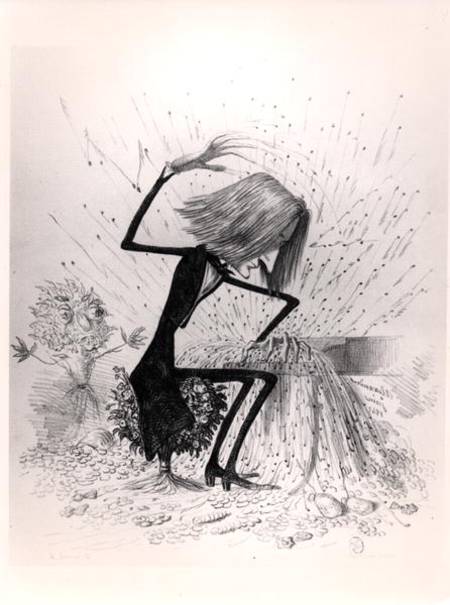
| | Franz Liszt - Rolling the New Orleans piano on "Deep Purple" | | |
My students include members of:
- Weezer (Rivers & Brian)
-
Vampire Weekend (Ezra & newest addition, Greta)
- Incubus (Mike)
- The Strokes (Nick)
- Rooney (Robert)
-
Jason Schwartzman (The Hunger Games - 2023, Mozart in the Jungle, Mountainhead)
- Courteney Cox
- Pablo Dylan
| | |
| |
"Your site is incredible! I was stuck on about 8 measures of the organ solo of Evil Ways and now I have it thank you!! The band I play with is getting ready to work on Stormy Monday, so again, thank you."
- Beth S.
|
|
|
Los Angeles, CA
323-650-6602
| | | | | |