** Epic Wave 3 **
RWJBH-Rutgers Medical Group/ RWJ University Hospitals – New Brunswick, Hamilton, and Rahway / Bristol-Myers Squibb Children’s Hospital / CINJ Infusion Center / CINJ Physician Practice
|
|
Top 10 Inpatient Provider Change Readiness Topics
As we transition to Epic, ten topics require inpatient provider awareness at Go-Live.
These Special Edition newsletters, covering 1-3 points each, further outline the information for easy reference.
|
|
Topic 1: Revised Code Status (Code Status is Changing on Jun 4.)
Situation:
After system-wide review, Patient Code Status was standardized for all RWJBH hospitals and is now reflected in Epic.
Background:
Variation existed in the scope and naming of the code status order at each site, which is suboptimal for highly reliable care.
Assessment:
Our revised Code Status in Epic includes the following three statuses:
-
Full Code: Provide Intubation / Provide Chest Compressions
-
Do Not Resuscitate (DNR): NO Intubation / NO Chest Compressions
-
Partial Resuscitation: Provider Intubation/NO Chest
Compressions
Recommendation:
The code status defaults to assume Full Code if no order yet exists, but is reflected in real-time on the patient’s storyboard as providers update the code status order.
This order has been simplified to quickly and accurately show the patient’s key directives during emergencies while deferring other care decisions such as vasopressors, antibiotics, and other support to our notes. The patient’s advanced directives are also readily available in the Advanced Care Planning (ACP) Activity if entered electronically or scanned into Epic.
|
|
Topic 2: Ordering Outside of a Post-Op Navigator |
|
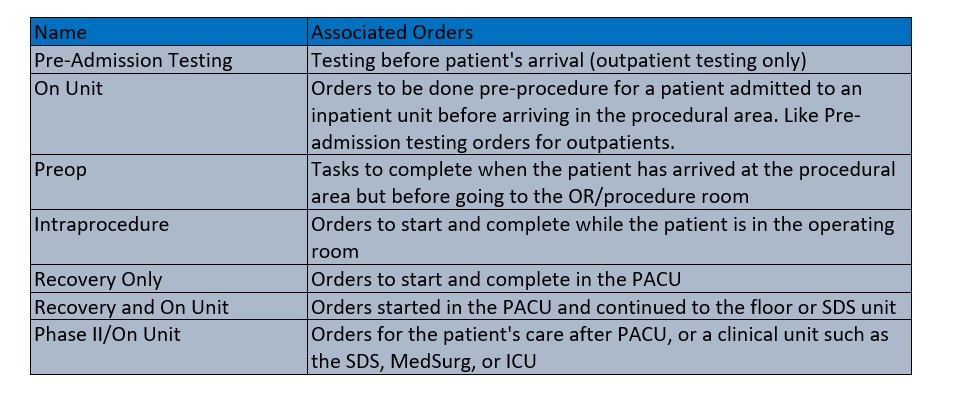
In order to discuss ordering outside of the Post-Op Navigator it is important to understand Phases of Care: Phases of Care are defined as the healthcare systems (RWJBH) designated patient care areas (Pre-admission testing, On Unit, Preop, Intraprocedure, Recovery Only, Recovery and On Unit, Phase II/On Unit) within a patient movement. This allows providers to choose the "phase of care" when and where they want an order to be carried out.
RWJBH Phases of Care
(right-click to see image)
|
|
Using the Post Op Navigator: When utilizing the post-op navigator to place post-op orders using a post-op order set, the phase of care for where the order becomes active is already defaulted by design.
Outside of the Post-Op Navigator: When a physician places an order outside of the post-op navigator (i.e., Orders activity), a phase of care for where the provider wants the order to become active must be picked by the provider.
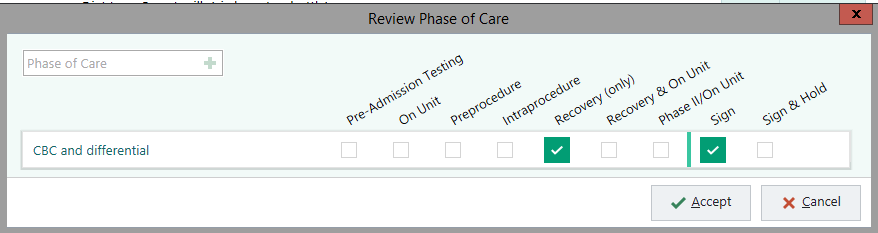
For example, if a provider orders a CBC and wants it active in the PACU, a phase of care of "Recovery Only" should be selected.
|
|
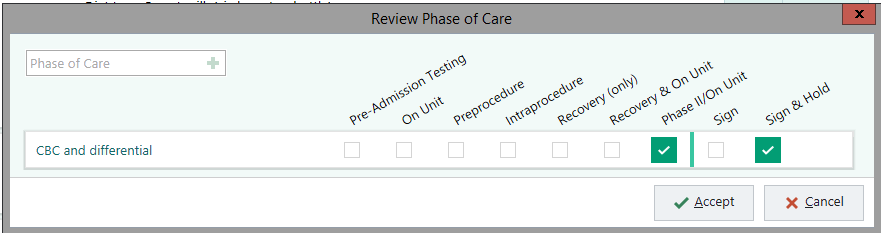
On the contrary, if a provider wants the same CBC to become active when the patient arrives on the floor, the provider should pick Phase II/On Unit. |
|
Signed and held orders: As depicted in the screenshots above, Sign and Held orders will depend on where the patient is located, and the phase of care selected.
For example (first image), if the patient is physically located in the PACU and the provider places an order to be carried out in the PACU, the system automatically defaults to "Sign."
On the contrary (second image), if a patient is physically located in the PACU and the provider chooses the phase of care of the order to be active when the patient arrives on the unit, the system automatically will default to "Sign and Hold." In this scenario, the nurses will have to release the order once the patient arrives on the unit.
|
|
Epic Together's Guiding Principles:
Patient Safety & Quality, Patient Engagement; Clinician & Staff Satisfaction;
Frequent and Transparent Communication; Research & Education;
Project Approach – Configuration not customization; Optimize Financial Systems
|
|
RWJBH-Rutgers Medical Leadership Team
|
|
Dr. Joshua Bershad
EVP, Physician Services;
Clinical Assistant Professor of Medicine Rutgers Robert Wood Johnson Medical School
Cell: 973-202-0900
Dr. Frank Sonnenberg
Chief Medical Informatics Officer, RWJBarnabas-Rutgers Medical Group; Professor of Medicine, Rutgers Robert Wood Johnson Medical School
Cell: 908-313-6563
Dr. Carol Ash, DO, MHCDS, MBA, FACHE, CPHQ, CHCQM-PHYADV
Chief Medical Officer
Robert Wood Johnson University Hospital Rahway
Phone: 732-499-6134
Cell: 732-857-6535
Dr. Seth D. Rosenbaum, MD, MMM
SVP, Chief Medical Officer Robert Wood Johnson University Hospital Hamilton;
Clinical Assistant Professor, Department of Medicine, Rutgers-Robert Wood Johnson Medical School
Phone: 609-584-2865
Cell: 609-508-7951
|
|
Dr. Sal Moffa
Phone: 908-685-2816
Cell: 609-238-5248
Dr. Stephen O’Mahony
SVP & Chief Health Information Officer, RWJBarnabas Health;
Clinical Associate Professor of Medicine, Rutgers New Jersey Medical School
Phone: 973-322-4231
Cell: 203-820-6519
Sheraz Siddiqui, MD
Chief of Hospital Medicine
Robert Wood Johnson University Hospital
Associate Professor, Department of Family Medicine and Community Health
Rutgers-Robert Wood Johnson Medical School
Cell: 732-986-3577
Dr. Deborah L. Toppmeyer
Professor of Medicine, Robert Wood Johnson Medical School; Chief Medical Officer, Chief, Division of Medical Oncology, Director, The Stacy Goldstein Breast Center
Rutgers Cancer Institute of New Jersey
Rutgers, The State University of New Jersey
Phone: 732-235-9692
|
|
|
|
|
|
|
|