|
Funding Opportunities for
Municipalities
| | | |
New or Due Soon
-
BUILD (previously RAISE) | U.S. DOT
-
LOTCIP | CRCOG
-
Partners for Places Matching Grants | The Funders Network & Urban Sustainability Directors Network
-
Energy Resilience Construction RFP | CT DEEP
-
Lead Hazard Reduction Grant Program | HUD
-
Choice Neighborhoods Implementation Grants Program | HUD
- Institute of Museum and Library Services (IMLS) Grant Programs
-
Brownfield Municipal Grant Program | CT DECD
-
Disaster Supplemental Grant Program | U.S. EDA
-
Section 5310 Enhanced Mobility of Seniors and Individuals with Disabilities Grant Program | CT DOT
-
Maritime Administration (MARAD) Port Infrastructure Development Program (PIDP) | U.S. DOT
-
Continuum of Care (CoC) Competition & Youth Homeless Demonstration Program (YHDP) Grants | HUD
-
Community Challenge Grants | AARP CT
-
Active Transportation Microgrant Program | CT DOT
Transportation
-
Build America Bureau - Technical Assistance and Financing | U.S. DOT
Energy and Environment
Housing and Community Development
-
Urban Act Grant | CT DECD
- CT Department of Housing Funding Opportunities
- HUD Discretionary Funding Opportunities
- Connecticut Children's Healthy Homes Program
News and Upcoming Events
-
BASICS Act | U.S. Congress
-
Housing Environmental Improvement Revolving Loan and Grant Fund | CT DEEP
Tools & Resources
- Helpful Links
- CRCOG's Competitive Funding Awards Dashboard
Requests for Your Input
ICYMI
| |
This newsletter includes information about state and federal funding opportunities that municipalities are eligible to apply for.
CRCOG staff are here to help with your grant applications. We provide technical assistance for your grant applications and look forward to working with you to build a better region. If you have questions or would like to discuss priority projects in your community, and how to fund them, please contact Elizabeth Sanderson.
| | |
U.S. DOT BUILD (previously RAISE)
Application Deadline: February 24, 2026 by 5 pm
The U.S. Department of Transportation (U.S. DOT) has $1.5B available for grants awarded through the FY 2026 Better Utilizing Investments to Leverage Development (BUILD) Grant Program. Previously known as RAISE and TIGER, the BUILD program seeks to fund projects that will have a significant local or regional impact and improve transportation infrastructure.
Two types of grants with the minimum award amounts:
- Capital Projects
- Minimum Award in Rural Areas: $1M
- Minimum Award in Urban Areas: $5M
- Planning Projects - no Minimum Award amount.
Maximum award size for all grants is $25M.
Cost Share/Local Match:
Typically, no more than 80% of total project cost may be funded from Federal sources. However, projects located in Rural Areas, Areas of Persistent Poverty (APP), and/or Historically Disadvantaged Communities (HDC) are eligible to receive 100% Federal funding.
View U.S. DOT's interactive map to see if your project location is with an Urban or Rural Area. View this interactive map to determine if your project is located in an APP or HDC. View this interactive map to check your project's
The Notice of Funding Opportunity (NOFO), initial version here, will be amended by U.S. DOT before the application deadline. Sign up to receive updates from U.S. DOT and/or Grants.gov to stay informed of latest updates.
Apply through Grants.gov.
| |
CRCOG LOTCIP
Application Deadline: February 18, 2026 by 2 pm
The Capitol Region Council of Governments (CRCOG) is making $45M available through the Local Transportation Capital Improvement Program (LOTCIP) for for transportation improvement projects.
CRCOG Member Municipalities are invited to review the Request for Proposals (RFP) for information about how to apply.
Templates for RFP required documents, along with associated supporting documents, can be found on CRCOG's 2026 LOTCIP Solicitation Webpage.
Following receipt of proposals, CRCOG will complete a review and rating of proposals for Transportation Committee and Policy Board endorsement. Selected applications will be submitted to CTDOT for potential approval in the form of a Commitment to Fund Letter. This solicitation assumes the continuation of current LOTCIP funding levels, and therefore selection under this solicitation does not guarantee funding.
Please contact Sotoria Montanari with questions, or if you would like more information.
| |
The Funders Network & Urban Sustainability Directors Network — Partners for Places Matching Grants
Application Deadline: April 13, 2026
Partners for Places is a matching grant program led by The Funders Network in partnership with the Urban Sustainability Directors Network (USDN). The program supports equitable sustainability projects that advance climate action, environmental justice, and community-driven solutions, while fostering strong local partnerships between municipalities, community organizations, and place-based funders.
$10 million is available nationwide, issued in grants ranging from $25,000 to $150,000. to support collaboration and leverage local philanthropic investment place-based sustainability initiatives. Grant recipients must provide a 1:1 match. Examples of past awards include $65,000 in Green Infrastructure developments in Hartford, and $40,000 in the Mill River Trail Corridor in New Haven. Learn more about Partners for Places here.
Municipalities and other local governments, community-based organizations, and place-based funders are eligible to apply.
Apply through the TFN Online Application. Additional application resources are available here.
| |
CT DEEP Energy Resilience Construction RFP
Application Deadline: May 8, 2026
The Connecticut Department of Energy and Environmental Protection (DEEP) has issued the Final Energy Resilience Construction Request for Proposals (under its expanded Climate Resilience Fund (DCRF)). This funding opportunity will provide up to $24.295M to support energy resilience projects that strengthen community infrastructure, enhance reliability during extreme weather events, and deliver direct community benefits.
Eligible projects must incorporate a holistic approach to meet community energy needs and may include microgrids, backup power systems, distributed energy resources, and other resilience-focused infrastructure. Priority is given to projects serving vulnerable populations and critical community facilities. Eligible applicants include municipalities, nonprofit organizations, public agencies, utilities, and other qualified entities as defined in the RFP.
Apply via email at DEEP.EnergyBureau@ct.gov.
| |
HUD FY 2025 Lead Hazard Reduction Grant Program
Application Deadline: February 26, 2026
The HUD Lead Hazard Reduction Grant Program provides funding to identify and control lead-based paint hazards in eligible housing. The program aims to protect children and families from lead poisoning and improve health outcomes in communities with older housing. Nationwide, there is an estimated $4.45M available. Award amounts will be between $1M and $2.5M.
Municipalities and other local governments, states, tribes, and eligible public entities are eligible to apply.
Apply online through Grants.gov.
| |
HUD FY 2025 Choice Neighborhoods Implementation Grants Program
Application Deadline: March 9, 2026
The HUD Choice Neighborhoods Implementation Grants Program supports comprehensive neighborhood revitalization efforts that integrate housing redevelopment with education, economic development, health, and public safety strategies. The program focuses on transforming distressed neighborhoods into sustainable, mixed-income communities. There is an estimated $75M in total funding available. There is no award floor, and the award ceiling is set at $26M.
Municipalities, public housing authorities, nonprofit organizations, and eligible partners working collaboratively are all eligible.
Read the Notice of Funding Opportunity and apply online through Grants.gov.
| |
Institute of Museum and Library Services (IMLS) — Grant Programs
Application Deadline: March 13, 2026
The Institute of Museum and Library Services (IMLS) offer a range of grant programs that support museums and libraries in expanding access, enhancing learning, strengthening community engagement, and fostering innovation. Funding priorities and eligibility vary by program. Opportunities include:
Up to $500,000 for museum projects that build career pathways, strengthen professional networks, and identify and share effective workforce education and training practices in the museum field.
Up to $75,000 support small museums of all disciplines in project-based efforts to serve the public through educational programs and exhibits, community partnerships, and collections of stewardship activities.
Eligible museums, libraries, municipalities, and related institutions, depending on the specific grant program are all eligible to apply.
View grant programs and application guidance here.
| |
CT DECD Brownfield Remediation and Development Municipal Grant Program
Application Deadline: March 25, 2026 (12 pm, noon)
The Connecticut Department of Economic and Community Development (DECD) Office of Brownfield Remediation and Development (OBRD) has announced Round 23 of the Brownfield Municipal Grant Program. Four financial assistance programs are available:
-
Brownfield Remediation and Development Municipal Grant Program, opening grants of up to $6M per application. The minimum grant request amount is $200,000. DECD encourages public-private partnerships for this funding. For more information, refer to the NOFA.
-
Assessment-only Grant. The minimum request amount is set at $100,000, and the maximum is $200,000. Applicants who are Councils of Governments (COGs) and Brownfield Land Banks (BLBs) can submit grant requests that total up to $500,000.
-
Targeted Brownfield Development Loan Program, provides low-interest loans of $500,000 to $6,000,000 to support the environmental remediation and redevelopment of brownfield sites in Connecticut. This funding is designed for prospective brownfield purchasers and current owners who have no direct or related liability for the site’s contamination. The loan program requires a minimum developer equity of 10% of total project costs.
-
Brownfield Area-Wide Revitalization (BAR) Planning Grant Program. This program provides up to $200,000, with a required 10% cash match, to support comprehensive planning efforts focused on the remediation and redevelopment of areas impacted by multiple brownfields.
Apply by uploading applications and supporting documents to a custom DECD SharePoint folder, or email to brownfields@ct.gov by the deadline. SharePoint folders can be requested by emailing brownfields@ct.gov by Monday, March 23, 2026, at noon.
|
Economic Development Administration (EDA) FY25 Disaster Supplemental Grant Program
Application deadline: March 3, 2026
The U.S. Economic Development Administration makes $1.45B available to support economic recovery activities in major disaster declaration areas because of hurricanes, wildfires, severe storms and flooding, tornadoes, and other natural disasters that occurred in 2023 and 2024.
Read the Notice of Funding Opportunity and visit the Program Webpage to learn more. Apply through Grants.gov.
| |
Connecticut Department of Transportation (CTDOT) Section 5310 Enhanced Mobility of Seniors & Individuals with Disabilities Program FFY 2025
Application Deadline: March 31, 2026 (4 pm)
The Connecticut Department of Transportation (CTDOT) Section 5310 Program seeks to improve mobility for seniors and individuals with disabilities by removing barriers to transportation services and expanding transportation options. Funding is available for Traditional Capital, Nontraditional Capital, and Nontraditional Operating projects. The program supports initiatives that enhance access to transportation services for eligible populations across Connecticut. Eligible projects include vehicle purchases, mobility management activities, and specialized transportation services designed to increase access and independence for older adults and individuals with disabilities.
Applicants pursuing capital projects must publish a public notice in a major newspaper by March 6, 2026, and provide advance notification to transportation operators in the proposed service area. Additional eligibility details and program requirements are available on the program website.
Review the Program Overview and Guidance. Application materials are available through the State of Connecticut’s contracting portal, CTsource Bid Board (search for solicitation #34347). Submit applications and supporting documentation as one (1) PDF file via email to DOT.Section5310@ct.gov and copy Dagmar Noll, Principal Transit Planner at CRCOG.
| |
U.S. DOT / Maritime Administration (MARAD) Port Infrastructure Development Program (PIDP) FY 2026
Application Deadline: February 28, 2026
The Maritime Administration (MARAD) Port Infrastructure Development Program (PIDP) is a competitive discretionary grant program funding planning and capital projects that improve the safety, efficiency, or reliability of freight movement into/out of/within ports. The program supports projects across urban and rural ports and includes a set-aside for small ports. MARAD notes the Bipartisan Infrastructure Law provided $2.25B (FY22–FY26) for PIDP, including $450M made available in FY 2026.
Who is eligible: PIDP is designed for ports and port-industry stakeholders, state or local government, tribes, or special purpose districts with a transportation function. Specific eligible applicant types and match requirements are detailed in the FY26 NOFO and Grants.gov opportunity materials linked from MARAD’s PIDP page. Review the FY26 NOFO.
How to apply: Apply at Grants.gov
| | | |
HUD FY 2025 Continuum of Care (CoC) Competition & Youth Homeless Demonstration Program (YHDP) Grants
Application Deadline: February 25, 2026
The U.S. Department of Housing and Urban Development (HUD) CoC program is the primary federal competitive funding stream for homelessness assistance, supporting projects such as permanent supportive housing, rapid rehousing, transitional housing, supportive services, and coordinated entry, with a dedicated component for youth homelessness through YHDP. Applicants are typically CoC-designated eligible entities which can include nonprofits, state/local governments, and public housing agencies. Applications should be submitted through the Continuum of Care processes and HUD’s requirements. Read the Notice of Funding Opportunity (NOFO).
Important note: HUD has flagged the Continuum of Care (CoC) NOFO because it is subject to ongoing federal litigation challenging changes HUD made to the FY 2025 CoC funding requirements. A federal court has issued a preliminary injunction blocking HUD from implementing or enforcing the revised FY 2025 NOFO while the case proceeds. As a result, HUD is reverting to the prior FY 2024–2025 CoC NOFO framework for certain renewal activities, but it cannot obligate or award funds until further court direction. Applicants should closely monitor HUD’s posted updates, as deadlines, requirements, and award timing may change depending on the outcome of the litigation.
How to apply: Apply at Grants.gov.
| | | |
2026 AARP Community
Challenge Grants, Connecticut
Application Deadline:
March 4, 2026, 5:00 p.m. ET.
AARP Connecticut is now accepting applications for the 2026 AARP Community Challenge, a competitive “quick action” grant program that funds projects to make communities more livable for people of all ages, with a focus on improvements to public places, transportation, housing, digital connections, and disaster resilience. In its tenth year, AARP notes it will award over $8 million nationwide through its Livable Communities initiative.
This year’s program includes three grant tracks: Flagship grants (awards ranging from a few hundred dollars up to $15,000), capacity-building microgrants (paired with technical support; $2,500 awards), and demonstration grants (typically $10,000–$20,000, not to exceed $25,000, with a 2026 focus that includes pedestrian safety, broadband access/adoption, and housing choice design competitions).
Who is eligible: The Community Challenge is open to eligible 501(c)(3), 501(c)(4), and 501(c)(6) nonprofit organizations and government entities. Other organization types may be considered case-by-case. All projects must align with AARP’s mission, serving the needs of people 50 and older while benefiting the larger community.
Project completion requirement: All funded projects must be completed by December 15, 2026.
Apply using the application on AARP's website.
|
CT DOT Active Transportation Microgrant Program
Quarter 1 Application Deadline: March 25, 2026
CRCOG is now accepting applications for the CT Department of Transportation’s Active Transportation Microgrant Program. $750,000 is available to fund schools, school districts, municipalities, and 501(c)(3) nonprofit organizations for the purchase of items like bicycle helmets; bicycle locks; bicycle fleets; safety vests; bicycle maintenance training and materials; and pay for League Cycling instructors training; and programs, events, and materials for bicycle and pedestrian safety education. Organizations may apply for a $5,000 grant, and once spent, may apply for a second grant for $5,000. No match/cost share is required.
Another round of applications is anticipated to be reviewed in June 2026, and quarterly thereafter, until funds are expended.
Read the Program Guidance and complete the Application Form and email it along with supporting documents to Mike Cipriano. Learn more.
| | | Transportation-Related Funding Opportunities | | |
U.S. DOT Build America Bureau
The U.S. Department of Transportation Build America Bureau provides technical assistance and financing products for federal transportation projects. Through technical assistance and flexible, low-cost financing, you can complete projects faster and at lower cost.
Eligible large transportation projects can benefit from flexible loan programs like Transportation Infrastructure Finance and Innovation Act Transportation Infrastructure Finance and Innovation Act (TIFIA) and Railroad Rehabilitation & Improvement Financing (RRIF). Funding for Transit-oriented Development (TOD) projects is now also available for eligible areas.
While the TOD Eligibility Map for TIFIA and RRIF identifies the following CRCOG municipalities as eligible: Berlin, Rocky Hill, Glastonbury, Hartford, Windsor, Windsor Locks, and Enfield, it is important to note that: The map does not identify all potentially eligible TOD areas in our region. Just because your municipality is not listed above or highlighted on the map does not mean you cannot pursue this loan program.
Contact Build America to apply or learn more. Copy Elizabeth Sanderson if you would like to include a representative from CRCOG.
| | |
Environment and Energy-Related Funding Opportunities
| | | |
Closing America’s Wastewater Access Gap | US EPA
Application Deadline: Rolling
The U.S. Environmental Protection Agency’s Closing America’s Wastewater Access Gap Initiative provides no-cost technical assistance to small, rural, and historically underserved communities with failing septic systems, cesspools, or little to no existing wastewater infrastructure. Through this initiative, EPA and its partners help communities assess their wastewater and septic needs, identify feasible technical and financial solutions, and prepare competitive applications for funding—particularly through the Clean Water State Revolving Fund (CWSRF) made available under the Infrastructure Investment and Jobs Act. Rather than offering direct grant dollars to municipalities, the program supplies expert technical assistance, which can include needs assessments, evaluation of alternatives (such as onsite, cluster, or centralized systems), preliminary engineering support, rate and feasibility studies, and help with local ordinances and long-term operations and maintenance planning. EPA is expanding the initiative to support 150 communities nationwide, with participation accepted on a rolling basis, so there is currently no fixed application deadline.
Communities may be strong candidates for this assistance if they are experiencing widespread septic failures or wastewater backups, lack adequate sewer service, or are still working to rebuild wastewater and septic infrastructure after storms or other disasters. Eligible requesters include local governments, utilities, Tribes, states, territories, and in some cases homeowner groups or community-based organizations working in areas with significant wastewater challenges.
Contact for questions: SepticHelp@epa.gov.
Assistance request form
|
USDA Rural Development Emergency Community Water Assistant Grant
USDA's Rural Development Emergency Community Water Assistance Grant Program is accepting applications to help eligible communities prepare, or recover from, an emergency that threatens the availability of safe, reliable drinking water. Rural areas and towns with populations of 10,000 or less are eligible to apply (verify your project's address).
Contact CT's Rural Development Office to learn more and to apply.
| | |
CT Hazard Mitigation Grant Program
Application Deadline: Rolling Basis
Connecticut's Division of Emergency Management and Homeland Security is accepting applications and letters of intent for all FEMA Hazard Mitigation Grant programs. These programs fund projects aimed at reducing the impact of natural disasters.
Learn more and send your letter of intent to DEMHS.HMGP@ct.gov.
| | | |
CT DEEP ConneCTed Communities Program
Application Deadline: Rolling
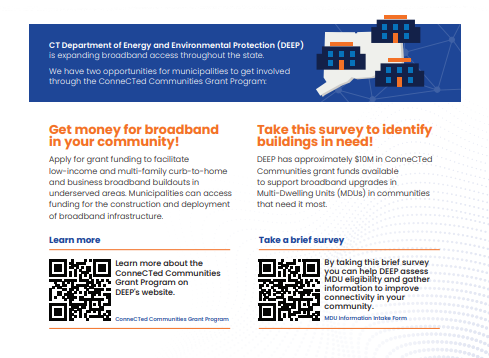
The ConneCTed Communities Grant Program has an estimated $6.7M available for the construction and deployment of broadband upgrades in Multi-Dwelling Units (MDUs) in communities that need it most.
DEEP is seeking applications for grant funding to facilitate low-income and multi-family curb-to-home and business broadband infrastructure buildout in underserved areas. All projects funded through this program must reach substantial completion before December 31, 2026. Learn more and Apply Online.
| | | Housing and Community Development-Related Funding Opportunities | | |
Urban Act Grant Program
Application deadline: Rolling basis
Connecticut municipalities that are designated as economically distressed, public investment communities, or urban centers are eligible to apply for the Urban Act Grant Program. This program seeks to promote community conservation and development and improve the quality of life for urban residents. A wide range of projects are eligible, including economic and community development; transportation; housing; recreation development; solid waste disposal; public safety; and social services-related projects. Learn more.
Complete the Application and submit it, per instructions, to the CT Department of Economic and Community Development.
| | |
Connecticut Department of Housing Funding Opportunities
Application deadlines vary by program.
The State of Connecticut Department of Housing (DOH) has numerous discretionary grant programs available that support agency initiatives such as Affordable Housing Development and Preservation, Housing Affordability initiatives, Community Development, and Individual & Family Support.
Visit the DOH Programs and Initiatives page to see a list of opportunities and learn how to apply.
| | |
HUD Discretionary Funding Opportunities
Application deadlines vary by program.
HUD offers 20 competitive grant programs available that support agency initiatives such as Affordable Housing Development and Preservation, Community and Economic Development, Environment and Energy, Fair Housing, Homelessness, Homeownership, Rental Assistance, Supportive Housing and Services. A few opportunities are featured in the "New and Due Soon" section of this newsletter.
Learn more at Grants.gov or HUD's Grant Information webpage.
| | |
Connecticut Children's Healthy Homes Program
Applications accepted on a rolling-basis.
The Connecticut Children's Healthy Homes Program, developed with support from the U.S. Department of Housing and Urban Development (HUD) and the Connecticut Department of Housing (CT DOH), offers grants to improve the well-being of children.
Funds can be used to address the toxins and hazards often found in older or poorly maintained homes. Homeowners and tenants of all income levels are eligible. Although funding may no longer be available at this time, more may become available in the future. Interested applicants are encouraged to contact the CT DOH to learn when more funding is available. Learn more and apply.
You may also be interested in HUD's Healthy Homes Program and other efforts in the State of Connecticut to address lead poisoning, like the CT Department of Public Health Childhood Lead Poisoning Prevention Program.
| | | |
BASICS Act Webinar
On February 9, a new bipartisan House bill was introduced in U.S. Congress. The Bridges and Safety Infrastructure for Community Success Act - BASICS Act (H.R. 7437) is co-sponsored by Representatives McDonald Rivet (D-MI-08) and Bresnahan (R-PA-08), both members of the House Committee on Transportation and Infrastructure. If passed, this bill will help local governments access more federal resources to repair and rebuild roads and bridges.
On Thursday, February 19, the National League of Cities (NLC) will host a webinar with other national associations to review more about the BASICS Act:
Date: Thursday, Feb. 19
Time: 12:00 PM ET
Register
Learn more about the BASICS Act and how you can show your support. New marker bills and other legislation is anticipated to be released over the coming weeks, as Congress is charged with replacing the Infrastructure Investment and Jobs Act (IIJA), which is set to expire September 30, 2026. CRCOG will share more information about the surface transportation act reauthorization process as we learn more.
| | | |
CT DEEP Housing Environmental Improvement Revolving Loan and Grant Fund
Anticipated Launch: Late 2026
Governor Ned Lamont and the State Bond Commission have approved $18M in bond funding to establish the Housing Environmental Improvement Revolving Loan and Grant Fund, a new statewide program created to support energy efficiency and environmental upgrades in existing homes. The program will be administered by the Connecticut Department of Energy and Environmental Protection (DEEP).
Loans and grants will be available to help homeowners reduce energy costs, improve building performance, and enhance housing sustainability. Expected eligible upgrades include insulation, heating and cooling systems, building envelope improvements, and related efficiency measures. DEEP is currently developing program guidelines and plans to recruit implementing entities in early to mid-2026, with the goal of launching the program by the end of 2026.
CRCOG will share more about this program and the application process once available from DEEP.
Review Program Updates and Announcements and read the Governor’s Announcement.
| | |
-
Transition to Release Based Cleanup Regulations - In March 2026, new laws will go into effect related to brownfields. To educate about this transition, Robinson + Cole has published a podcast entitled "The Release Report."
- The University of Connecticut Technical Assistance to Brownfields Program (UCONN TAB) has several resources available related to brownfield identification and redevelopment in CT: UCONN TAB CT Resources.
-
Visit CRCOG's BIL Webpage for more information about many of the grants and funding opportunities featured in this newsletter.
| | | |
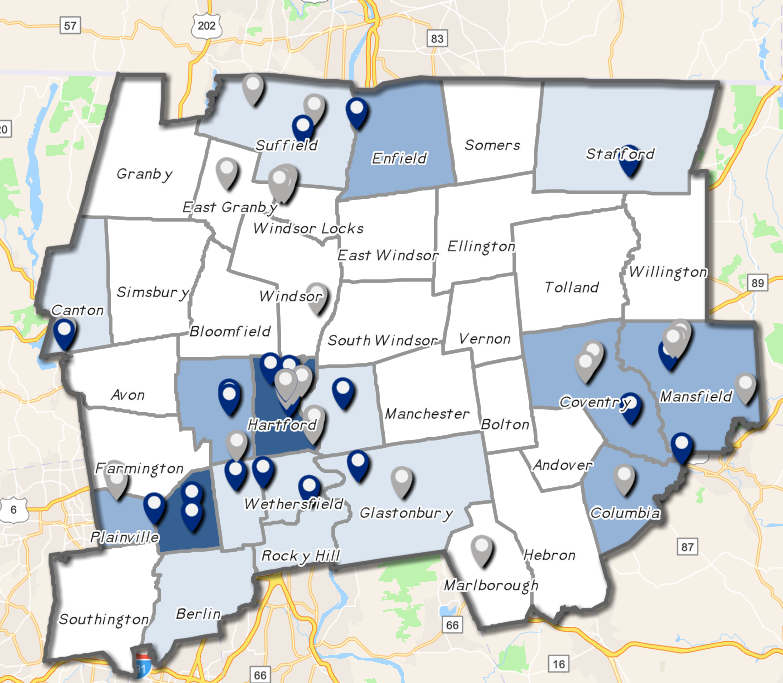
Federal Competitive Grants Awarded in the CRCOG Region
Learn more about grant awards coming to our region. CRCOG's GIS Team has developed an Interactive Online Map of Federal Competitive Grant Awards. This map is updated quarterly with available information about awards in our region.
As of July 2025, $66.4M has been awarded to CRCOG and its Member Municipalities. Additional funding has been awarded to non-municipal entities.
More information about these grant awards is available on the map and the related Dashboard.
| | | |
U.S. Department of Transportation (DOT) — Request for Information
Submission Deadline: March 6, 2026
The U.S. Department of Transportation (U.S. DOT) Office of the Assistant Secretary for Research and Technology requests your input to inform development of a comprehensive Transportation Digital Infrastructure (TDI) strategy that will modernize the nation’s transportation system. Providing information about multimodal transportation, safety, asset management, cybersecurity, and the deployment of emerging technologies across all transportation modes will help U.S.DOT create research, development, and deployment activities.
Members of the public; municipalities and other state, local, and tribal transportation agencies; industry and technology developers; researchers; and other transportation stakeholders are encouraged to respond.
Submit written responses by email to TDI-Strategy-RFI@dot.gov by March 6, 2026. Responses should provide feedback to specific questions and be in the format described here.
|
CT DEEP's Broadband Infrastructure Improvements for Multi-Dwelling Units
Connecticut Department of Energy and Environmental Protection's (CTDEEP’s) Bureau of Energy and Technology Policy (BETP) is seeking input from representatives of distressed municipalities and multi-dwelling units (MDUs) to promote equitable broadband infrastructure and service across Connecticut for the ConneCTed Communities Grant Program. Complete the Multi-Dwelling Unit Survey to identify MDUs within distressed municipalities that could benefit from broadband infrastructure improvements. More information about this grant program is provided below.
For this program, the following CRCOG Member Municipalities are identified as "distressed":
- East Hartford
- Hartford
- Mansfield
- New Britain
- Enfield
The survey is also included on DEEP's ConneCTed Communities webpage along with this map of underserved locations in CT that are eligible for funding under this program.
|
Governor Lamont's Funding Survey
Governor Lamont has released an online reporting tool for municipalities, nonprofits, and businesses to report impacts of federal funding cuts. The state aims to compile a central database to provide lawmakers with a better understanding of how federal directives are affecting various groups, geographical regions and sectors of the economy.
|
Share Your Concerns About Federal Funding with Congressman Joe Courtney
Representative Joe Courtney has developed a survey that people can use to share their concerns about Federal funding attempted pauses.
| | | |
350 Church St., 3rd Floor
Hartford, CT 06103
| | | | | |