|
Funding Opportunities for
Municipalities
| | | |
New or Due Soon
-
Community Investment Fund 2030 | CT DECD
-
Safe Streets and Roads for All (SS4A) | U.S. DOT
-
Building Resilient Infrastructure and Communities (BRIC) | FEMA
Transportation
-
Build America Bureau - Technical Assistance and Financing | U.S. DOT
Energy and Environment
-
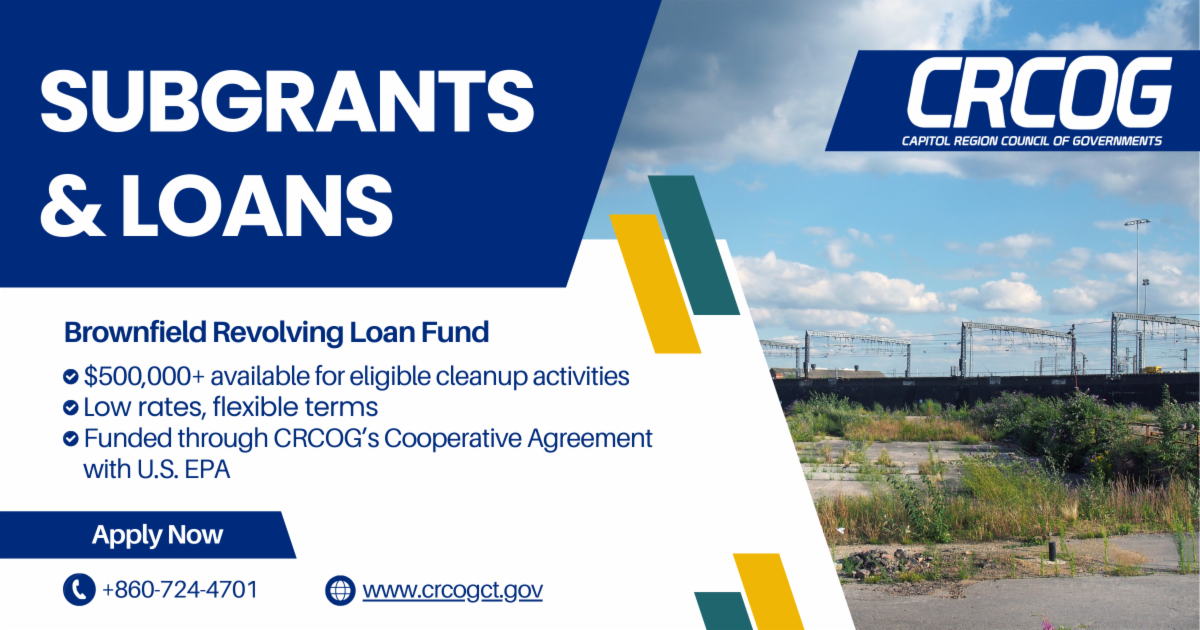
Brownfields Program | CRCOG
-
Closing America’s Wastewater Access Gap | U.S. EPA
-
Water Infrastructure Finance and Innovation Act (WIFIA) Funding | EPA
-
Rural Development Emergency Community Water Assistant Grant | USDA
-
Hazard Mitigation Grant Program | CT DEMHS
-
ConneCTed Communities Program | CT DEEP
Housing and Community Development
-
FY25 Disaster Supplemental Grant Program | U.S. EDA
-
Urban Act Grant | CT DECD
- CT Department of Housing Funding Opportunities
- HUD Discretionary Funding Opportunities
- Connecticut Children's Healthy Homes Program
News and Upcoming Events
Tools & Resources
Requests for Your Input
ICYMI
| |
This newsletter includes information about state and federal funding opportunities that municipalities are eligible to apply for.
CRCOG staff are here to help with your grant applications. We provide technical assistance for your grant applications and look forward to working with you to build a better region. If you have questions or would like to discuss priority projects in your community, and how to fund them, please contact Elizabeth Sanderson.
| | |
|
CT DECD Community Investment Fund 2030
Application Deadline: June 5, 2026 at 12 PM (noon)
The Connecticut Department of Economic and Community Development (CT DECD) has opened Round 9 of the Community Investment Fund 2030 (CIF) grant program. CIF was established to support economic development in historically underserved communities in Connecticut. Funding is available for two types of grants:
-
Capital projects (must have a minimum budget of $1.5 million);
-
Planning projects (must have a minimum budgets of $250,000).
The Notice of Funding Availability (NOFA) provides more information about eligible projects for each grant type.
Eligible applicants include eligible municipalities, and nonprofits, arts/culture organizations, and community development corporations (CDCs) that serve these eligible municipalities. Eligible municipalities in CRCOG include:
- Bloomfield
- East Hartford
- East Windsor
- Enfield
- Hartford
- Manchester
- Mansfield
- New Britain
- Newington
- Plainville
- Stafford
- Vernon
- Wethersfield
- Willington
- Windsor
- Windsor Locks
Applicants are encouraged to review the informational webinar slides and schedule one-on-one meetings with CIF staff through this email CommunityInvestmentFund@ct.gov. Projects should demonstrate economic impact, community benefit, and alignment with neighborhood revitalization goals.
Contact CIF staff at CommunityInvestmentFund@ct.gov to apply, and/or if you have any questions. Round 9 includes an abbreviated re-application process for certain prior applicants.
CRCOG Staff are here to help! Contact us if you would like assistance with your application.
| |
Safe Streets and Roads for All (SS4A) – U.S. Department of Transportation
Application Deadline: May 26, 2026
The U.S. Department of Transportation has released the FY2026 Notice of Funding Opportunity for the Safe Streets and Roads for All (SS4A) program, which provides nearly $1 billion in funding to help communities reduce roadway deaths and serious injuries. The program offers Planning and Demonstration Grants, which support the development or enhancement of Safety Action Plans and demonstration activities, and Implementation Grants, which fund projects aligned with an existing safety plan to improve roadway safety.
Eligible applicants include local governments, regional organizations, metropolitan planning organizations, and Tribal governments. Applications must be submitted through the Valid Eval online portal and typically require a project narrative, safety data justification, and project budget. You can apply for one of two grant types: Planning and Demonstration, or Implementation:
Learn more on CRCOG's summary webpage and Grants.gov.
CRCOG has developed application assistance documents:
| |
FEMA Building Resilient Infrastructure and Communities (BRIC) Program
Sub Applicant Deadline: July 1, 2026
FEMA has announced $1 billion in funding through the Building Resilient Infrastructure and Communities (BRIC) program to support projects that reduce disaster risk and strengthen infrastructure resilience. Funding is available for large-scale mitigation projects that protect communities from hazards such as flooding, wildfires, earthquakes, and hurricanes.
The Connecticut Department of Emergency Management and Homeland Security (DEMHS) is the eligible applicant for the State of Connecticut. Eligible sub applicants include local governments and special districts. Applications require detailed project proposals, including hazard mitigation benefits, engineering information, and cost-benefit analysis. Application tools are available
Sub applicants must apply through the FEMA GO portal by July 1, 2026, which will give DEMHS time to review and submit a final application to FEMA by the July 23, 2026, application deadline.
Learn more on Grants.gov and DEMHS' BRIC webpage. Review your local annex of CRCOG’s Hazard Mitigation & Climate Adaptation Plan for project ideas. Contact DEMHS to discuss your project before applying: demhs.hmgp@ct.gov and review CRCOG's Guidance Document.
| | | Transportation-Related Funding Opportunities | | |
U.S. DOT Build America Bureau
The U.S. Department of Transportation Build America Bureau provides technical assistance and financing products for federal transportation projects. Through technical assistance and flexible, low-cost financing, you can complete projects faster and at lower cost.
Eligible large transportation projects can benefit from flexible loan programs like Transportation Infrastructure Finance and Innovation Act Transportation Infrastructure Finance and Innovation Act (TIFIA) and Railroad Rehabilitation & Improvement Financing (RRIF). Funding for Transit-oriented Development (TOD) projects is now also available for eligible areas.
While the TOD Eligibility Map for TIFIA and RRIF identifies the following CRCOG municipalities as eligible: Berlin, Rocky Hill, Glastonbury, Hartford, Windsor, Windsor Locks, and Enfield, it is important to note that: The map does not identify all potentially eligible TOD areas in our region. Just because your municipality is not listed above or highlighted on the map does not mean you cannot pursue this loan program.
Contact Build America to apply or learn more. Copy Elizabeth Sanderson if you would like to include a representative from CRCOG.
| | |
Environment and Energy-Related Funding Opportunities
| | | |
Closing America’s Wastewater Access Gap | US EPA
Application Deadline: Rolling
The U.S. Environmental Protection Agency’s Closing America’s Wastewater Access Gap Initiative provides no-cost technical assistance to small, rural, and historically underserved communities with failing septic systems, cesspools, or little to no existing wastewater infrastructure. Through this initiative, EPA and its partners help communities assess their wastewater and septic needs, identify feasible technical and financial solutions, and prepare competitive applications for funding—particularly through the Clean Water State Revolving Fund (CWSRF) made available under the Infrastructure Investment and Jobs Act. Rather than offering direct grant dollars to municipalities, the program supplies expert technical assistance, which can include needs assessments, evaluation of alternatives (such as onsite, cluster, or centralized systems), preliminary engineering support, rate and feasibility studies, and help with local ordinances and long-term operations and maintenance planning. EPA is expanding the initiative to support 150 communities nationwide, with participation accepted on a rolling basis, so there is currently no fixed application deadline.
Communities may be strong candidates for this assistance if they are experiencing widespread septic failures or wastewater backups, lack adequate sewer service, or are still working to rebuild wastewater and septic infrastructure after storms or other disasters. Eligible requesters include local governments, utilities, Tribes, states, territories, and in some cases homeowner groups or community-based organizations working in areas with significant wastewater challenges.
Contact for questions: SepticHelp@epa.gov.
Assistance request form
| |
EPA Water Infrastructure Finance and Innovation Act (WIFIA) Funding
Application Deadline: Rolling
The EPA’s Water Infrastructure Finance and Innovation Act (WIFIA) Program provides low-cost federal credit assistance for large-scale water infrastructure projects. The program supports drinking water, wastewater, stormwater, water recycling, and other water infrastructure projects that improve public health and environmental protection.
The EPA has announced $7 billion in newly available funding, including $6.5 billion through WIFIA and $550 million through the State WIFIA (SWIFIA) program for state infrastructure financing authorities.
Eligible applicants include municipalities, public utilities, state infrastructure financing authorities, private entities, and public-private partnerships undertaking eligible water infrastructure projects.
Learn how to apply and send a letter of interest to press@epa.gov.
|
USDA Rural Development Emergency Community Water Assistant Grant
USDA's Rural Development Emergency Community Water Assistance Grant Program is accepting applications to help eligible communities prepare, or recover from, an emergency that threatens the availability of safe, reliable drinking water. Rural areas and towns with populations of 10,000 or less are eligible to apply (verify your project's address).
Contact CT's Rural Development Office to learn more and to apply.
| | |
CT Hazard Mitigation Grant Program
Application Deadline: Rolling
Connecticut's Division of Emergency Management and Homeland Security is accepting applications and letters of intent for all FEMA Hazard Mitigation Grant programs. These programs fund projects aimed at reducing the impact of natural disasters.
Learn more and send your letter of intent to DEMHS.HMGP@ct.gov.
| | | |
CT DEEP ConneCTed Communities Program
Application Deadline: Rolling
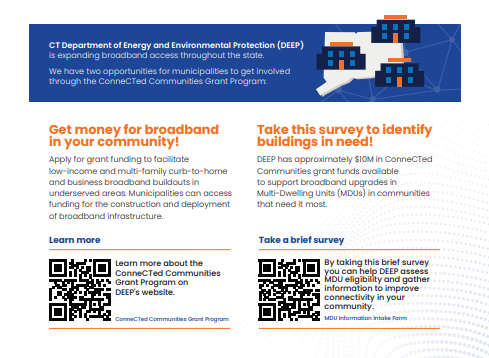
The ConneCTed Communities Grant Program has an estimated $6.7M available for the construction and deployment of broadband upgrades in Multi-Dwelling Units (MDUs) in communities that need it most.
DEEP is seeking applications for grant funding to facilitate low-income and multi-family curb-to-home and business broadband infrastructure buildout in underserved areas. All projects funded through this program must reach substantial completion before December 31, 2026. Learn more and Apply Online.
| | | Housing and Community Development-Related Funding Opportunities | | |
Economic Development Administration (EDA) FY25 Disaster Supplemental Grant Program
Application deadline: Rolling
The U.S. Economic Development Administration has nearly $1.5B available to support economic recovery activities in major disaster declaration areas because of hurricanes, wildfires, severe storms and flooding, tornadoes, and other natural disasters that occurred in 2023 and 2024.
|
Urban Act Grant Program
Application Deadline: Rolling
Connecticut municipalities that are designated as economically distressed, public investment communities, or urban centers are eligible to apply for the Urban Act Grant Program. This program seeks to promote community conservation and development and improve the quality of life for urban residents. A wide range of projects are eligible, including economic and community development; transportation; housing; recreation development; solid waste disposal; public safety; and social services-related projects. Learn more.
Complete the Application and submit it, per instructions, to the CT Department of Economic and Community Development.
| | |
Connecticut Department of Housing Funding Opportunities
Application deadlines vary by program.
The State of Connecticut Department of Housing (DOH) has numerous discretionary grant programs available that support agency initiatives such as Affordable Housing Development and Preservation, Housing Affordability initiatives, Community Development, and Individual & Family Support.
Visit the DOH Programs and Initiatives page to see a list of opportunities and learn how to apply.
| | |
HUD Discretionary Funding Opportunities
Application deadlines vary by program.
HUD offers 20 competitive grant programs available that support agency initiatives such as Affordable Housing Development and Preservation, Community and Economic Development, Environment and Energy, Fair Housing, Homelessness, Homeownership, Rental Assistance, Supportive Housing and Services. A few opportunities are featured in the "New and Due Soon" section of this newsletter.
Learn more at Grants.gov or HUD's Grant Information webpage.
| | |
Connecticut Children's Healthy Homes Program
Application Deadline: Rolling, as funds are available
The Connecticut Children's Healthy Homes Program, developed with support from the U.S. Department of Housing and Urban Development (HUD) and the Connecticut Department of Housing (CT DOH), offers grants to improve the well-being of children.
Funds can be used to address the toxins and hazards often found in older or poorly maintained homes. Homeowners and tenants of all income levels are eligible. Although funding may no longer be available at this time, more may become available in the future. Interested applicants are encouraged to contact the CT DOH to learn when more funding is available. Learn more and apply.
You may also be interested in HUD's Healthy Homes Program and other efforts in the State of Connecticut to address lead poisoning, like the CT Department of Public Health Childhood Lead Poisoning Prevention Program.
| | | News and Upcoming Opportunities | | | |
Reauthorization of the Surface Transportation Bill
As the transportation industry prepares for the expiration of the Infrastructure Investment and Jobs Act (IIJA) on September 30, 2026, discussions are brewing about what the next Surface Transportation Bill will look like. On February 9, a new bipartisan House bill was introduced in U.S. Congress: the Bridges and Safety Infrastructure for Community Success Act - BASICS Act (H.R. 7437). Co-sponsored by several bipartisan U.S. Representatives, the bill seeks to help local governments access more federal resources to repair and rebuild roads and bridges.
Learn more about the BASICS Act and how you can show your support. New marker bills and other legislation is anticipated to be released over the coming months as Congress reviews proposed legislation. CRCOG will share more information about the surface transportation act reauthorization process as we learn more.
| | | |
CT DEEP Housing Environmental Improvement Revolving Loan and Grant Fund
Anticipated Launch: Late 2026
Governor Ned Lamont and the State Bond Commission have approved $18M in bond funding to establish the Housing Environmental Improvement Revolving Loan and Grant Fund, a new statewide program created to support energy efficiency and environmental upgrades in existing homes. The program will be administered by the Connecticut Department of Energy and Environmental Protection (DEEP).
Loans and grants will be available to help homeowners reduce energy costs, improve building performance, and enhance housing sustainability. Expected eligible upgrades include insulation, heating and cooling systems, building envelope improvements, and related efficiency measures. DEEP is currently developing program guidelines and plans to recruit implementing entities in early to mid-2026, with the goal of launching the program by the end of 2026.
CRCOG will share more about this program and the application process once available from DEEP.
Review Program Updates and Announcements and read the Governor’s Announcement.
| | |
-
Transition to Release Based Cleanup Regulations - In March 2026, new laws will go into effect related to brownfields. To educate about this transition, Robinson + Cole has published a podcast entitled "The Release Report."
- The University of Connecticut Technical Assistance to Brownfields Program (UCONN TAB) has several resources available related to brownfield identification and redevelopment in CT: UCONN TAB CT Resources.
-
Visit CRCOG's BIL Webpage for more information about many of the grants and funding opportunities featured in this newsletter.
| | | |
Federal Competitive Grants Awarded in the CRCOG Region
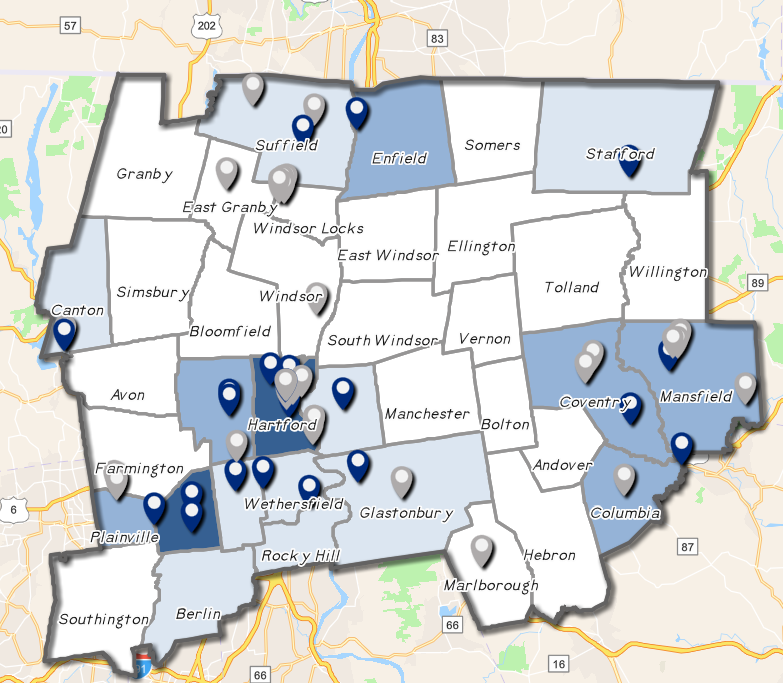
Learn more about grant awards coming to our region. CRCOG's GIS Team has developed an Interactive Online Map of Federal Competitive Grant Awards. This map is updated quarterly with available information about awards in our region.
As of July 2025, $66.4M has been awarded to CRCOG and its Member Municipalities. Additional funding has been awarded to non-municipal entities.
More information about these grant awards is available on the map and the related Dashboard.
| | | |
CRCOG's Transportation Safety Action Plan - Request for Public Comment
Deadline: May 31, 2026
CRCOG's Capitol Region Transportation Safety Action Plan is available for public review and comment. The Safety Action Plan establishes a data-driven framework to reduce and ultimately eliminate fatal and serious roadway crashes across the Capitol Region.
Please review the Safety Action Plan and Appendices, and submit your comments:
- Via Mail: Roger Krahn, Principal Transportation Engineer, CRCOG, 350 Church Street, 3rd Floor, Hartford, CT 06103
-
Via Email: Roger Krahn
-
Verbally during the Public Forum portion of the CRCOG Transportation Committee Meeting at 12:00 noon on May 18, 2026. This meeting is remote only. See registration information here: Transportation Committee Meeting Information
The Safety Action Plan was developed in accordance with requirements of the U.S. DOT Safe Streets and Roads for All (SS4A) program, and will serve as a core CRCOG transportation planning document to guide implementation of roadway safety projects and strategies in our region.
| |
CT DOT Active Transportation Plan
As the Connecticut Department of Transportation (CT DOT) works to finalize the Statewide Active Transportation Plan (ATP), they invite you to register to attend an upcoming open house:
The ATP will guide future improvements on state routes, and will serve as a strategic roadmap to develop and modernize sidewalks, bike lanes, paved trails, and intersection improvements on or along state routes to make them safer and more comfortable for a variety of roadway users.
Contact CTDOT Active Transportation with questions or comments.
| |
Connecticut’s Long-Range Transportation Plan
Deadline: May 22, 2026
The Connecticut Department of Transportation (CT DOT) is developing goals and plans to include in our five-year statewide multimodal long-range transportation plan and requests your input. Connecticut 2055, the statewide Long-Range Transportation Plan seeks to assess future needs, track performance, and guide investments through the year 2055. The plan will also include recommended strategic actions for the next five years to help improve the transportation system.
Help answer the question: “What do you imagine when you think about the future of Connecticut Transportation?” Learn more on the Study Website.
Read the draft plan and submit your comments to CT DOT by email, phone, or mail using the contact information found here.
| |
U.S. Department of Transportation (DOT) Build America Bureau — Request for Public Comment
,
Comment Deadline: May 18, 2026
The U.S. Department of Transportation Build America Bureau is seeking public comment on proposed guidance related to preferred maximum loan sizing policies for Transit-Oriented Development (TOD) projects financed through TIFIA and RRIF programs.
While this is not a direct grant opportunity, the guidance could significantly impact municipalities, transit agencies, and developers pursuing federal financing for TOD projects. The proposal would establish new thresholds tying maximum federal loan amounts to measurable transportation benefits generated by a project.
Stakeholders are encouraged to submit comments through the Federal Register regarding how transportation benefits should be calculated and how the policy may affect project feasibility and infrastructure investment. Submissions must be submitted through the Federal Register.
Contact BuildAmerica@dot.gov with questions.
|
CT DEEP's Broadband Infrastructure Improvements for Multi-Dwelling Units
Connecticut Department of Energy and Environmental Protection's (CTDEEP’s) Bureau of Energy and Technology Policy (BETP) is seeking input from representatives of distressed municipalities and multi-dwelling units (MDUs) to promote equitable broadband infrastructure and service across Connecticut for the ConneCTed Communities Grant Program. Complete the Multi-Dwelling Unit Survey to identify MDUs within distressed municipalities that could benefit from broadband infrastructure improvements. More information about this grant program is provided below.
For this program, the following CRCOG Member Municipalities are identified as "distressed":
- East Hartford
- Hartford
- Mansfield
- New Britain
- Enfield
The survey is also included on DEEP's ConneCTed Communities webpage along with this map of underserved locations in CT that are eligible for funding under this program.
|
Governor Lamont's Funding Survey
Governor Lamont has released an online reporting tool for municipalities, nonprofits, and businesses to report impacts of federal funding cuts. The state aims to compile a central database to provide lawmakers with a better understanding of how federal directives are affecting various groups, geographical regions and sectors of the economy.
|
Share Your Concerns About Federal Funding with Congressman Joe Courtney
Representative Joe Courtney has developed a survey that people can use to share their concerns about Federal funding attempted pauses.
| | | |
350 Church St., 3rd Floor
Hartford, CT 06103
| | | | | |