View as Webpage


NOVEMBER 2025

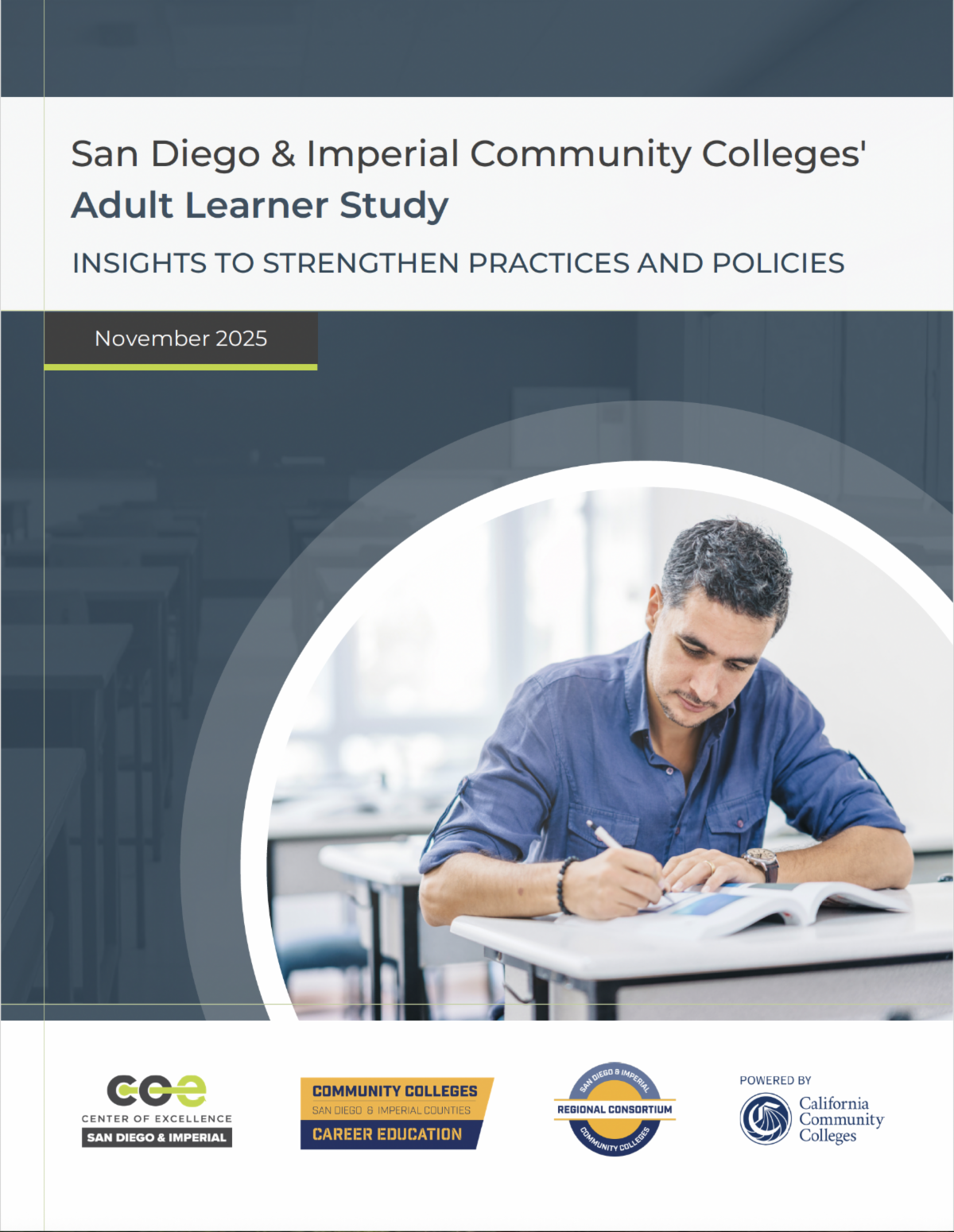
New Report: Understanding and Supporting Adult Learners

Across San Diego & Imperial Community Colleges

Adult learners—individuals aged 25 and older who balance college with work, family, and other responsibilities—represent nearly half of all students across the San Diego & Imperial Community Colleges. Their educational success is central to achieving the state's goal of ensuring that 70% of working-age Californians will hold a postsecondary degree by 2030.


To help community colleges strengthen strategies and policies that support adult learners, the San Diego & Imperial Center of Excellence (COE) surveyed over 600 adult learners who attended one or more community colleges in the region.


This new report shares adult learners' experiences both inside and outside the classroom and offers recommendations to better support their success. Explore highlights from the report below!


📩 You're Invited: Presentation on the Adult Learner Study

The San Diego & Imperial Regional Consortium and Center of Excellence (COE) invite you to the next Workforce Development Council (WDC) meeting for a presentation highlighting the findings from this report. Educators, economic/workforce development professionals, community-based organizations, and anyone interested in adult learners in San Diego & Imperial Counties are invited to attend.


WDC Meeting Details:

📆 Friday, November 21, 2025

⏱️ 10:30 AM - 12:00 PM (PST)

📍 Zoom


Registration is required.

Please select the November 21st WDC meeting and any others you would like to attend. After registering, you will receive a confirmation email with your unique Zoom link.

📊 Key Insights from the Study

1️⃣ Adult Learners are Balancing Multiple Responsibilities

Adult learners juggle work, parenting, and caregiving, which often makes it difficult to find classes that fit their schedules. Two out of five (41%) non-completers paused or stopped their studies due to class schedules that conflicted with work or personal commitments.


2️⃣ Flexibility is Key to Persistence

Flexible class schedules and short-term courses were cited as the most helpful supports for completion. In terms of course format, 67% of adult learners preferred a variety of online or hybrid options that included in-person components.


3️⃣ Satisfaction is Linked to Completion

Completers were significantly more likely than non-completers to agree that their community college education was a worthwhile investment and to report higher levels of satisfaction overall.


4️⃣ Completion Opens Career Opportunities

Adult learners who completed their educational goals saw greater career gains—they were more likely to receive promotions, find full-time employment, and report greater alignment between their training and employment—than non-completers.


💡 Recommendations for Colleges

To support adult learners, the report offers the following recommendations:


➡️ Prioritize flexible scheduling and online learning options

Colleges should review local Career Education pathways and strategic enrollment plans to ensure alignment and flexibility for full-time, part-time, day, evening, and online students. They need to build capacity to continuously evaluate scheduling practices, identify gaps in course offerings, and develop targeted solutions.


➡️ Streamline re-enrollment and re-engagement processes

Colleges should simplify administrative steps for the re-enrollment process and personalize outreach to students who stopped out. The report offers examples of institutions across the state that are using innovative strategies to re-engage adult learners.


➡️ Provide high-touch, proactive guidance

Colleges should expand access to academic, career, and other support services that help adult learners navigate complex college systems. Findings show that students who used academic support services were nearly twice as likely to complete their educational goals.


➡️ Enhance pathways to high-demand, high-wage careers

Colleges should strengthen connections between education and employment by promoting the use of career services and ensuring adult learners have access to programs that lead to high-demand, high-wage careers—such as the priority jobs identified in San Diego County and Imperial County.


With growing state-level support through new funding opportunities, professional development, and regional collaboration, community colleges can use the reflection questions and resources in the report to spark meaningful discussions and create data-informed plans that better serve adult learners.


REPORTS & RESOURCES


ABOUT THE CENTER OF EXCELLENCE

The San Diego & Imperial COE supports the San Diego & Imperial Community Colleges with data-informed program development and strategic planning. The COE is funded in part by the California Community Colleges Chancellor’s Office through the Economic and Workforce Development Program and Strong Workforce Program.


Tina Ngo Bartel

Executive Director

Robert Chu

Regional Programs Manager

John Edwards

Research Analyst

Tasi Rodriguez

Regional Professional Development Manager