|
The Great Depression’s Unlikely Millionaire
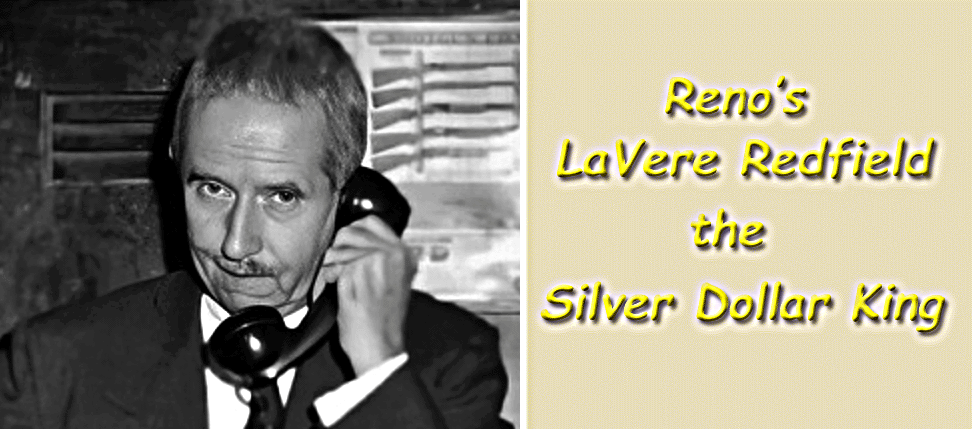
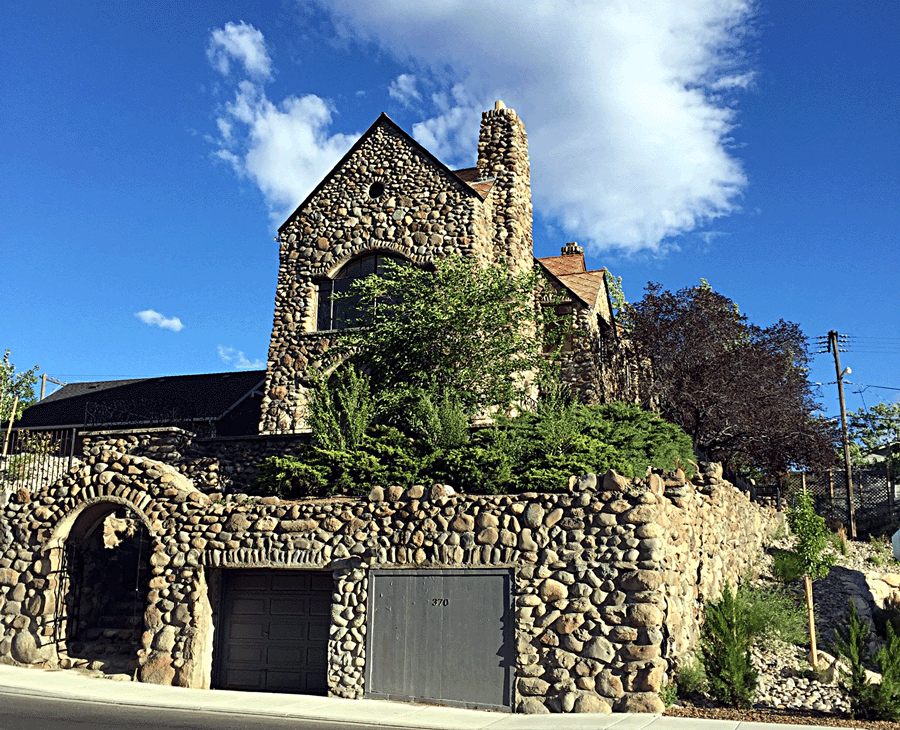
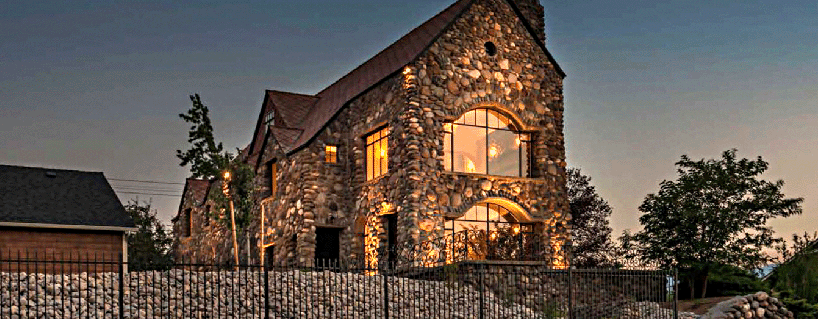
If you’ve ever driven by the corner of Mount Rose Street and Plumas Avenue in Reno and wondered what’s up with that enormous rock house, you’re not alone. Towering and unmistakable, it’s the kind of home that practically dares you to ask questions. As it turns out, the man behind that house is just as unforgettable as the structure itself. Welcome to the story of LaVere Redfield, investor, eccentric, and the architect of the greatest silver dollar stash in American history.
Born with a knack for buying low and selling high, LaVere Redfield made his first fortune when most people were selling apples on street corners during the Great Depression. After marrying his wife, Nell, at the age of 24, Redfield moved to Los Angeles and began investing in stocks. It wasn’t just good timing, it was impeccable instinct.
During the Great Depression, when others were tightening belts and rationing hope, Redfield was snatching up stocks for pennies and selling them for pounds.
He once explained it simply: “I’m thrifty, but not stingy.” And he wasn’t kidding. “If I can save a nickel on an item,” he said, “I buy it by the case saving one or two dollars. If I hadn’t done that all my life, I’d be just like so many people today, one step ahead of the bill collector.”
His frugality didn’t just apply to canned goods. With his profits, Redfield began acquiring real estate, land and oil leases sold at tax auctions or coming out of bankruptcy.
By 1935, when California flirted with implementing a state income tax, Redfield saw the writing on the wall. That’s when he packed up and moved to Reno, a city that had cleverly marketed itself as a haven for the tax weary.
| |
Life in Reno and a House Full of Silver
Upon arriving in Reno, LaVere and Nell purchased a 15 room stone mansion and surrounding farmland at Mount Rose and Forest Streets. But rather than simply enjoying his wealth in a traditional sense, Redfield made it a habit to convert large chunks of it into silver dollars. Yes, actual coins.
His appearance gave no clues to his fortune. He drove around in a dusty old Chevy pickup and wore flannel shirts and jeans like any average Joe. But beneath that down home image was a man who was slowly turning his house into a private Fort Knox.
At one time he owned over 55,000 acres in Washoe County. Each time he closed a big real estate deal, Redfield asked the bank to pay him in canvas bags filled with silver dollars, 1,000 coins per bag. These weren’t for show. He hauled them home in his truck and dumped them, one bag at a time, down a coal chute into the basement. By all accounts, this became something of a tradition.
Of course, storing tons of silver under your house isn’t exactly subtle, especially in a town like Reno, where everyone knows everyone else’s business. Rumors of Redfield’s hoard began to swirl. His distrust of banks, rooted in the bank failures he’d witnessed during the Depression, only fed the local lore. As did his passionate dislike for paying income taxes.
| |
Blackjack and Burglars: Money Behind Walls
LaVere Redfield may have looked like your friendly neighborhood rancher, but his habits were as colorful as a Las Vegas neon sign. He loved to gamble and was often spotted at local casinos playing blackjack or roulette, still in his trademark jeans and flannel. When he won, he was generous. Tipping in silver dollars was his signature move, and he had plenty to go around.
It’s said he could win or lose up to $250,000 in a single night, and if he came out ahead, he would insist on being paid in silver dollars. Casinos at the time used real coins the way modern casinos use chips. If luck was on his side, he might even invite a charming dealer to dinner.
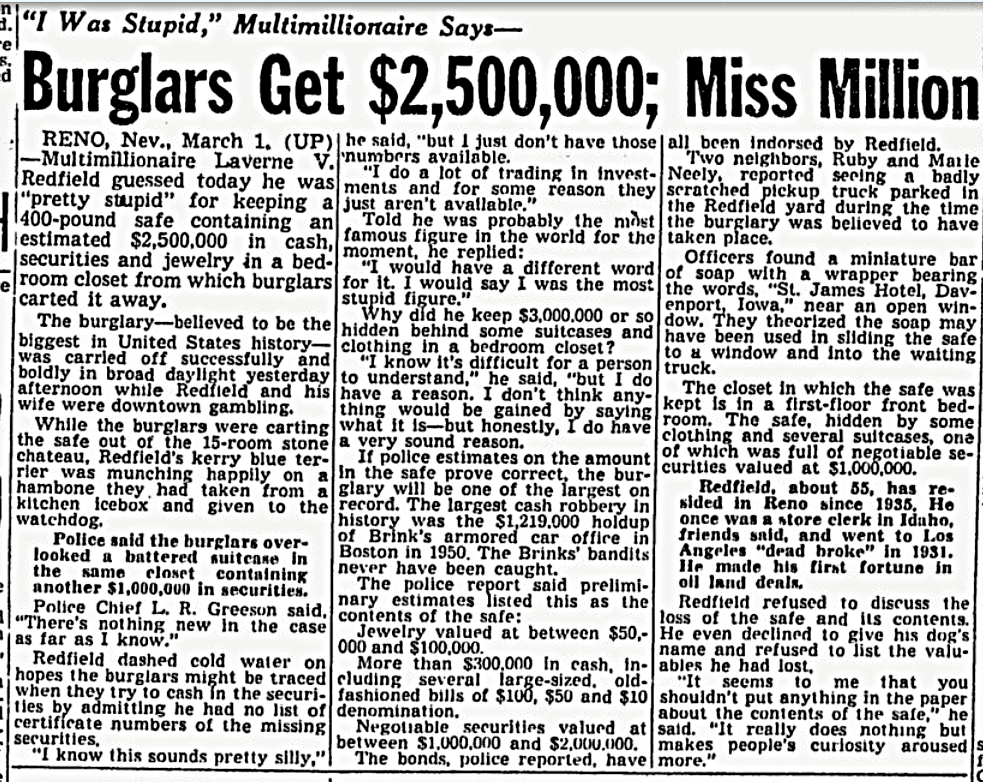
But fortune doesn’t always come without risk. Redfield’s refusal to use banks and his very public quirks made him an attractive target. In 1952, and again in 1963, his home was burglarized.
Thieves got away with thousands in coins and jewelry, validating long standing rumors of his cash hoard. One of the break ins was so substantial that it was dubbed the nation’s “record burglary,” drawing comment from none other than FBI Director J. Edgar Hoover himself when the ringleader was arrested.
Redfield’s response? He started hiding his silver behind false walls in the basement. It was a clever twist that only deepened the mystique around his wealth, and it turned out to be more than just a security measure. It was a time capsule.
Of course, not all trouble came from burglars. Redfield’s attempts to avoid paying taxes caught up with him. Following the robbery investigation, authorities discovered he had failed to report substantial gambling winnings.
In 1952, he was convicted of income tax evasion, served 18 months in jail, and paid a $60,000 fine.
| |
The Silver Tsunami: What They Found After He Died
When LaVere Redfield passed away in 1974 at the age of 77, his estate was the stuff of local legend, but even the most enthusiastic rumors fell short of reality. As executors and IRS agents combed through his house, they stumbled across an astonishing discovery.
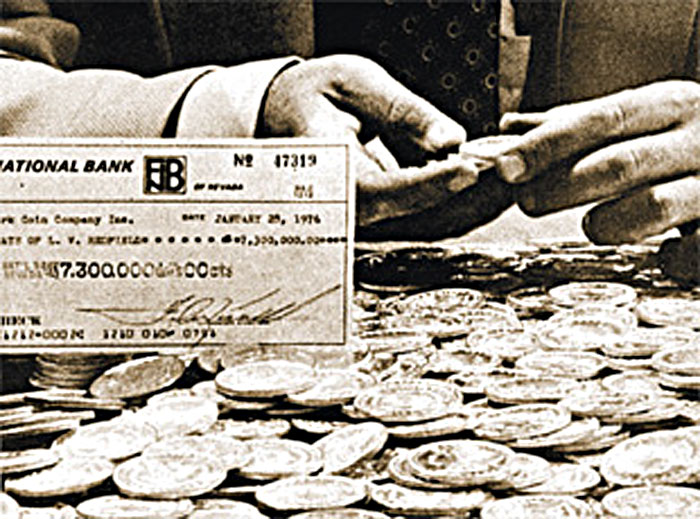
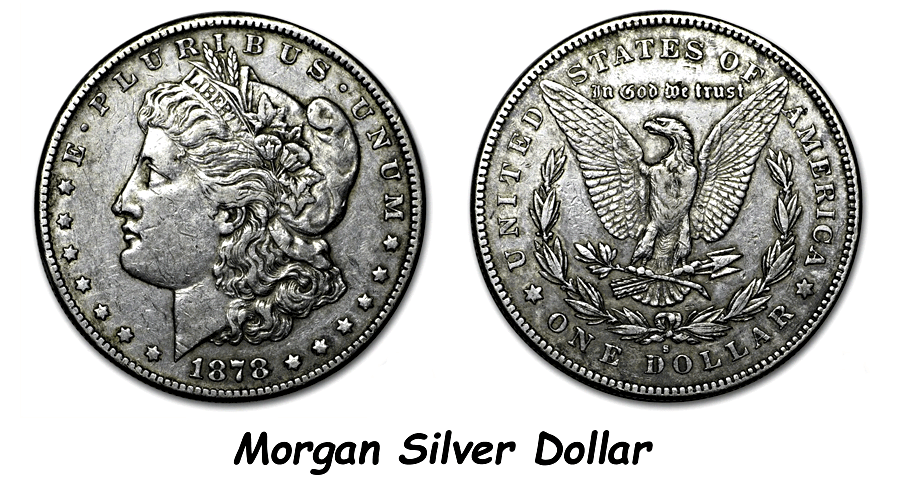
Behind one of the basement’s false walls were 680 bags filled with silver and gold coins. In total, there were 407,283 Morgan and Peace silver dollars, 351,259 of which were uncirculated. The total weight of the hoard? Over 22,000 pounds. That’s 11 tons of precious metal sitting quietly beneath a river rock mansion.
Naturally, such a treasure couldn’t be sold all at once. To avoid tanking the market, the coins were auctioned off in smaller lots. Even so, the collection fetched $7.3 million, a staggering sum at the time.
Today, the value would be significantly higher. Keep in mind, these were coins Redfield had acquired when they were still worth exactly one dollar each. Today, even a common silver dollar melt value fetches $29-$30. The Morgan Silver Dollars are worth much more.
Ironically, his real estate holdings were worth more than his silver coin hoard. The estimate of his estate being worth over $50 million at his time of death in 1974 (equals $335 million today).
| |
Reno’s Rock Solid Legend
The house that once hid the hoard still stands proudly at 370 Mount Rose Street. Built of gleaming Truckee River rock and perched on a hill with sweeping views of downtown Reno and Mount Rose itself, the home remains a testament to both vision and eccentricity.
It is, quite literally, the largest river rock structure many locals, myself included, have ever seen. More than a home, it became a fortress, a vault, and a symbol of a man whose philosophy was equal parts frugality and flamboyance.
Redfield never quite fit the mold. He was a millionaire who dressed like a farmer, a gambler who trusted silver more than banks, and a tax dodger who built a legacy that even the IRS couldn’t ignore. His story reads like fiction, but it’s all true, coin by coin, acre by acre, rumor by confirmed fact.
In 1974, Nell J. Redfield his widow, established a non-profit, private foundation to carry out her charitable wishes and to perpetuate her charitable objectives after her death.
Since its inception, the Foundation has returned more than $100 million to the Reno community through gifts to more than 300 different non-profit organizations. It regularly supports more than 80 different local non-profits each year.
Although Nell J. Redfield died in 1981, her dreams for a better community are brought to reality on a daily basis through her Foundation and her memory is honored by the projects which bear her name or receive her support.
| |