Context


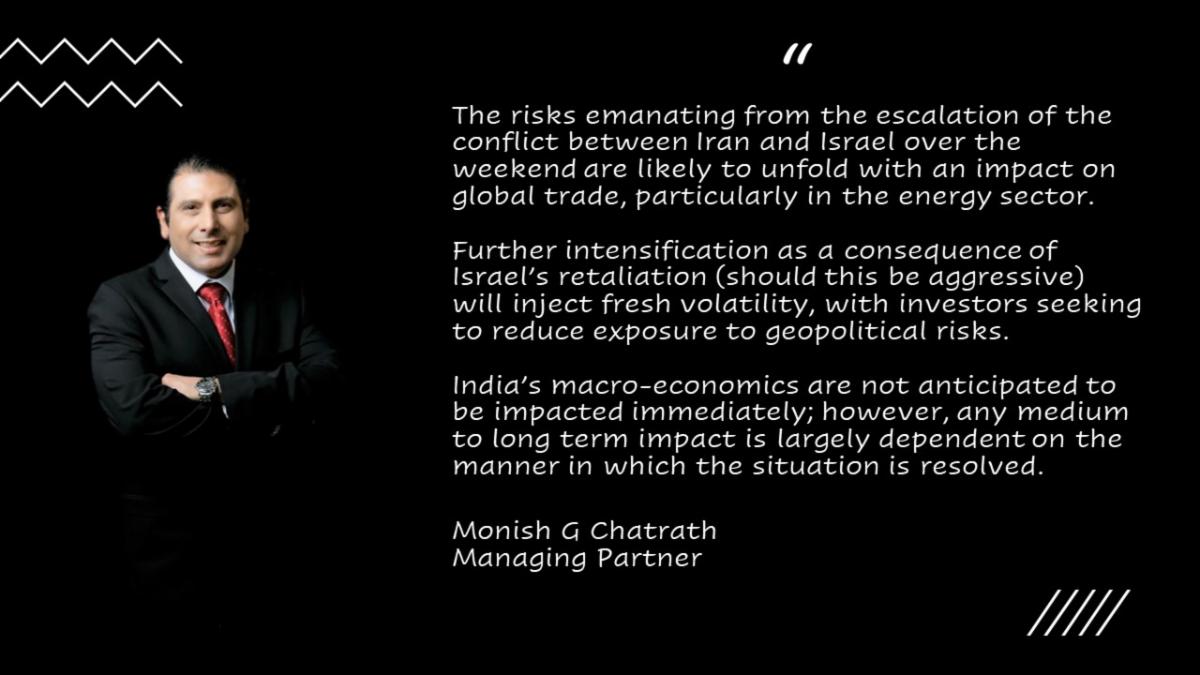
A new era is unfolding in the geopolitical and economic risk landscapes with global implications post Iran’s unprecedented strike on Israel over the weekend. This development could give way to immediate business repercussions across the globe, some of which are already erupting, amidst concerns of further escalation.


In this thought leadership, we have assessed the potential business risks that are expected to emerge in the near (immediate) to medium term (in the weeks ahead).

Emerging risks


Industries such as energy, aviation, ports, pharmaceuticals, paint, and tires may experience negative consequences as tensions escalate. Air and maritime security have already been impacted, leading to alterations in routes and anticipated fare increases. While the market may downplay the broader regional conflict risk in the immediate term, the economic impact of enhanced measures for air travel safety, longer flying times and volatility in flying schedules could be further accentuated with rises in crude prices in the medium term, with a narrowing gap between the RASK (revenue per average seat kilometer) and the CASK (cost per average seat kilometer).


The shipping industry needs to combat potential supply chain disruptions and route blockages. The Red Sea is a key corridor for trade between Asia and Europe and the continued or escalated conflict could result in shifting large amounts of cargo traffic to air mode such as leather goods, while increasing air freight volume.


Within the region, the Suez Canal serves as the primary maritime trade route between Asia and Europe, providing the quickest and most direct connection between the Mediterranean Sea and these continents. Among the exports from Asia to Europe are energy, commodities, consumer goods, and components. The canal handles over a tenth of global freight traffic, encompassing various types of commodities such as oil, raw materials, and containers, and nearly a third of global container traffic. Indian exporters should anticipate a decrease in new project exports to Europe via this route and an increase in shipping and insurance costs for the duration of the conflict.


Capital goods companies should anticipate order execution slowdowns in the Gulf Cooperation Council region, impacting businesses with substantial EPC (Engineering, Procurement and Construction) franchises in hydrocarbon projects. Prolonged regional strife could disrupt business flows and execution in the area.


Iran ranks seventh globally in oil production and is the third-largest member of the OPEC (Organization of the Petroleum Exporting Countries). India relies significantly on the Middle East (for importing over 80% of its crude oil). Oil prices could rise in the medium term (potentially disrupting oil exports via the Strait of Hormuz) and resulting in cost-push inflation with oil-dependent industries facing higher input costs, impacting the economic growth, trade balance and stability of the currency.

In summary


The present evaluation of geopolitical risks concerning the Middle East conflict is notably intricate, marked by various interwoven factors intensifying instability in global markets. We anticipate these occurrences to drive structural shifts in the geopolitical order, surpassing temporary fluctuations.


This analysis is based on the latest developments and could change with additional developments as new details emerge. It is important for all enterprises to stay well-informed and consider reevaluating their strategic and operational risks at this juncture. Entities with economic ties, whether direct or indirect, and corporate stakes in both nations, should closely monitor the evolving scenario.


Should you require any clarifications or assistance, please do not hesitate to reach out to us at contactus@mgcglobal.co.in.


Best regards

Markets Team

MGC Global Risk Advisory


About MGC Global Risk Advisory 

Recognized as one of the '10 most promising risk advisory services firms' in 2017, as the 'Company of the Year' in 2018 &, 2019 (both in the category of risk advisory services), one of the 'Top Exceptional Companies to Work For' in 2020, amongst the 'Top 25 Customer Centric Companies' in 2020, 'The Consultant of the year' in 2021 (in the category of risk advisory services), 'Top Exceptional Leaders in Risk Advisory Services' in 2023 and 'Best place to work' in 2024; MGC Global is an independent member firm of Allinial Global.


MGC Global provides services in the areas of enterprise-wide risk management, forensic, internal audits, control assessments (SOC, IFCR & SOX), process re-engineering, governance frameworks, privacy & data protection (including GDPR & DPDP), IT risk advisory, GDPR, VAPT, ISO readiness, cyber security, vCISO, accounting advisory, forensic, ESG & CSR services.


Our firm has the capabilities to service its clients through its offices in Bengaluru, Mumbai, NCR; and has service arrangements with associate firms in all major cities in India.

About Allinial Global

Allinial Global (formerly PKF North America) is currently the world's second-largest member-based association. With collective revenues to the tune of approximately US$ 5 billion, Allinial Global has dedicated itself to the success of independent accounting and consulting firms since its founding in 1969. 


It currently has member firms in over 105 countries, who have over 28,000 professional staff and over 6,000 partners operating from nearly 700 offices across the globe.


Allinial Global provides its member firms with a broad array of resources and support that benefit both its member firms and their clients in the key impact areas of learning & development, human resources, international outreach, technical support, knowledge-sharing through its specialized communities of practice, information technology and practice management. 

Web  Facebook  LinkedIn