July 2022 Week Two - In this issue:
- "Understanding Gender Equity" - by Dr. Lori Livingston
- "Politics, language and the Minto Cup' - by Pierre Filion
- "Executive Director's Corner" - with David Soul
- A Lacrosse Minute with Kevin Alexander
Coming July 2022 - Week Three:
- "In conversation with Wayne Goss" - hosted by Rad Joseph
- "One Plus One Equals Two" - by Pierre Filion
- "What were the real underlying purposes of the 1883 Great Britain Tour?" by Daniel Ferland
- Juxtaposition
With much more in the three additional issues to come this month including:
- "Remember 1982" - Vicky Brkich
- "Why YOUR "great ones" are not in the Hall" - Pierre Filion
- "Which team is the best ever JR A team in Canada?" - Dean McLeod
|
|
Please note that all opinions expressed in these articles are those of the author and not those of the editorial staff
or the Canadian Lacrosse Hall of Fame
|
|
Understanding Gender Equity - Dr. Lori Livingston |
|
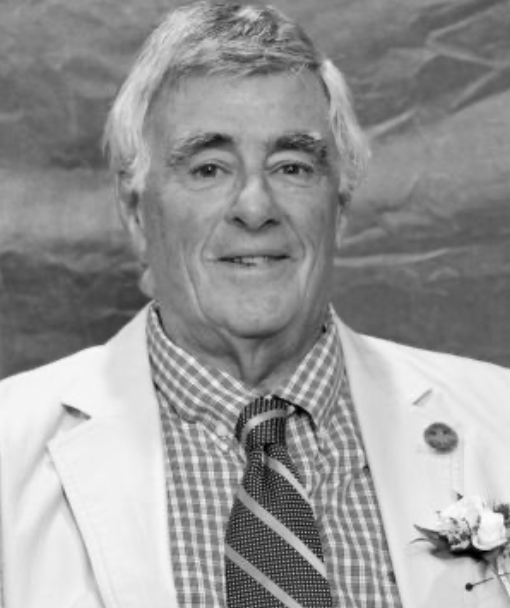
Dr. Lori Livingston
University Provost and Vice-President, Academic
Lacrosse Player and Builder
|
|
It’s Time to Address Gender Inequity in All Sports Including Lacrosse
I absolutely love sport and all the opportunities it has afforded me. It has brought me many fond memories and good times. It brought me closer to my brother, with whom I would spend endless hours playing catch or pick-up hockey, and my dad with whom I would spend endless hours watching professional sport broadcasts on TV. Sport has always been part of my very core – as an athlete, coach, umpire, and administrator at the provincial, national, and international levels. I have travelled across Canada and around the world because of it. It also brought me a profession I love, as a post-secondary educator and researcher in the areas of physical education and kinesiology.
|
|
Today, as a university Provost and Vice-President, Academic, I openly acknowledge the importance of sport in contributing to my leadership philosophy and skillset. Sport is part of my very soul and I will always prefer to see all of the positives in it. However, not all girls and women have experienced sport in the same way that I have and still do. Something needs to change.
From my perspective, the lack of sport participation by all Canadians - but especially by girls and women - is alarming. This article begins with a very brief look at how participation in the sport of women’s field lacrosse has changed since it was first introduced in a meaningful way to Canada in the early 1980’s. This is followed with a summary of recent changes in sport participation by Canadian females over the past decade, and how participation rates in sport change for females across age groups over time. Thereafter, it explores some of the known barriers to sport participation and what strategies sport organizations may use to first stop and then begin reversing these trends.
The Beginnings of Women’s Field Lacrosse in Canada
Gender inequity in sport has a long history in Canada (1) and to understand why, one needs to understand that sport is a powerful cultural institution that has long reinforced male dominance and resisted the inclusion of women (2). The origins of these perspectives are historical and social in origin, with modern day perspectives dating back to the late nineteenth century when limited scientific knowledge, medical beliefs, and social perceptions came together to create opinions on what kinds of physical activity might be most appropriate for girls and women. Female bodies were considered to be inferior to those of their male counterparts, with overly vigorous exercise being seen as detrimental to the health of women’s reproductive systems and therefore their ability to bear children (3). These prevailing cultural attitudes did not stop all girls and women from participating in sport, but their participation rates were severely limited by them until about the latter half of the twentieth century.
The catalyst for change was the feminist movement of the late 1960s and early 1970s which contributed to groundbreaking legislation, such as Title IX in the United States in 1972 (4), the 1975 Sex Discrimination Act in Britain (5), and in Canada, the 1970 Report of the Royal Commission on the Status of Women. As recognition of the underrepresentation of women and girls in sport and recreation grew, the Canadian government began to introduce targeted funding to support women’s sport initiatives in the mid-to-late 1970s and early 1980s (6). At the same time, the game of women’s lacrosse was experiencing overwhelming growth in the United States (7) and England’s Maggie Boyd was taking a lead role in the formation of the International Federation of Women’s lacrosse Associations (IFWLA) in 1972 (8). With its member countries including England, Scotland, Wales, Australia and the United States, by the late 1970s and early 1980s the IFWLA began planning for its first World Cup.
In 1982, the Canadian Lacrosse Association (CLA) joined the IFWLA and sent a team to the first Women’s Field Lacrosse World Cup event in Nottingham, England (8). This event yielded not only an unexpected bronze medal for a Canadian team made up of experienced female box lacrosse players primarily from British Columbia and Ontario, but also targeted funding to increase female participation in the sport to the form of a $28,000 bonus payment from Sport Canada (9). This provided the impetus for the formation of the Women’s Field Lacrosse Sector Committee which included Carol Patterson, Jenny Kyle, and Carolyn O’Keefe, and Pierre Filion. At its peak (i.e., 1985-1987, inclusive), seven provinces competed in the Canadian senior women’s national championship tournament (10). However, by 1996, only two provincial teams competed at the senior level for the national title. This decline was due to a number of factors, not the least of which included the lack of play at the more junior levels. The sport remains alive today, albeit less so at the senior level, in select locations across Canada thanks to the strong commitment of a few women in coaching, officiating, and administrative roles. However, unless we start to address the trend of declining sport participation by girls and women in Canada, the future of women’s field lacrosse and the involvement of girls and women in other versions of the game such as box lacrosse, may be at risk.
The Decline in Sport Participation by Girls and Women
In 2010-2011, 74% of all Canadian children and youth participated in sport (11). By 2020 this number had dropped to under 60%, a drop of more than 14% in a ten-year period. When comparing the involvement of females and males in organized sport, participation rates are much lower for girls than boys, declining from a high of 57% for girls age 6-12 years to 47% for girls age 13-15 years. By the time girls reach the age of 16-18 years, only 38% remain active in sport. While both girls’ and boys’ participation rates decline over time, across adolescence one in three girls will drop out in comparison to one in ten boys. For women, the decline continues, with only 18% of women aged 16-63 being involved in sport.
Multiple Contributing Factors to Non-Participation and Drop Out
In trying to understand the phenomena that influence involvement in sport, it must be acknowledged that there are many factors that support participation as well as those that detract from it. How those factors come together, or intersect, creates unique experiences for each and every potential participant and it is their personal experiences that will determine their persistence in or dropout from sport. Understanding these factors is a must for all organizations seeking to elevate participation rates for females in roles as athletes, coaches, officials, and administrators in sport.
In 2020, researchers were brought together to produce a report and call to action to address existing gender inequities and to improve female participation rates in Canadian sport. They identified multiple factors that contribute to non-participation and drop out and the actions needed to reverse the trends. It is beyond the scope of this brief article to outline all of the findings of The Rally Report: Encouraging Action to Improve Sport for Women and Girls (1), yet here are some of key findings.
Access Barriers. There are many different access barriers which may limit entry into a sport. One of these barriers is the lack of availability or awareness of the opportunity. Stated another way, low profile sports, and especially those not played at the professional level or routinely covered by the media, may not catch the attention of potential participants. Sport participation is also generally greater in urban versus rural areas where participants can be drawn from a larger population base and there are more playing facilities available for use. For individuals living outside of urban centres, the absence of public transportation options or, alternatively, the time and cost of travelling to participate may be prohibitive. The rising cost of sport participation as a function of travel, registration, and equipment costs can also become a barrier and especially so for those from low income households. If the number of girls involved in a sport is low, this can also lead to fewer women taking on future leadership roles within the sport.
Lack of Role Models. Just as the visibility of a particular sport limits awareness of it, so too does the absence of role models involved in it (12). In Canada, women are underrepresented in sport leadership roles as board members, administrators, and coaches at the local club, provincial, and national levels. Without the opportunity to engage in these positions of influence within a sport, the cycle of inequity between males and females remains in place unchallenged.
Quality of Experience and Safety Concerns. Forty-three percent of adolescent girls reported that the quality of sport was a barrier to their participation, with the perceived lack of quality resulting from substandard coaching, the absence of role models, and poor overall past experiences. More specifically, one in three girls reported feeling unwelcome while one in five reported safety concerns as reasons preventing them from continuing to participate. Unsafe sport environments are a product of many factors, not the least of which is the frequency with which dismissive sexist comments (e.g., “You play like a girl.”; “You’ll never be as good as your older brother.”) are used to demean participants. Sexism is harmful to girls and boys, women and men, and it is not unique to sport - but it is tolerated in sport at all ages, within the playing, coaching, and administrative ranks, when openly overt sexist statements are ignored, giggled about, or accepted (13).
Other Factors. As stated at the outset, multiple factors can contribute to the decisions by girls and women not to participate in sport. Some of these factors not yet discussed include lack of confidence, negative body image, religion or culture, and competing activities or priorities.
Strategies to Reverse the Trend
Sport is the most prevalent extra-curricular and organized activity for adolescents in Canada and it offers many benefits (1), yet these are not being realized due to low and declining rates of participation. This trend needs to be reversed as soon as possible. Moreover, sport organizations know that there is much to be gained (e.g., financial sustainability, greater media recognition, external revenue and funding opportunities, increased access to elite competitions such as World or Olympic Games, etc.) through expanding their membership base. It only makes sense to grow an organization by including girls and women as participants.
Not everyone is motivated to participate in sport, yet many do and the question as to why they do is important. Role models (e.g., family members, teachers, coaches) play a key role in encouraging girls and boys to enter sport. The key to keeping them there is to make sure they are enjoying the experience (14). This is an exceptionally important concept in this day and age where there are so many other non-sport related activities and competing priorities (e.g., part-time jobs) to choose from. Individuals are going to naturally gravitate to an environment and a fun activity which supports their inclusion and their interests. If these elements are missing, drop out will be the end result.
If an organization wants to grow female participation numbers, the commitment has to be made by all facets of the organization. Girls and women need to be welcomed in and valued as athletes, coaches, officials, and administrators. They also need to be included at all levels, from the entry level to the elite level, given the opportunity to occupy leadership roles, and to become role models within the sport and the organization. To ensure that this happens, existing organizational policies and practices need to be updated, amended, or created to include explicit membership requirements for women on Boards and operational committees with decision making responsibilities. Moreover, including girls and women in your organization’s strategic planning and operational activities is critical to ensure that their perspectives are heard and reflected. If you truly value them, you will identify objectives and goals to support their best interests as participants. Ontario Soccer has done a fantastic job of creating a strategic plan which embodies these principles and approaches to inclusion in a welcoming environment (15). Moreover, there are a multitude of resources available to support such efforts, including The Rally Report (1) which provides a concise summary of recommended actions to enhance the retention of girls as participants, the participation of women in leadership roles, and the creation of equitable and inclusive sporting environments.
In Conclusion
Lacrosse is a fantastic sport that should be equally accessible to girls and boys and men and women alike and everyone (i.e., athletes, coaches, officials, administrators, spectators, and others) involved in the sport has a responsibility to contribute to the creation of an inclusive, equitable, and diverse sporting environment. Many of the barriers experienced by girl and women in sport as discussed in this paper, can be addressed and, with a firm commitment, either minimized or eliminated. In 2022, there is no excuse not to address the declining rate of participation by girls and women in the game for the sake of the game. The time to act is now.
References
-
Canadian Women & Sport (2020). The rally report: Encouraging action to improve sport for women and girls. Retrieved from: https://womenandsport.ca/wp-content/uploads/2020/06/Canadian-Women-Sport_The-Rally-Report.pdf
-
Fink, J.S., Borland, J.F., & Fields, S.K. (2010). Sexist acts in sports: Media reactions and forms of apologia. International Journal of Sport Communication, 3, 198-216
- Vertinsky, P.A. (1994). The eternally wounded woman: Women, doctors, and exercise in the late nineteenth century. Champaign, IL: University of Illinois Press
- Cahn, S. (1994). Coming on strong: Gender and sexuality in twentieth century women’s sport. New York: Maxwell Macmillan International.
- Hargreaves, J. (1994). Sporting females: Critical issues in the history and sociology of women’s sport. London: Routledge.
- Macintosh, D., & Whitson, D. (1990). The game planners: Transforming Canada’s sport system. Montreal & Kingston: McGill-Queen’s University Press.
- Trafford, B., & Howarth, K. (1989). Women’s lacrosse: The skills of the game. Ramsbury, England: The Crowood Press.
- Blaydes, E. (1987). International lacrosse. In Souvenir Brochure, Lacrosse 75, 1912-1987 (pp. 30-31). London: All England Women’s Lacrosse Association.
- Yee, S. (1996). The emergence of a new national game: The development of women’s field lacrosse in Canada. Unpublished undergraduate paper, Wilfrid Laurier University.
- Livingston, L.A. (2015). Ready…draw!: The golden age of senior women’s field lacrosse in Canada. Sport History Review, 46, 226-258.
-
Canadian Fitness and Lifestyle Research Institute (CFLRI) (2012). Participation in sport among children and youth. Retrieved from: http://www.clfri.ca/sites/default/files/node/1135/files/CLFRI-B1.Sport%20Participation_2011_12.pdf
- Meier, M. (2015). The value of female sporting role models. Sport in Society, 18, 968-982.
- Fink, J.S. (2016). Hiding in plain sight: The embedded nature of sexism in sport. Journal of Sport Management, 30, 1-7.
- Livingston, L.A., Forbes, S.L., Wattie, N., & Cunningham, I. (2020). Sport officiating: Recruitment, development, and retention. London: Routledge.
-
Ontario Soccer (2022). Ontario Soccer announces its new 2022-2026 strategic plan. Retrieved from: https://www.ontariosoccer.net/news_article/show/1212330
|
|
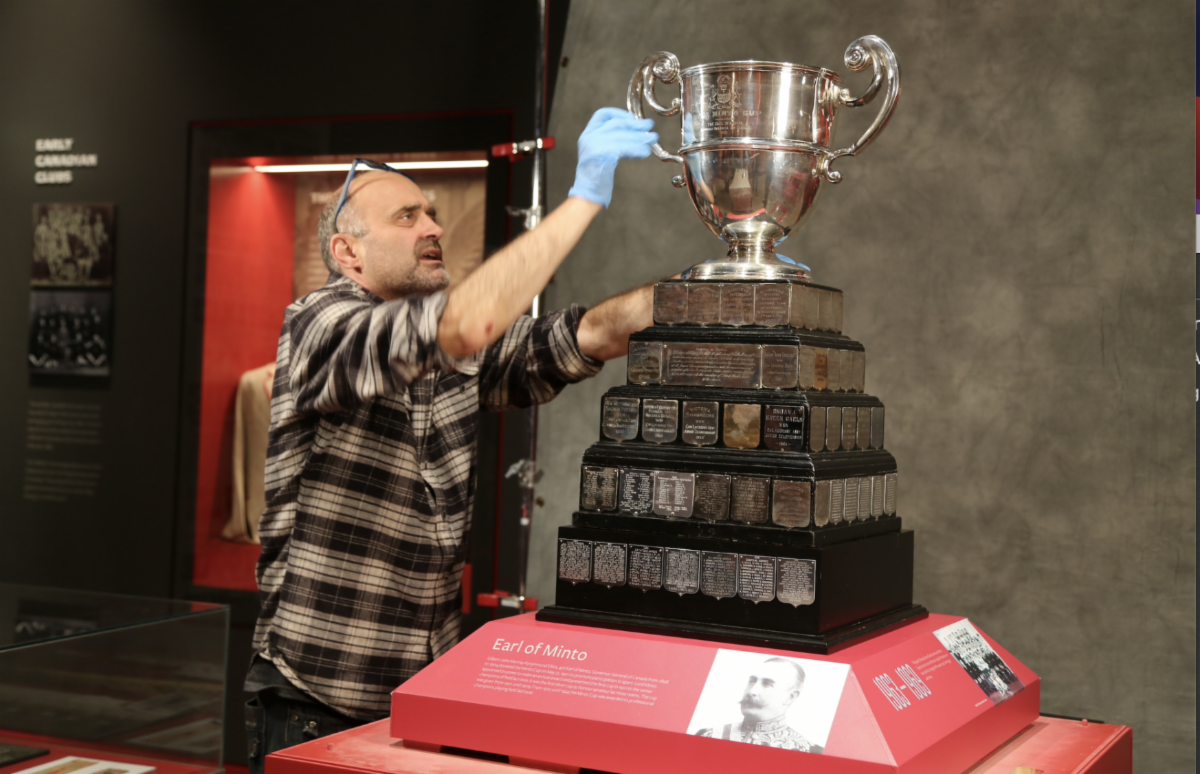
Each year brings a change to the Minto Cup!
The Prestigious Trophy is liberated from its secure enclosure so a craftsman can install the plaque with the team of the current winner and then the pieces are carefully aligned and the case reinstalled to protect and safely preserve the trophy.
|
|
Politics, Language and the Minto Cup - Pierre Filion |
|
Pierre Filion
CLHOF Director
CLHOF Class of 2021
|
|
A humorous look down memory lane
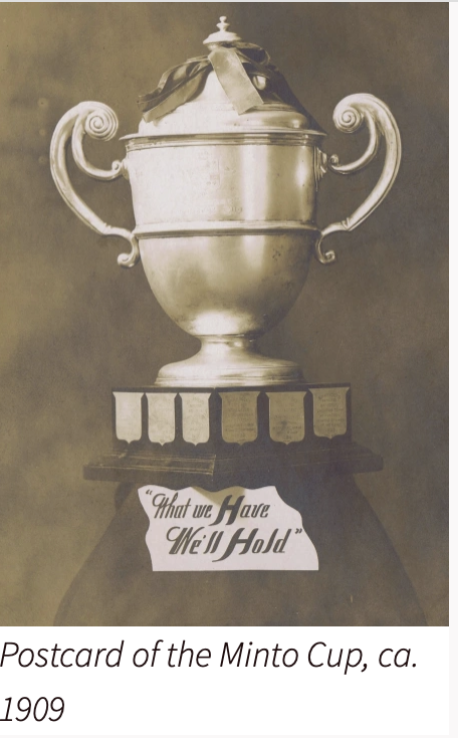
In February 1974 the Canadian Lacrosse Association called a meeting of the provinces in Toronto to be in better contact with the provinces, to receive their requests and suggestions and to plan the budget for the upcoming fiscal year. There was a large attendance and good representation from most provincial lacrosse associations. The mood was good and everyone was appreciative of the fact that the CLA was officially ‘’listening’’ to provincial needs. The CLA had brought the Minto Cup to the meeting to showcase one of the game’s greatest Trophy. Everyone wanted to see and touch the prestigious Cup…Gordon Hammond, as a father figure, was presiding over the meeting and things went off rather well. And smoothly.
Most provinces wanted money from the CLA; some wanted to facilitate interprovincial play or the movement of players from one province to another; some requested coaching manuals and better training for officials. Some wanted important rule changes to the game. Some wanted sticks and balls for introductory clinics…Different needs, different requests. Different answers.
|
|
The Quebec delegation had one request; that the CLA produce a French rule book for box lacrosse in order to facilitate governance and uniformity of rules across the country. The request would mean that the CLA would cover the costs of translation and of production. One game, one set of rules in both languages.
The QC request was met with passionate unanimity; everyone was against it. But for different reasons.
- A lawyer said: ‘’The language law in Canada only applies to the Federal government and not to funded federal sport associations’’; ‘’Your Trudeau has not protected you correctly; we can’t legally be bound by the Official language law’’;
- A unilingual delegate said: ‘’if ‘’you guys’’ were not that lazy you would learn English and we would not have to deal with this issue here’’; ‘’look Pierre, your English is perfect; why don’t everyone else do just like you did and simply learn English’’; ‘’you are wasting our time here’’;
- A delegate and surely a student of Canadian history said ‘’ you guys seem to have forgotten that you lost the Battle of the Plains of Abraham; it’s over, get over with it; you lost, move on’’;
- A treasurer expressed his concern; ‘’Financially this is ridiculous; we will not sell one French rule book in our province; no way we should spend ‘’national money’’ on that; it only concerns one province; this is not a national program, it’s a provincial whim’’;
- ‘’This is a separatist plot to have us pay for the French rule book then ‘’these guys’’ are going to run away and separate’’;
- An experienced on floor official mentioned that ‘’when Québec would play Ontario would we have to make our calls in both languages?’’; ‘’which rule book would have predominance over the other? Which call will we need to make first, the call in English or the call in French? This is totally impractical; the games will never end’’;
This passionate expression of unanimity lasted for over an hour, some delegates even repeating themselves time and time again in order to make their point and share their concerns. Few delegates addressed the issue of governance and the need to have a French rule book in a French province.
After a while president Hammond called the delegates to lunch and stopped the discussion; the delegates left the meeting room, hungry and angry. I don’t know if they were angrier or hungrier!
The QC delegates were left alone in the meeting room, assessing the onslaught and their options when they realized that the Minto Cup had been left there unattended, unprotected, unsupervised in an open meeting room where doors were not locked. The Minto Cup, the crown jewel, the valuable trophy was just left there. Anyone in the Hotel could have stolen the Minto Cup without any problem…
The QC delegates left the meeting room as lunch was on their agenda. Did I hear you say pea soup and frogs’ legs? In 1974, maybe; surely not today!!!
After lunch when the meeting reconvened president Hammond noticed that the Minto Cup was not where he had left it. It was missing. It was stolen. ‘’Not on my watch, not on my watch; this can’t happen to me’’ was he heard saying moving vehemently across the room. He was perspiring as if he had played a full game of box lacrosse… ‘’’Gentlemen this is the darkest day in the history of the CLA; the Minto Cup has been stolen. We have called Toronto Metropolitan Police and they will search everywhere; this is such a unique trophy. They have to find out who stole our Cup’’. The delegates were all very quiet; some felt responsible for not having attended to the Cup after displaying such emotion for a French rule book. It was as if death had struck. The silence was eloquent. The mood was not good at all.
I had the pleasure of brightening the day by saying to our friends and colleagues: ‘’Gentlemen (because there were no women at that time at CLA meetings) Québec is willing to trade the Minto Cup for a French rule book’’.
And we took the Minto Cup from our room to bring it back to the meeting room. Some thought it was very funny; some others really did not see any humour there.
Jack Christie, the very wise Executive Director of the OLA, came to the QC delegation and very quietly told us. ‘’Gentlemen you have made your point with great diplomacy; we acted as idiots in the issue of your request for a French rule book and behaved irresponsibly by abandoning our Minto Cup. And you pointed all that out very cleverly’’…. Our answer to Jack was ‘’Mister Christie, you make good cookies’’.
Somehow something there was lost in the translation as Jack walked away slightly shaking his head….
A few years later the CLA produced a French rule book and progressively became a functionally bilingual national association. So you see, things change. It just takes time, patience and a will to move forward, together with understanding and empathy. And with a little bit of humour.
And if ever you ask. Yes, today the Minto Cup is well protected.
And if you want to know, this is a true story. It really happened that way. I was there.
|
|
"Executive Director's Corner" by David Soul |
|
David Soul
CLHOF Executive Director
|
|
|
What does "Growing the Heritage" entail?
Quite simply the purposes of the Canadian Lacrosse Hall of Fame are to:
- foster and promote the game of lacrosse and to stimulate the public interest of the game in Canada
- promote and develop community spirit but the encouragement of athletics and in particular the game of lacrosse
- Honour the tradition of lacrosse and be a keeper of the rich traditions, stories, artefacts, and history of the game
- Induct into the Hall of Fame "the best of the best" persons and teams best exemplifying the spirit of friendly rivalry and excellence
That said, "Growing the Heritage" must be more than just collecting the significant events, traditions, and contributions of the various lacrosse communities across Canada – it must be about making them visible throughout Canada, both to existing lacrosse communities and to the general public. Canada’s Summer National Sport deserves no less!
How can the Canadian Lacrosse Hall of Fame accomplish this? Through partnerships with the communities we serve!
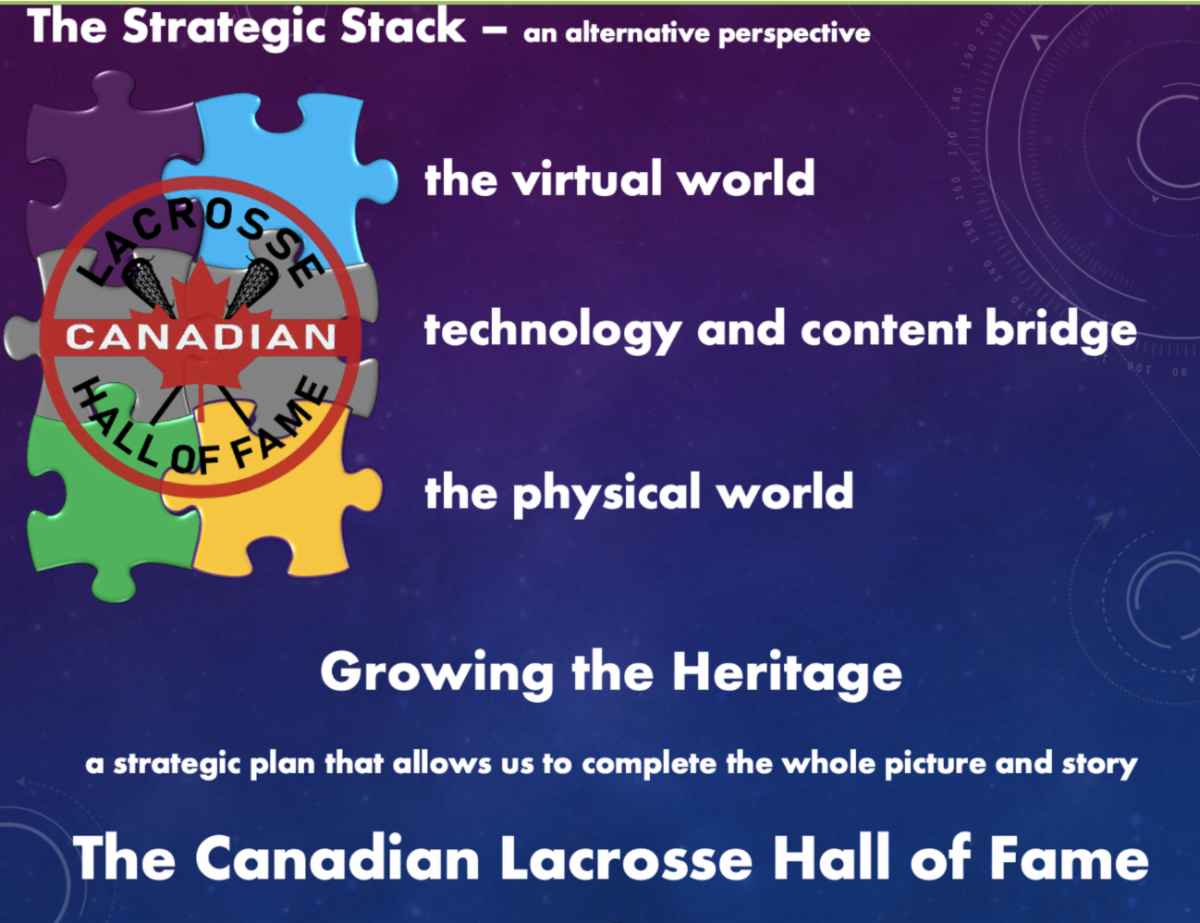
Looking at the foundations (green and gold in the “Strategic Stack”), these are currently featured in our “Wall of Fame” and other displays in our Lacrosse Museum in New Westminster but these are not enough to meet the goal of “Growing the Heritage” so we will be looking to collaborate with Provincial Lacrosse bodies to promote the game through grass roots physical “pop up” travelling displays at major championship events that will celebrate the game and hopefully showcase past and current stars and “role models” that current participants may be inspired by.
It is our intent to increasingly capture “Future History Now” by working in partnership to capture stories, images and artefacts now so that we have not just statistics but reflections of the continuing impact of the sport on Canadians. The CLHOF is more than a repository of names and photos of our greatest players, builder, officials and teams; it is the keeper of our national summer sport’s history and we need your support, including through organizations you are members of, to make this possible!
The top two pieces of the puzzle above represent our Main web site and social media platforms (blue) and our continuing development of “Powers’ Bible of Lacrosse” – the “start here guide to everything lacrosse.” Both of these available on demand from anywhere will hold not just statistics and “just the facts” but increasingly digital images of our game (programs and other documents will be scanned and indexed) and more importantly stories – written and oral.
For these partnership with individual members of the community will be key. An early example of how this will work is in this very newsletter that you are reading now.
We are proud to be a contributing partner with the Canadian Lacrosse Foundation’s “Legends of lacrosse” videos. We also look forward to establishing more partnerships to create such great memories and make them available for generations to come.
We will do this by establishing video archives and placing back issues of the ONWARDS newsletter, and more, in our virtual archive as represented in the grey pieces of the diagram.
Finally, the CLHOF is a member of several museum and sport heritage sector organizations (BC Museums Association, Canadian Museums Association, the Canadian Association of Sport Heritage, and the BC Council of Sports Halls) who we will partner with to make representations to all levels of government, private foundations, and corporations regarding the importance of support to capturing, preserving and promoting the values of sport, and specifically lacrosse, to the well-being our communities.
Our resources are limited however we are committed to making all the above a reality in the years to come. I welcome your feedback, thoughts and suggestions which can be sent through by email via the"letter to the editor" button at head of this article.
|
|
A Lacrosse Minute - with Kevin Alexander |
|
Kevin Alexander has been called the Wayne Gretzky of lacrosse because of his stick prowess and scoring ability. He was inducted into the Canadian Lacrosse Hall of Fame in 1991 after retiring from Box Lacrosse in 1986. |
|
|
|
Do you have an idea for a story line or pictures to share?
Please drop us a note !
|
|
|
|
Support the Hall of Fame! |
|
As a non-profit organization we need public support, your donation supports activation of the Canadian Sports Hall of Fame's programming so that we can increase outreach throughout the country. |
|
|
|
|
|
|