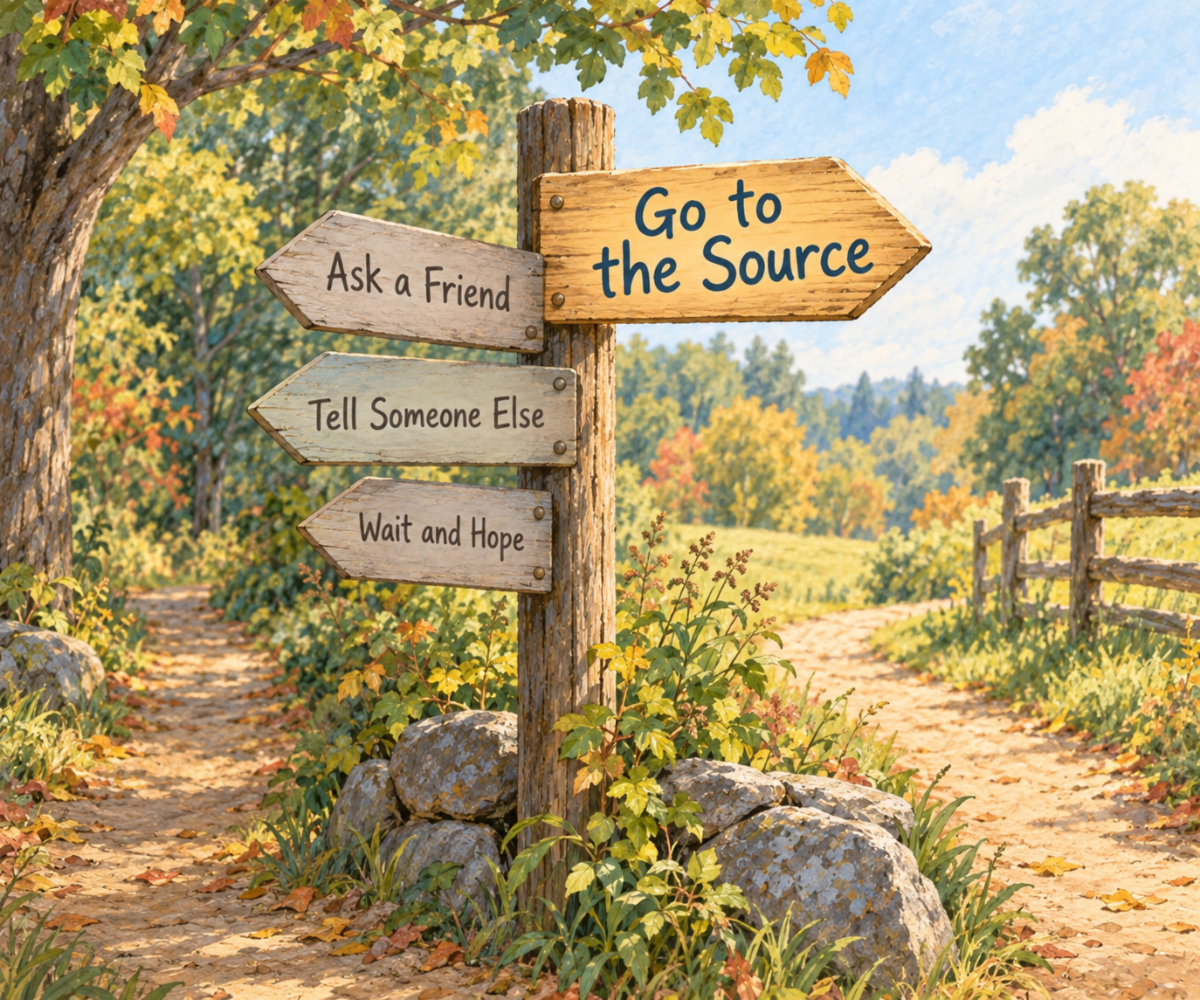
Go to the Source
There’s a question I ask kids (and myself) pretty regularly:
“Who can actually help you with this?”
It sounds simple, but it’s a surprisingly important social skill.
Humans often bring a problem to someone who isn’t in a position to solve it. For kids, this can sound like:
“She won’t let me have a turn.”
“He said I couldn’t play.”
“I don’t know what she meant.”
Sometimes they tell a friend. Sometimes they tell another kid. Sometimes they come find an adult. And sometimes, by the time the story has traveled through several people, a fairly small problem has become much bigger than it needed to be.
That’s when I’ll help them think about going to the source.
If you want to know what someone meant, ask them.
If you need something from someone, ask them.
If someone did something that bothered you, when it’s appropriate, talk to that person.
Every extra person we put in the middle creates another opportunity for assumptions, misunderstandings, and hurt feelings to creep in. It’s a little like the old game of telephone. The farther the message travels, the less likely it is that everyone is working with the same information.
Of course, going to the source doesn’t mean kids should always handle problems by themselves.
Sometimes a child needs help calming down first. Sometimes they need an adult to help them figure out what they want to say. And if there’s a safety concern, bullying, or a situation where approaching the other person wouldn’t be appropriate, getting adult help absolutely makes sense.
There’s a difference between getting support and adding people to a problem who can’t actually solve it.
That’s the piece I want kids to learn to recognize.
Instead of immediately jumping in to solve the problem, we can sometimes simply ask:
“Who can actually help you with this?”
Often, they already know the answer.
And learning to go to that person—to ask the question, clarify the misunderstanding, express what they need, or work through the problem—is a social skill they’ll use for the rest of their lives.
|