|
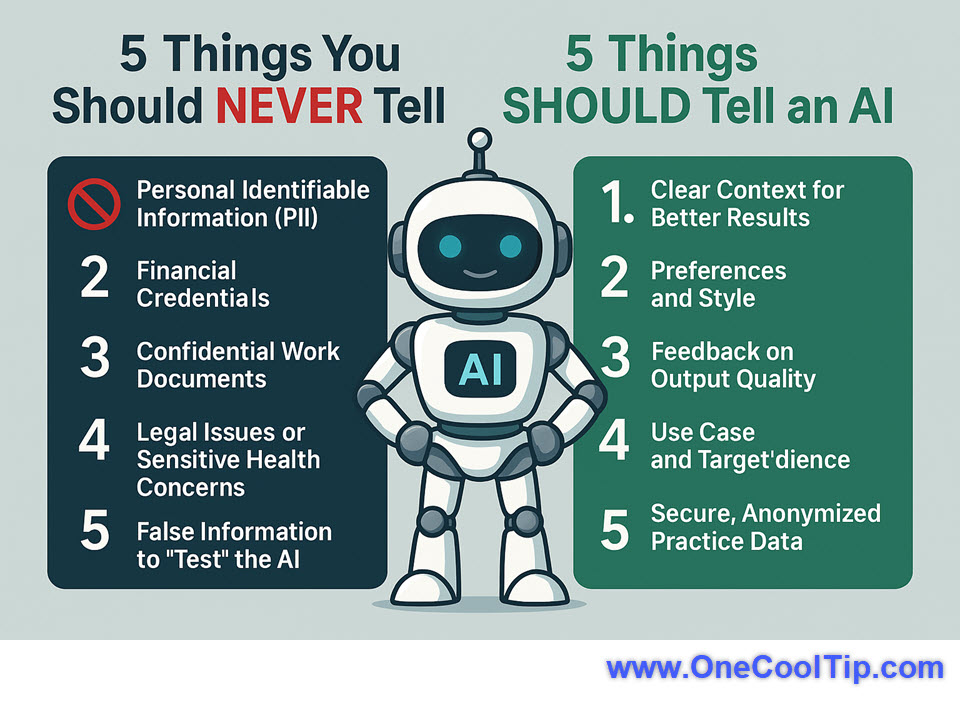
🙋♂️ Here are 5 Things to Never Tell an AI and 5 Things You Should
Are you saying too much to your AI?
Unlike your closest confidant, an AI doesn't forget, and it may not always be as secure as you'd think.
Whether you're using ChatGPT, Google Gemini, Microsoft Copilot, or any number of AI-powered tools, your prompts matter.
🚫 5 Things You Should NEVER Tell an AI
1. Personal Identifiable Information (PII)
Avoid: Full names, addresses, phone numbers, social security numbers, birthdates.
Why: Even in supposedly private conversations, these data points could be stored, mishandled, or inadvertently exposed. No AI tool guarantees permanent data deletion across all logs.
2. Financial Credentials
Avoid: Credit card numbers, bank account information, PINs, or passwords.
Why: AI tools are not payment processors or password vaults. Sharing this information puts you at risk of fraud and identity theft.
3. Confidential Work Documents
Avoid: Internal memos, trade secrets, client data, source code, unreleased products.
Why: Many AI platforms (especially free versions) train on user input. That means your company's secrets might help improve a model used by your competitors.
4. Legal Issues or Sensitive Health Concerns
Avoid: Ongoing legal cases, private medical diagnoses, or treatment plans.
Why: AI doesn’t offer legally or medically accurate advice. You risk misdiagnosis or misguided actions without professional oversight.
5. False Information to “Test” the AI
Avoid: Fake scenarios, misleading questions, or lies.
Why: AI learns from interaction. Misinforming it can degrade its responses for you and potentially for others downstream.
✅ 5 Things You SHOULD Tell an AI
1. Clear Context for Better Results
Do: Share the goal of your task or request.
Example: Instead of “Write a paragraph,” try “Write a 100-word introduction to a blog post about cybersecurity for small businesses.”
2. Preferences and Style
Do: Specify tone, length, or formatting.
Example: “Make it sound like The Verge, under 600 words, and include bullet points.”
3. Feedback on Output Quality
Do: Say what you liked or disliked.
Example: “This was too formal—can you make it more casual?”
Why: Many AI platforms are tuned to your feedback, especially within a single chat session.
4. Use Case and Target Audience
Do: Share who you're writing for, their knowledge level, and your intended platform.
Example: “This tip is for a beginner Excel user reading a newsletter.”
5. Secure, Anonymized Practice Data
Do: Test AI features using fake or anonymized data sets.
Example: Dummy names, generic company names, or open-source sample files.
AI can be a powerful partner, but only when you use it thoughtfully.
Learn more HERE.
|