What's In This Issue:

Water Works Summary

Meet Dini - Our Newest Staff!

Water & Forage Cost Surveys

Learn about Thistle Rust Fungus

Insect Update

Newsworthy Shares

Community Shoutouts

Water Works Day Summary


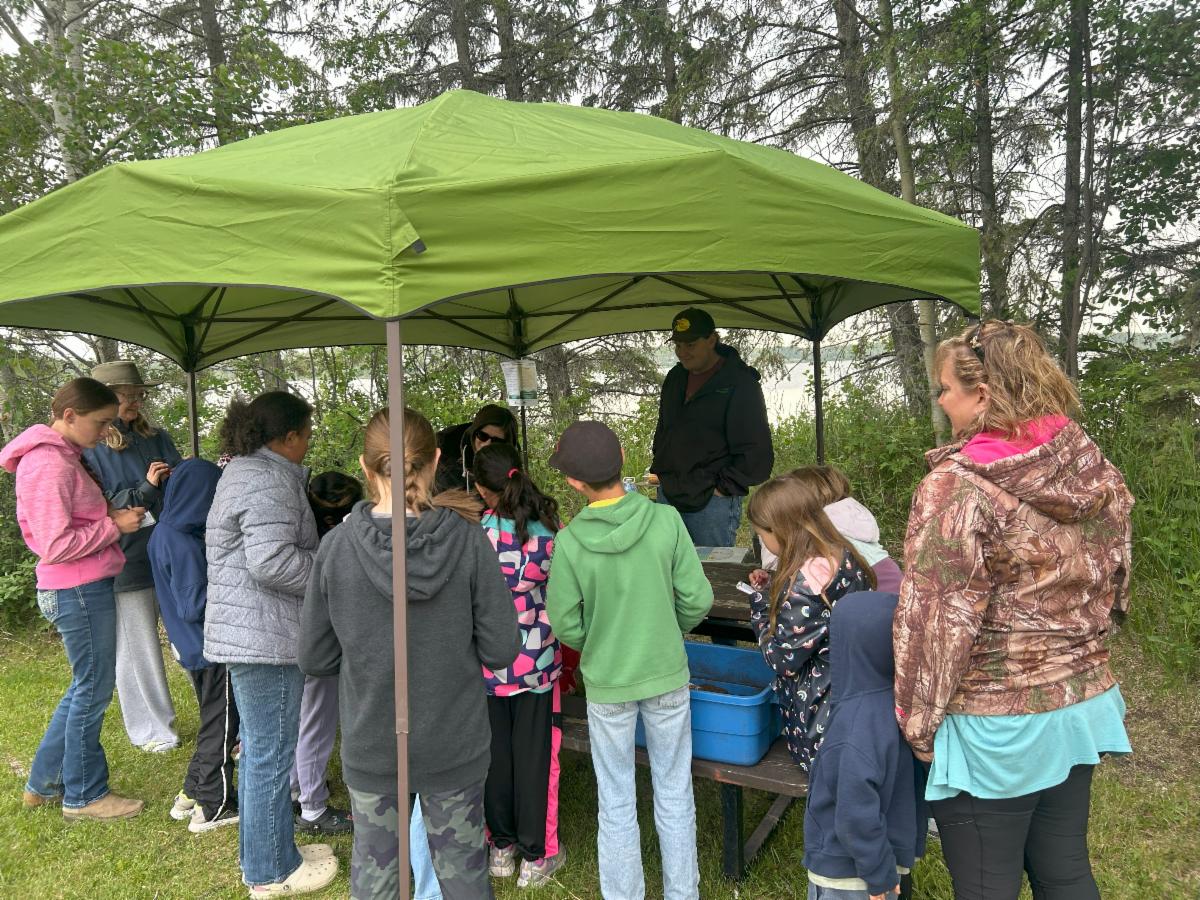
Barrhead Water Works Day: Teaching Kids the Power of Soil and Water (and Summoning Rain?)


Barrhead Water Works Day was a splash—literally. Held as part of a larger effort to connect local youth with the natural systems that sustain their communities, the event brought together Grade 4 students to explore the relationship between soil and water through the lens of agriculture.


Hosted at Thunder Lake, the day featured interactive, hands-on learning stations designed to teach students how water moves through soil, how different soil types affect water retention, and why farmers care deeply about both. Through muddy experiments, filtration demos, and plenty of enthusiastic questions, students learned that healthy soil is essential not just for growing food, but also for managing water—especially in times of drought or flood. We wanted to show the kids how soil acts like a filter and sponge, cleaning and holding onto water, and how farmers use this knowledge to protect crops and the environment.


While the students were busy learning about water, the sky decided to offer a real-life demonstration: clouds rolled in and delivered a much-needed downpour. After weeks of dry weather, the area received a generous soaking—enough to force an early wrap-up of the outdoor activities. The timing couldn’t have been more ironic. We spent the morning talking about how valuable water is, and by lunchtime we had to run for cover. It was the best kind of interruption.

Meet Our Newest Team Member!

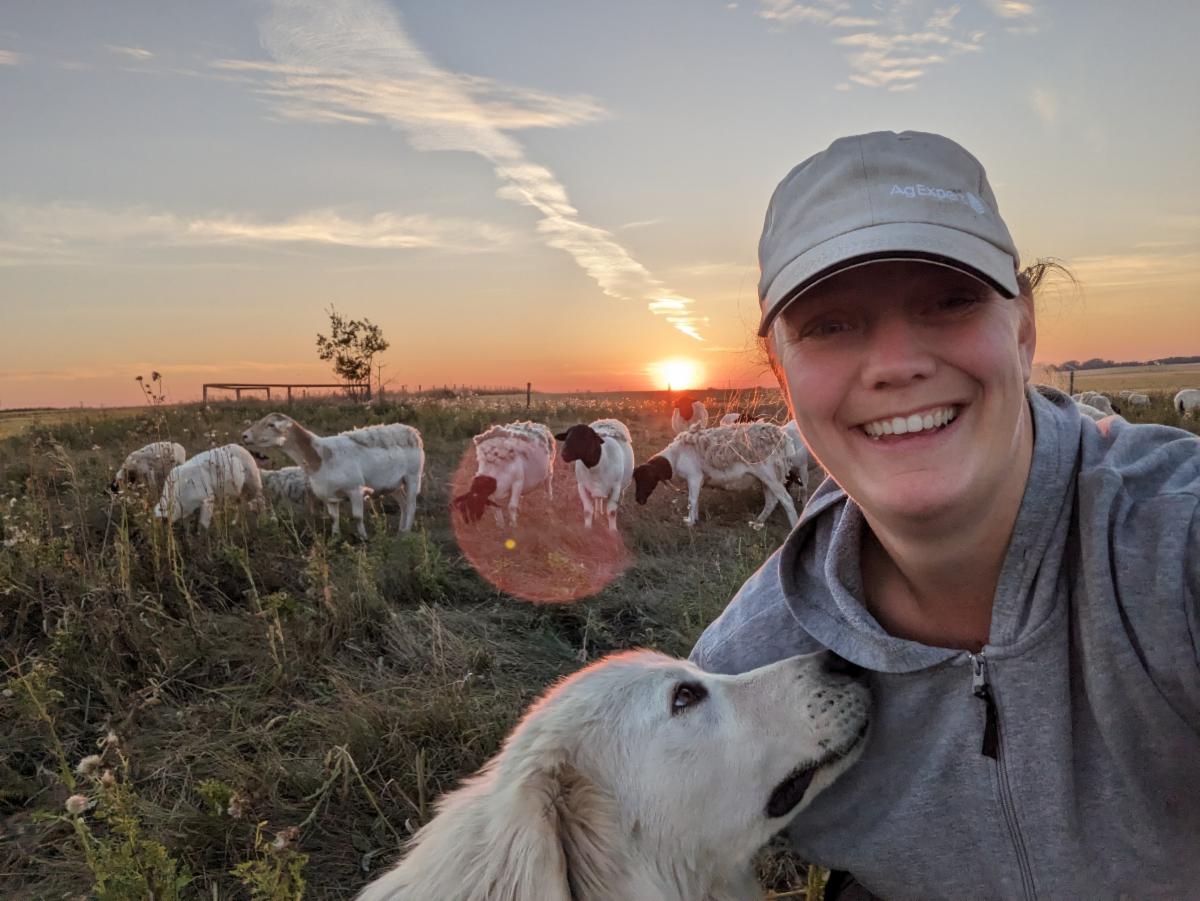
Welcome Dini to the Farming Forward Team!

We're excited to welcome Dini as our new Extension & Communications Coordinator! Dini brings a background in ag-tech, global farm experience, and is also starting a sheep farm right here in Lac Ste. Anne. She’ll be taking the lead on upcoming events and this newsletter, and she’s keen to connect with members.


“It’s a big change, but we’re figuring it out day by day, and every bit of local knowledge helps.”


 Read more about Dini’s journey and what she’s looking forward to in her new role →

2025 Q2 Forage Pricing Survey

📢 Help Us Collect Forage Prices –

We’re gathering current pricing information on hay, silage, and greenfeed in the west-central region of Alberta, and we need your help!

If you’re buying or selling forage, please consider sharing your pricing details with us. This information is collected to support AFSC and helps ensure accurate, local data is available for everyone.

📬 What we’re looking for:

  • Type of forage (hay, silage, greenfeed)
  • Price (per bale, per ton, etc.)
  • Location (nearest town or general area)

All information will remain confidential and only be used for regional price reporting.


Share Your Water Management Issues

Thistle Rust Fungus: Nature’s Ally in the Fight Against Canada Thistle


Canada thistle (Cirsium arvense) is one of Alberta’s most tenacious invasive weeds. Known for its aggressive root system and prolific seed production, it quickly overtakes cropland, pastures, and native plant communities—reducing productivity and outcompeting beneficial vegetation. Traditional control methods like tilling and herbicides offer limited and often temporary results. But what if we could let nature lend a hand?


Thistle Rust Fungus: Nature’s Ally in the Fight Against Canada Thistle

Canada thistle (Cirsium arvense) is one of Alberta’s most tenacious invasive weeds. Known for its aggressive root system and prolific seed production, it quickly overtakes cropland, pastures, and native plant communities—reducing productivity and outcompeting beneficial vegetation. Traditional control methods like tilling and herbicides offer limited and often temporary results. But what if we could let nature lend a hand?


What Is Thistle Rust Fungus?

Puccinia punctiformis, commonly known as thistle rust fungus, is a naturally occurring organism that targets only Canada thistle. This host-specific fungus lives within the roots of infected plants, acting as a systemic parasite. Unlike chemical herbicides, it poses no risk to water, livestock, or nearby vegetation—including other thistle species. That makes it an environmentally responsible tool for long-term biological control.


How It Works

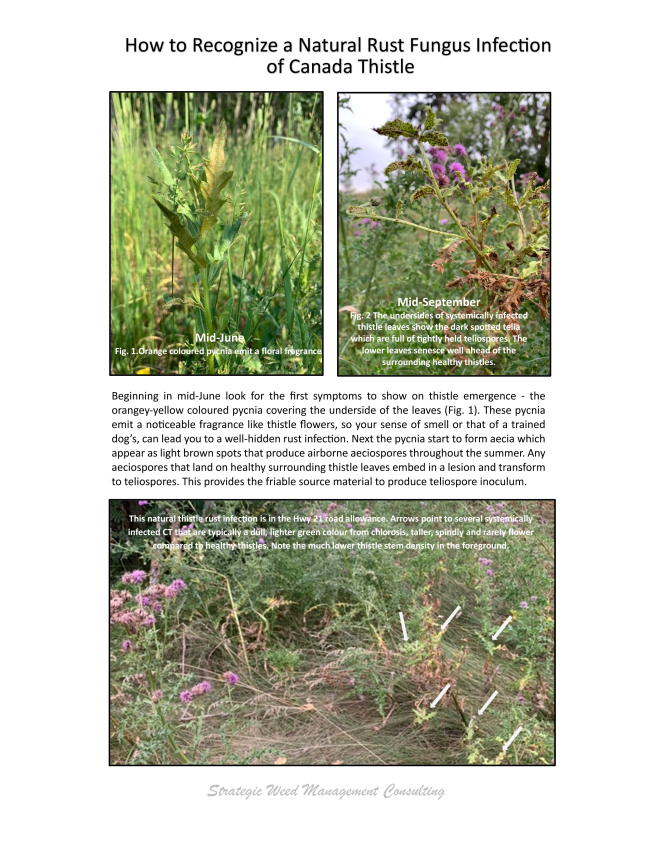
Once thistle rust infects a plant, it travels through the roots and slowly weakens the thistle over time. Infected plants may show stunted growth, yellowing leaves, and distinctive rusty-red pustules on the stems and foliage. Over a season or two, this can lead to severe dieback and even local eradication. Under ideal conditions, infestations can be reduced by up to 100% within 18 months.

Because it spreads naturally and slowly—mainly through spores or infected plant debris—its effectiveness is often maximized when introduced strategically, such as in cool, damp fall conditions when healthy rosettes are most vulnerable.


How to Spot It

  • Spring: Watch for thistle stems that are oddly tall and sparse, with yellow spots or black spores under the leaves. These stems may emit a subtle floral scent.
  • Summer to Fall: Look for rusty freckles or red-brown pustules on leaves and stems. As the plant decays, infected material drops to the ground and transfers the fungus to new rosettes.


Farming Forward’s Role: Scouting for Solutions

Farming Forward is currently leading an Alberta-wide scouting project to identify and collect Canada thistle plants naturally infected with thistle rust. The goal is to determine whether the infected plant material can be used to develop a foliar spray, making it easier to spread the fungus to new thistle patches. By helping the disease spread more efficiently, this project could accelerate thistle decline across the province.

This proactive approach takes advantage of a natural process, encouraging long-term suppression of Canada thistle without heavy reliance on chemical inputs. If successful, it could become a valuable tool in both conventional and organic weed management systems.


Why Consider Thistle Rust?

Thistle rust offers an exciting, sustainable alternative in integrated weed management—particularly for producers looking for long-term, ecological solutions. While results are not instant, this natural method works with the land, not against it.

For updates on the scouting project or help identifying infected thistle, reach out to Farming Forward. Together, we can explore smarter, greener ways to manage invasive species—starting with one of Alberta’s toughest weeds.


Thank you Strategic Weed Management Consulting for the photos.

Insect Update


(Via Agri-News | Alberta.ca)

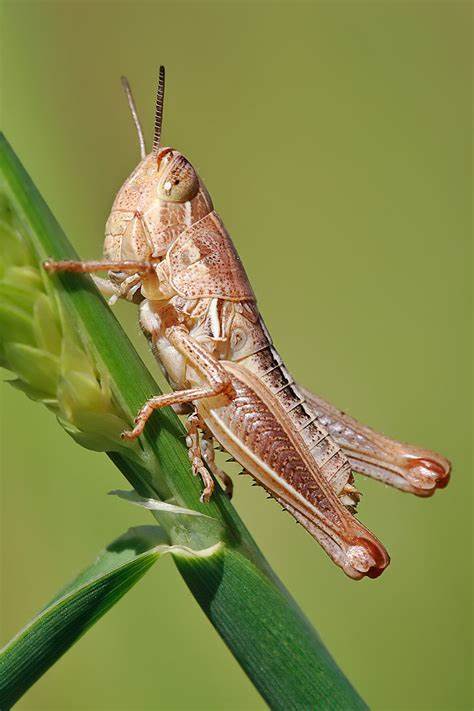
Grasshoppers are maturing quickly across the province. Fourth instar Melanoplus sp. nymphs were observed east of Edmonton at the start of June. Grasshoppers are most easily controlled in early life stages, so scout now. Last year, well-timed spring rains reduced grasshopper populations, but the weather this year has not been as helpful. There are many regions of Alberta with high grasshopper risk for 2025.


Stressed plants are more susceptible to damage from grasshoppers, so the economic thresholds also consider crop condition. Areas that have received little rain this spring should be scouted closely. Review the Prairie Pest Monitoring Network’s grasshopper diversity guide and read more about grasshoppers here.


Continue to scout for flea beetles in seedling canola. Seed treatments have a limited window of effectiveness after seeding, so pay close attention to slower-growing or thinner fields. Flea beetle damage can accumulate quickly across a field. Read about flea beetle management in canola.

Diamondback moth monitoring continues across the province. See the live map.


The annual pea leaf weevil survey is wrapping up. Learn more about monitoring for pea leaf weevil.


Both cutworms and wireworms continue to be an issue. Scout fields with poor emergence, patchy stands, plant yellowing or clipped leaves. You can check out the live cutworm map.


And remember when considering adding an insecticide to a tank mix to scout, that considering beneficial insects as well as economic thresholds can be helpful. For insect pests below threshold levels, preserving natural enemies acts like an insurance policy. Read about field heroes.


Newsworthy Shares

138683_web1_MJR23092021_canola_2 image

Public trust in Canadian Food System at a low


By: Delaney Seiferling

Western Producer


Click here to read this article!

FCC Capital announces $2 billion investment into ag and food innovation


Farm Credit Canada


Click here to read this article!

Community Shoutouts!

S-CAP Value-Added Grant

Program Overview Webinar


Thu, Jun 19, 2025 10:00 AM - 11:30 AM MDT


Are you interested in applying for a Value-Added Program grant but not sure where to start? The upcoming webinar will give you an easy-to-follow overview of everything you need to know, from understanding eligibility to putting together a complete application.

Sangudo Ag Society

50th Anniversary

Saturday, June 21, 2025

4:00 PM - 10:00 PM

Sangudo Arena

The Sangudo Ag Society is excited to celebrate its 50th anniversary with the community!

Join us Outdoors at the Sangudo Arena for a cornhole tournament, delicious meal and live 

music, to make for an amazing evening! Follow 

directions on the poster to purchase tickets and

sign up for the tournament! See you all there!


  • Cornhole tournament (kids & adults): 4 pm: // $5 registration
  • Live music featuring Cole Martin & Friends: 5-9 pm
  • Dinner catered by the Jaded Chef: 6 pm


Click here for more details!

X Share This Email
LinkedIn Share This Email

Base funding provided by

Issue 77