Working together to support students with disabilities | |
|
Resources for Special Education Professionals
This newsletter is designed to inform special education professionals about the different resources available to them to support their work with students and families.
This edition of AJE's newsletter for Special Education Professionals includes:
- In-person and Online Professional Development Opportunities
- Resources to better help you serve families
We hope you find our information helpful. If you do, please forward it to colleagues!
| |
|
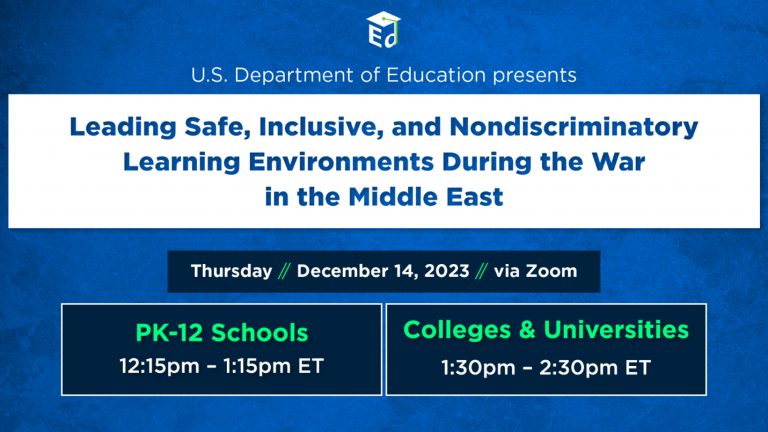
On December 14, Secretary Cardona hosted two national webinars on how PK-12 schools (remarks and video) and postsecondary institutions (remarks and video) can support students and ensure all are free to learn in a safe, inclusive learning environment.
These webinars, featuring prominent education officials, presented resources from the Department to help respond to the rise in antisemitism, Islamophobia, anti-Arab hate, and other forms of discrimination. Compendia of resources for preventing and addressing antisemitism and Islamophobia in schools are available from the Department’s Center for Faith-Based and Neighborhood Partnerships.
| |
|
The next session in the “Lessons from the Field” webinar series, January 17 from 3 to 4 p.m. Eastern Time, will explore navigating conflict to support inclusion.
Conflict is inevitable in any school community. Managing that conflict effectively can promote inclusivity and help build a positive school climate where all students feel a sense of belonging and can participate fully. Schools can help students and staff in addressing conflict in ways that further build relationships, understanding, empathy, and trust. This session is the third in the Free to Learn webinar series, which offers evidence-based practices to prevent, address, and ameliorate the effects of bullying, violence and hate while also supporting school safety, school-based mental health, and positive school climates
Related resources
| |
|
Coaching & Skill Building (Virtual)
Tuesday, January 9 (4:00 p.m. – 5:30 p.m.)
Register today!
Are you struggling with a particular restorative practice? Is there a restorative justice plan or project you want some help with? Just wondering where to start? Join this informal session to receive customized coaching from our restorative justice experts! We design these sessions to support individuals or small groups from a variety of learning communities. Together, we’ll focus on primary elements of restorative justice, including family engagement, student engagement, staff engagement, behavior and discipline approach, and content delivery. Get guidance on mindset, facilitation, and developing intervention skills and walk away with pro tips for practical implementation and training.
Professional Development (In Person)
Wednesday, January 17
Restorative Justice Applications & Alignment with Multi-Tiered Systems of Support* (9:00 a.m. - 11:30 a.m.)
Teaching & Learning Using Academic & Learning Circles* (1:00 p.m. - 3:30 p.m.)
Community of Practice (In Person)
Thursday, January 18
Creating a Positive Staff Culture (9:30 a.m. – 11:00 a.m.)
Are you concerned about staff wellbeing? We are too! Join us at Sojourner Truth Montessori Public Charter School. We want to provide a restorative space for educators and school partners to discuss staff communication and well-being and problem-solve with peers from across the city about the challenges and successes of developing staff connections.
Adults are constantly adjusting to the pace of the school day– managing transitions, the physical stamina of being in the classroom, the social and emotional effects of working with students who experienced trauma, violence and heightened anxiety, and the ability to handle conflicts in a restorative manner. Join us to explore staff well-being in our schools and share promising practices for addressing these needs.
All sessions use trauma-informed approaches and teach skills and practices that you can implement immediately. Funded by the DC Office of the State Superintendent of Education.
To learn more, read our SY2023-24 catalog or visit our online calendar!
| |
|
Grant Opportunity
On January 3, 2024, Attorney General Brian L. Schwalb announced that the Office of the Attorney General (OAG) is launching a new series of public safety grants—the “Leaders of Tomorrow Youth Violence Prevention Grant Program”—designed to foster positive development among District youth. The grants will provide up to $250,000 to local non-profits dedicated to an evidence-based, preventive approach to crime reduction.
Grants are available for Fiscal Year 2024 and eligible applicants must apply by 11:59 PM on Friday, February 2, 2024.
To receive grant funding, all services and programming must be provided in the District of Columbia. The full Notice of Funding Availability (NOFA) is available here.
| |
|
Upcoming SNAP Trainings
D.C. Hunger Solutions are continuing SNAP training and technical assistance work to ensure that the District residents and community partners are equipped with the tools to access SNAP. For this reason, quarterly SNAP 101 and monthly specific SNAP training have begun. You can find slides and recordings from previous trainings on the Training and Technical Assistance page.
| |
|
CADRE offers a variety of resources designed to help schools and administrators develop tools to improve IEP teams' ability to build and strengthen their local level capacity through communication by offering facilitation and mediation options.
Facilitate IEPs:
Interested in IEP Facilitation? This publication describes, from an administrator's perspective, the benefits of including a facilitator as a member of your IEP teams as a means to improve communication between parents and educators. It clearly defines the role of a facilitator and provides helpful tips to those considering facilitation as a dispute resolution option.
Mediation:
This publication describes, from an administrator's perspective, the benefits of participating in mediation as a means to solve special education disputes between parents and educators. It dispels common concerns and provides helpful tips to those considering mediation as a dispute resolution option.
DC offers facilitation and mediation options, schools/families schools can learn more below:
| |
|
Mental Health First Aid and Narcan (naloxone) Access
As educators, many have taken an first aid class or know the signs of a stroke or heart attack, but what do you know about assisting someone having a mental health crisis or who has taken an overdose of an opiate? The DC Department of Behavioral Health (DBH) can help you know what to do.
DBH makes naloxone, a life-saving medication used to reverse an opioid-related drug overdoses widely available and easy to get for DC residents for FREE by mail and at pharmacies and community sites across the District of Columbia.
Register here to learn how to use Narcan in a life-threatening overdose situation, and here to learn about Verbal De-escalation, which is a vital skill for being able to provide Mental Health First Aid to a person in emotional distress. You can find out to how to become fully trained in Mental Health First Aid here, and many trainings listed there are free and available online. Trainings are available for youth and adults, including educators.
Finally, DBH, has a new online training site; the DBH Training Institute is intended to be a resource for behavioral health education and e-learning for professionals and community members, and many trainings are free and appropriate for school staff.
| |
For information about classroom resources, click here. | |
|
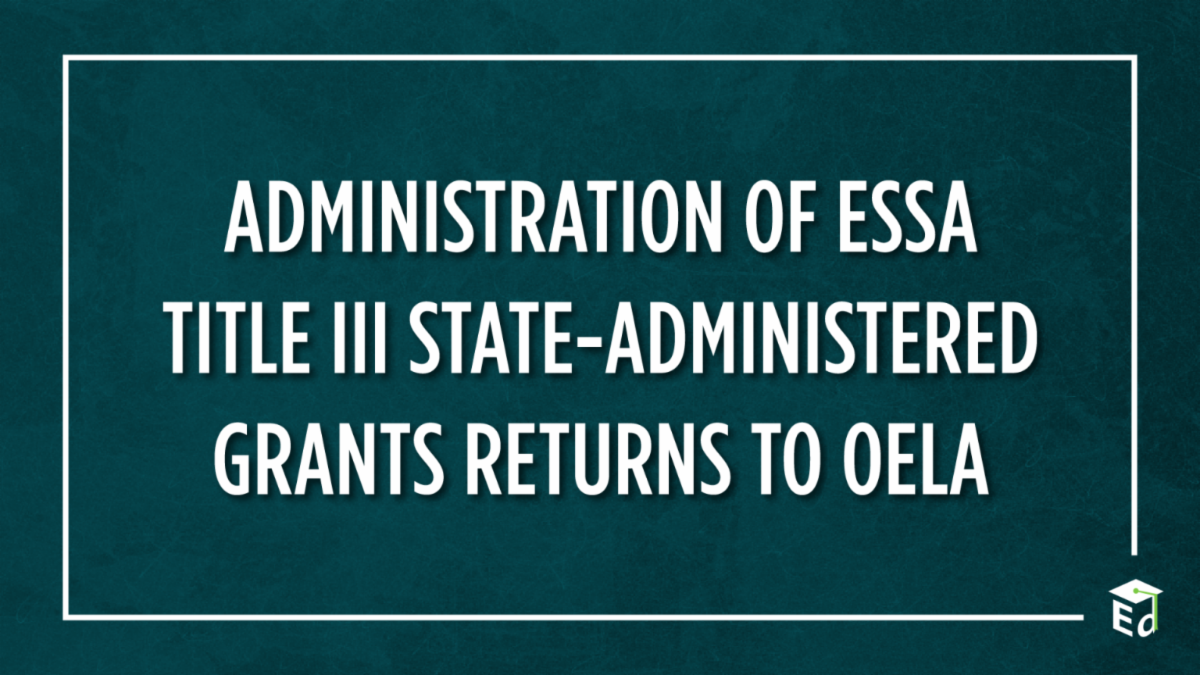
Secretary Cardona notified Congress last February of his intention to move the administrative functions of state-administered grants under Title III, Part A of the Elementary and Secondary Education Act (ESEA) from the Office of Elementary and Secondary Education (OESE) to the Office of English Language Acquisition (OELA), where they were originally located more than 15 years ago. The move took place on December 17th (blog post).
Title III funding is designed to improve the education of English Learners and immigrant children and youth through supplemental services that boost English language proficiency and academic achievement.
This change will allow the Department to focus the work that supports English Learners in one office, while the critical collaboration between the Title III State Formula Program and Title I team in OESE will continue across offices to support states and school districts.
| |
|
ODDS & ENDS from the Department of Education
-
Last month, Vice President Harris launched the Administration’s Safer States Initiative to provide states with additional tools and support to reduce gun violence and save lives. And, to help kick off the initiative, the White House released the Safer States Agenda, while the Department of Justice announced two new executive actions.
-
The Department recently announced $44.5 million in grants to 22 postsecondary institutions to help improve rates of enrollment, persistence, and completion in rural communities.
-
Further, the agency announced $93 million in grants to 20 Historically Black Colleges and Universities (HBCUs), Minority-Serving Institutions (MSIs), and Tribally Controlled Colleges and Universities (TCCUs) to improve the completion rates of underserved students.
-
On December 14, the Department of Labor announced a Notice of Proposed Rulemaking (NPRM) to enhance the National Apprenticeship System by modernizing regulations for Registered Apprenticeships. Among other enhancements, the proposed rule would create a student-centric Registered Career and Technical Education Apprenticeship designed to make it more seamless for full-time high school and community college students to enroll in a Registered Apprenticeship -- modeled after youth apprenticeship systems in states. (Note: The agency is sponsoring a webinar on January 11, from 2 to 3 p.m. ET, to review the proposed rule and how to submit public comments.)
-
On December 29, the Department of Agriculture published an interim rule to ensure continued access to food when school is not in session for the summer via several innovative approaches.
UPCOMING EVENTS from the Department of Education
January is National Human Trafficking Prevention Month and National Mentoring Month.
AmeriCorps is asking Americans to appropriately honor Dr. Martin Luther King, Jr.’s legacy on January 15 by making the holiday a day ON -- versus a day off. MLK Day became a national day of service in 1994, when Congress passed legislation to give the holiday even greater significance. A web page offers resources and enables individuals to find volunteer opportunities and organizers to register projects nationwide.
Apply now for the Department’s 2024-25 School Ambassador Fellowship Program. This program enables outstanding teachers, principals, counselors, psychologists, social workers, and other school-based professionals interacting with students on a daily basis to bring their expertise to the Department and expand their knowledge of the national dialogue on education. In turn, fellows facilitate the learning and input of other educators and community members. As in previous years, applicants may choose to apply as Full-Time Fellows -- take a leave of absence from their local districts and support the Department’s efforts remotely on a daily basis -- or as Part-Time Fellows -- continue serving in their local districts while working with the agency up to 10 hours a week. The application closes February 5 at 11:59 p.m. ET.
| |
|
FEDERAL STUDENT AID
On December 30, the Department soft launched the 2024-25 Free Application for Federal Student Aid (FAFSA®) form -- for new and returning students who plan to attend college between July 1, 2024, and June 30, 2025. During this soft launch, there will be overnight pauses to the site, allowing the agency’s Federal Student Aid (FSA) team to make improvements. The form may go offline as the team monitors site performance and responds in real time to any potential issues impacting the applicant experience.
Students and families will have ample time to complete the 2024-25 FAFSA and do not need to rush to fill out the form, as the Department will not begin to transmit results to institutions until later this month.
Stakeholders interested in assisting students complete the FAFSA form are encouraged to visit FSA’s 2024-25 FAFSA Updates web page. In addition to official publications for financial aid professionals, FSA has posted a number of outreach materials, webinars, and other useful resources.
| |
|
Don't forget!
AJE's online Calendar of Events always has upcoming trainings and events for families!
| |
|
Don't forget!
AJE's Blog always has resources, information and links for DC families of students with disabilities and/or special health care needs!
| | | |
About AJE:
Advocates for Justice and Education is the federally designated Parent Training and Information Center and the Health Information Center for DC. AJE seeks to empower families, youth, and the community to be effective advocates to ensure that children and youth, particularly those who have special needs, receive access to appropriate education and health services.
Our passion is empowering families by equipping parents and students with disabilities with the tools they need to be their own best advocates.
Have questions? We are here to educate, advocate and empower. Contact us today!
| |
Advocates for Justice and Education, Inc.| (P) 202.678.8060 | (F) 202.678.8062 |
| | | | |