|
Inside, you'll find:
- News and Updates
- Upcoming Events
-
Research Spotlight: Summarized Results of the 2025 On-farm Strawberry Pest and Disease Survey
- Photos
| | NOFA-VT's Resilience Grant Applications Open Now! | |
NOFA-VT’s Resilience Grant Program distributes funds directly to farmers to support projects that will improve long-term resilience on the farm and in the community. This could serve a wide range of projects related to promoting organic practices to build an economically viable, ecologically sound, and socially just Vermont agricultural system that benefits all living things. Farms are able to apply individually or in collaboration with other farms. The grant offers up to $5,000 per participating farm, with a maximum total request of $20,000.
Application deadline: January 26, 2026
| | Soil Testing Designed for Vermont Farmers: UVM's Soil Health Research and Extension Center (SHREC) Now Accepting Soil Samples | SHREC is a new center at UVM offering soil health testing services to farmers and gardeners in Vermont and across the region. SHREC provides soil health testing options for land managers who want to understand more about their soil's physical and biological characteristics and how they respond to management changes. | | Updated Funding Information for Dairy and Crop Operations Available Now | Read the most updated information about grants and programs that can help support your farm. This webpage provides an overview, and the button below takes you to more details to help you apply for funding. | | 2026 Nutrient Management Plans (NMPs) | If you need assistance updating your NMP, please reach out to UVM Extension NWCS Program Manager Susan Brouillette at 802-656-7611 or 802-524-6501 (Toll-free in VT) or email Susan.Brouillette@uvm.edu. | | Get Paid for Using Untreated Seeds | |
The American Bird Conservancy's (ABC) Untreated Seed Program is currently accepting applications for the 2025-2026 planting/growing season. This program provides per-acre incentive payments to growers who are either currently using crop seeds without neonicotinoids as part of the coating package, or who are interested in switching away from neonicotinoid coatings.
The ABC is not asking growers to change any other practice – only the coatings used on seeds. They are most interested in corn, soy, and wheat crops.
Reach out to untreatedseedprogram@abcbirds.org with any questions, or call Hardy Kern at 202-750-1412.
| | |
2026 Integrated Pest Management (IPM) Week
Monday, January 26 - Friday, January 30, 12:00 to 1:00 p.m.
This free webinar series hosted by UVM Extension will provide all of the most important updates and information on pest management strategies based on local research.
| | |
Tri-State Dairy Exchange Monthly Webinar Series: Advancing Dairy Systems through Technology
Wednesday, January 28, 11:30 a.m. - 12:30 p.m.
Topic: Wearable Animal Health Monitoring Technology Part 1
Speakers: Joseph Gilbert, Account Manager for smaXtec, Inc.; and Rebecca Colgan, Northeast Customer Success Specialist for Merck Animal Health
| | |
Organic Dry Bean Production Online Short Course
Mondays and Fridays, 12:00 p.m. - 1:15 p.m.
February 2–20, 2026 (excluding Presidents’ Day)
This online short course provides practical field skills, general education, and resources to farmers and technical service providers interested in growing dry beans.
Read the flyer to learn more.
| | |
On-Farm Milk Culturing for Mastitis Management Workshop
Thursday, February 12, 10:00 a.m. - 12:00 p.m.
Billings Farm and Museum, 69 Old River Rd, Woodstock, VT 05091
This workshop will highlight Billings Farm’s experience implementing on-farm milk culturing as a practical tool for mastitis detection and management. Participants will learn proper milk sampling and culturing techniques, how to interpret culture results, and how on-farm diagnostics can support timely, targeted treatment decisions.
| | |
Milk Quality for Small Ruminant Producers
Saturday, February 14, 11:00 a.m. to 1:00 p.m.
UVM Davis Center, Sugar Maple Ballroom or online via Zoom
Join UVM Extension’s Small Ruminant Team for an in-depth presentation focused on milk quality management for dairy goat and sheep producers. Dr. Michelle Buckley of Cornell University’s Quality Milk Production Services (QMPS) will discuss the key components of milk quality, common challenges faced by small ruminant dairies, and practical strategies producers can use to improve milk quality on their farms.
| | |
2026 No-Till & Cover Crop Conference
Thursday, February 19, 9:00 a.m. - 4:30 p.m.
DoubleTree by Hilton, 870 Williston Road, So. Burlington, VT 05403
Hosted by UVM Extension and the Northeast Cover Crops Council, the conference brings together farmers, researchers, technical assistance providers, agricultural professionals, and students to share the latest insights about soil health, tillage practices, and cover crops. New this year, there will be multiple sessions focused on cover cropping and tillage strategies for vegetable farmers.
Showcase your research at the 2026 NTCC conference! Are you conducting research related to no-till and/or cover cropping? Submit a research poster by January 22, 2026 at this link. Find poster specifications here. Contact Victoria Ackroyd (vackroyd@umd.edu) with any questions about your poster.
Read the conference brochure to learn more.
| | |
Fiber Hemp Production Online Short Course
Tuesdays, 1:00 p.m. to 2:15 p.m., February 24 - March 17
Learn the fundamentals of fiber hemp production in this free, research-based course for farmers, technical service providers, and anyone interested in the expanding hemp fiber industry in the Northeast. Class sessions will feature presentations from farmers, field researchers, and industry experts. The curriculum topics will primarily focus on best agronomic practices in hemp production.
Read the course flyer here.
| | |
Dairy Sustainability Day
Thursday, March 5, 2026, 10:00 am to 3:30 pm
American Legion Post 27, 49 Wilson Road, Middlebury, VT 05753
Join representatives of UVM Extension teams from across Vermont—including the Champlain Valley Crop, Soil, and Pasture Team, the Northwest Crops and Soils Program, and the Agricultural Business Team—for a free workshop focused on dairy sustainability. Lunch and refreshments will be provided. Session highlights will include genetic selection strategies for dairy herds and a precision agriculture approach to enhancing sustainability and resiliency in dairy cropping systems and herd management.
| | |
2026 Grain Growers Conference
Wednesday, March 18, 9:00 a.m. - 4:30 p.m.
The Essex Resort & Spa, 70 Essex Way, Essex Junction, VT 05452
UVM Extension’s Northwest Crops and Soils Program and the Northern Grain Growers Collaborative (NGGC) present the Annual Grain Growers Conference. Hear presentations from grain growers, bakers, millers, and more; taste grains in the Baker's Showcase; and network with others.
Sign up now for the second annual Bakers Showcase! If you are a baker and want to showcase your products at the 2026 Grain Growers Conference, please contact Carrie.Brisson@kingarthurbaking.com.
View the conference flyer here.
| | |
Research Spotlight
Summarized Results of the 2025 On-farm Strawberry Pest and Disease Survey
In 2025, the UVM Extension Northwest Crops and Soils program began conducting the Managing Disease in Organic Strawberry Production project, supported by the Vermont Agency of Agriculture, Food, & Markets' Specialty Crop Block Grant Program, project award no. 02200-SCBGP-21-02. Throughout the 2025 growing season, we assessed nine strawberry fields across Vermont and New Hampshire for crown/root, foliar, and fruit diseases.
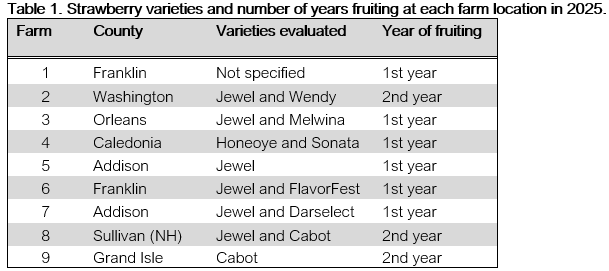
A member of the UVM Extension Northwest Crops and Soils Program (NWCS) evaluated two strawberry varieties at each farm. We evaluated a total of eight varieties; “Jewel” was assessed at six of the nine farms (Table 1). Fields varied in management practices (see full report on our Research Reports page for more details).
We conducted assessments twice throughout the season: once in May (prior to fruit set) and once in June or July (during harvest).
| | |
In May, the incidence (presence or absence) of foliar disease was recorded on 100 plants per variety. A total of 1,700 plants were evaluated for foliar fungal pathogens, including “Angular Leaf Spot” (Xanthamonas spp.), “Powdery Mildew” (Sphaerotheca spp.), “Leaf Spots” (Mycosphaerella spp.), “Leaf Scorch” (Diplocarpon spp.), “Leaf Blight” (Phomopsis spp.), and abiotic symptoms (i.e., nutrient deficiencies, frost or wind damage, etc.).
Also in May, one to five whole plant samples were collected from each variety to assess the incidence of crown/root disease and winter injury. Sixty-five plants were tested for crown/root diseases, including “Black Root Rot Complex"(Pythium, Rhizoctonia, and Idriella spp.), “Red Stele Root & Crown Rot” (Phytophthora spp.), “Anthracnose Crown Rot” (Colletotrichum spp.), and winter injury. All samples were assessed at the UVM Plant Diagnostic Clinic.
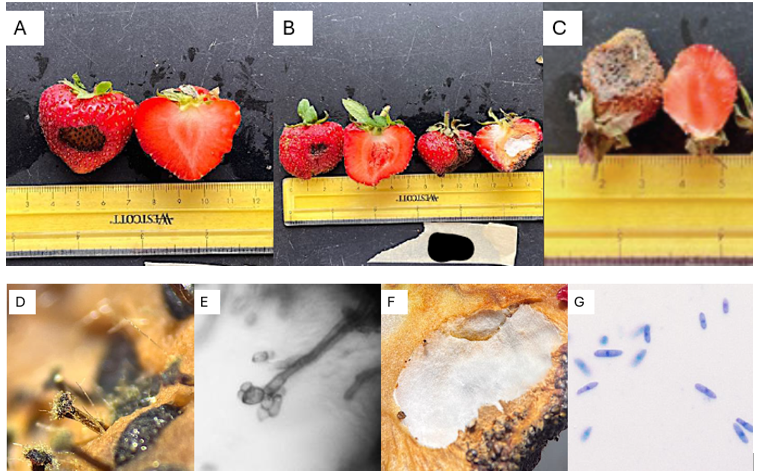
In June and July, fruit assessments were conducted on 100 berries per variety per farm. A total of 1,700 berries were assessed. The fruit assessment evaluated fungal pathogens, insect damage, and abiotic damage (i.e., excess water, hollow centers, and ripeness). The fungal pathogens included “Anthracnose” (Colletotrichum spp.), “Grey mold” (Botrytis cinerea), and “Leather Rot” (Phytophthora cactorum) (Image 1).
| | |
Image 1. UVM Plant Diagnostic Clinic berry disease evaluations. Photos A-C: Cross sections of ripe berries; A: Botrytis blight, B: Both Botrytis blight (berries 1 & 3) and Colletotrichum (anthracnose) (berry 4), & C: Phytophthora (leather rot). Photos D & E: Signs of Botrytis blight include conidiophores on stigma (8X magnification) and spores (20X). Photos F & G: Signs of anthracnose fruit rot. Spores stained with methylene blue (20X magnification).
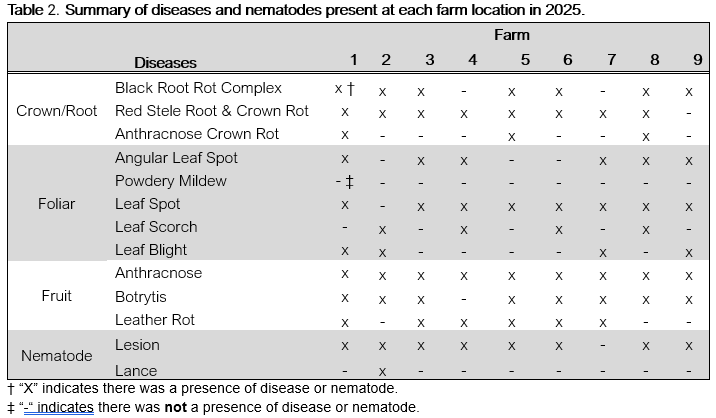
All surveyed farms had multiple foliar and fruit pathogens present in the field. Leaf spot was the most prevalent foliar pathogen observed during scouting: 29.2% of all plants showed signs of the pathogen, followed by leaf blight at 2.35%. Botrytis was the most prevalent fruit pathogen: 4.35% of all berries showed symptoms, followed by Anthracnose at 2.94%. Of the 65 strawberry plants examined at the Plant Diagnostic Clinic, two crown and root diseases stood out. Red Stele Root & Crown Rot was the most prevalent. It was found at 88% of the farms, and on 41.5% of the plant samples showed signs of it. Black Root Rot Complex was found at 77% of the farms, and 33.8% of the plant samples showed signs of it (Table 2).
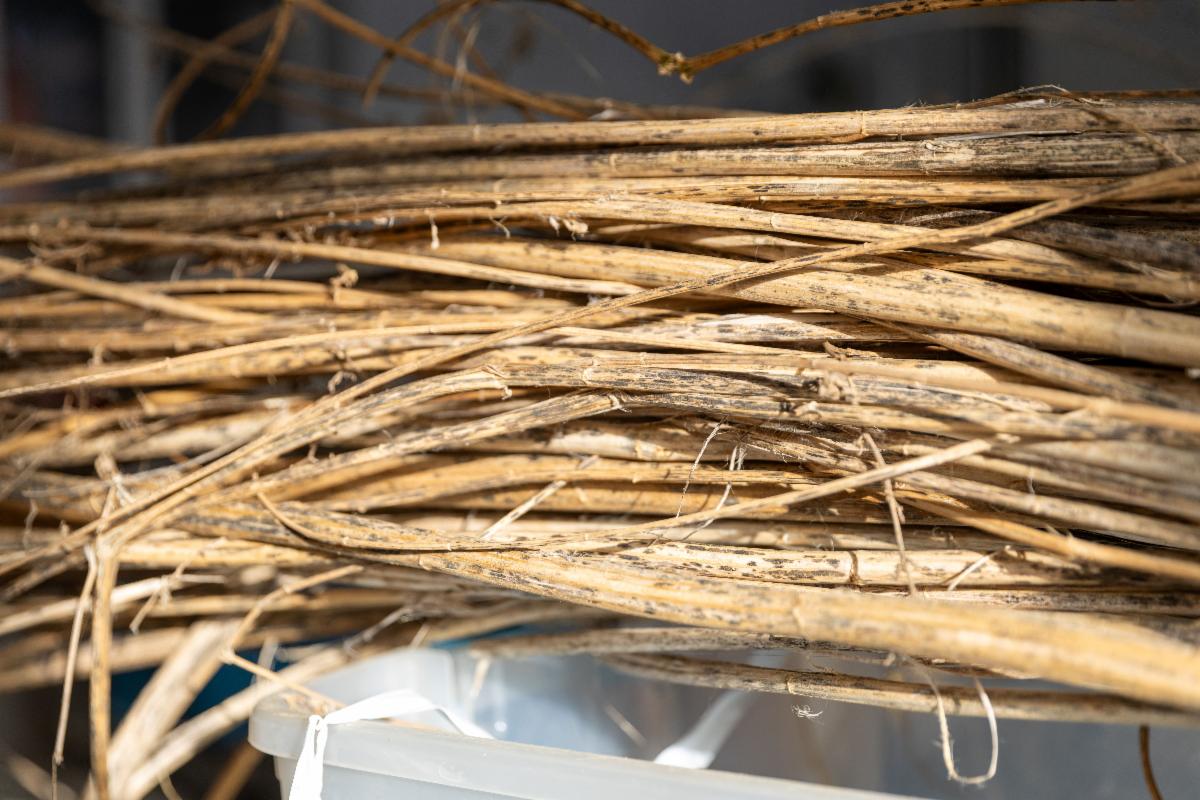
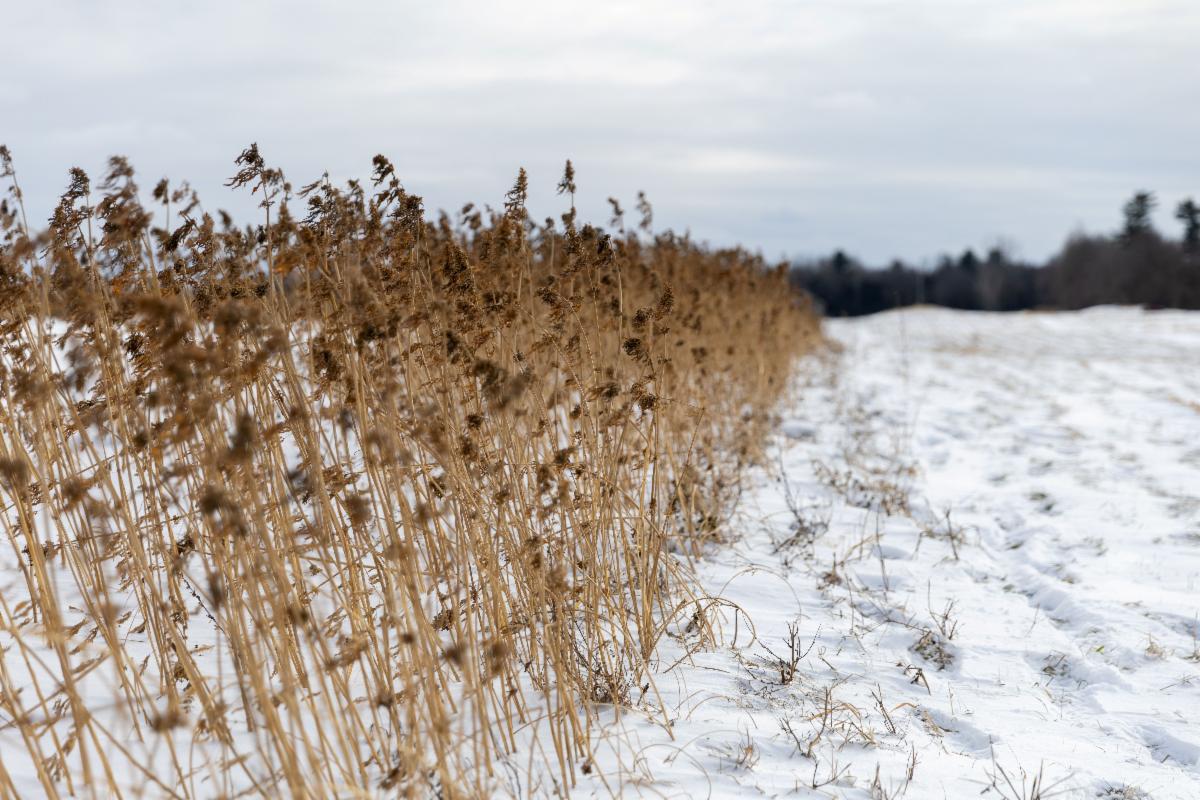
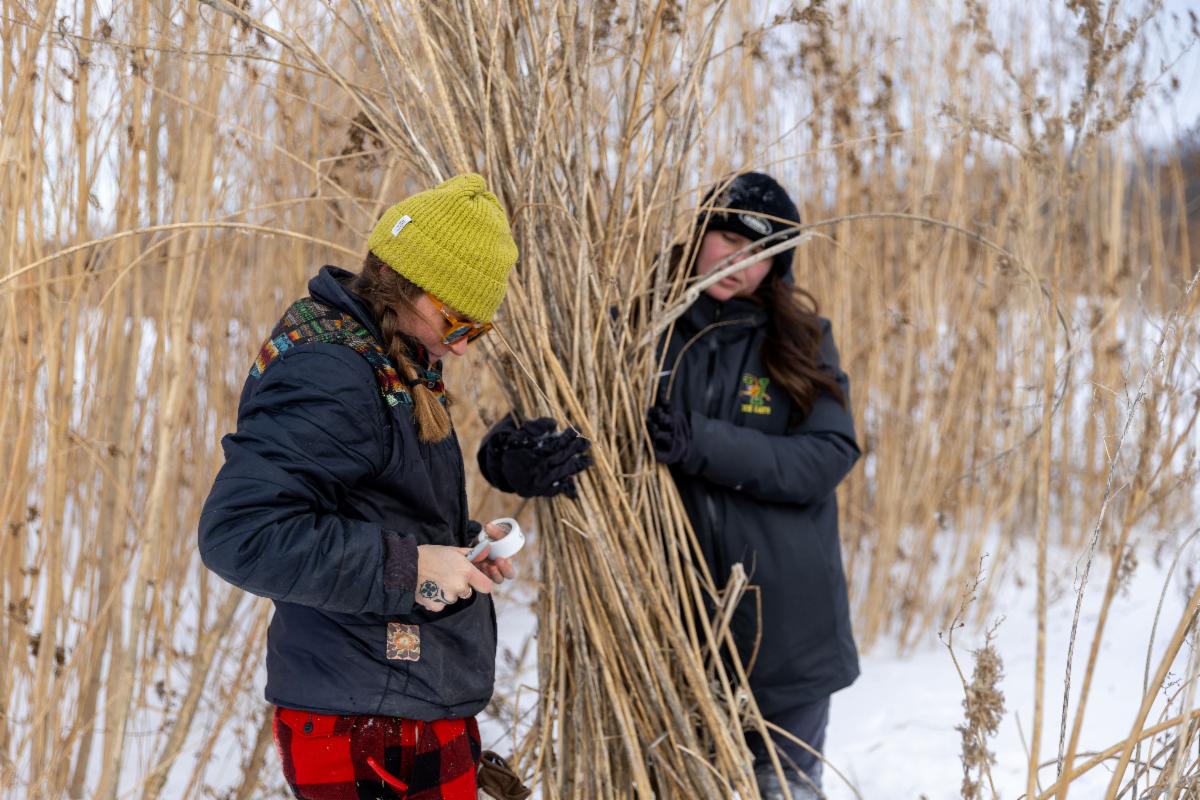
| | During the June/July scouting date, soil samples were taken from each strawberry field to evaluate the presence of plant-pathogenic nematodes. Twenty 1x8-inch soil cores were taken around the field near plant roots and sent to the University of Arkansas Extension’s Arkansas Nematode Diagnostic Lab. Soil samples were assessed for fifteen different nematode species, but only two were found: “Lesion” (Pratylenchus spp.) and “Lance” (Hoplolaimus spp.). Lesion nematodes were the most common, present on 88% of the farms with an average of 12.3 nematodes per 100 cm³ of soil. Lance nematodes were also present on 11% of the farms with an average of 0.4 nematodes per 100 cm³ of soil. Nematode feeding can make roots vulnerable to pathogenic fungi and bacteria. Studies have found that the Lesion nematode is associated with black root rot disease. Currently, management options for nematodes and black root rot are limited. Implementing a three- to five-year crop rotation using cover crops and cash crops, but avoiding crucifers and legumes, could limit pathogen buildup. | | Last January, our team was harvesting winter-retted hemp at Borderview Research Farm in Alburgh, VT. Winter retting is the process of leaving hemp in the field over the winter and letting the freeze-thaw cycle loosen the natural glues that bind the outer bast fiber and the inner woody core. If you want to learn more about fiber hemp and the retting process, check out the upcoming Fiber Hemp Production Online Short Course! | | |
UVM Extension NW Crops and Soils Program | Website
278 South Main Street, St. Albans, VT 05478 I 802-656-7610
For more information contact shannon.macdonald@uvm.edu
Having trouble viewing this email? Click "Trust sender" or "View in browser".
| | Issued in furtherance of Cooperative Extension work, Acts of May 8 and June 30, 1914, in cooperation with the United States Department of Agriculture. University of Vermont Extension, Burlington, Vermont. University of Vermont Extension, and U.S. Department of Agriculture, cooperating, offer education and employment to everyone without regard to race, color, national origin, gender, religion, age, disability, political beliefs, sexual orientation, and marital or familial status. | | | | |