¡Versión en español a seguir! | | This month at QSLA, we focus on partnering with families to foster healthy development in young children! | |
Welcoming Environment
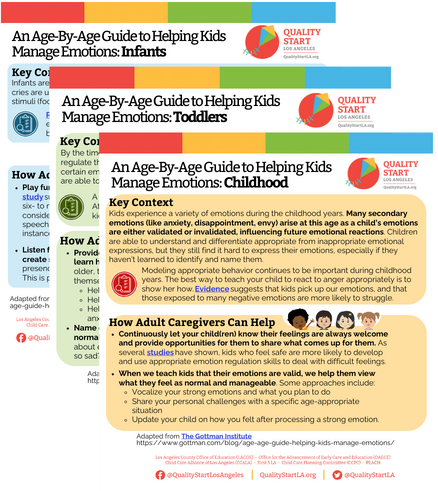
Ensure Your Program Feels Inviting
| | | |
Age-By-Age Guide to Helping Kids Manage Emotions
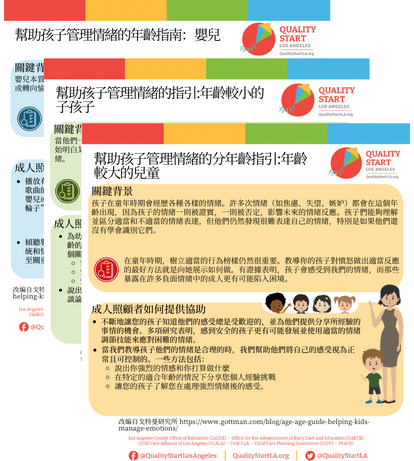
幫助孩子管理情緒的年齡階段指南
| | This resource will support ECERS-R: Item 9 and FCCERS-R: Item 35- Provisions for Parents, PAS: Item 16- Family Communications, and BAS: Item 7- Provider Parent Communications. | |
Family Partnerships
Work with Families to Build a Stronger Program
| |
| Developmental Resources from Zero To Three | | |
Understanding infant/toddler communication and the impact of early math and science experiences can empower parents and caregivers to support children’s cognitive growth effectively! Zero To Three offers several resources to support the learning and development of young children until age three, including these:
-
Problem Solvers: A Free Early STEM Curriculum - Problem Solvers is a free, downloadable early childhood and preschool STEM curriculum for children aged 30 to 48 months that includes: 22 play-based preschool math activities, 22 play-based science and engineering activities, 44 specially-composed songs that support early STEM learning, 44 book suggestions and extension activities that nurture early math language through reading, 44 family resources (English/Spanish) that build bridges between school and home, and give caregivers ideas for engaging STEM play, and a Teacher’s Guide for curriculum implementation!
| | -
How do infants translate sounds to language? - This article includes 3 specific strategies: exploring the Power of "Parentese", the Importance of Conversational Turn-Taking Infants, and the Impact of Early and Rich Language Exposure.
| | |
ASQ Early Educator-Parent Toolbox
ASQ 早期教育工作者 - 家長工具箱
| | |
Together, let’s nurture every stage of a child’s growth! The Ages and Stages Toolbox simplifies communication, fosters understanding, and ensures children receive the support they need during these crucial early years. This toolbox is perfect for:
- Early childhood educators looking for structured resources.
- Parents eager to collaborate on their child’s development.
- Programs focused on building strong educator-parent partnerships.
讓我們一起呵護孩子成長的每個階段!年齡和階段工具箱簡化了溝通,促進了理解,並確保孩子在這些關鍵的歲月中得到他們需要的支持。讓我們一起呵護孩子成長的每個階段!此工具箱非常適合:
- 尋找結構化資源的幼兒教育工作者。
- 父母都渴望為孩子的成長提供合作。
- 此計畫致力於建立強而有力的教育者與家長夥伴關係。
| | This resource will support ECERS-R: Item 38 and FCCERS-R: Item 35- Provisions for Parents, PAS: Item 16- Family Communications, and BAS: Item 7- Provider Parent Communications. | |
Community Partnerships
Use Community Resources to Strengthen Program Quality
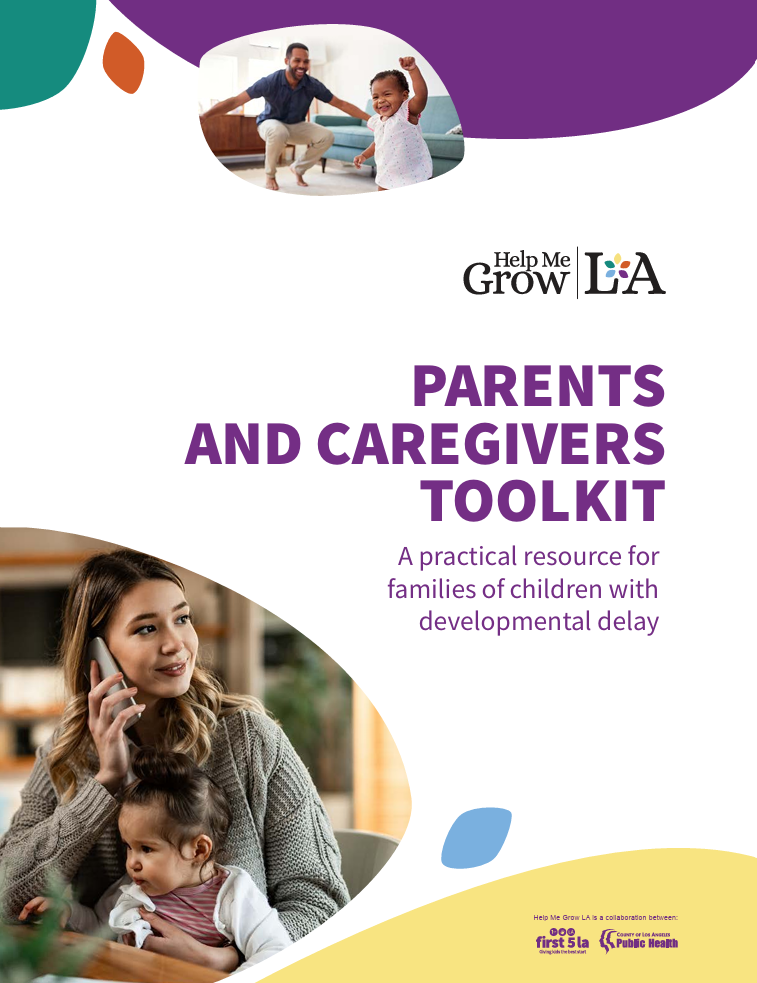
| | | Help Me Grow LA's Parents & Caregivers Toolkit | | |
Add to your resources with community partner, Help Me Grow LA's, new Parents and Caregivers Toolkit, full of practical resources that support healthly milestones in all children, including children with developmental delays. This toolkit features three sections: information about developmental milestones and delays, practical information for next steps after identifying a developmental delay, and resources!
| | | Knowing and using these community resources will support PAS: Item 17- Family Support Involvement, BAS: Item 8-Community Resources, and NAEYC Accreditation: Standard 7-Families | |
Equitable Approaches to Supporting Children and Families
| |
| How Early Childhood Experiences Affect Lifelong Health and Learning | | |
How is ongoing, severe stress and adversity in early childhood connected to chronic disease in adults? What can we do about it?
In this animated video, narrated by the Center on the Developing Child at Harvard University's Founding Director Jack P. Shonkoff, MD, learn what the latest science tells us about how early experiences affect not only early learning and school readiness, but also lifelong health. Watch and share this video to help families, colleagues, and yourself understand the effects of adversities such as poverty, discrimination, systemic racism, exposure to violence, and child maltreatment, abuse, and neglect on the developing brain and many other systems in the body.
| |
Staff Development and Support
Enhance Your Family Engagement Knowledge and Skills
| | | Expanding Our Capacity to Support Child Development | | |
How Trauma Impacts Development, Part 2 | (国语/普通话) 第二单元: 创伤是如何影响成长的(下)
本次2 小时的培训以创伤知情关怀的概念为基础,并继续讨论创伤如何影响儿童的早期发展,特别是与压力反应系统、感觉系统和依恋有关的方面。
本次培训将涵盖的主题:
• 创伤如何影响发育:依恋、压力反应系统和感觉系统
| |
| |
日期/时间:3月20日,星期四,下午6:30 - 晚上8:30
| | |
Family Child Care at Its Best (FCCB): Child Observation
These FCCB workshops helps you practice reflections to better understand unconscious bias and its relationship to children’s behavior. Analyze assessment tools and explore ways to use child observations to support children, families, and program development.
Participants will learn to critically analyze assessment tools and explore ways to use their observations to support children, families, and program development. Issues of bias will be addressed in relation to the role of the observer. Observation will be considered as part of a responsive process as well as a quality improvement tool.
| |
| |
Day 1: Tuesday, April 1, 6:00 – 8:30PM
Day 2: Thursday, April 3, 6:00 – 8:30PM
| | |
Desired Results Developmental Profile (DRDP) Webinars
Desired Results for Children and Families is offering several DRDP related webinars in the coming months to support implementation around DRDP tools and related conversations. Note: After registering, you'll receive a confirmation email is sent with instructions to join.
| | |
-
DRDP and Parent Conferences: Review strategies for planning a positive conference experience built on relationships, like the DRDP Online Parent Report, Child Developmental Progress Report, and how best to use them.
- Option 1: Thursday, March 20th at 5:00PM
- Option 2: Wednesday, March 26th at 5:00PM
- Option 3: Wednesday, April 16th at 5:00PM
- Option 4: Tuesday, April 22nd at 1:00PM
-
Ask the Expert: Bring your questions about the Desired Results process (observation, assessment, DRDP Online).
- Time/Date: Tuesday, April 29th at 4:00PM
-
DRDP for Family Child Care Providers: Designed for new FCC providers, network with other family child care providers while discussing the power of the DRDP in home settings, options for implementation, and free, easy-to-use resources.
- Option 1: Saturday, March 22nd at 9:00AM
- Option 2: Thursday, April 24th at 4:00PM
- Option 3: Saturday, May 3rd at 9:00AM
| | |
Supporting Young Children's Development and Learning
CECO offers this three-module series exploring the exciting ways young children develop and learn. As a learner, you will strengthen your observation skills which will help you uncover important information you can use to support children’s development and learning from birth through age five. You can expect to learn:
- Describe key areas of development and ways young children learn
- Recognize multiple methods to observe and record children's development and learning
- Practice analyzing and making sense of observations
- Identify ways to use observations and understanding of development to plan learning experiences
| | | |
Three modules, self-paced
Note: Register for your free CECO account here and receive your professional development credits certificate from their site.
| | These trainings support ECERS-R: Item 43- Opportunities for Professional Growth, PAS: Item 3- Staff Development, FCCERS-R: Item 37- Opportunities for Professional Development, and BAS: Item 1-Qualifications and Professional Development | | |
A baby’s brain is hard at work, forming over 1 million new neural connections per second.
These connections enable everything from movement to language and problem-solving. But they don’t form on their own—positive interactions with caregivers and engaging daily experiences help build and strengthen these pathways that last a lifetime! Here’s how:
-
Talk, read, sing and play: Everyday activities stimulate brain development.
-
Responsive relationships: Loving, dependable adults responding to a child’s cues are key to healthy brain growth.
-
Exploration and interaction: Using all five senses to explore the world builds neural connections that last a lifetime.
| | | |
Were you forwarded this email?
Would you like to sign up to receive our Family Engagement Newsletters?
| | Check out our QSLA pages below! | | NEW QualityStartLA Instagram! Click the icon above! | | | | |