|
September 21, 2026
Dear Readers, Hard Workers, and Leaders,
Are We Leaving Valuable Resources on the Table?
If there is one concern I continue to hear across our industry, it is workforce.
Finding people. Developing people. Keeping people. Preparing the next generation. Building stronger leaders. And perhaps just as importantly—finding enough time to invest in the people we already have.
That is why much of today’s newsletter centers around workforce and workforce development. We hope you’ll find ideas and strategies you can actually take back to your organization and put to work.
But I also want to challenge you on something else.
SLC3 just might be one of the most untapped resources in our region.
Every week, we work to bring you relevant industry news, education, best practices, resources, connections, and opportunities to learn from one another. We host programs and conversations designed around what we are hearing from owners and our broader AEC community. We have a website filled with resources, an app that puts information at your fingertips, and a calendar full of opportunities to learn, grow, and connect.
Yet I also know what we are competing against: your time.
Your calendar is full. Your inbox is overflowing. Projects need attention. Clients need answers. Teams need you. And sometimes the very things that could help us grow, work smarter or make better connections are the easiest things to push aside.
So perhaps this week, build a little time back in.
Read an article you normally would have skipped. Save the date for an upcoming SLC3 event you want to attend. Forward this newsletter to someone on your team. Open the app. Visit our website. Share an article with a colleague who could benefit from it.
And please—share, share, share.
This newsletter isn't meant to be a secret. Neither are our programs, resources, or events. If something we produce helps you, there is probably someone else in your organization or network who could benefit from it too. You can be instrumental in extending the impact simply by passing it along.
Workforce development isn't only about recruiting more people into our industry. It's also about investing in the people who are already here—giving them opportunities to learn, connect, develop new skills, exchange ideas and become stronger professionals and leaders.
That's something all of us can participate in.
So as you read today's newsletter, I hope you'll find at least one idea worth using, one resource worth sharing, and one upcoming event worth putting on your calendar.
Let's make time to learn. Let's make time to grow. Let's make time to connect. And let's make sure the valuable resources available to our industry are actually being used.
We’re building them for you.
Now help us share them.
Warmly,
Kelly
Kelly Jackson
Executive Director
St. Louis Council of Construction Consumers (SLC3)
| | |
INSIDE THIS ISSUE
News & Updates
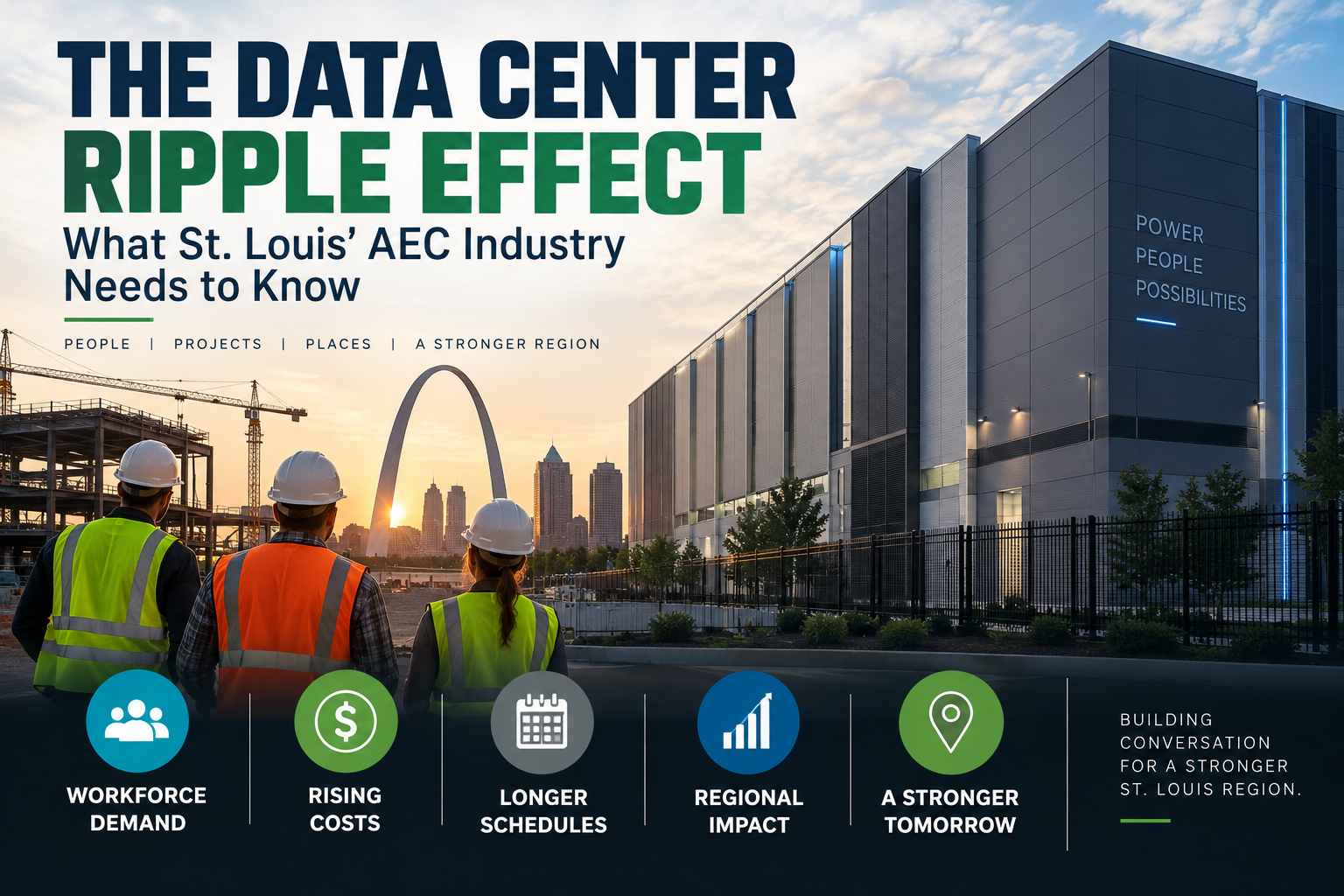
The Data Center Ripple Effect:
What St. Louis' AEC Industry Needs to Know
A New $5 Billion Financing Window Could Unlock Challenging St. Louis Projects
St. Louis Sets New Ground Rules for Data Center Development
Building the Workforce Before the Work Begins
Training & Education
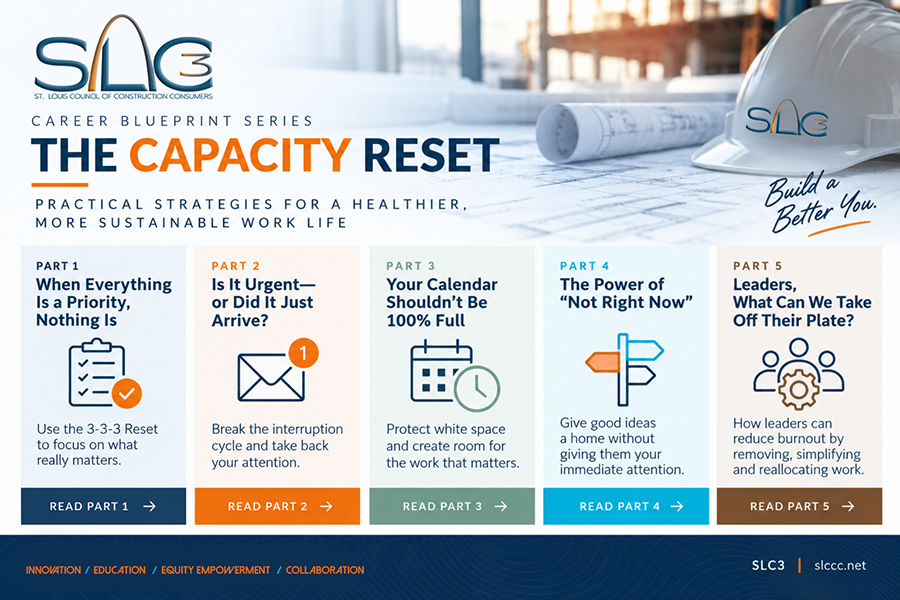
The Capacity Reset
Owner's Perspective
Materials Management: Procurement Has Become a Strategic Advantage
| | ARE YOU WANTING TO BE AN ANNUAL SPONSOR? | | Want to sponsor our newsletters? Contact us! 65% Open Rates! Great opportunity for visibility and showing support! | | UPCOMING PROGRAMS & EVENTS | | |
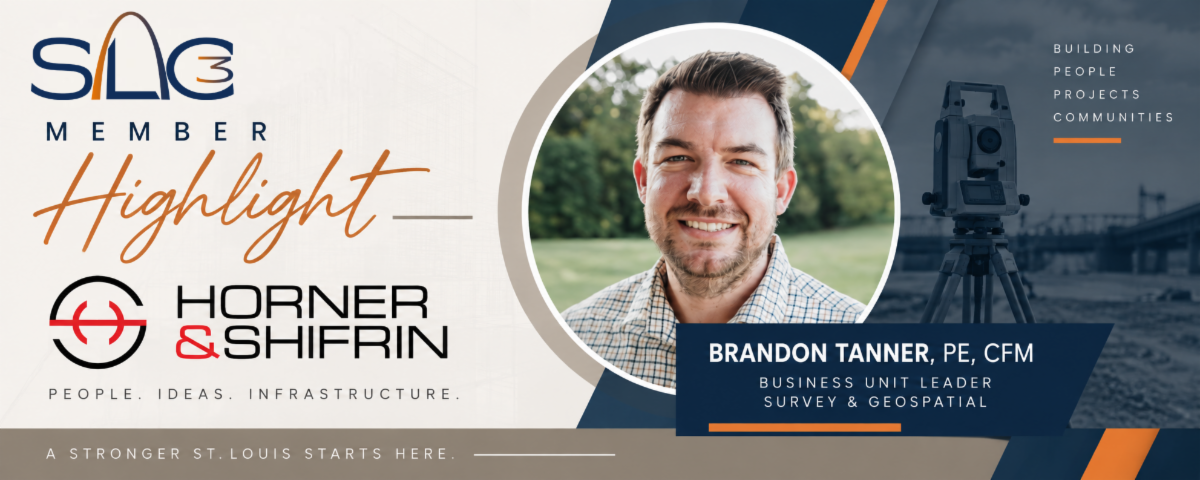
Member Highlight | Horner & Shifrin Welcomes Brandon Tanner
SLC3 member Horner & Shifrin, Inc. (H&S) is expanding its Survey & Geospatial practice with the addition of Brandon Tanner, PE, CFM, as Business Unit Leader.
Brandon joins H&S after serving as County Engineer for Johnson County, Illinois, where he oversaw 400 miles of roadway, 71 bridges and nearly $5 million annually in federal, state and local funding. His owner-side experience adds another valuable perspective to H&S’s established expertise in land surveying, GIS, drone services and 3D scanning.
Please join SLC3 in congratulating Brandon and the Horner & Shifrin team on this exciting next chapter!
| |
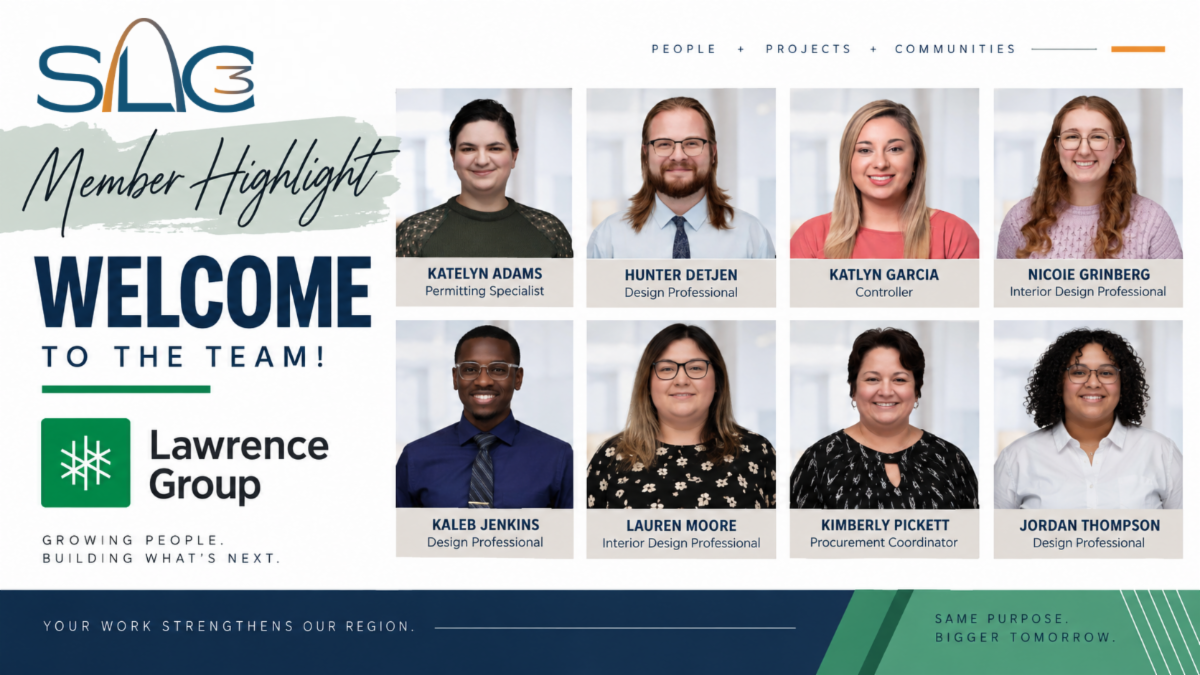
Member Highlight | Lawrence Group Welcomes New Team Members
SLC3 member Lawrence Group is growing! The firm recently welcomed a group of talented professionals bringing new experience, perspectives and expertise to its team.
New team members include Katelyn Adams, Hunter Detjen, Katlyn Garcia, Nicole Grinberg, Kaleb Jenkins, Lauren Moore, Kimberly Pickett and Jordan Thompson, representing roles across permitting, design, interior design, procurement and operations.
Please join SLC3 in welcoming these new professionals and congratulating Lawrence Group on its continued growth!
| | |
Member Highlight | Horner & Shifrin Welcomes Seth Marton
SLC3 member Horner & Shifrin, Inc. is welcoming Seth Marton, P.E. to the team as a new Project Manager!
We’re always excited to see our member companies continue to grow and add talented professionals to their teams.
Please join SLC3 in congratulating Seth on his new role and wishing him and the Horner & Shifrin team continued success!
| |
|
The Data Center Ripple Effect:
What St. Louis' AEC Industry Needs to Know
| |
Data centers can represent significant construction and economic-development opportunities. These highly specialized facilities require substantial investments in electrical systems, backup power, cooling infrastructure, security, telecommunications, and building controls.
They can also place unusual demands on the communities in which they operate.
Unlike a typical commercial building, a data center can require enormous amounts of electricity, operate critical computing and cooling equipment around the clock, and generate continuous mechanical noise. Its infrastructure demands can affect electric utility capacity, adjacent land uses, infrastructure investment, and long-term community planning.
St. Louis’ new framework attempts to establish expectations before proposals reach the construction phase.
Greater Certainty—With Additional Responsibilities
For owners and developers, clearly defined regulations can provide something every project needs: predictability.
Knowing where a facility may be located and which environmental, operational, and community requirements will apply allows project teams to evaluate feasibility earlier. It also makes early coordination with utilities, design professionals, public officials and surrounding neighborhoods increasingly important.
Project teams considering data center work in the city should expect greater attention to:
- Site selection and zoning compliance
- Electrical and utility capacity
- Mechanical-system noise
- Environmental impacts
- Community engagement
- Long-term operational performance
These issues will need to be addressed during planning—not after design is substantially complete.
Why It Matters to the St. Louis Bi-State Region
Data centers are becoming a major construction market, but for the St. Louis region, their impact could extend well beyond the facilities themselves. One of the most significant concerns for owners and the broader AEC community is workforce capacity.
Data centers are highly labor-intensive projects with particularly strong demand for electricians, mechanical trades, controls specialists, pipefitters, and other skilled workers. As multiple large projects compete for an already constrained workforce, the effects can ripple across the entire regional construction market.
For SLC3 members, that could mean greater competition for skilled labor, rising labor rates, reduced workforce availability, longer schedules, and increased project costs—even for owners who never build a data center.
This makes workforce planning a regional issue, not simply a data center issue. Owners may need to engage contractors and trade partners earlier, evaluate labor availability during project planning, consider procurement and scheduling strategies, and build greater flexibility into budgets and timelines.
Data center investment can bring substantial construction activity to the region, but the industry must also prepare for what that level of demand could mean for every other project competing for the same skilled workforce. Understanding and planning for that ripple effect may be one of the most important conversations our region needs to have now.
| | | |
A New $5 Billion Financing Window Could Unlock Challenging St. Louis Projects | |
Why Construction Owners Should Pay Attention to the 2026 New Markets Tax Credit Round
Some projects with the greatest potential community impact are also the hardest to finance.
On September 17, the U.S. Treasury Department’s Community Development Financial Institutions Fund opened the 2026 New Markets Tax Credit allocation round, making $5 billion in allocation authority available for investment in qualifying low-income communities.
Although the program operates through specialized financial and community-development organizations, its effects can be highly tangible: renovated buildings, expanded manufacturing facilities, community-serving developments, new jobs, and construction activity in areas where conventional financing may not be sufficient.
How the Program Works
The New Markets Tax Credit program encourages private investment in economically distressed communities.
Certified Community Development Entities receive authority to offer federal tax credits to investors. Those organizations then direct the resulting capital into qualifying businesses and projects. Investors may claim credits totaling 39% of their qualified investment over seven years.
Since the program began in 2000, the federal government has awarded $91 billion in allocation authority. According to the CDFI Fund, the program has supported millions of square feet of manufacturing, office, and retail development while creating or retaining more than 950,000 jobs.
| | | |
St. Louis Sets New Ground Rules for Data Center Development | |
What the City’s New Regulatory Framework Means for Owners, Developers and Project Teams
As demand for artificial intelligence, cloud computing and digital services grows, communities across the country are preparing for a new wave of data center development.
The City of St. Louis has now established its own framework for managing that growth.
On September 17, Mayor Cara Spencer signed Board Bill 49 into law, updating the city’s zoning code to create specific land-use requirements and community protections for future data center projects. City officials describe it as one of the country’s most comprehensive municipal approaches to data center regulation.
| | | |
Building the Workforce Before the Work Begins | |
A New St. Louis Program Is Preparing Participants for Building-Trades Apprenticeships
The construction industry cannot deliver tomorrow’s projects without building tomorrow’s workforce.
That effort gained new momentum this month as the Missouri Works Initiative launched a new St. Louis Apprenticeship Ready Program in Construction. The program runs from September 14 through October 16 and is designed to prepare participants to enter registered building-trades apprenticeship programs.
Rather than placing individuals directly onto jobsites without preparation, the program helps participants understand what the skilled trades require and equips them to compete for formal apprenticeship opportunities.
Apprenticeships Remain a Critical Entry Point
Registered apprenticeships offer one of the construction industry’s most effective workforce-development models. Participants earn wages while learning a trade through a combination of classroom instruction and supervised, hands-on experience.
However, beginning an apprenticeship can still present barriers.
Applicants may be unfamiliar with the available trades, entrance requirements, jobsite expectations or long-term career opportunities. Some need assistance developing basic industry knowledge and workplace readiness before they can successfully move into a registered program.
Apprenticeship-ready initiatives help bridge that gap.
Why Preparation Matters to Employers
Workforce development is not simply about bringing more people into construction. It is about helping people enter the industry prepared to remain, advance and succeed.
Participants who understand attendance expectations, jobsite culture, safety responsibilities and the demands of construction work are better positioned to complete apprenticeships and become productive journey-level workers.
That matters because the cost of workforce turnover extends far beyond recruitment. It affects productivity, training capacity, scheduling, safety and the ability to staff future projects.
Pre-apprenticeship programs can help create a more reliable pipeline by allowing individuals to make an informed commitment before entering a trade.
The Owner’s Role in Workforce Development
Owners may not directly recruit apprentices, but their project decisions influence the strength of the regional labor pipeline.
Long-term capital planning, realistic schedules, consistent project demand, and support for workforce partnerships all give contractors and labor organizations greater confidence to invest in training.
Owners can also ask important questions during procurement:
- How is the project team developing new workers?
- Which apprenticeship programs does it support?
- How will entry-level workers be trained and supervised?
- What steps are being taken to improve retention?
- How will workforce availability affect the project schedule?
These conversations make workforce capacity part of project planning instead of a problem discovered after construction begins.
These conversations make workforce capacity part of project planning instead of a problem discovered after construction begins.
Why It Matters to the Region
- The St. Louis region has billions of dollars in proposed and active construction work. And, delivering that work will require more than projects, materials, and technology. It will require people.
- The new Apprenticeship Ready Program represents an important front door into the industry—one that can connect more St. Louis residents with sustainable careers while strengthening the labor pipeline available to regional owners and contractors.
- Workforce development is not separate from project delivery. It is one of the conditions that makes successful project delivery possible.
| | | | |
Project Spotlight: $60 Million Film-Studio Development Planned for Metro East
A proposed $60 million film-production complex could introduce an entirely new development sector to the Metro East while transforming underused industrial properties into modern production facilities.
Hollywood River Studios is advancing plans for a studio complex at the former Envirotech Business Park in Wood River. The development is expected to include professional sound stages, production facilities and an E-Game arena designed to support film, television and digital-media production.
The company has also opened a 55,000-square-foot storage and support facility at America’s Central Port in Granite City. The facility occupies a former U.S. Army locomotive-repair building, bringing new activity and purpose to an existing industrial structure located just minutes from downtown St. Louis.
Building a New Industry in the Metro East
Film studios require highly specialized environments that extend well beyond traditional warehouse construction. Sound stages must accommodate acoustic isolation, heavy electrical demands, lighting grids, production technology, large equipment and flexible spaces that can be adapted for different projects.
If the full development moves forward, the project could create opportunities involving:
- Sound-stage and production-facility construction
- Adaptive reuse and warehouse improvements
- Electrical and technology infrastructure
- Acoustic systems and specialized interiors
- Structural modifications and production rigging
- Site development and supporting infrastructure
- Mechanical, fire-protection and life-safety systems
The development could also support increased regional film production while creating economic activity for local businesses, vendors and skilled workers.
Adaptive Reuse Meets Economic Development
The Granite City support facility demonstrates how existing industrial buildings can be repositioned to serve emerging industries.
Reusing the former locomotive-repair facility preserves an existing structure while adapting it for a modern purpose. This approach can reduce the amount of new construction required, reactivate underused property and preserve part of the region’s industrial character.
The larger Wood River development would build upon that momentum by creating dedicated infrastructure for an industry that has historically had a limited physical presence in the St. Louis region.
Why It Matters
Hollywood River Studios represents both a major capital investment and a potential expansion of the region’s construction market.
The project could generate opportunities for architects, engineers, contractors, specialty trades, technology providers and suppliers with experience in industrial facilities, entertainment venues, adaptive reuse and complex building systems.
More broadly, the development demonstrates how the Greater St. Louis region can use its existing buildings, central location and skilled workforce to compete for investment in emerging industries.
If successful, Hollywood River Studios could do more than produce films—it could help produce a new chapter of economic development for the Metro East.
| |
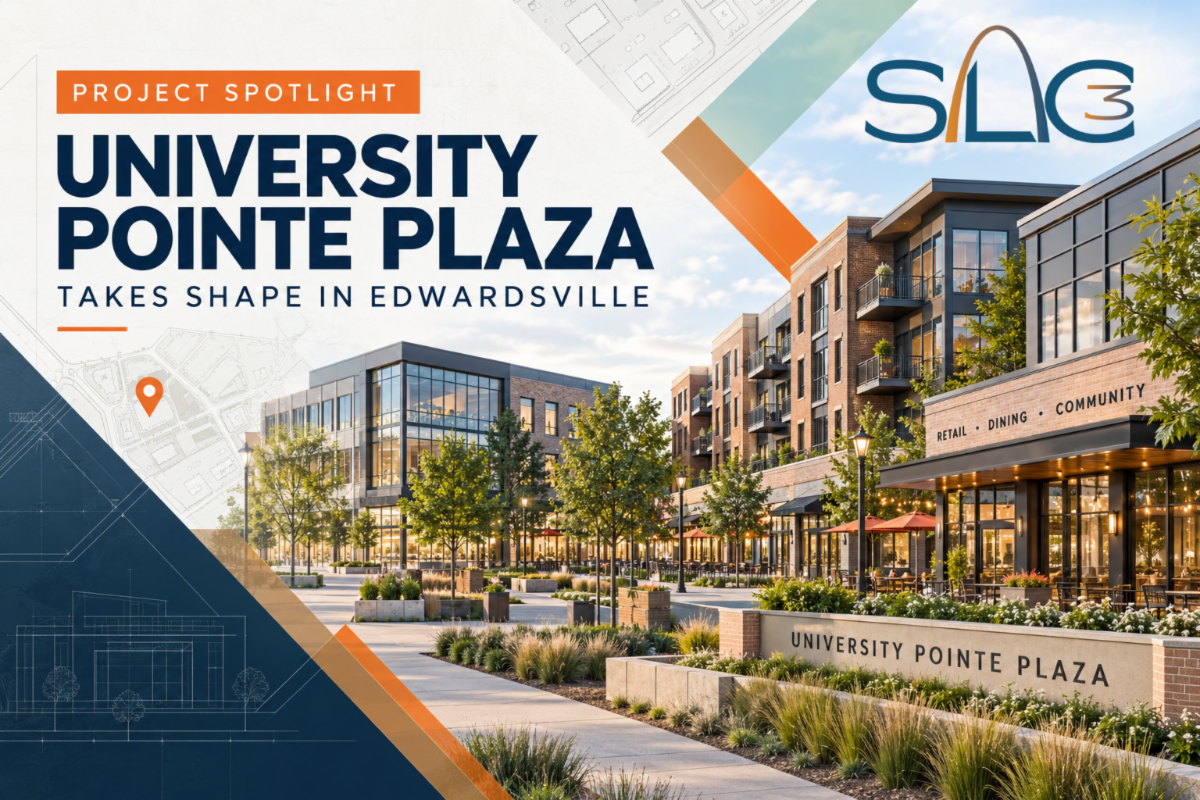
Project Spotlight: University Pointe Plaza Takes Shape in Edwardsville
A new mixed-use development is beginning to take shape at the intersection of Illinois Route 157 and University Drive in Edwardsville.
University Pointe Plaza is planned to bring together professional offices, retail businesses, restaurants and residential units in a highly visible location near Southern Illinois University Edwardsville. Site work began in spring 2026, laying the groundwork for the development’s future buildings and supporting infrastructure.
Construction on individual buildings will begin as the corresponding lots are sold, allowing the project to grow in phases. The first businesses are currently expected to open by the end of 2027.
A Phased Investment in the Metro East
The development reflects continued investment in Edwardsville and the surrounding Metro East, where population growth and economic activity are creating demand for new places to live, work, dine and conduct business.
Because University Pointe Plaza will be developed over time, the project could generate a continuing pipeline of opportunities involving:
- Site preparation and infrastructure
- Architecture and engineering
- Commercial and residential construction
- Interior buildouts
- Landscaping and public-space improvements
- Specialty trades, materials and building systems
University Pointe Plaza represents more than a single construction project. Its phased, mixed-use approach could create opportunities for architects, engineers, contractors, specialty trades and suppliers over several years.
The project also highlights the continued growth of the Metro East as an important part of the Greater St. Louis construction market. As communities such as Edwardsville attract new residents, employers and businesses, demand for thoughtfully planned commercial, residential and infrastructure development is likely to continue.
| |
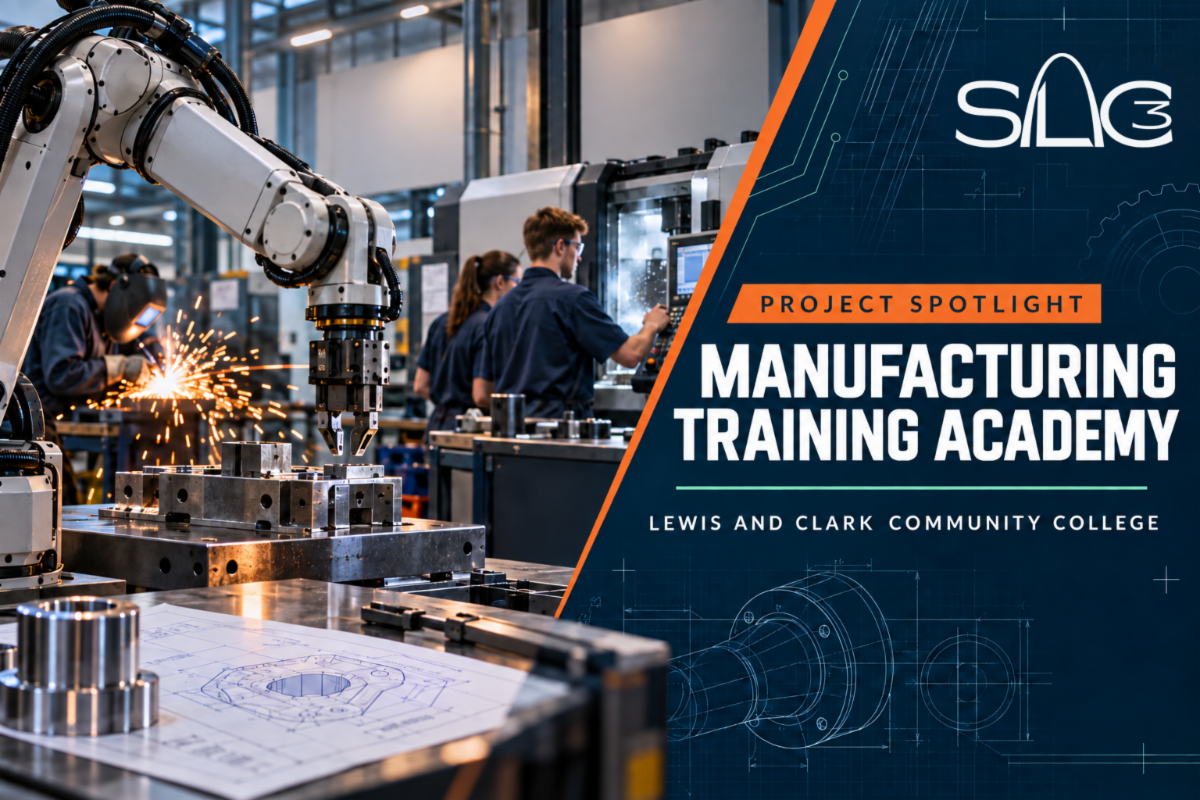
Project Spotlight: Lewis and Clark Community College Plans Manufacturing Training Academy
Lewis and Clark Community College has received a $2.3 million state grant to establish a new Manufacturing Training Academy, strengthening the connection between education, workforce development and the future of advanced manufacturing in the Metro East.
The investment will support facility construction, specialized equipment and new curriculum focused on high-demand technical fields, including automation, robotics, industrial maintenance, machining, metal fabrication and biomanufacturing.
Preparing Workers for the Future of Manufacturing
Modern manufacturing facilities increasingly rely on advanced technology, automated systems and highly skilled technicians. The new academy will provide students with hands-on experience and industry-relevant training designed to prepare them for these evolving careers.
The investment comes as manufacturers and construction-industry employers continue to face challenges finding workers with the specialized skills needed to operate, maintain and support increasingly sophisticated facilities.
By combining classroom instruction with practical technical training, the academy could help create a stronger pipeline of qualified workers for employers throughout Southwestern Illinois and the Greater St. Louis region.
More Than a Workforce Initiative
Although workforce development is at the center of the project, establishing the academy may also create opportunities connected to:
- Facility construction and renovation
- Laboratory and training-space design
- Automation and robotics systems
- Specialized electrical and mechanical infrastructure
- Manufacturing and machining equipment
- Technology integration and installation
The academy is part of a broader Illinois initiative to establish or expand advanced-manufacturing training programs at community colleges across the state.
| |
|
When Everything Is a Priority, Nothing Is
Have you ever started your morning with a plan—and by 9:30 a.m. you were already working on something completely different?
Welcome to the modern workday.
An email arrives. Someone needs a quick answer. A client calls. A project issue surfaces. A meeting gets added. Someone stops by with, "Do you have a minute?"
Suddenly, the work you thought was important has been replaced by whatever arrived most recently.
And by the end of the day, you've been incredibly busy—but you're not sure you accomplished what actually mattered.
That's a capacity problem.
Not Everything Can Be a Priority
When we have 15 priorities, we really have none.
One simple way to regain control is something we're calling the 3-3-3 Reset.
At the beginning of your day, identify:
- 3 things that truly need to happen.
Not everything you'd like to accomplish. What actually matters today?
Make a conscious decision to postpone them instead of carrying them around mentally all day.
- 3 things someone else can handle.
Delegate, automate, ask for help—or consider whether they need to be done at all.
That's it.
Nine decisions before the day starts.
Here's the Hard Part
Once you've identified your three priorities, you have to protect them.
Before abandoning one because another email, request or problem appears, ask:
"Is this more important than what I already decided was important today?"
Sometimes the answer will absolutely be yes.
Construction and design don't always cooperate with our calendars.
But you'd be surprised how often the answer is no.
Try It Tomorrow
Before opening your inbox, write down your 3-3-3.
Then see what happens.
You may not get everything done.
That's not the goal.
The goal is making sure the right things get done.
Because reducing burnout doesn't always require a vacation, a new productivity app or a complete lifestyle overhaul.
Sometimes it starts with deciding what deserves your attention today—and what doesn't.
| | | |
Owner Perspective Series | Week 4 |
Materials Management: Procurement Has Become a Strategic Advantage
Not long ago, procurement was viewed primarily as an administrative function—order the materials, track delivery, and keep the project moving. Today, it has become one of the most strategic components of successful project delivery.
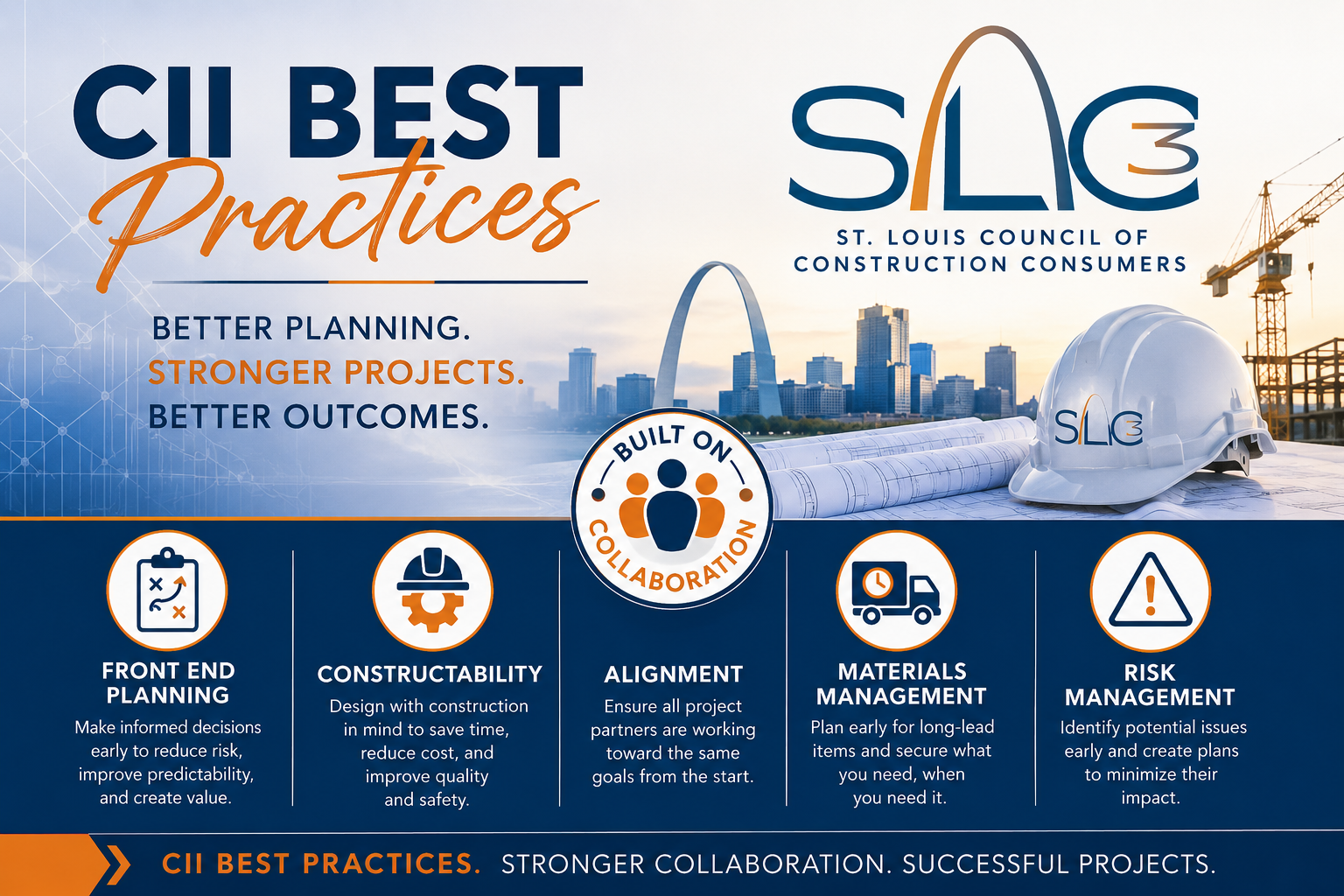
The Construction Industry Institute (CII) recognizes Materials Management as a Best Practice because the availability of materials directly impacts labor productivity, project schedules, and overall project performance.
In today’s market, it’s not uncommon for critical equipment such as electrical switchgear, transformers, generators, HVAC equipment, and specialty mechanical components to have lead times measured in months rather than weeks. If those materials aren’t available when the workforce is ready, valuable labor sits idle, schedules slip, and costs increase.
Forward-thinking owners are changing their approach by engaging procurement much earlier in the project lifecycle. Rather than waiting until construction begins, they’re identifying long-lead items during design, coordinating closely with suppliers, exploring alternate products when appropriate, and sequencing work around procurement realities.
This proactive strategy doesn’t just protect the schedule—it helps maximize the productivity of today’s limited workforce.
Questions Every Owner Should Ask
- What materials have the longest lead times?
- Can any critical equipment be released early?
- Are there approved alternate products if availability changes?
- How will procurement delays affect the construction schedule?
- Are suppliers communicating regularly with the project team?
As labor shortages continue and demand for construction grows, the companies that successfully integrate procurement into project planning will be better positioned to deliver projects on time and with fewer surprises.
Owner Takeaway
The right people can’t install materials that haven’t arrived. Strategic procurement planning ensures skilled labor stays productive instead of waiting on deliveries.
Industry Insight
Many of today’s highest-performing project teams now include procurement discussions during the earliest planning meetings—not after design is complete. By treating materials management as a project strategy instead of a purchasing task, owners can reduce risk, improve schedule certainty, and keep projects moving despite ongoing supply chain challenges.
| | | | |
|
AI Did You Know?
AI can learn your style.
If you always write in a friendly, conversational tone, tell AI:
"Every response should sound like me—friendly, encouraging, and easy to understand."
You'll spend less time editing and more time creating.
| | CALL FOR COMMITTEE MEMBERS? TIME TO HELP... | | |
Much of the work we do is driven by member volunteers, and right now our committees could use a few more voices and helping hands. Committee service offers an opportunity to influence priorities, collaborate with peers, and support initiatives that impact the industry and our region. If you’re willing to get involved—even in a small way—we invite you to sign up.
| | | HELP US KEEP THE PICTURE CURRENT | | |
The construction and development landscape across the region continues to move quickly—and keeping our information accurate and relevant matters.
We’ve recently updated our construction and development listings to reflect new projects, changes in scope, and activity across the greater St. Louis area. These updates help ensure that our members have access to timely, useful insight into what’s being built, redeveloped, and planned throughout the region.
That said, no one has a better pulse on what’s happening than the people working in it every day. If you’re aware of a project that’s underway, planned, or evolving—or if you notice something that needs to be updated—we invite you to share it with us. Your input helps strengthen the resource for everyone.
Keeping this information current is a collaborative effort, and we appreciate your help in making it as accurate and valuable as possible.
| | |
Have something to share? Reach out anytime—we’re always glad to hear from you.
| | SEND US YOUR COMPANY UPDATES! | | If you are considering joining us, contact Morgan McDevitt about Membership. Don't miss our member-only activities and perks! | Let's be sure to welcome our newest members! We look forward to partnering with you! | |  | |
SLC3 2026 Officers:
Michael Hargrave (BJC Health) - President
Vince Nutt, (BJC Health)- 1st Vice President
Mark Flannery (Bayer), 2nd Vice President
Tiffanie Toles, (Kwame Building Group)
Secretary
Danielle Thomas (Hazelwood SD), Treasurer
Frank Niemerg (Ameren), Immediate Past President
Kelly Jackson, Executive Director
| DON'T FORGET: If you are a member of the SLC3 you can access all our members in the InfoHub. Make sure to login and regularly check it out! | | Looking to fill a position? Send us your roles and we will promote them! | | |
BRONZE SPONSORS
(WE SHOULD HAVE MORE SPONSORS HERE????)
| | |
St. Louis Council of Construction Consumers
301 Sovereign Ct, Suite 101, Ballwin, MO 63011
636.394.6200 | info@slccc.net | slccc.net
Staff:
Kelly Jackson // Executive Director
Morgan McDevitt // Membership Engagement Manager
| | CONNECT, INTERACT & SHARE WITH US! | | Please note unsubscribing from this communication will unsubscribe you from ALL communications from the SLC3. | | | | |