|
Lawmakers Receive Briefing on
Chronic Wasting Disease in Delaware
The bipartisan Delaware Sportsmen's Caucus received a briefing this week from a state deer biologist on chronic wasting disease (CWD).
Thursday's presentation followed last week's disclosure by the Department of Natural Resources and Environmental Control (DNREC) that Delaware's first case of CWD had been confirmed in a deer taken in south-central Sussex County.
Chronic Wasting Disease affects cervid species, including deer, elk, and moose. It's caused by prions, a type of misfolded, infectious protein. Prions are poorly understood and, unlike bacteria or viruses, are not living organisms. They contain neither RNA nor DNA. Since they are not alive, they cannot be killed, are highly resistant to heat and disinfection, and can persist in the environment for years.
Scientists believe that CWD prions are spread between animals through bodily fluids, including saliva, blood, urine, and feces, which can occur through direct contact or indirectly through contamination of soil, food, or water. However, as with the Sussex County detection, CWD can suddenly and inexplicably appear in an area without any obvious link to a nearby infected population.
Until last week, Delaware was one of only 14 states where CWD had not been confirmed. First identified in the U.S. in the 1960s in captive deer herds, CWD was detected in wild deer in 1981. It has also been found internationally in Canada, South Korea, Finland, Norway, and Sweden.
In deer infected by CWD prions, the prions appear to act as a template for normal proteins, causing them to also mutate. The misshapen proteins cause progressive, irreversible neurological damage. All deer that contract CWD will get sick and die.
At present, CWD does not appear to be transmissible to humans, dogs, or cats. Eating meat from an infected deer appears to be safe, but experts urge caution and recommend avoiding the consumption of any material from a deer suspected or confirmed to be infected.
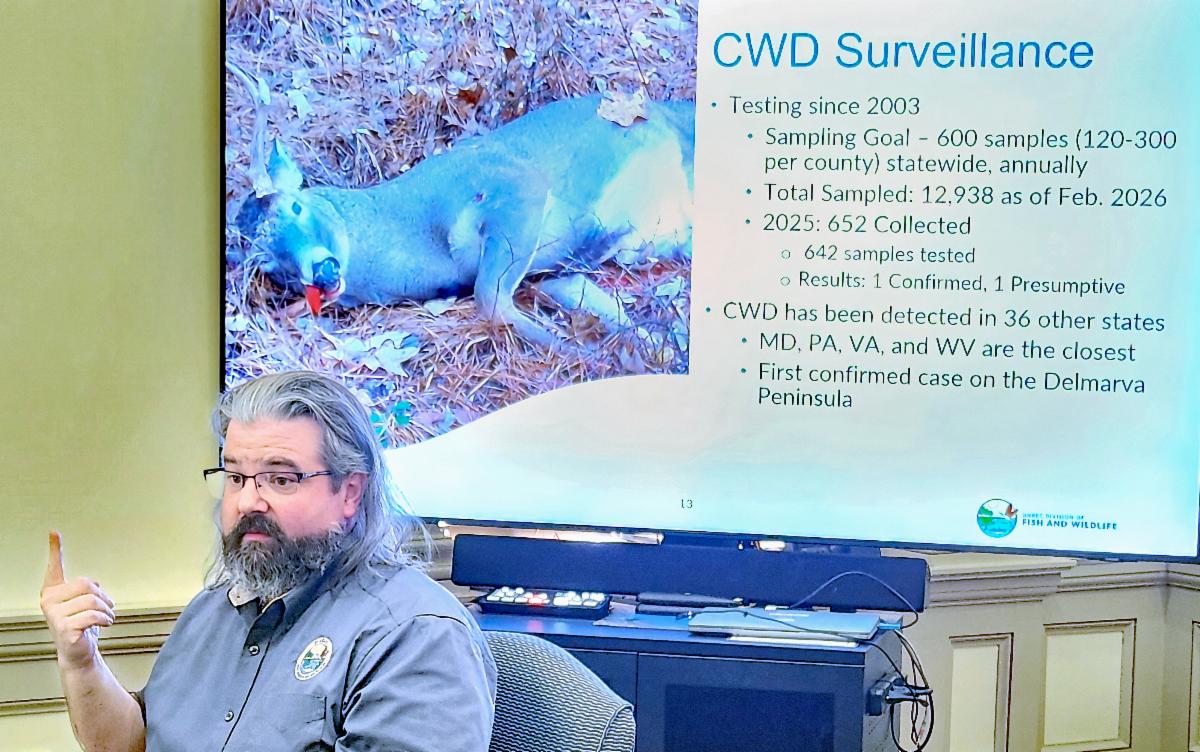
Infected deer can take many months to show any signs of the disease. In fact, DNREC Wildlife Biologist Sam Millman told lawmakers at the briefing that the Sussex County deer that tested positive appeared to be very healthy (see photo). The only reason it was detected was a statewide random sampling program conducted by DNREC for more than 20 years. Mr. Millman said that since 2003, up to 600 samples from harvested white-tailed deer have been lab-tested annually.
Division of Fish & Wildlife Director Pat Emory said the lack of obvious symptoms in deer in the early stages of CWD poses a challenge for Delaware, since it could undermine hunting. "We can't stop shooting deer," he said Thursday, noting that hunting is the only means to effectively keep deer numbers in check. He said without it, crop damage and vehicle collisions would rise dramatically, and CWD would spread faster.
"We've got it (CWD), and we're going to have to deal with it," Mr. Emory said. "We have to work to give the public a level of confidence that what they shoot is safe to eat."
He said his agency is currently working on a testing protocol that would allow successful hunters to send samples of their deer to a lab for testing to confirm the presence or absence of prions.
DNREC has established a CWD Management Zone, which encompasses wildlife management zones 14 and 16. These zones are located within the boundaries of RT 13, RT 9, RT 113, and the state line. DNREC will begin cluster sampling in that area to look for additional cases. Mr. Emory said DNREC is also expected to issue emergency regulations to establish restrictions in the zone to slow the spread of the disease.
People who spot deer who are obviously ill, disoriented, behaving oddly, or emaciated should immediately report them to state officials for follow-up.
For more information on chronic wasting disease, please contact Wildlife Biologist Sam Millman, at Sam.Millman@delaware.gov or 302-735-8676.
For more information about CWD visit: de.gov/cwd.
To access a U.S. map of CWD infected areas, click here.
|