 |
Courtesy of BoSacks & The Precision Media Group
America's Oldest e-newsletter est.1993
|
We know what we are, but know not what we may be.
William Shakespeare
Dateline: Charlottesville, Va
|
|
"A trend no publisher-large or small-can afford to overlook"
6.5.0
|
 |
|
:
Social commerce set to be the most important channel by 2029
https://whatsnewinpublishing.com/
https://bit.ly/2QQtnqn
Social commerce, that is, promotion and sales via social media sites, is looking at exponential growth in the coming years as digital native consumers grow up. In
The Publisher's Guide to eCommerce, Damian Radcliffe, Journalist, and Professor at the University of Oregon,
shows how shoppable content has been rapidly taking off on the major social networks,
including Pinterest, Facebook, Instagram and Snapchat.
We see clear signs that social commerce is taking off as more and more customers make purchases directly from social media platforms instead of heading to a brand's online store or high street outlet after discovering a product on social media.
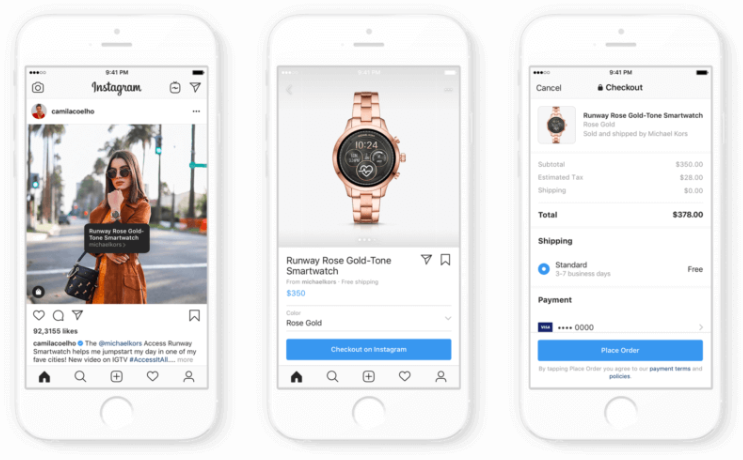
Instagram's new Checkout feature, as just one example, is being welcomed by publishers as a major improvement in shopping experience. All of this signals substantial upcoming opportunities for publishers who are into eCommerce, or are considering it as a potential revenue stream.
Social commerce, the most important sales channel by 2029
A recent
report by Wunderman Thompson Commerce found that 72% of digital commerce leaders believe that consumers of the future will prefer to shop online. The report is
based on interviews with over 500 senior decision-makers in digital commerce from the US and UK.
Among the decision-makers
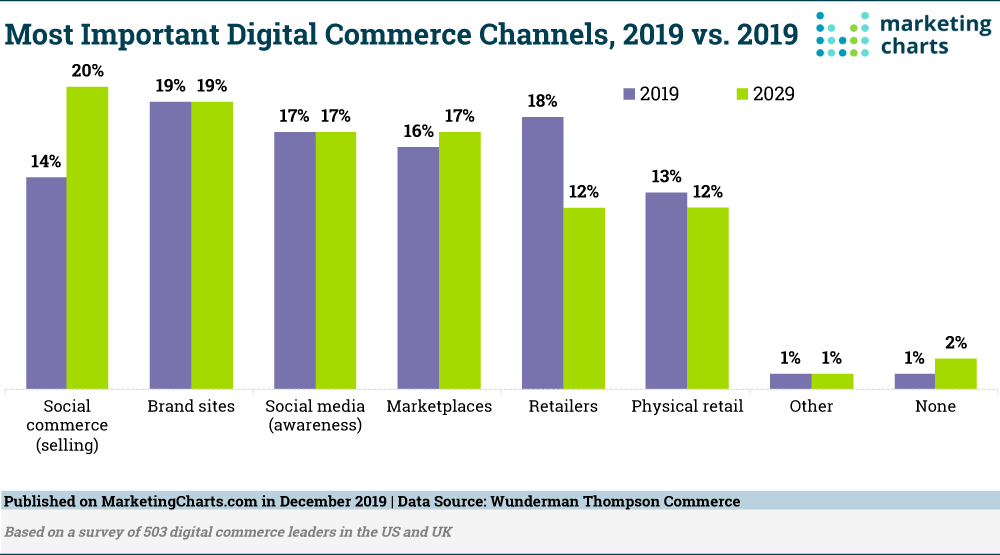
interviewed, the most important digital commerce channels in 2019 were brand sites (19%), retailers (18%), and social media (17% - awareness). They were followed by marketplaces (16%), social commerce (14% - selling) and physical retail (13%). Additionally, 71% confirmed that influencers were making a big impact, and 68% were already working with them.
The survey participants said that in the next 10 years, they anticipate a shift towards social commerce. 20% said that it will be the most important channel in 2029, followed by brand sites (19%), marketplaces (17%) and social media (17% - awareness). Retailers (12%) and physical retail (12%) are expected to lose importance over time.
|
|
|
Additionally,
according to GroupM (part of WPP), eCommerce related ad spend is growing faster than digital advertising, a trend which "holds implications for both marketers and media owners."
Publishers (and some journalists) are already influencers among their loyal readers. They have the advantage of expertise and credibility in specific areas, like the NYTimes' gadget recommendations website,
Wirecutter. This makes them potentially powerful eCommerce partners.
As more and more consumers eschew brick and mortar retail stores in favor of online platforms like Amazon, they're increasingly turning to online review sites to suss out which products are worth buying.
The Wirecutter has ostensibly replaced the Best Buy store clerk who could walk you through the features of each television or laptop on sale.
Speaking on Wirecutter's acquisition, The New York Times CEO Mark Thompson
said that besides being a part of wider efforts to broaden The New York Times Company's revenue base, the move was also an exploration of a closer integration between sites and products, like Wirecutter, and the NYT's "core" news output.
"Potential for telling stories with eCommerce"
GlobalWebIndex
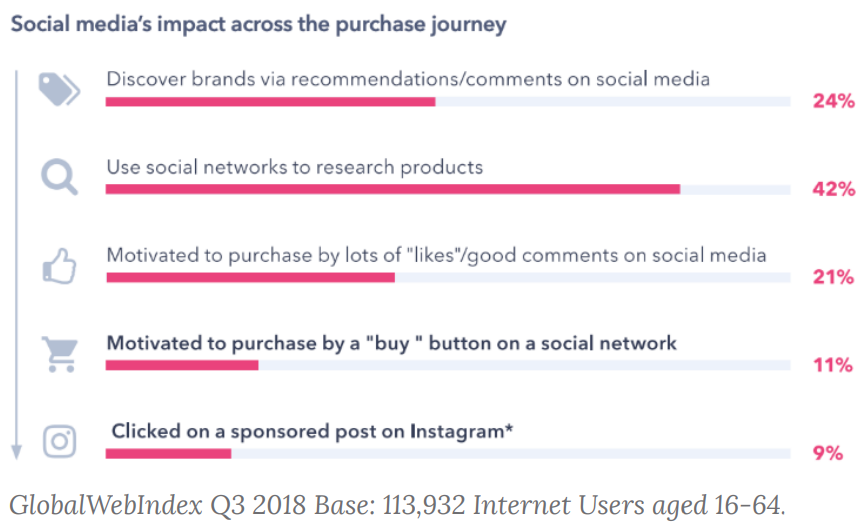
found that, "nearly 3 in 10 cite researching/finding products online as a main reason for using social media."
According to
PopSugar Insights, "67% of millennial women wish that they could take advantage of the benefits of shoppable content and instantly purchase the products they see in digital content, such as articles, photo galleries, or videos."
Given this demand from consumers, it is clear that the lines between social, eCommerce and editorial are going to become increasingly blurred. Perhaps more blurred than ever. As shoppable content gathers momentum, more and more outlets will explore the potential for telling stories with eCommerce with touchpoints baked into them.
|
|
|
Ben-Itzhak adds, "according to Socialbakers data, shopping-related content - including shopping experiences leveraging VR - is rapidly proliferating on social media. And platforms are responding by adding more eCommerce features. Instagram already launched
Instagram Shopping for selected brands, giving businesses an immersive storefront for people to discover and explore products, as well as a link for purchases."
"Facebook's family of applications - WhatsApp, Facebook Messenger, and Facebook Groups - already offers tools for customer care and community management so that all marketing funnel activity - from product discovery to post-purchase customer care and evangelism - can happen on social media. And TikTok recently opened the door to social commerce with beta tests that let influencers embed social commerce links in videos on the app," he adds.
Instagram's
Checkout feature, launched in 2019, allows users to buy products tagged in posts and stories without leaving the platform. This makes the purchase process seamless.
The feature was initially
rolled out to about 50 influencers, designers and media titles, including Ferragni, Jenner and Aimee Song, as well as publishers like Vogue and Hypebeast. Later, the company invited several publishers, including Condé Nast, Group Nine and Highsnobiety, to use the platform as an eCommerce channel.
"If the editorial staff is hosting the stories, it translates well for the viewer"
Publishers like New York Magazine, Food52 and PopSugar have already been using in-feed and story ads on Instagram to drive readers to their commerce content. Food52, which has 2.5M followers on Instagram has two-thirds of its revenue coming from commerce,
according to its VP of Digital Marketing Grace Ouma-Cabezas.
We're now generating more commerce sales from our Instagram ads than our Facebook ads.
|
|
|
"Instagram Stories more frequently has become a go-to format. Generally speaking, it's appealing to brands because it's an organic way to reach our followers. If the editorial staff is hosting the stories, it translates well for the viewer,"
adds Geoff Schiller, CRO of Group Nine.
PopSugar, a Group Nine publication, has 1.3M followers on Instagram, and generates revenue through advertising, as well as its own commerce offerings.
"A whole new era for what this might be"
But the user experience has not been entirely satisfactory, until now that is. Instagram Checkout marks a substantial improvement.
"When we send our followers off-platform, we typically direct them to our link in bio. It can sometimes feel like a clunky process, especially when we are asking them to buy something, so I love that we can keep the purchase within platform," Rachel Karten, Associate Director of Social Media for Bon Appétit and Epicurious
told Digiday.
"It feels like a more seamless process than the link in bio. I also like how I don't have to list out prices in the caption - they are right there on the image for our followers to see."
Bon Appétit has been testing the new feature by selling its own merchandise. They include branded shirts, sweatshirts, hats and other items. Some of the posts feature the publication's popular test kitchen editors-turned-influencers.
Clicks from the shoppable links have been "incremental," said Karten, "so far, we're definitely pleased."
|
|
|
An increasingly essential component of publishers' revenue streams
"It signals a whole new era for what this might be,"
added Brian Lee, Group Nine's (PopSugar's publisher) EVP of Commerce. "It's slowly growing to become a big, big part of our overall meaningful sales. We think this feature is going to be huge for that category, for fashion, fitness and wellness."
Radcliffe writes in
The Publisher's Guide to eCommerce, "As eCommerce continues to become more pervasive, and purposeful social media behaviours - such as using social networks to research and find products to buy - further nudge eCommerce forward, platforms, retailers, publishers and content creators alike, must all strive to innovate in their efforts to grab a slice of the eCommerce pie.
This is a field which has momentum; and as a result, we can confidently expect more publishers to get involved in eCommerce over the coming months and years. For most players it will never be a panacea for historic business models, but eCommerce looks to become an increasingly essential component of a growing number of publisher's revenue streams. Subsequently, this is a trend no publisher-large or small-can afford to overlook.
Damian Radcliffe, Journalist, and Professor at the University of Oregon
|
|
"The Industry that Vents Together Stays Together"
Responses to all Articles and Bo-Rants are greatly encouraged
and may be included in " BoSacks Readers Speak Out"
All news items and the various opinions expressed in this newsletter are not necessarily the opinion of, nor in agreement with the opinions of BoSacks. They are just interesting thoughts and other opinions that BoSacks thinks you should know about.
After all, as the Japanese proverb goes:
"If you believe everything you read, perhaps you better not read."
"Heard on the Web" Media Intelligence:
Courtesy of The Precision Media Group.
Print, Publishing and Media Consultants
193 Brookwood Drive, Charlottesville VA 22902
Contact - Robert M. Sacks 917-566-7437
BoSacks@aol.com
www.bosacks.com
WHO IS BOSACKS
?
-
========================================
SUBSCRIBE - If this free opt-in newsletter has been forwarded to you, and you wish to subscribe, simply go to
www.bosacks.com
|
|
|
|
|
| |
|
|
|
|