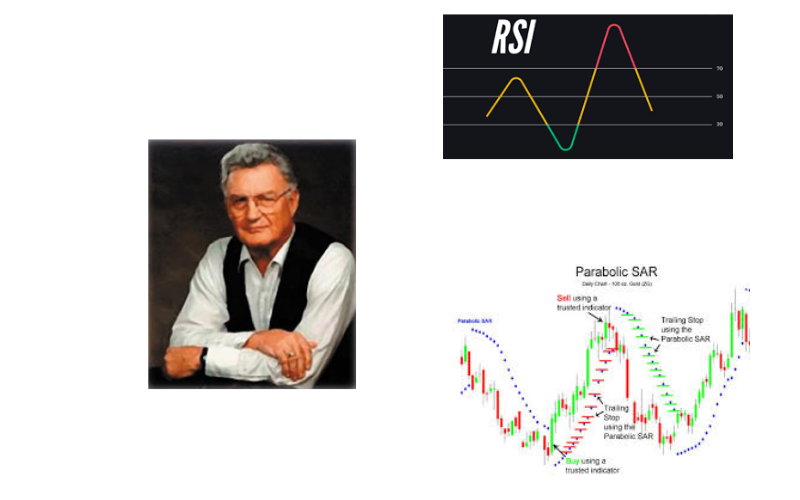
This month Welles Wilder, a titan of technical analysis, passed away. He was the inventor of RSI, Parabolic SAR and Average Directional Index. There is no trader alive that has ever pulled up a chart and threw a few indicators on it that has not used Mr. Wilder’s inventions at one time in their life.
Mr. Wilder was a trained mechanical engineer and he brought the mathematical discipline of that profession to the field of price analysis and for that the trading community will forever be grateful.
But if you’ve ever used any of Mr. Wilder’s tools for more than a month you will quickly notice something very unusual. Unlike the always consistent measurements of mechanical engineering Mr. Wilder’s indicators will often provide diametrically opposite signals. RSI for example is often used as a proxy for overbought and oversold conditions with 70 suggesting that an asset is in overbought territory and 30 indicating that it is oversold. But sometimes the RSI value of 70 is the perfect place to buy as it signals massive momentum strength and RSI value of 30 is the perfect place to sell as it signals the start of a complete collapse of price.
That’s because price action unlike mechanical engineering does not follow the rules of Newtonian physics, but the undulating waves of human behavior which is always interpretive. This means that every single aspect of technical analysis contains its own binary opposite. Double tops can become a support zone for further breakouts and so could head and shoulders patterns and everything else. In short in technical analysis every conventional buy signal can become a perfect sell set up and vice versa. All of it depends on what type of price regime is dominating trade at the moment.
As I’ve written a million times there are only two types of trades that exist in the markets - continuation and mean reversion. You don’t even need to spend years of pouring over charts to understand this dynamic. Just take a look at stock index futures over a 24 hour cycle as I do every day. During the Asian and early European sessions when liquidity is low and participation is muted prices tend to trade in relatively narrow and well defined ranges. Selling tops and buying bottoms - a classic mean reversion technique - generally works well. From around 0700 NY time when the North American corps comes on line the price movement begins to extend significantly and continuation trades work much better.