Mid-Summer Greetings to our Bakshi News members.
Today we have the Foreward from
Unfiltered by a special Bakshi fan - Quentin Tarantino. Enjoy and Happy Summering.
(
Unfiltered is Now Out of Print but can be found online at
www.ralphbakshi.com)
____________________________________
"When New York Times film critic, Vincent Canby, put together his top ten list of films for 1973, two of the ones he was most excited about were gritty films about New York by two young directors-one was Mean Streets by Martin Scorsese and the other was Heavy Traffic by Ralph Bakshi. Not only that, he even referred to the films as almost companion pieces, saying you could switch their titles and they would still both work (which is even more intriguing when you consider Bakshi did an animated paraphrased remake of Mean Streets called Hey Good Lookin', made in 1975 and later reworked until its eventual reissue in 1982 with vocal talent consisting of two Mean Streets actors, David Proval and Richard Romanus-a movie I prefer to even Heavy Traffic). Mr. Canby was right to be excited. 1973 was a very exciting time in American film, as was the emergence of two exciting artists like Scorsese and Bakshi-two directors dealing with autobiographical material, set in a "new-to-the-movies" New York, exciting, dangerous, profane, cinematic (and in Bakshi's case, both funky, i.e., black, and brimming with Jewish humor), and as far away from Donen and Kelly's On The Town as humanly possible.
Heavy Traffic drew a cartoon of a funkified pinball machine- like New York with Italian, Jewish, and black denizens who not only could not escape each other, but couldn't escape commingling. (Again, these different concerns are all too autobiographical, Bakshi came from the heavily black, Jewish, and Italian Brownsville).
His urbanized retelling of the Uncle Remus' Brer Rabbit tales, Coonskin-released in 1975 during, but just after the peak of the blaxploitation movement-is hands down the most incendiary piece of work in the entire genre. Using negro folklore and slave tales of non-violent resistance, along with the White American/European media's racist caricatures of the past (i.e., Disney's Black Crows, Warner Brothers' Coal Black, every James River pickaninny that smilingly stared back from grocery shelves, the spaghetti benders of Lady and the Tramp, and the Jews of the Nazi Party produced The Eternal Jew), Bakshi, with zero timidity, challenged his audiences' sensibilities in ways that made all the other blaxploitation titles seem like the wish-fulfillment fantasies they were.
In fact, the only voice of the time that had a symbiotic relationship to Bakshi's work could be found in Richard Pryor's monologues.To discover that the two gentlemen were friends, and Pryor was a huge fan of Coonskin, comes as no surprise. An America that considers Blazing Saddles and All In The Family stinging racial satire is an America not ready for Coonskin. Even when screened today, Coonskin is still an explosive piece of work that risks combustion with every audience who views it, something Ivan Dixon's radical The Spook Who Sat by the Door ceased doing eighteen years ago. (One of Bakshi's biggest influences was George Herriman, the black cartoonist who created Krazy Kat. The Herriman-influenced "Maybelline" scene from Heavy Traffic, and the "Malcolm the Cockroach" scene from Coonskin, are two of Bakshi's best set pieces.) Then when Bakshi moved away from his "street pictures" into fantasy with Wizards, a picture he later called his audition for Tolkien, he reinvented that genre. Bringing his Jewish Catskill's-like humor, along with a heavy dose of Jewish anger, to a sword and sorcery tale of a new holocaust set ten million years in the future, he created his other masterpiece. With his hero Avatar, a cross between Tolkien's Hobbit, Mel Brooks' 2000 Year Old Man, and Marvel Comics' Howard the Duck, and his villain Blackwolf (also simultaneously called Hitler in the film), whose physicality resembles Eisenstein's Ivan the Terrible, Bakshi presents a battle of good and evil, played out with hip '60s' and '70s' sensibilities, vaudeville humor, and Eerie Magazine cover graphics.
All this and I haven't even mentioned his Mighty Mouse years in the eighties during which, in his words, he wanted to create a Saturday morning cartoon show so hip you could show it on Saturday night. This serious treatment of a very fearless satirical artist is long overdue.
-Quentin Tarantino
And A few New Pieces Added to Gallery ....
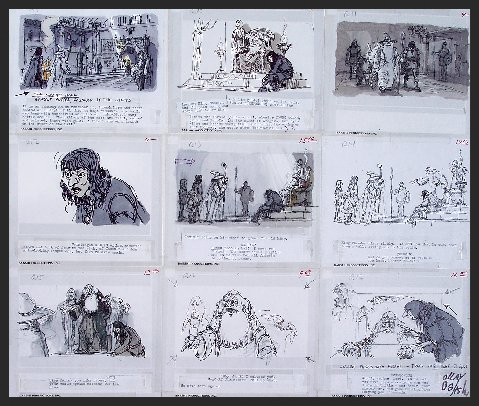
Lord of the Rings Storyboard
Gandalf and Theoden in Lord of the Rings
An ORIGINAL STORYBOARD used by Bakshi - illustrated by Mike Ploog - used in the Making of The Lord of the Rings. 22" x 26" . $1150




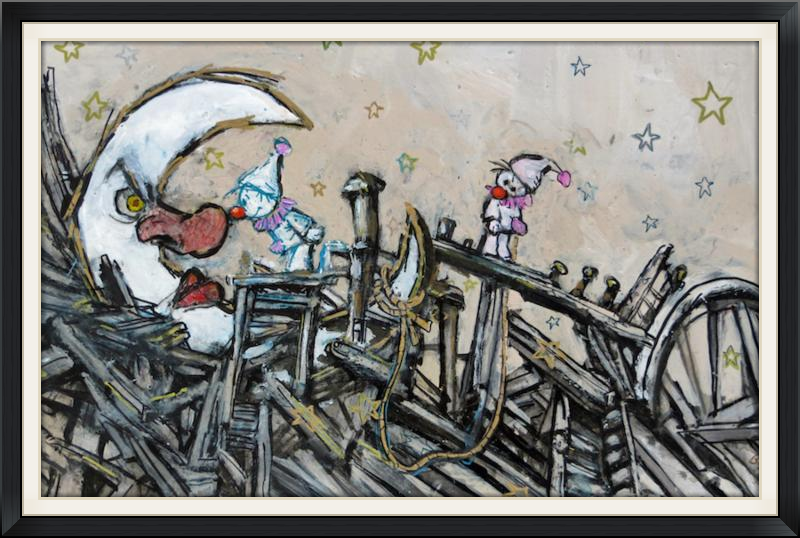 Paper Moon - Bakshi