|
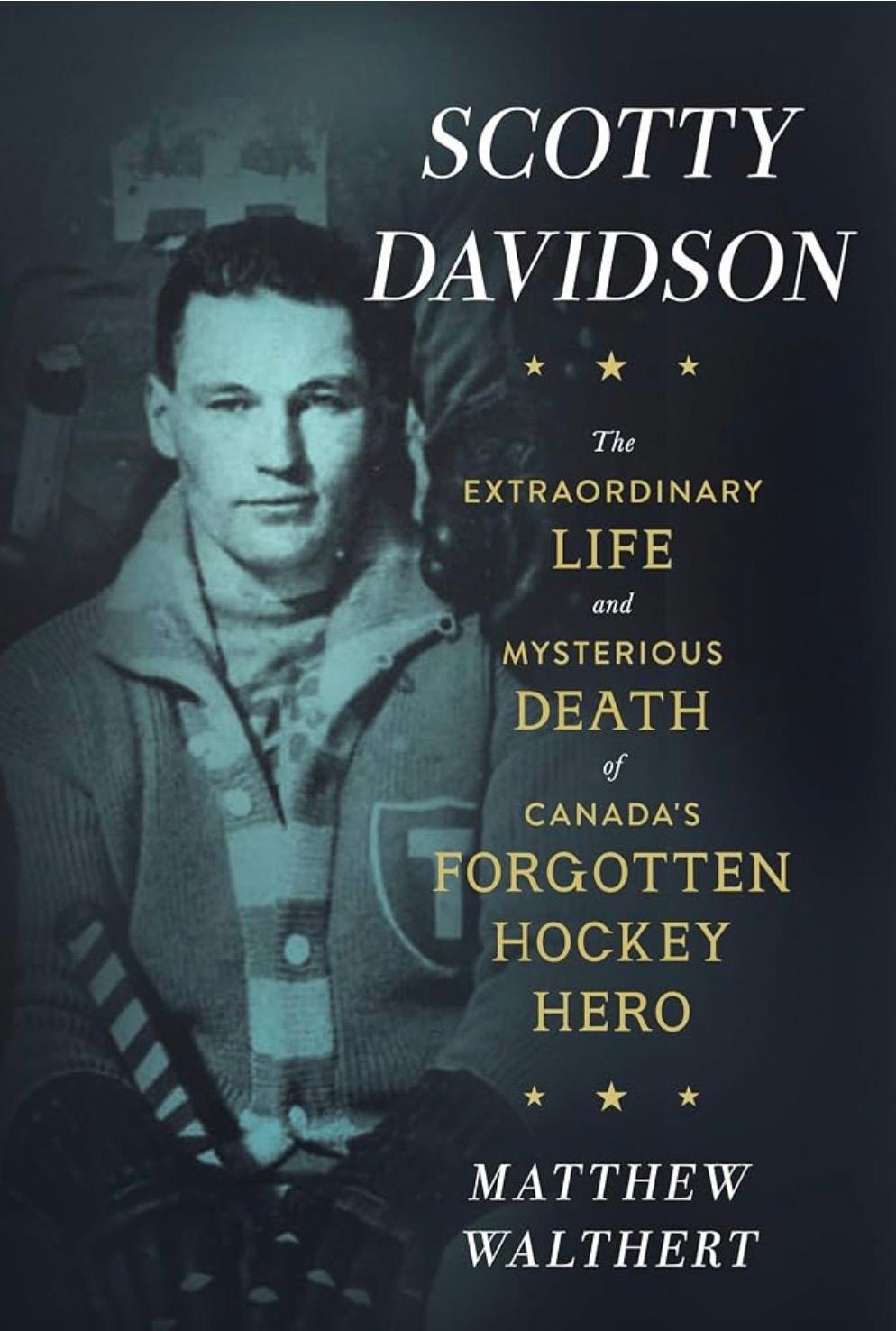
While Scotty Davidson may be well-known among Kingston hockey history buffs, in other parts of the country he gets little recognition. In his new book, Ottawa author Matthew Walthert calls Davidson “Canada’s forgotten hockey hero.”
Davidson’s accomplishments are many. In 1914, he scored a Stanley Cup-winning goal with the Toronto Blueshirts. He volunteered during the First World War, serving valiantly before being killed in action. His death helped spur the creation of the Memorial Cup, now the Holy Grail of junior hockey supremacy in Canada. And he was elected posthumously to the Hockey Hall of Fame.
“I’d never heard of him before,” admits Walthert, who began looking into Davidson’s extraordinary life more than a decade ago. That’s a big acknowledgement from a writer who has spent his career focusing on two themes – hockey and Canadian military history.
“I like to write about topics that have not been covered,” Walthert told the Original Hockey Hall of Fame. “As I began researching Davidson’s life, I found that there was more to the story than meets the eye.”
Let’s start at the beginning.
Allan “Scotty” Davidson was born in Kingston on March 6, 1891, and grew up skating on the Lake Ontario harbour in Portsmouth Village. He was a standout with the Kingston Frontenacs, a junior division team in the Ontario Hockey Association. Davidson led the squad to consecutive provincial titles in 1910 and 1911.
He turned pro with the National Hockey Association’s Toronto Blueshirts and was one of the top players of his era. According to sportswriters at the time, “he could skate faster backwards than other players could skate forwards.”
He scored his Cup-winning goal against legendary Montreal goalie Georges Vezina in March 1914.
“The timing of that goal is one of the reasons that Davidson is not well-known today,” says Walthert.
“The Maple Leafs only recognize the team history starting with the inception of the National Hockey League in 1917. So, any list of the greatest Toronto players of all time begins on that date.”
With the outbreak of war in Europe in July 1914, Davidson signed up to go overseas. It was a natural move since he was already in the militia reserve in Kingston.
By all accounts, he was a fearless soldier. “He asked to serve at the front, despite the fact that his experience as a machinist in Kingston meant that he could have been very useful behind the lines maintaining and repairing equipment,” Walthert says.
He was killed at age 24 during the Battle of Givenchy in France on June 16,1915 when an artillery shell landed in his trench.
Davidson’s death has been surrounded by confusion. Months later, an officer in his brigade, Captain George Richardson, also from Kingston, wrote a letter to a newspaper stating that Davidson was killed in a valiant fight with the Germans, refusing to retreat.
In his book, Walthert delves into the differing accounts. He says it’s clear that Davidson was killed by an artillery shell.
“We really have no idea why Richardson wrote the letter. Unfortunately, Richardson was killed in action in 1916 so no one was able to ask him about the discrepancy.”
The creation of the Memorial Cup
Davidson’s untimely death on the battlefields of France served to minimize his hockey legacy. “He never came back to Canada and played in the National Hockey League, which was the successor to the National Hockey Association. As a result, you don’t see his name on lists like the top 100 NHL players of all time,” Walthert says.
After the war ended, Capt. James Sutherland, himself a veteran of the conflict, wanted to honour Davidson and Richardson, both of whom had played for him when he coached the Kingston Frontenacs. He was devastated by their deaths.
The Memorial Cup was born out of that desire to remember the two players. “While the Memorial Cup was rightly dedicated to everyone who served overseas, it also meant that the two Kingston players did not earn a lasting legacy from the trophy,” Walthert says.
He compares the Memorial Cup to the Hobey Baker Award, given to the top NCAA hockey player each year. That trophy is named for a Princeton University athlete who served in the First World War and was tragically killed in a plane crash just a month after the armistice was declared in 1918.
“Everybody in hockey knows who Hobey Baker is,” says Walthert. “Unfortunately, Scotty Davidson did not get the same legacy, even though it was well-deserved.”
Both Scotty Davidson and George Richardson were inducted into the Hockey Hall of Fame in 1950.
The book, Scotty Davidson: The extraordinary life and mysterious death of Canada’s forgotten hockey hero, is available on Amazon.
|