|
There is a lot of hype these days about protein, perhaps leading us to believe we should be stuffing ourselves with as much of it as we can get. It seems protein is being added to just about everything. Food manufacturers are highlighting the amount of protein in their products to entice us to buy them, because we’re convinced we’re not getting enough of it. The more we eat, the healthier and more muscular we’ll be, right?
The truth is that most of us are eating more than enough protein, and sometimes from less healthful sources. Protein, when broken down into amino acids, has many important functions in the body. However, protein alone does not build muscles; those muscles must also be exercised.
The recommendation for the minimum to eat to avoid deficiency is 0.8 g/kg of body weight for most healthy people (weight in lbs./2.2 = weight in kg). Older people need slightly higher amounts (1-1.2 g/kg) to help preserve muscle mass, which we lose at a more rapid rate as we age. Someone who is acutely or chronically ill or healing a wound may need 1.2-1.5 g/kg; for malnourished older people in a hospital or nursing home, as much as 2.0 g/kg.
Protein should provide 10-35% of your daily calories. It is important to remember that without sufficient carbohydrates and fats in the diet for energy, protein may be used for energy and muscle mass will be lost. Carbohydrates should make up 45-65% and fats 20-35% of your daily calories. Eating excessive amounts of protein, especially red meat, may increase the risk of kidney damage, kidney stones, heart disease, cancer, and GI problems.
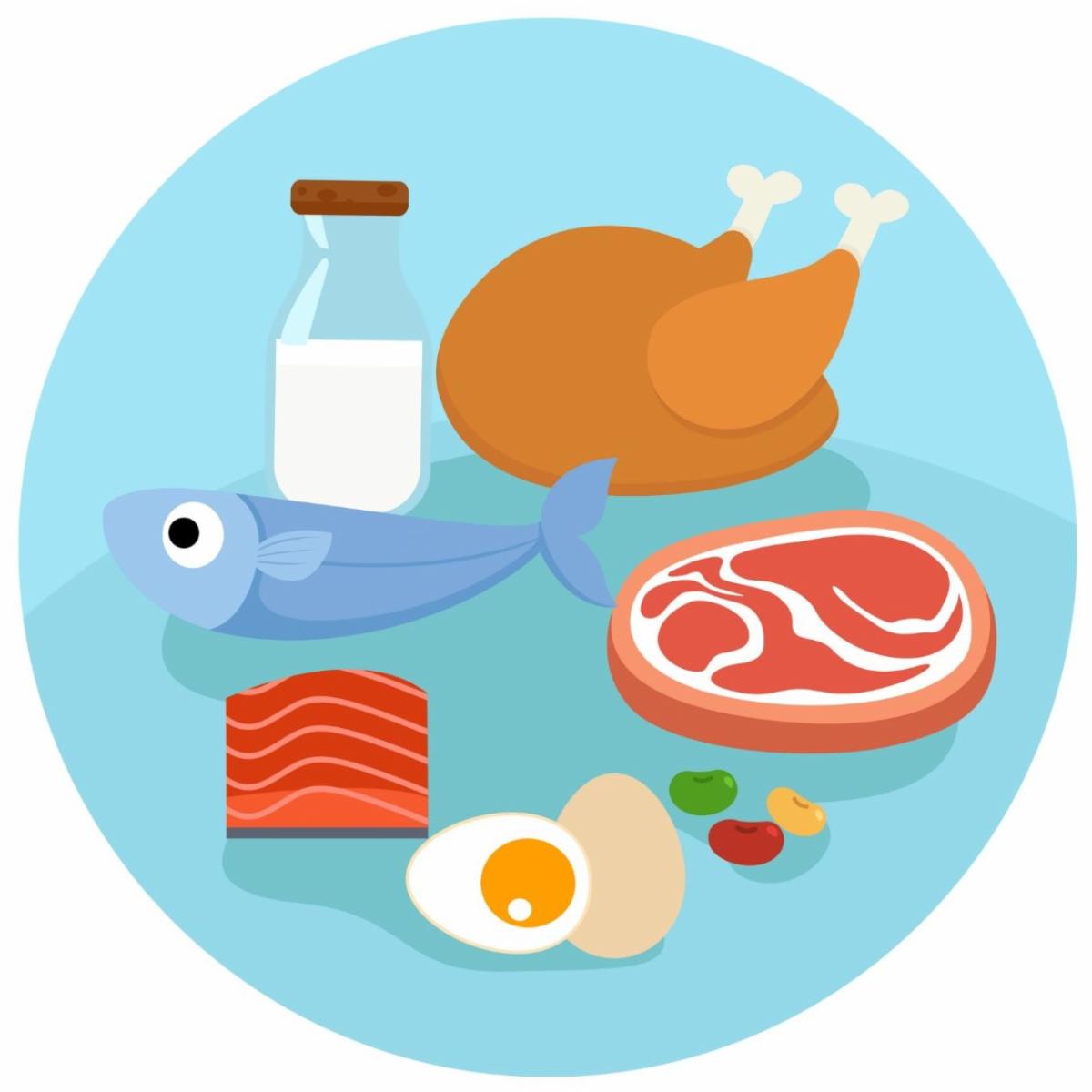
When we think of protein-rich foods, we think mostly of meat, poultry, fish, and dairy. There are also plant-based sources, such as legumes (beans), soy products (tofu), and nuts and seeds. Vegetables and grains provide some protein, but fruit and fat do not.
To get a general idea of how much to eat, go to MyPlate.gov and click Resources and then Tools. Enter your information and you’ll get a MyPlate Plan with the total calories you might aim for to maintain, lose, or gain weight, and how to get them by food group. You will find that protein portions are measured in ounce-equivalents, which is simpler than trying to figure out grams or ounces for food that is not packaged with a Nutrition Facts Label. The recommendations range from 5 to 7 ounce-equivalents per day. Here’s the list of protein ounce-equivalent foods:
1 ounce lean meat, poultry, fish (eat fish at least twice a week!)
¼ cup cooked beans, peas, lentils, edamame; 6 tablespoons hummus
1 egg or 2 egg whites
1 tablespoon peanut butter or other nut butter
½ ounce nuts (unsalted, dry-roasted, or raw) or seeds (hulled and roasted)
¼ cup (about 2 ounces) tofu; 1 ounce tempeh, cooked
If you eat a couple of eggs for breakfast (2 ounce-equivalents), 2 tablespoons of peanut butter for lunch (2), and 3 ounces of chicken for dinner (3), you’ve met the recommendation for the day. You’ll likely eat more protein throughout the day in other foods, so deficiency is nearly impossible.
Try to:
1. Choose lean meat and poultry for less saturated fat. Cooking methods count; broiling, for example, reduces fat content.
2. Limit or avoid processed, packaged meats such as hot dogs, sausage, ham, bacon, etc., because of their high fat and sodium content.
3. Spread out protein foods throughout the day rather than eating them all at dinner time.
4. Increase the variety of your protein choices to include seafood, nuts, seeds, and soy, which also provide unsaturated (good) fats, fiber (nuts and seeds), minerals, and vitamins.
MyPlate has quizzes to test your knowledge of the different food groups. On the home page, click on the Protein section of the plate, then scroll down to the Protein Foods Quiz. Explore the other choices on that page, too – there’s a Tip Sheet, vegetarian choices, etc. Have fun exploring this informative resource!
|