| |
NASA History News & Notes
JULY 2026 • Volume 43, Number 6
| | |
CONTENTS
- Viking’s legacy lives on 50 years after the first American Mars landing
- Coming soon: the continued story of NASA’s Discovery Program
- Get the Fiscal Year 2025 issue of the Aeronautics and Space Report of the President
- Join our next NASA History Speaker Series presentation
- Trivia challenge: Gemini X’s missing photos
| | |
MARS EXPLORATION HISTORY
Our First Look at the Surface of Mars
And How Viking Shaped the 50 Years Since
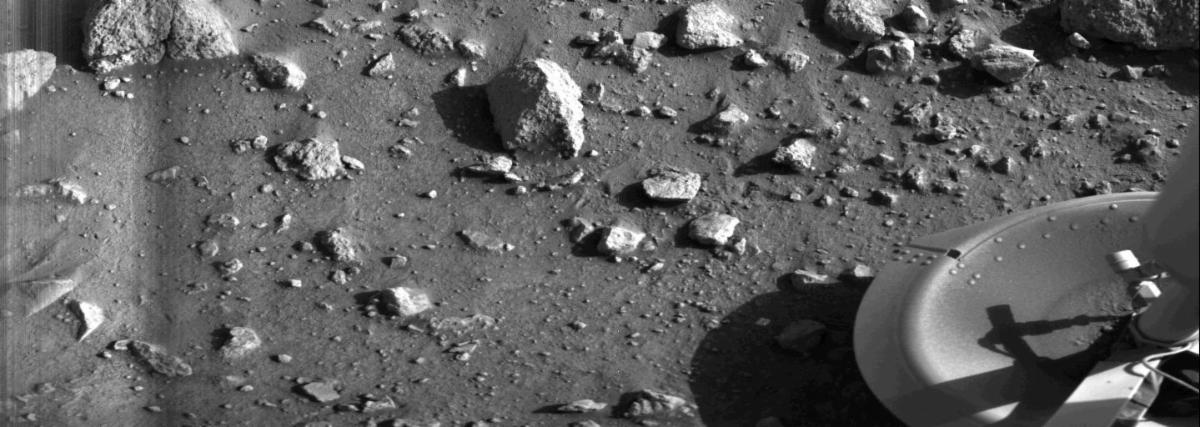
| | “Touchdown, we have touchdown!” At 5:12 a.m. PDT, July 20, 1976, mission controllers at NASA’s Jet Propulsion Laboratory (JPL) erupted in cheers as they learned that the Viking 1 lander had successfully survived its descent through the thin Martian atmosphere. Forty minutes later, the lander’s first image began to slowly appear, line by line. For the first time, humans were able to see Mars’s rocky terrain from its surface. | | Viking Lander 1's first image from the surface of Mars, July 20, 1976. A footpad of the lander is visible in the lower right corner. Credit: NASA/JPL-Caltech | | |
The Viking 1 and Viking 2 landers, each built to last 90 days, continued to return images and data for years, with the Viking 1 lander transmitting data back to Earth until November 1982.
Together, the Viking orbiters and landers gave us our first understandings of Martian weather as well as its surface temperature, chemistry, and terrain. Frustratingly, the first-of-their-kind biology experiments on the landers yielded weakly positive results that could be ascribed to biological processes, but could also be the result of purely chemical processes, leaving no conclusive evidence of life on Mars.
|
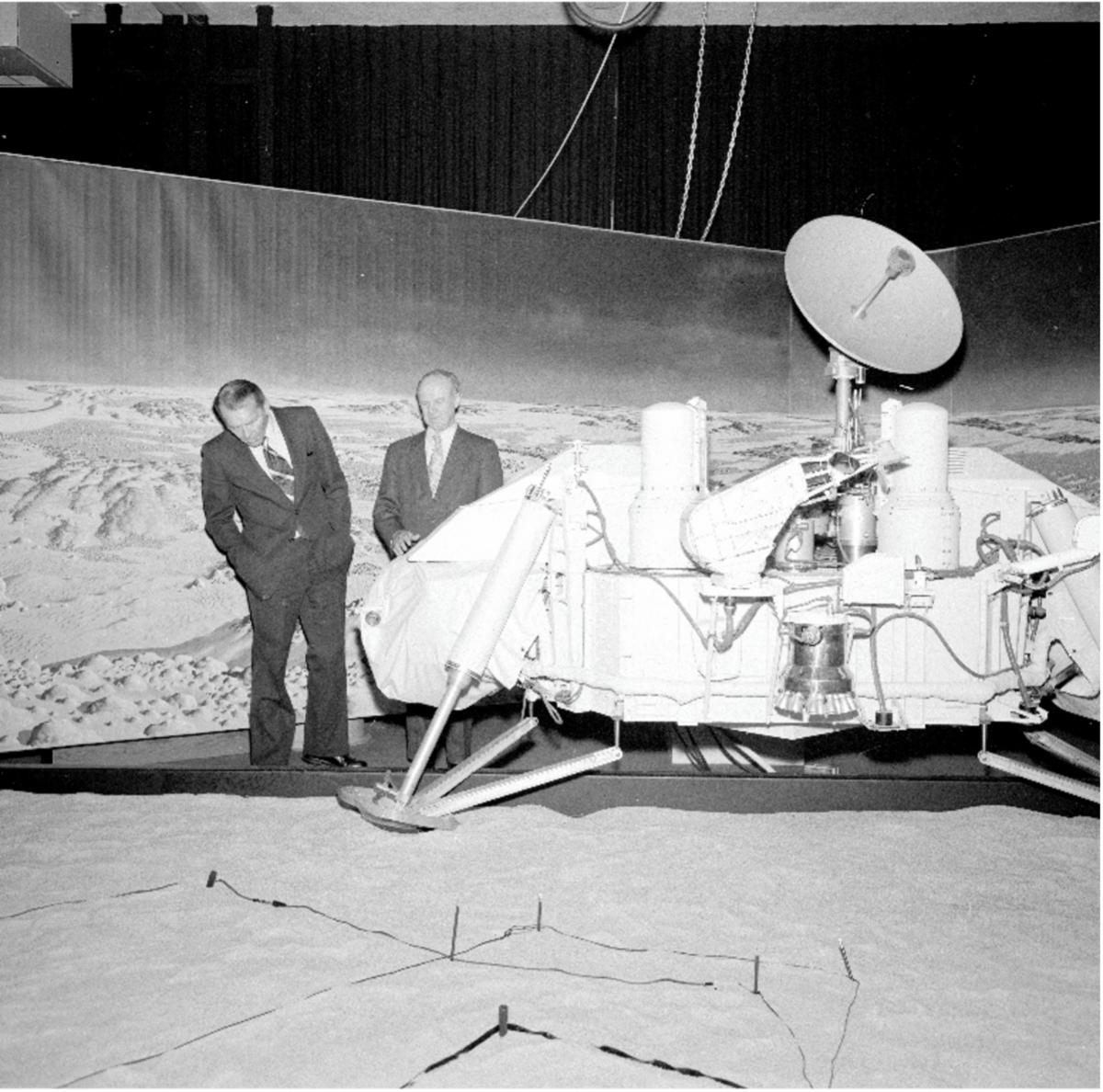
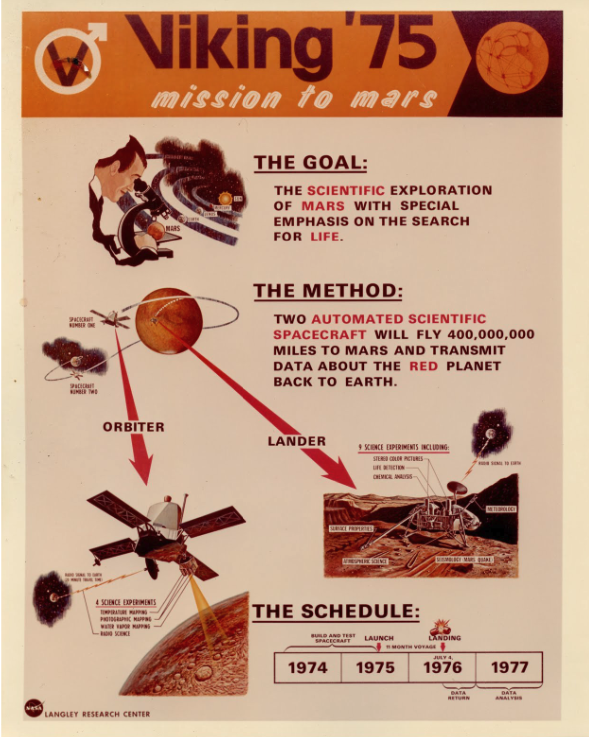
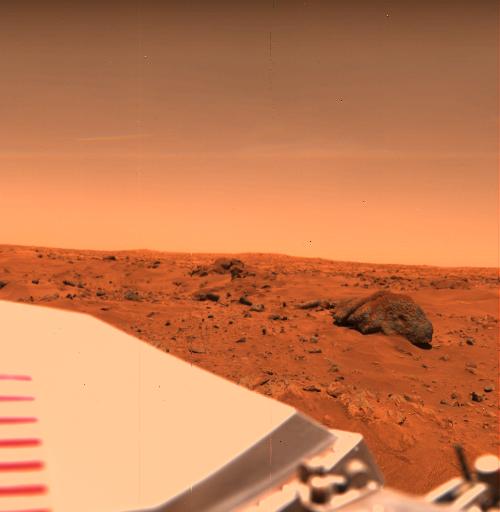
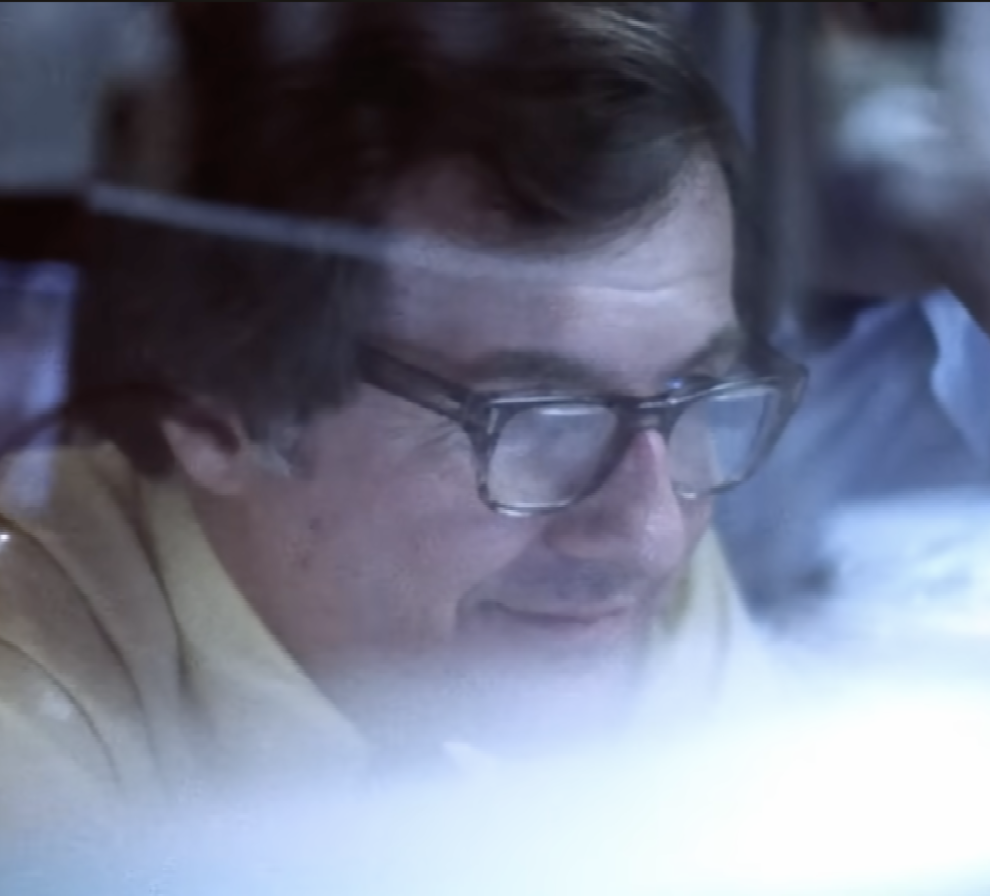
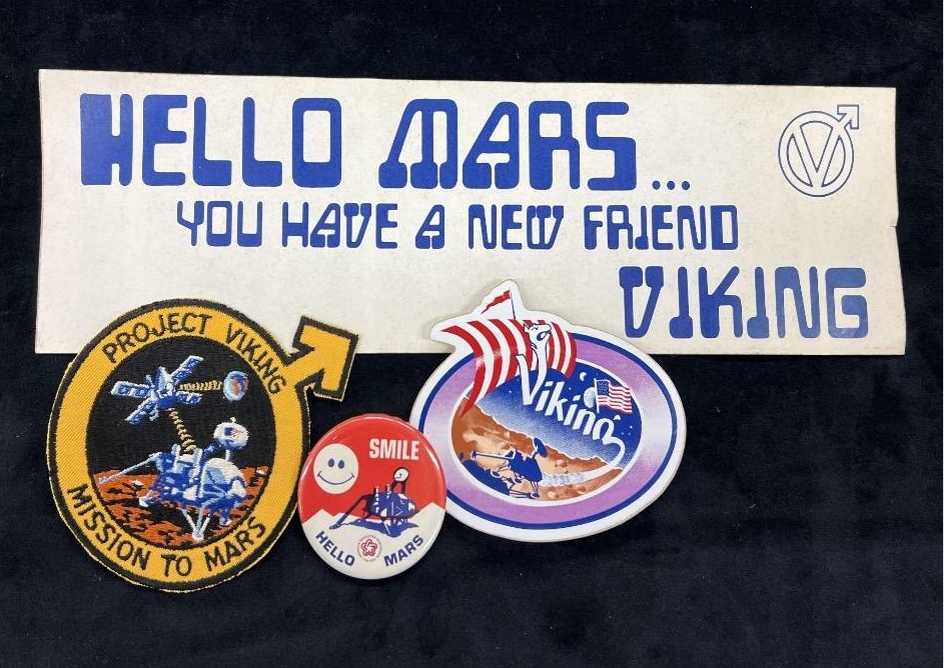
| Dr. William Pickering, JPL Director, and Robert Finch, Lieutenant Governor of California, inspect the full-scale Viking Lander on display at JPL in March 1976. Credit: NASA/JPL-Caltech | | The nationwide team of planners, engineers, and scientists, directed by a formidable leader, Jim Martin, were “the best of the best.” Martin’s leadership style demanded excellence but provided those working on the project with opportunities to develop. Gus Guastaferro, the Viking Management Operations Manager commented, “Many Viking team members dedicated nearly a decade to the formulation, development, and operation of the Viking project. Each of us was provided an opportunity to grow as engineers, scientists, and leaders.” After Viking, many of them were promoted into further leadership roles. Alphonso V. Diaz, a protégé of Guastaferro, went on to serve as the Director of Goddard Space Flight Center and NASA’s Associate Administrator for Science. A. Thomas Young started as Viking’s science integration manager, later becoming the mission director, and eventually a Lockheed Martin vice president. | | Flyer produced by NASA’s Langley Research Center outlining Project Viking. Credit: NASA | | The data provided by Viking also inspired a new generation of scientists to dedicate their lives to planetary exploration. Steve Squyres, the principal investigator of the Mars Exploration Rover project, was a student at Cornell University in 1977. Looking for a topic for a class term paper, he asked to view the Viking 1 orbiter photographs sent to his professor Joe Veverka, a member of the Viking science team. In his August 22, 2017 oral history interview, he describes the day. "I just pulled some of the binders off the shelves and figured I would spend 15 or 20 minutes flipping through the pictures and see if I could come up with an idea for a term paper. I was in that room for four hours, and I walked out of there knowing exactly what I wanted to do with the rest of my life. It was an absolutely transformational moment for me, because this was the blank canvas I had been looking for." | | A Viking 1 Lander surface panorama shows the rocky terrain of Mars, including “Big Joe,” a roughly 2-meter long boulder about 8 meters from the lander which would have spelled the end of the mission had it landed on that spot. Credit: NASA/JPL-Caltech | | |
The JPL Archives Staff and
Michele Ostovar, NASA History Communications Lead
| |
Explore Viking Through NASA History Resources
The NASA History Office offers extensive resources for researchers wishing to explore the Viking mission in depth.
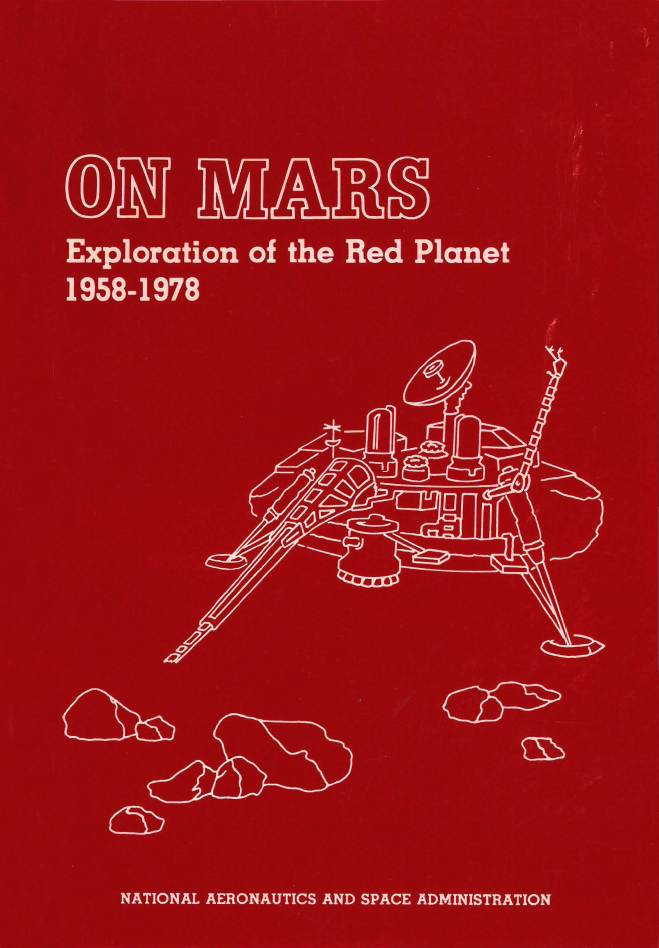
| | On Mars: Exploration of the Red Planet, 1958–1978 (NASA SP-4212), written by Edward Clinton Ezell and Linda Neuman Ezell, traces the Viking mission from its origins through the end of the extended mission. | | The NASA History Office’s oral history collection holds interviews with engineers, scientists, and managers who made Viking possible. These transcripts offer an irreplaceable human dimension to the technical record and are available to researchers online. | | The JPL Archives holds 93.8 cubic feet of Viking project material, including project documents, mission analysis and design materials, flight operations and mission control documents, and an extensive photo negative collection spanning the full arc of the mission. These collections are accessible by contacting the JPL Archives directly at archives@jpl.nasa.gov. | | | | |
NASA HISTORY SERIES
The Continued Story of NASA's Discovery Program
| |
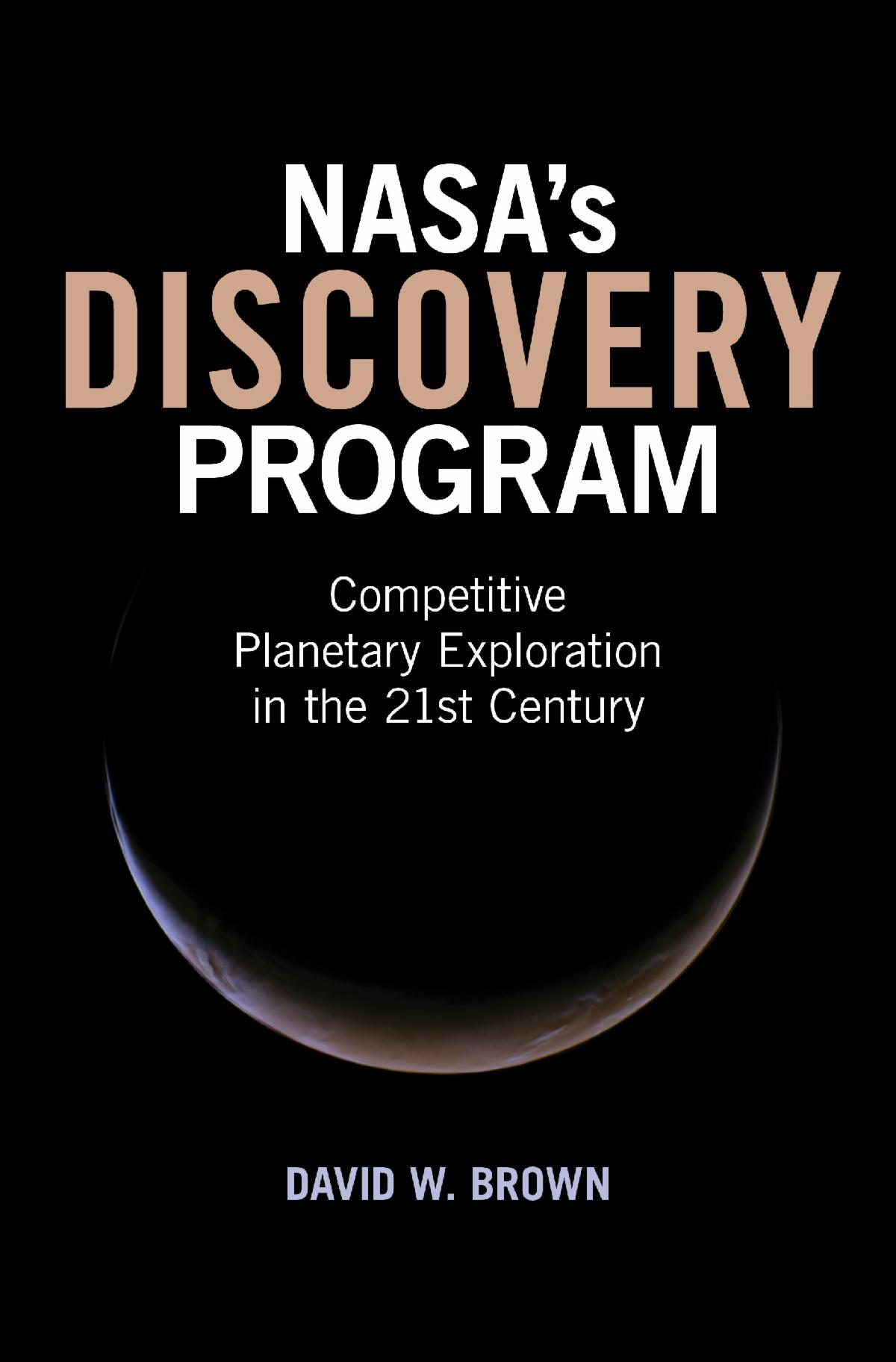
The next title in the NASA History Series — NASA's Discovery Program: Competitive Planetary Exploration in the 21st Century by David W. Brown — is now in production and slated for release this fall.
Picking up where NASA's Discovery Program: The First Twenty Years of Competitive Planetary Exploration left off, this new volume chronicles the program's missions and milestones from 2011 through 2025. This engaging book offers an in-depth look at more than a decade of innovative planetary exploration and continues the story of focused cost-capped planetary science investigations.
| | |
PUBLICATIONS
Now Available: The FY 2025 Aeronautics and Space Report of the President
| | | | |
The Fiscal Year 2025 edition of the Aeronautics and Space Report of the President, coordinated by staff in the NASA History Office, is now available! You can access this report and all previous reports going back to 1958 online.
Produced in coordination with more than a dozen agencies of the U.S. government, the Aeronautics and Space Report of the President fulfills a statutory requirement to provide Congress a description of the annual program activities and accomplishments of all agencies of the United States in aeronautics and space. Preparations for the production of the Fiscal Year 2026 report, covering October 1, 2025, through September 30, 2026, are now underway!
| | |
SPEAKER SERIES
Reminder: Join the Next Presentation in Our Speaker Series
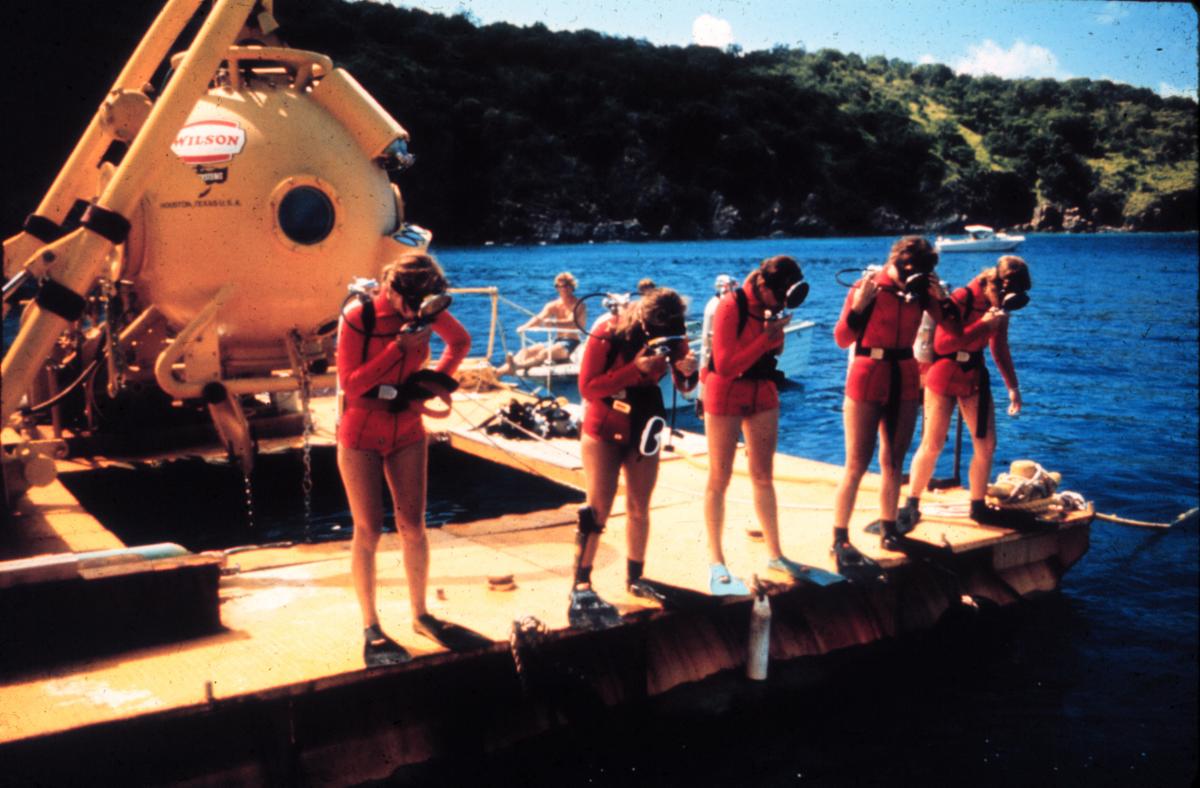
| | Five women that inhabited the Tektite II underwater laboratory train for their 1970 mission. Credit: OAR/National Undersea Research Program (NURP); National Park Service/C. Stoughton | | |
On Wednesday, July 29 at 12:00 pm EDT, space historian and curator emerita of the National Air and Space Museum Valerie Neal will present “NASA’s First and Only Mission with an All-Women Crew.”
In 1970, the all-woman crew of Tektite II gave NASA its first look at women as potential astronauts and was, in effect, NASA’s first mission to include women, not to mention the agency’s only all-women crew.
| | |
|
TRIVIA CHALLENGE
Gemini X's Missing Photos
| | |
July 18 marks the 60th anniversary of NASA’s Gemini X mission, the eighth crewed flight of NASA’s Gemini program. Along with rendezvousing with two separate targets and completing two spacewalks, astronauts John Young and Michael Collins set a new altitude record for human flight in July 1966, making progress on a number of the important prerequisites for landing the first astronauts on the Moon by the end of the decade.
Michael Collins was the third American astronaut to perform a spacewalk. Why do we not have any photos from this extravehicular activity?
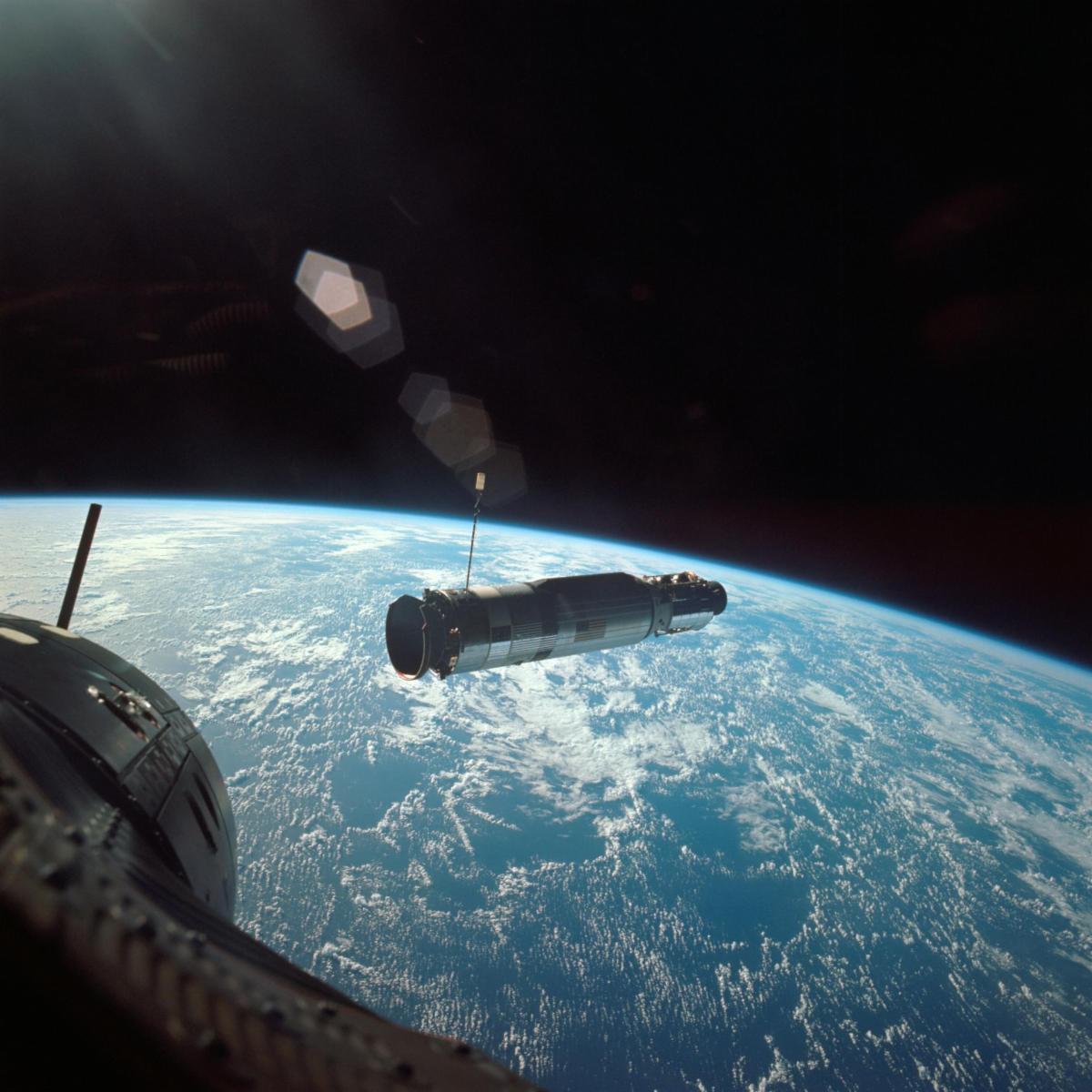
| | Astronauts John Young and Michael Collins capture the Agena Target Docking Vehicle through the window of the Gemini X spacecraft on July 18, 1966. Credit: NASA | | Click on your choice to reveal the correct answer. | | |
NASA History
The NASA History Office documents and preserves NASA’s remarkable history and strives to engage with the public about NASA's past and how it relates to our world today.
| |
| |
National Aeronautics and Space Administration
NASA explores the unknown in air and space, innovates for the benefit of humanity, and inspires the world through discovery.
Visit nasa.gov
| | | | | |