Issue 684 - September 25, 2026

IN THIS ISSUE


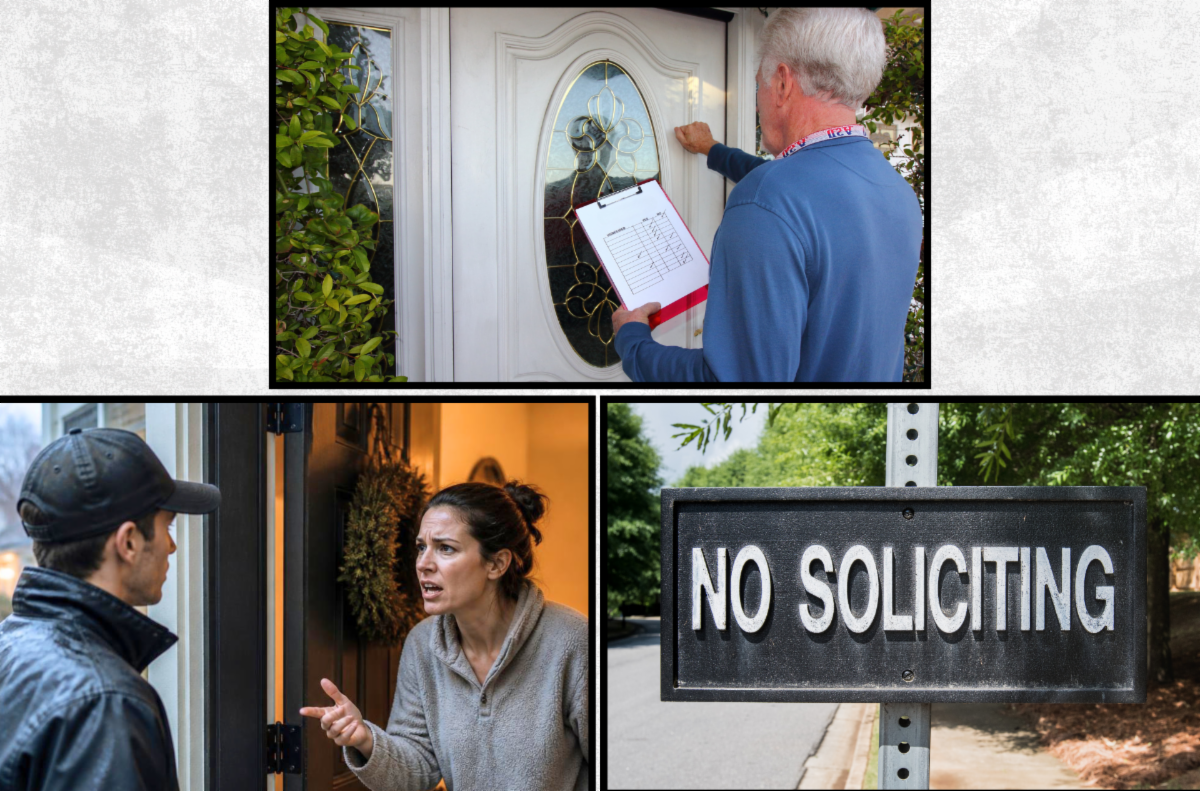
  • FEATURE: Confusion Over Solicitation and Political Canvassing Creates Friction, Conflict
  • ELEPHANT'S GRAVEYARD: Bills Seeking to Increase Electricity Supply and Eliminate Needless Expenses Left to Die
  • NEWS: Lawmakers Take Part in Special Event at Historic Site to Commemorate 250th Anniversary of Independence

FEATURE

Confusion Over Solicitation and Political Canvassing Creates Friction, Conflict


With less than six weeks remaining until Election Day, political candidates and their supporters throughout Delaware are actively campaigning, leading to more complaints and confrontations over confusion between solicitation and canvassing.


Decades of case law have established Americans' right to advocate for political, religious, and non-profit causes door-to-door, even in privately owned communities.


Solicitation involves situations in which individuals go door-to-door to sell goods or services. By contrast, canvassing is a noncommercial exercise of free speech guaranteed by the First Amendment to the U.S. Constitution. In political canvassing, volunteers or candidates visit homes to share information, discuss public issues, register voters, or encourage people to vote. Canvassing for political, religious, and non-profit groups is a protected right. Noncommercial canvassers are legally entitled to go door-to-door, speak with residents, and distribute literature.


Federal court cases over more than sixty years have affirmed and framed these rights, striking down state and local attempts to prohibit or unreasonably restrict such activities.


In Lovell v. City of Griffin (1938), the Supreme Court of the United States (SCOTUS) found that a city ordinance requiring a permit to distribute “circulars, handbooks, advertising, or literature of any kind” was unconstitutional. The ruling established a precedent for broadly allowing canvassing and the distribution of flyers, declaring it a form of protected speech. 


In Martin v. City of Struthers (1943), the Supreme Court found unconstitutional a municipal ordinance that barred anyone from contacting citizens in their homes to distribute handbills or circulars. Delivering the prevailing opinion, Justice Hugo Black noted that the ability to distribute information to every citizen was “so clearly vital to the preservation of a free society that…it must be fully preserved.”


Generally, constitutional freedoms cannot be suspended inside privately owned communities. 


In Marsh v. Alabama (1946), the High Court considered a case in which religious materials were being distributed in Chickasaw, a town exclusively owned by a corporation. Company officials posted the notice stating: "This Is Private Property, and Without Written Permission, No Street, or House Vendor, Agent or Solicitation of Any Kind Will Be Permitted." 


A woman handing out literature for the Jehovah's Witnesses was later arrested when she refused to comply with the declaration. In this case, the justices found that even though the community was under exclusive private ownership, the owners could not arbitrarily curtail citizens’ constitutional rights. “Ownership does not always mean absolute dominion,” the court’s prevailing opinion stated. “When we balance the Constitutional rights of owners of property against those of the people to enjoy freedom of press and religion, as we must here, we remain mindful of the fact that the latter occupy a preferred position.”


Political canvassers cannot be required to obtain a license, pay a fee, wear an identification card, be subject to a criminal background check, or get permission from any municipality or homeowners association –- all rights affirmed in decisions made in the decisions of: Murdock v. Pennsylvania (1943); Watchtower Bible & Tract Society of New York, Inc. v. Village of Stratton (2002); and Lovell v. City of Griffin (1938).


While political canvassing is legally protected and cannot be prohibited by state law, municipal ordinance, or most homeowners’ associations, it is not without limits.


Private, gated communities, whose roads are not open to public access, can bar canvassers from entering.


Within reason, restrictions can limit the hours during which political canvassing can occur, such as between 9 a.m. and 9 p.m.


Homeowners have the right to bar canvassers from their properties by posting “No Trespassing” or “No Canvassing” signs. 


Canvassers must also leave the property immediately if the homeowner asks them to. Under Delaware law, people who knowingly violate the property owner's wishes could be found guilty of criminal trespass in the second or third degree.

ELEPHANT'S GRAVEYARD

A CONTINUING OPINION FEATURE LOOKING AT BILLS SUPPORTED BY HOUSE REPUBLICANS DURING THE 153RD GENERAL ASSEMBLY THAT DID NOT BECOME LAW...BUT PROBABLY SHOULD HAVE.

Bills Seeking to Increase Electricity Supply and Eliminate Needless Expenses Left to Die


Several measures sponsored by House and Senate Republicans to lower power costs and increase electricity supply failed to advance in the 153rd General Assembly. Here are examples of some of the proposals and their fates:


Encouraging the Construction of Efficient, New Power Plants

HOUSE BILL 186: State Rep. Kevin Hensley (R-Townsend, Odessa, Port Penn) and State Sen. Brian Pettyjohn (R-Georgetown) sponsored this bipartisan bill to increase power generation in Delaware. It would incentivize the construction and operation of up to three high-efficiency combined-cycle gas turbine generation facilities, with outputs between 100 MW and 500 MW, by creating an Electricity Production Tax Credit (EPTC) and bonus credits. 


Two 500 MW plants would provide more than enough electricity to serve every residential dwelling in the state at peak demand. 


Combined-cycle gas turbine power plants are a proven technology that can provide significant dispatchable power to meet Delaware’s growing energy needs. These facilities are a foundation of modern energy grids, offering a blend of operational flexibility and lower environmental impacts than most traditional power plants. Rep. Hensley said the proposal would increase cost-effective production within the state. Delaware currently imports most of its electricity, which reduces energy security and adds transmission expenses. 


The bill would not require any public expenditure.


STATUS: Died in the House Revenue & Finance Committee. A reworked and improved version of the legislation is expected to be introduced in the upcoming 154th General Assembly.


Curtailing an Ineffective Program Costing Ratepayers Cash

HOUSE BILL 80: The Renewable Portfolio Standard is the percentage of electricity that utilities must source from renewables. This is presently set at 25.5% and will increase annually, topping out at 40% in 2035.


“The thing is, Delaware does not have enough renewable energy to meet the current mandate, let alone the future,” said State Rep. Mike Smith (R-Pike Creek Valley). “But our state allows utilities that can’t hit the mark to buy their way out of it with 'alternative compliance payments' (ACPs)."


In 2025 alone, Delmarva Power customers paid $14.3 million in ACPs—costs that were passed along to ratepayers.


Rep. Smith’s proposal would have rolled back the Renewable Portfolio Standard to 10% and frozen it for 10 years, providing time to build new renewable energy capacity and connect it to the regional grid while giving ratepayers some needed relief.


STATUS: The bill died in the House Natural Resources & Energy Committee after being tabled.


Eliminating the Tax You Didn’t Know You Were Paying 

SENATE BILL 65: Delaware belongs to a group of 11 states called the Regional Greenhouse Gas Initiative (RGGI), initially formed to cut carbon dioxide (CO2) emissions from power plants.


In these states, fossil fuel generators must buy “allowances” to emit CO2. These costs are quietly passed along to ratepayers. In 2025, Delaware ratepayers collectively paid an additional $12.3 million in RGGI-imposed costs. Participating states have reduced their annual power sector CO₂ emissions by about 50% since the program's 2005 benchmark year, far exceeding the program's initial goals.


This proposal, sponsored by Sen. Gerald Hocker (R-Ocean View) and State Rep. Bryan Shupe (R-Milford South), would remove Delaware from the Regional Greenhouse Gas Initiative, eliminating the hidden tax it imposes on Delawareans.


Supporters of the bill say Delaware's residential electricity costs are higher than in most states and that continuing Delaware's membership in a program that has already met its objectives is a needless burden on ratepayers. Exiting the program will give Delaware decision-makers more flexibility to pursue prudent energy policies while improving affordability.


STATUS: The bill died after spending more than a year awaiting action in the Senate Environment, Energy & Transportation Committee without receiving a hearing.

NEWS

Lawmakers Take Part in Special Event at Historic Site to Commemorate 250th Anniversary of Independence


New Castle’s Old Court House, one of the oldest surviving public buildings in the nation, hosted a special event Thursday commemorating the 250th anniversary of the signing of the Declaration of Independence and Delaware’s statehood.


On June 15, 1776, the "colonial assembly of the Lower Counties" met at the New Castle Courthouse and passed the Act of Separation, ending the region’s contentious relationship with the Colony of Pennsylvania and the British Empire. Less than three weeks later, Delaware delegates joined the Continental Congress in Philadelphia to sign the Declaration of Independence.


Thursday’s ceremony was part of Delaware’s America 250 celebration. The 153rd General Assembly held a commemorative special session nearly 250 years after the first General Assembly met in the same building to adopt the state’s first constitution.


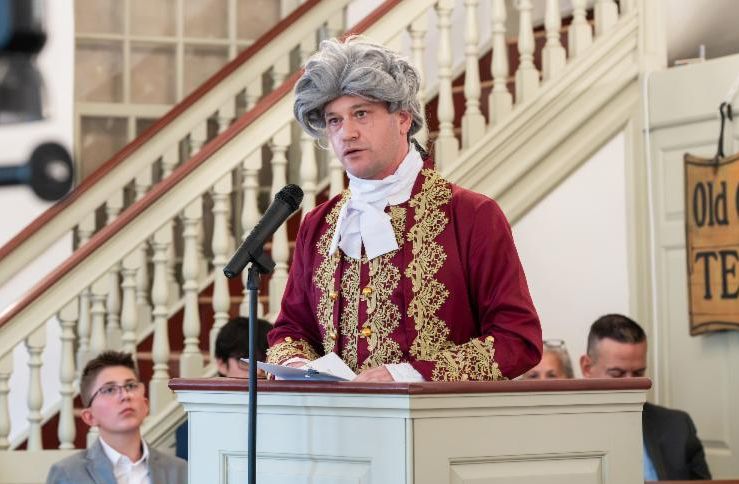
Appearing in period dress (top photo), State House Republican Whip Jeff Spiegelman (R-Townsend, Smyrna, Clayton) joined other legislative leaders in reenacting aspects of the historic proceedings.


"I told the Speaker and President Pro Tem that I had received a correspondence from the 2nd Continental Congress," Rep. Spiegelman said. "We had declared independence by voting in favor of the motion of independence introduced by Richard Henry Lee, a delegate from the Virginia House of Burgesses. A committee had put together a document listing the reasons, and I read it to the chamber."


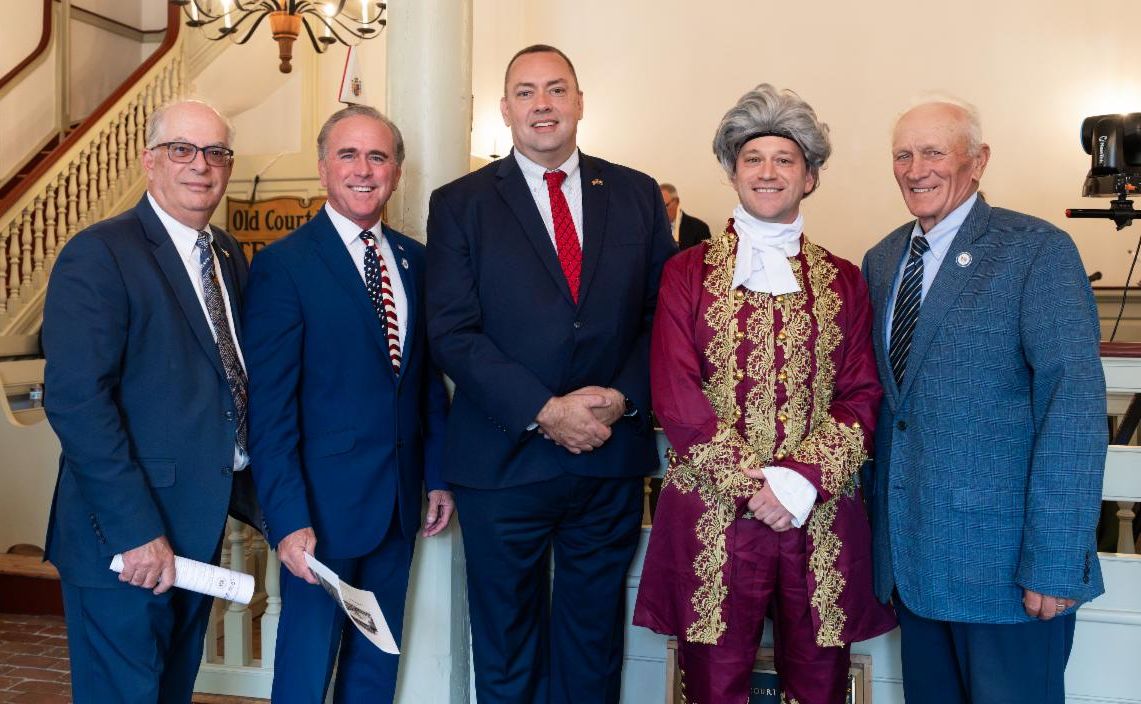
In group photo: Among those taking part in the special session were, from left, State Rep. Danny Short, State Sens. Eric Buckson & Brian Pettyjohn, State Rep. Jeff Spiegelman, and State Sen. Dave Wilson.