|
|
|
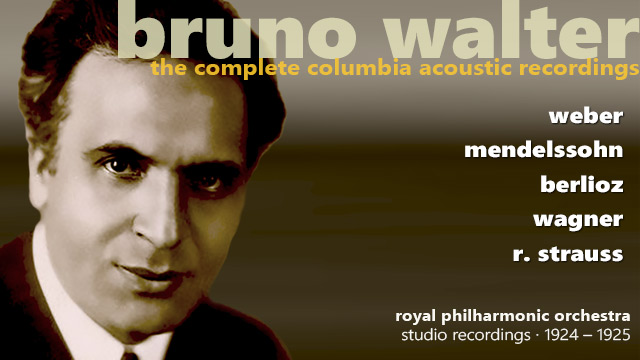
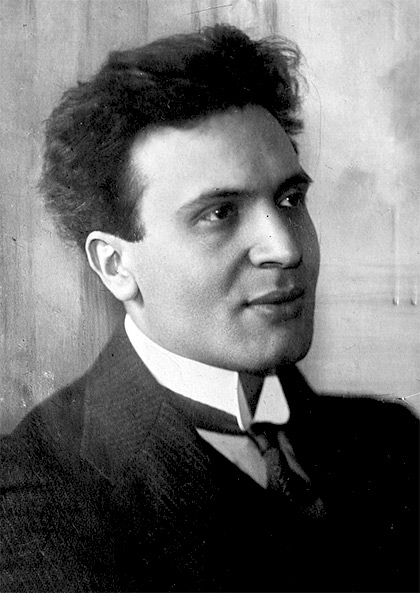
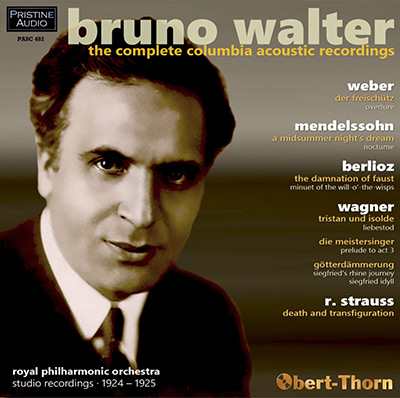
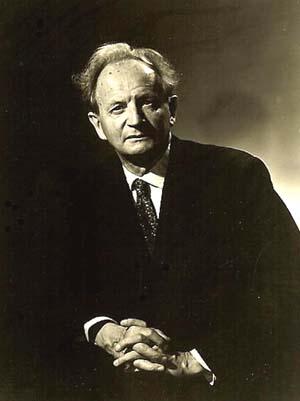
BRUNO WALTER
(1876-1962)
WEBER Der Freischütz - Overture MENDELSSOHN A Midsummer Night's Dream - Nocturne BERLIOZ The Damnation of Faust - Minuet of the Will-o'-the-Wisps WAGNER Tristan und Isolde - Liebestod
WAGNER Die Meistersinger - Prelude to Act 3 WAGNER Götterdämmerung - Siegfried's Rhine Journey
WAGNER Siegfried Idyll R. STRAUSS Death and Transfiguration
"
The Columbia Tod und Verklarung, with which Bruno Walter and the Philharmonic Orchestra make their début on the gramophone, is such a remarkably different interpretation from Albert Coates' H.M.V. performance that for once I do not grumble at unnecessary reduplication. But reduplication is a great trial to me, because reduplication of a large work means that I am asked to choose for readers which they shall acquire. I feel fairly confident that most of them would prefer the Columbia version. But those who prefer the Flonzaley Quartet to the Lener Quartet will prefer the H.M.V. version. Bruno Walter is more romantic, not to say sentimental. Coates inspires more awe. By the way, we get the famous gong in the Columbia version, which is five-sided. The sixth side is taken up by Berlioz's Dance of the Sprites from The Damnation of Faust. We want some more Berlioz on the gramophone. It's not fair to use him always for spare sides. What about the Symphonie Fantastique? Berlioz is sneered at by our impotent and introverted highbrows, but he was one of those who bore the heat of the fight and made it easy for those who followed him to do better what he had been the first to attempt. Sir Edward Elgar took me to hear this last autumn, and he did not sneer at a great, predecessor. Saint-Saëns, who was not half the man that Berlioz was, has had much more attention on the gramophone.
...
The great panorama music of Wagner goes with a noble stride. Walter controls very steadily, and lets the lighter parts sing out in all their sweetness. The body of tone and the building up of the whole are notable. This seems to me one of the best things we have had for some time. It ranks in my mind with the Funeral March of Siegfried, and with the Wedding Procession Music from Lohengrin, among other works, as quite at the high-water mark of present-day recording."
- The Gramophone, 1925
Bruno Walter was one of a handful of conductors and musicians whose recording careers spanned the incredible leaps in sound quality that were achieved in the years between the 1920s and 1950s, during which time acoustic horn recordings were superseded by the microphone, direct to disc recording was overtaken by magnetic tape, shellac gave way to vinyl and the long player, and mono sound blossomed out into stereo.
We've previously issued two albums of Walter's German acoustic recordings, made with the Berlin State Opera Orchestra and issued on the Polygram label in the years 1923-1925 (PASC142 and PASC322), in transfers by Ward Marston. This week Mark Obert-Thorn takes up the baton and moves us to London and the Petty France studios of the Columbia record company, where Walter conducted the Royal Philharmonic Orchestra (in its pre-Beecham incarnation) in a series of recordings made in the years 1924 and 1925.
It's all too easy to dismiss acoustic recordings as relics so distant and compromised in sound quality (and re-orchestration and cuts) as to be largely irrelevant to the modern listener, and certainly they can be an acquired taste. But that does not and cannot take away from the musicianship and fine interpretations to be heard on these recordings. And whilst electrical recording, begun in the summer of 1925, was to quickly render these discs technically obsolete, it should be recognised that by this time the acoustic process was mature and capable of a surprising degree of fidelity, given its inherent limits.
Here (and on our website) I've reproduced four review excerpts from issued of The Gramophone, all published in 1925, and all full of enthusiasm for these new recordings. I almost wrote "from this young conductor" there, but of course Walter was far from young and inexperienced - his 140th birthday looms on September 15th of this year, and he was already into his late 40s when the present recordings were made.
Here was one of the finest practitioners of his art, captured at what might have been considered at the time to be his peak, and delivering the goods to an audience still struggling with the concept of having to choose between recordings - fancy the modern reviewer writing lines like this: "for once I do not grumble at unnecessary reduplication. But reduplication is a great trial to me, because reduplication of a large work means that I am asked to choose for readers which they shall acquire"!
But read on - these recordings certainly captured the imagination of the day, and remain treasures more than 90 years later:
"The final outpouring of Isolde's love and sorrow is one of the hundreds of purely lovely pages in Wagner. That love-duet of Act 2, that we have sometimes (until we got into our Wagnerian second wind) found lengthy, supplies the themes for the final scene, and is here raised to a higher power still. We feel the poignancy of the parting as we feel few things in all opera. What a giant Wagner was! This is true art, that takes us off our earthly feet and carries us aloft with it in spirit. This disc goes with several recent Columbias in the hierarchy of recording.
...
The taste of the Prelude to the third act of The Mastersingers (wrongly called, on the record, The Meistersingers) is delectable. It epitomises the wise, kindly, tolerant spirit of Sachs, and has a touch of melancholy too. Wagner told us that the motive first heard is "the bitter cry of a man resigned and resolved to wear a brave and cheerful face before the world." Love is for the young. Sachs, a true gentleman, furthers the interests of Eva and Walter, keeping to himself his reflections on what might have been. His soul, "quieted and reconciled . . . reaches to the uttermost serenity of holy and peaceful resignation.""
- The Gramophone, 1925
Producer and Audio Restoration Engineer:
Mark Obert-Thorn
Total duration:
76:51 (1 CD)
Producer's Notes - by Mark Obert-Thorn
Although Bruno Walter claimed late in life that he had made his first recordings around 1900, his earliest documented discs date from 1923 when he began a series for Grammophon/Polydor in Berlin, most of which have been reissued on Pristine PASC 142 and PASC 322. In May, 1924, Walter was in London for the first presentation of a German opera season at Covent Garden since the end of the Great War. That month, he conducted Wagner's
Ring cycle,
Tristan und Isolde, and Strauss'
Der Rosenkavalier in enthusiastically-received productions featuring Frida Leider in her Covent Garden début, Lauritz Melchior, Friedrich Schorr, Lotte Lehmann and Elisabeth Schumann.
On May 22, Walter entered the Columbia studios at Petty France to make the first in a series of discs for a label with which, on one side of the Atlantic or the other, he would be associated for much of the rest of his life. A
Siegfried Idyll was recorded that day, followed by the first three sides of Strauss'
Death and Transfiguration the following day; however, neither was approved for release.
It would not be until the following December that Walter, who had returned to London to conduct the (old, pre-Beecham) RPO in a performance of Elgar's First Symphony in the presence of the composer, would be back in the Columbia studios. Over the next five days, he would preside over four recording sessions, one of which was devoted to a single title (Mozart's
Marriage of Figaro Overture) which ultimately remained unissued. Four further sides would be recorded the following February before the microphone supplanted the old acoustic method of recording.
The present collection brings together all of Walter's published acoustic Columbias. It includes one recording (Weber's
Freischütz Overture) which was only released in America, as well as two which were only published in Britain (the "Rhine Journey" and
Siegfried Idyll). A further recording of "Siegfried's Funeral Music" from
Götterdämmerung which came out on American Columbia credited to Walter was actually conducted by Hamilton Harty.
The repertoire chosen largely follows the composers and even some of the particular works with which Walter was making a name for himself at Covent Garden at the time - much Wagner, along with Strauss - and includes several works to which Walter would not return again in the studio (the Mendelssohn, Berlioz and the
Tristan "Liebestod"). The playing of the orchestra is variable, both in ensemble and pitch; and some of the tempi seem a bit speeded up in order to get the music onto a single side (particularly in the Mendelssohn and the
Meistersinger Prelude). Elsewhere, though, Walter is given the opportunity to take as long as he wants, with the Weber overture spread over three sides, as it would not be in his Paris remake fourteen years later, and the "Liebestod" generously given two 12-inch matrices for its six-minute duration.
The transfers for this release drew wherever possible upon American Columbia "New Process" pressings (for the Weber, Mendelssohn, Berlioz, Strauss and Wagner "Liebestod") which featured the most (relatively) quiet surfaces available, and English Columbia discs for the remainder. From its original release onward through all modern discographies I've seen, the Berlioz has always been misidentified as the "Dance of the Sylphs" rather than as the "Minuet of the Will-o'-the-Wisps", to which it has been corrected here.
|
|
|
|
| Kempff |
|
Pristine Exclusives
Wilhelm Kempff, piano
BEETHOVEN
Bagatelle in C, Op.33, No.5
Recorded Berlin 1931
Issued as
Polydor 62630
Transfer by Dr. John Duffy
Additional restoration by Andrew Rose
Wilhelm Kempff made what is believed to be his very first recording in c.1920, of this short Bagatelle by Beethoven, and he would return to the Bagatelles in the mid-1960s to make a complete recording. But this return to the Bagatelle Op. 33, No. 5 in C major, recorded in Berlin in 1931, has slipped past many of the discographies and ranks perhaps as one of Kempff's rarer Beethoven discs.
|
Audiophile Audition
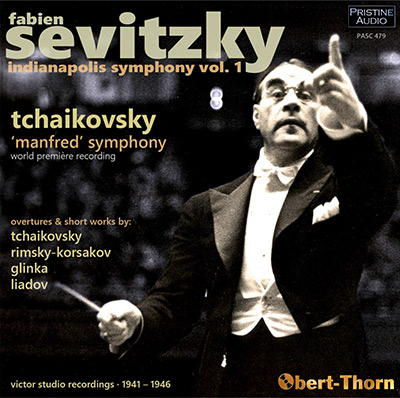
FABIEN SEVITZKY
Indianapolis Symphony, Vol. 1
TCHAIKOVSKY Manfred Symphony
TCHAIKOVSKY Eugene Onegin - Waltz
GLINKA Russlan and Ludmilla - Overture
RIMSKY-KORSAKOV Dubinushka
LIADOV Baba Yaga
Indianapolis Symphony Orchestra
Fabien Sevitzky, conductor
Studio recordings, 1941-46
PRISTINE AUDIO PASC 479
"Mark Obert-Thorn restores the World Premiere recording of Tchaikovsky's Manfred Symphony"
The restoration of the Fabien Sevitzky (nee Koussevitzky) reading of the Tchaikovsky
Manfred Symphony (27-28 January 1942) at the Mural Theatre, Indianapolis by audio engineer and annotator Mark Obert-Thorn is not the first CD incarnation of this performance: it had been issued on the Historic-Recordings.co.uk label in 2009 (HRCD 00017) in a transfer by Damien Rogan. Under that aegis, the gloomy, dramatic symphony inspired by Lord Byron's 1816 epic poem stands alone; here, Obert-Thorn adds - in the first two selections from 1941 - the earliest of the conductor's sessions at RCA Victor. Sevitzky (1891-1967) - nephew of his more illustrious uncle Serge Koussevitzky - had studied both with Liadov and Rimsky-Korsakov in St. Petersburg, so he had imbibed the Russian style naturally. An avid collector of neckwear, Sevitzky claimed to possess the second largest assortment of neckties, after that of the actor Adolf Menjou. The boast came as part of the Indianapolis Orchestra's appearance at Cornell University, 2 December 1940.
The
Manfred Symphony (1886) evolved from the efforts of Mily Balakirev to convince Tchaikovsky that the latter could write a programmatic work after Byron without having become overwhelmed by the Berlioz influence. Tchaikovsky balked a number of times, but he finally conceded to his own imagination, which had been thwarted for two years by his own admiration of the Schumann treatment of the poem as an incidental melodrama. Typically, Tchaikovsky utilizes a series of leitmotifs to follow the course of his protagonist, who suffers an acute form of Romantic Agony. Manfred pines for his lost beloved Astarte, and the various fits of passion enjoy throes worthy of Poe as well as Byron.
Given the modern popularity of the score among such conductors as Markevitch, Maazel, Rachlin, and Louis Lane, some of Sevitzky's tempos seem unconventional. Leonard Bernstein loathed the music, calling it "trash." Toscanini in 1949 performed the work, even extolling its form - and then cut well over 100 bars from the last movement. The outer movements from Sevitzky unfold quite sympathetically, and the Indianapolis string tone can be elegant. The second movement
Vivace con spirito - Manfred's meeting with an Alpine fairy - moves from
b minor to
D Major, and its secondary theme must be counted among Tchaikovsky's most lovely tunes, soon in counterpoint with the "Manfred" motif. The second movement received the attention of Albert Coates who, unfortunately, recorded no more of the work. Sevitzky slows down the romantic theme considerably, while the outer sections - somewhat in the "flighty" style of Mendelssohn - move briskly.
Sevitzky's
Andante con moto third movement - a
G Major siciliana much in the bucolic, Berlioz style - moves at a dangerously slow pace, threatening at moments to lose the melodic thread. Still, the winds and strings preserve a redolent, spatial sensibility, quite effective. The last movement means to convey subterranean bacchantes in the presence of Astarte's shade, and we soon hear Sevitzky's substitution of a side drum for the composer's designated tambourine. The fugal writing cedes more to German academics than to musically dramatic logic. The cymbal crashes prove jarring, as required. The Manichean progression from dark to light,
b minor to
B
Major, ends with an exalted chorale, Manfred's transfiguration. For a first complete rendition of this ambitious and ungainly score, the Sevitzky holds up well.
The other Russian items reveal an energetic, fiery personality before the music. The Glinka
Russlan and Ludmilla Overture (8 January 1941) bursts forth furiously, well in the manner of Yevgeny Mravinsky, with a vibrato-rich string tone. The 1905 political-campaign song
Dubinishka (7 January 1941) savors the
marcato approach, militant and somber. The Indianapolis brass shines here, as well it should. The
Op. 56 symphonic character-piece
Baba-Yaga by Liadov revives the folk-lore witch-figure, more recently embodied in Keanu Reeves' film
John Wick. The little demon snarls, hops and skips with adequate malevolence in a resonant RCA record from 9 February 1945. Tchaikovsky's
Waltz from Eugene Onegin first impressed me when Beecham's Royal Philharmonic played it. Then, I heard the Waltz with the vocal accompaniment in the opera, led by Mitropoulos. Here (19 March 1946), Sevitzky keeps the lithe, somewhat breathless, momentum primary, a real ballet tour de force in fine sound.
Gary Lemco
This article appears at Audiophile Audition
|
MusicWeb International
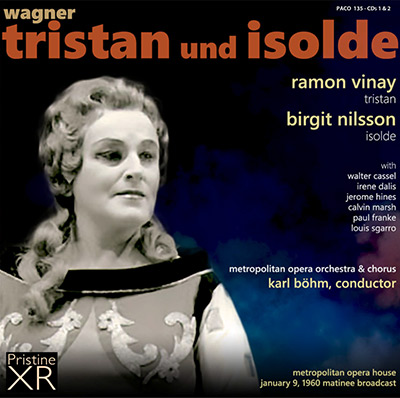
WAGNER Tristan und Isolde
Tristan -
Ramon Vinay
Isolde -
Birgit Nilsson
Orchestra & Chorus of the Metropolitan Opera
Karl Böhm, conductor
Live broadcast recording, 1960
PRISTINE AUDIO PACO 135
"A highly desirable memento of a great occasion"
For those who think Böhm's more celebrated live recording from Bayreuth in 1966 is too fast, this performance from the Met six years earlier will come as a shock: excluding Milton Cross's radio announcements it is a mere three hours and seventeen minutes, compared with just under three and a half hours in 1966 and about 3:20 at Bayreuth, with the same two principals, in 1962.
The latter certainly benefits from somewhat more relaxed speeds, as the review by my MusicWeb colleague Paul Godfrey points out but for some the febrile excitement of Böhm's attack on the score will carry its own thrill. To be fair, the love music of Act II does not sound too rushed, climaxes are skilfully paced and weighted, and key orchestra passages such as the one in Act I following "Herr Tristan trete nah" are beautifully judged, but for those who prefer a more temperate approach the 1962 Bayreuth performance will suit. Unfortunately, as with the Met relay here, the audience there is maddeningly bronchial; the 1966 recording is composite so the engineers were able to edit out the worst intrusions and select the best passages from both performances and rehearsals; here in 1960, you get what you get, as it was broadcast, persistent hacking and all. The coughing through the cor anglais solos opening Act II is especially irritating and the Met orchestra is perhaps lacking a tad in weight and "grunt" compared with its Bayreuth counterpart but it is still very fine.
However, there are distinct advantages to this recording, not least the usual superb Pristine XR remastering which enormously improves upon the original tapes and provides a realistic, unobtrusive Ambient Stereo effect. The sound is well balanced although a little brittle and peaky on higher, louder notes; nonetheless it is miraculous for its age and provenance. Furthermore, for those who like me admire Windgassen's artistry but find his tone rather whining, we hear a more virile, heroic Tristan from Ramon Vinay, still at his peak two years before he reverted to baritone roles. Finally, the thrill of Birgit Nilsson's debut as Isolde is captured in full; her actual debut which created a front-page sensation was three weeks earlier but she was partnered by a lesser tenor than either Vinay or Windgassen in Karl Liebl, subbing for an indisposed Vinay, so this is a more desirable memento of her Isolde in her youthful prime. Nilsson herself is of course phenomenal, the top C's effortless, the narratives full of bite and the concluding "Mild und leise" transcendent. Of course she also made a studio recording under Solti later that same year but while Fritz Uhl is serviceable and musical, there is something of the same imbalance between the lovers' voices which mars Nilsson's live performances with Windgassen. By all accounts, she preferred him above all as her Tristan but my preference remains for Vinay, whose baritonal heft and agonised delivery of the text rival Melchior and Vickers for animal passion. He was the pre-eminent Tristan for whole of the 1950's, taking over from Melchior, Lorenz, and Svanholm and his powerful voice matches Nilsson's in amplitude, whereas other tenors tend to be swamped by her laser-like intensity. The erotic intensity generated in the extended Act II love duet is electric and hardly compromised by Böhm pressing on the tempo.
The supporting cast has no weaknesses but few are as good as the 1966 Bayreuth recording. Irene Dalis' Brangäne is vocally not as beguiling as Christa Ludwig's - there are some slides and glottal mannerisms, and her rich tone can be a little "clotted" but the sound is voluminous, she has a splendid lower register and can keep up with Nilsson in their exchanges. Walter Cassel as Kurwenal cannot match Waechter or Hotter in his prime; he is rather blustery in Act I but smoother in Act III, even if again he occasionally barks a bit. Charles Anthony makes a lovely Sailor, better than Georg Paskuda in 1962 or Peter Schreier in 1966 and Jerome Hines delivers a big, warm stream of sonorous bass tone. His nobility and steadiness are admirable but his characterisation is rather generalised compared with the superb Martti Talvela, whose anguish is more touchingly palapable.
To sum up, this remains a highly desirable memento of a great occasion, compromised by audience coughing but greatly enhanced by Pristine's splendid remastering.
Ralph Moore
This article appears at MusicWeb International
|
|
|
|
|
|
|