Important note: If you experience issues with this newsletter's display,

please view the web version.

#RTC:Rural eNews

November

2025

A number of individuals in wheel chairs are in line for something. The photo shows them spaced evenly a part while they wait on a city sidewalk.
An older black man with a blue collard shirt black hat and beard sits in the drivers seat of a bus. He is turning behind to look at the camera.

“Being stuck in four walls for so many years, you know, it's very frustrating. I now have the freedom to do what I want, when I want, like anybody else.”


- Rider 


“I didn’t have access to transportation for at least 15 to 20 years… It was hard, it just sucked. When I became a quad I was only 22 and I had two and three year old girls. When they were in school I couldn't go to their performances. Now I can go see my grandkids.”


- Rider

Recruiting Transportation Voucher Pilot Sites! 

RTC:Rural is creating a Transportation Voucher Toolkit to guide rural CILs through the process of creating and managing their own transportation voucher program. This project is meant to provide committed CILs with tools and resources to engage and succeed in this process. Transportation voucher programs are a crucial strategy for improving rural transportation options. 


We are recruiting two CILs that have both the capacity and interest to pilot test using the toolkit to create their own rural transportation voucher program.


To apply, you must have: 

  • Rural counties in your service region. 
  • No existing transportation voucher programs at your CIL.  


Interested? Contact luke.santore@mso.umt.edu with questions or click the button to apply.

APRIL Conference Thank You and Recap 

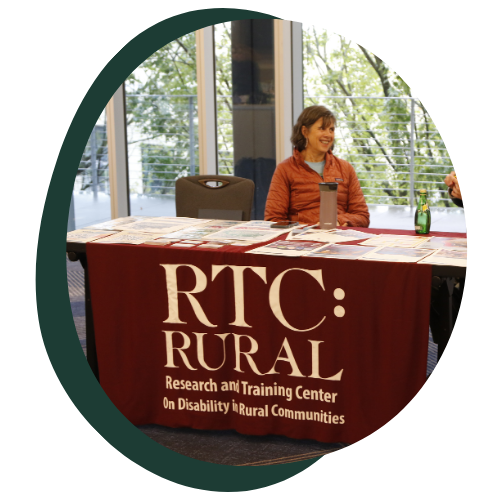
The 2025 APRIL Conference is in our rearview mirror as quickly as it came up, and it was another spectacular event. Thank you to all the CILs, advocates, researchers, and individuals that made the trip to Portland to learn and share about Independent Living. Special thanks to our rural librarian friends from Project CARE who attended to learn more about IL and the great work CILs are doing nationwide.  


We are working to synthesize the feedback from our sessions and will share the information as soon as possible. Please stay tuned! 


Photo courtesy of Jon Wick.

Catherine Ipsen sits at a table titled RTCRural at the 2025 APRIL conference.
A group of individuals sits around a table discussing something. The main man in the photo is a wheelchair user. He is wearing a tan shirt. He has short black hair and a black beard. He is speaking to a black woman who is also wearing a tan shirt. She has shoulder length curly hair.

New Publications!


Our team has been hard at work, and we're excited to share our latest research with you. Dive in to explore some of our findings!

TVR-SET Publication 


In this report, Catherine Ipsen and Luke Santore examine the impact of pilot training on the use of the Tribal Vocational Rehabilitation Self-Employment Toolkit (TVR-SET), developed to support American Indian Vocational Rehabilitation Services (AIVRS) programs. 


Self-employment is a vital pathway in reservation communities, promoting economic independence and cultural preservation. However, AIVRS programs face challenges in staff training and resources. The TVR-SET and its accompanying training address these gaps, enhancing counselors’ capacity to guide consumers in self-employment exploration and business development. 

An older woman of color is holding up a colorful purse she is selling. In front of her is a table of other colorful purses she is selling. She is wearing glasses. Has short straight greying hair and a teal short sleeve shirt.
A young woman with down syndrome sits at a table working on something. She has short brown hair and is wearing a light purple blouse.

New Research Report: Home Care Workers, Immigration, and an Aging Population 

The size of the Home Care Worker (HCW) workforce has not kept pace with demand, and inadequate compensation and benefits have historically contributed to poor HCW recruitment and retention.  Demographic trends put further strain on the workforce, with immigrants, naturalized citizens, and Black and Indigenous People of Color (BIPOC) individuals currently making up the majority of the HCW workforce. 

Policy changes, cuts to benefits, and immigration crackdowns threaten to further weaken the supply of HCWs while the demand continues to rise. In this report, Catherine Ipsen and Luke Santore provide analysis and strategies to support HCWs and strengthen the Personal Assistance Services system through proactive policy solutions. 

Assessing Vocational Rehabilitation Agency Capacity to Engage in Evidence-Based Decision Making 


The Evidence-based Policy-Making Act of 2018 requires that Federal agencies use their data to develop statistical evidence to support policy and programmatic decisions. But how well are agencies using this data to inform decision-making? Catherine Ipsen teamed up with researchers from George Washington University to participate in their grant looking at VR return on investment. This manuscript assesses the capacity of Vocational Rehabilitation (VR) agencies to use data to improve services and potential solutions to capacity deficits. 


The button below provides a preview of the manuscript, including the abstract. 


If you'd like a full copy, please contact catherine.ipsen@mso.umt.edu.


Two older white woman sitting together smile at the camera. One has short greying hair and sunglasses. She is wearing a striped shirt and holding up a peace sign. The other woman has longer white hair. She is wearing sunglasses and a blue shirt.

© 2025 RTC:Rural, All rights reserved

Instagram  Facebook

The Research and Training Center on Disability in Rural Communities (RTC:Rural) conducts research on disability as part of the Rural Institute for Inclusive Communities at the University of Montana.


RTC:Rural is funded by the National Institute on Disability, Independent Living and Rehabilitation Research (NIDILRR) grant number 90RTCP0007 to improve the ability of people with disabilities to engage in rural community living.