|
Campaigns spend in dollars. Elections are counted in votes.
At The New York Times DealBook Summit last week, Andrew Ross Sorkin asked Elon Musk about the reported $445 million he spent backing Republicans in the midterms. “I feel pretty foolish about having spent so much money and not seen much for it,” Mr. Musk said. TechCrunch · Associated Press
Asked what went wrong for Republicans on Election Day, an influential Beltway insider replied, “The consultants spent all the money on advertising, which doesn’t work.” Now comes the reckoning. The people who wrote the big checks are going to ask how much went to radio and television and how much went to getting voters to the polls.
Start with the elephant in the room. Political consulting is a business. Republican firms compete hard for clients, especially in open seats and targeted House races where budgets can run into the millions. Some even recruit the candidates they hope to sign.
Established firms like Axiom and newer outfits like the Trump-aligned AMMC offer campaign strategy, polling, direct mail, digital outreach, and media buying under one roof. That’s convenient for the candidate and lucrative for the firm. It also means the people advising a candidate on where to spend the money can sell the services they recommend.
When consultants earn a 15 percent commission on radio and television ads, every $1 million they steer to airtime earns them $150,000. Spend that same million knocking on doors and getting voters to the polls, and they earn zero in ad commissions. If the campaign manager gets a cut, too, who in that room is going to say, “We’ve bought enough airtime”?
Conservative radio host Erick Erickson saw this coming. In his view, Mr. Musk’s consultants were always going to favor flashy ads that paid hefty commissions and did little to get people to vote. Watch Erick Erickson’s remarks
Campaigns spend in dollars. Elections are counted in votes. The payoff comes when somebody who might have stayed home casts a ballot. That’s why turnout is the largest denomination of political currency. Michael Barone, a founding co-author of The Almanac of American Politics, put it in the title of his column, “All Politics Is Turnout—and Enthusiasm Is Key.” American Enterprise Institute
What 17 Percent Ought to Tell the Church
For years, former Ohio Congressman Bob McEwen spoke at our Rediscovering God in America pastors’ events across the country. He had an illustration we’ve never forgotten.
“Over here is Mount Vesuvius,” he’d say. By his estimate, 65 to 80 million Americans called themselves evangelicals, read their Bibles, and went to church. He figured half weren’t registered to vote, and only half of those who were registered would vote even in a presidential year. By his reckoning, that left one in four casting a ballot.
Then came his point. “If Mount Vesuvius so much as twitches,” he’d say, “and just 5 percent more of those folks show up at the polls, you win nearly every race up and down the ballot.”
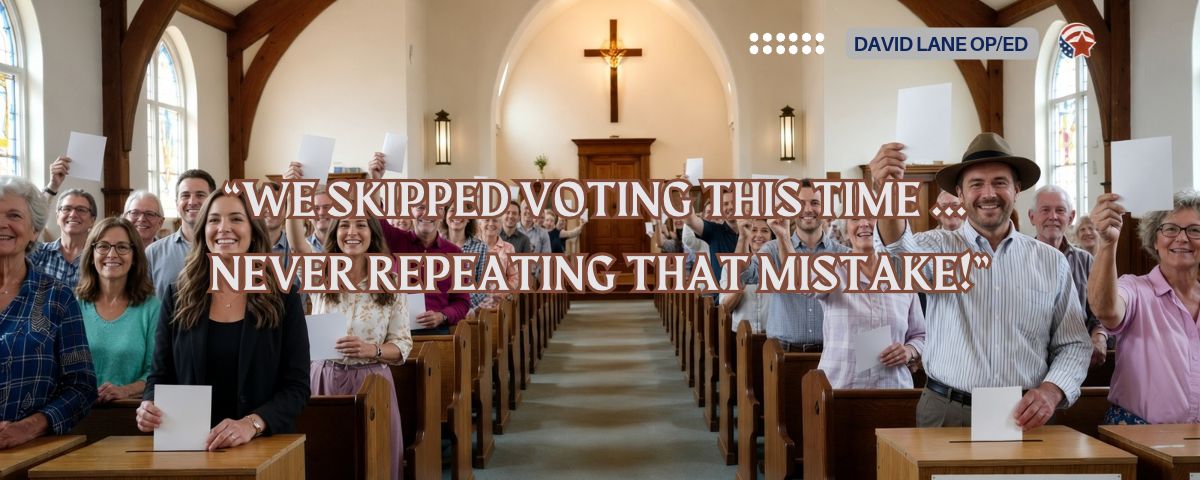
White evangelical or born-again Christians made up just 17 percent of all voters on November 3, down from 23 percent in 2024. That’s a sobering showing for American Christendom. We have churches in hamlets, towns, and cities across the country. In the spiritual battle for the soul of America, what are we doing with what the Lord has given us? Axios
If we mean to preserve this country for our children and theirs, every church ought to ask a pastor, elder, deacon, or congregant to consider running for local office. Start with the school board, city council, or county commission. There’s work to do in 2027, in 2028, in 2029, and in every election thereafter.
When the Church leaves the work of recruiting candidates and turning out voters to somebody else, we leave it to somebody else to govern. Then we wonder why the people who win elections write laws that treat as profane what Scripture calls sacred. Two plus two still equals four.
Mr. Musk could have done some of the Lord’s work with that $445 million. Imagine putting up nearly half a billion dollars each election cycle and letting the churches that reach 100 percent participation split the pot. To qualify, every eligible congregant would have to be registered and cast a ballot. How parishioners vote is their own business. Sunday after Sunday, pastors have a responsibility to teach their flocks to bring Biblical convictions to the decisions they make.
The idea is to give churches a reason to do their part in sustaining freedom in a Republic by helping every eligible voter in their pews register and get to the polls.
Speakers and Builders
Writing in The Wall Street Journal, Matthew Continetti drew attention to something Secretary of State Marco Rubio told the Federalist Society on November 13. “Victory requires something beyond good arguments,” Mr. Rubio said. It takes institutions and networks that can organize people around a common purpose. Rubio’s Federalist Society address
Here’s what often passes for mobilization in evangelical circles. We invite a gifted speaker to a rally. He draws a crowd, preaches his best sugarstick sermon, and gets a thunderous round of applause. Then everybody goes home thinking we’ve done something.
Come Monday morning, Pastor, put one person you trust in charge of the work. Give that person your blessing to put together a Salt & Light Committee. Ask the committee to help folks register, call every member of the congregation before Election Day, and make sure the widow who asks for a ride has one.
Nehemiah Put Names to the Work
When Nehemiah came to Jerusalem, the walls were rubble and the people were discouraged. He called them to rebuild. “Let us rise up and build,” they answered (Nehemiah 2:18).
Read Nehemiah 3. Eliashib the high priest and his brethren rebuilt the Sheep Gate. The men of Jericho built next to them, and Zaccur took the next stretch. Some made repairs right in front of their own houses. The chapter goes on that way, name after name, all the way around the wall.
When threats came, Nehemiah stationed the people “after their families” at the exposed places (Nehemiah 4:13, KJV). They knew where to stand and who was standing with them. The wall was finished in fifty-two days (Nehemiah 6:15).
The stakes in 2027 and 2028 are high. Pastor, who in your congregation will take the first stretch of wall?
“Let us rise up and build,” beginning with the foundation.
Thankfully, Gideons and Rahabs have begun to stand.
David Lane
American Renewal Project
|