|
What Residents Should Know About Flock Cameras, Privacy and Public Safety.
There has been some recent community discussion about Flock public-safety cameras, including questions about privacy, how the cameras are used, and how they were funded.
Those are fair questions. Residents should expect transparency and appropriate safeguards whenever their local government uses technology.
But those conversations should also be based on accurate information about what the technology actually does, how it has actually been used in Two Rivers, and how it was approved and funded.
What is Flock?
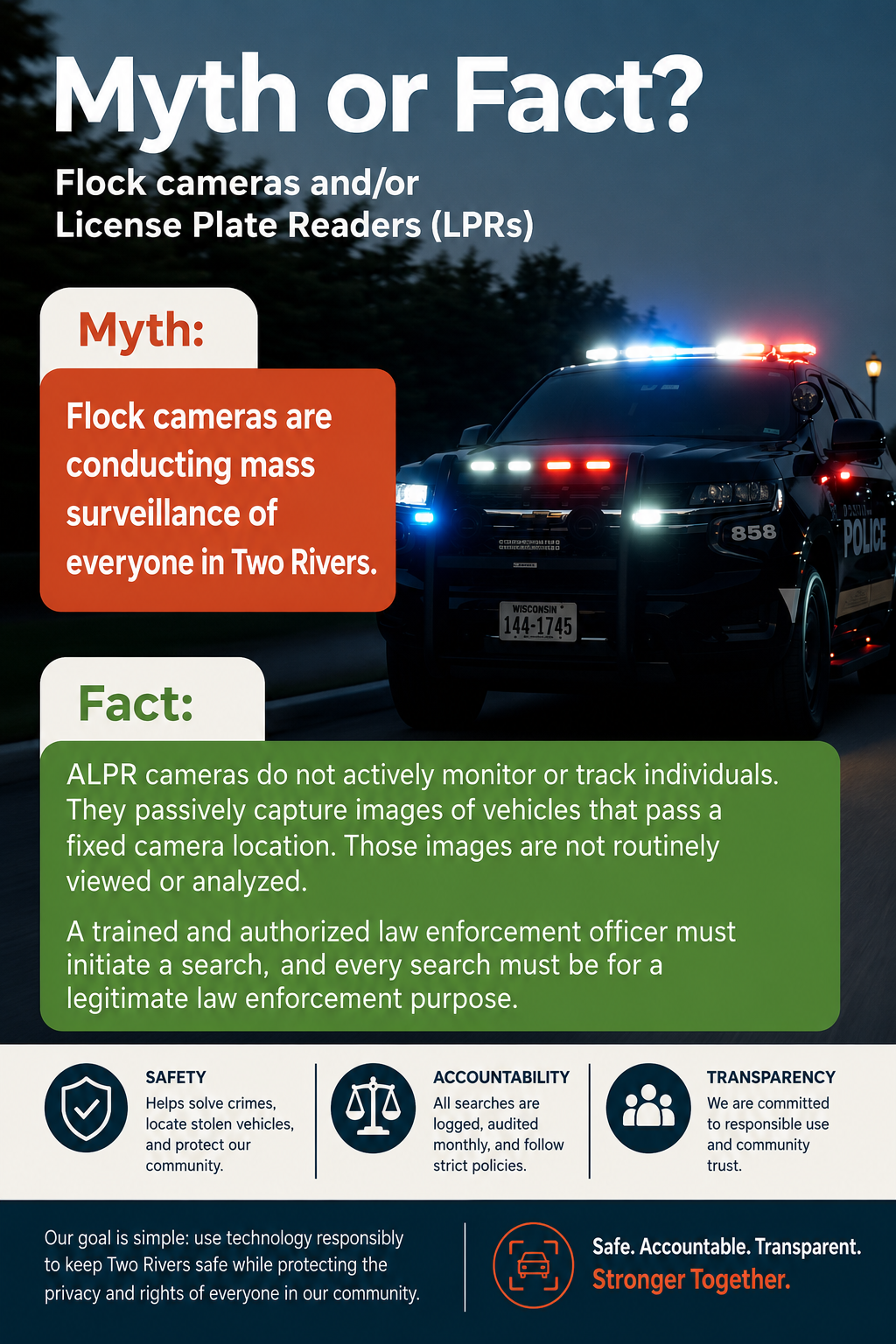
Flock cameras are automated license plate reader cameras. They capture information visible from public roadways, primarily license plates and vehicle characteristics. The exact same information a person standing on a corner can see and record.
They are not someone sitting behind a screen watching everyone's movements 24/7.
A simple way to understand the technology is that it allows police to answer a question such as: “Did the vehicle we're looking for pass this location?”
For an officer investigating a stolen vehicle, hit-and-run, missing child, theft, or other serious incident, knowing where a particular vehicle was last observed can provide a critical investigative lead.
And we don't need hypothetical made-up examples to demonstrate that. We have real ones from right here in Two Rivers.
Real Cases. Real Results. From Here.
During just the past year, Flock has assisted the Two Rivers Police Department in a variety of investigations. Not scary hypotheticals.
-
In an arson investigation, Flock provided information that helped locate the suspect.
-
Following a $9,000 theft, police identified the suspect vehicle and followed investigative leads to Milwaukee, where an arrest was made and a significant amount of stolen property was recovered.
- After a hit-and-run, officers used a vehicle description and Flock to locate the suspect vehicle within minutes.
-
In another case within the last year, an alert identified a stolen vehicle leaving Two Rivers on Highway 310. Manitowoc County Sheriff's deputies were notified and ultimately stopped the vehicle on I-43.
-
In another case, officers were alerted that a different stolen vehicle had entered Two Rivers, quickly located it, and returned it to its proper owner.
- Flock has also assisted in cases involving an endangered child, child abuse, an overdose investigation, drug investigations, homicide investigations, and a juvenile runaway. All within the past year.
- In the runaway case, Two Rivers Police assisted Manitowoc County investigators in determining that a vehicle associated with the juvenile had most recently been detected in the Sheboygan area.
The technology has helped recover property. It has helped locate suspects. It has helped neighboring law-enforcement agencies. It has helped officers determine where to look next.
And importantly, it has also helped clear innocent people from suspicion.
This Didn't Start With the 2024 Elijah Vue Investigation
It's also important to understand that the City's interest in strategically located public-safety cameras did not begin with the Elijah Vue investigation.
The need for cameras at key public locations, including parks, public streets, public infrastructure, and the beach, was recognized in Two Rivers more than 15 years ago and has continued to be discussed over the years.
The challenge has always been how to provide useful camera coverage in a practical and financially responsible way. Building and maintaining a traditional network of cameras throughout an entire community can become expensive very quickly when equipment, connectivity, data storage, maintenance, and eventual replacement are all considered.
Then came the tragic disappearance of Elijah Vue in 2024. That investigation didn't create the need for better camera infrastructure. But it exposed our vulnerability in a tragic way.
During that investigation, law enforcement was attempting to reconstruct movements, identify vehicles, establish timelines, and follow leads across the community and beyond. Unfortunately, Two Rivers had very limited camera infrastructure available to provide that information.
Our community saw that vulnerability firsthand. At the time, many residents understandably asked why more cameras weren't available and why the City didn't have better tools to help investigators piece together where vehicles had traveled.
That experience added urgency to a conversation that had already been occurring for many years.
Rather than attempting to build an extensive traditional surveillance-camera network throughout Two Rivers, the Police Department pursued a more targeted approach: strategically located automated license plate reader cameras, beginning at the City's three primary highway entrances and exits.
The system was later expanded to key locations around Neshotah Beach—another area where the City had long recognized the value of better public-safety camera coverage.
So the history is important.
Flock wasn't a reaction to one case. The City had recognized the need for strategic community cameras for more than a decade. The Elijah Vue investigation tragically demonstrated the consequences of having significant gaps in that infrastructure and reinforced the need to finally address them.
What Does Two Rivers Actually Have?
Two Rivers currently operates 10 Flock cameras along the City's three major highways and around Neshotah Beach.
The objective was never to create a camera on every street corner. In fact, as the City evaluated the cost of expanding the system, it was determined that attempting to cover every entrance and exit from the community was not financially practical.
Instead, cameras have been concentrated where they can provide the greatest investigative value to local police helping residents solve crimes.
And the actual record of their use is worth emphasizing:
Stolen cars. Hit-and-runs. Theft. Arson. Endangered children. Juvenile runaways. Drug investigations. Overdose investigations. Child abuse. Homicide investigations.
Those aren't theoretical public-safety benefits. Those are actual uses of the system.
Was Flock "Hidden" in the City Budget?
There has also been a false suggestion on social media channels that Flock funding was somehow quietly or secretly inserted into the City's budget by staff at the end of 2024.
That is false and not what happened.
The initial camera installation was included in the City's 2025 capital borrowing program at an estimated cost of up to $10,000. The actual installation ultimately cost approximately $5,300 and was properly charged to the City's capital account.
The approximately $18,000 annual Flock expense was budgeted within the Police Department's computer software operating account.
That's where it belongs.
Modern policing depends upon a significant amount of technology, and that same general area of the Police Department budget includes expenses associated with fingerprinting and scanning systems, digital evidence software, body-worn and squad camera systems, scheduling software, squad computers, background-check services, emergency communications, training and compliance systems, and social-media archiving.
Flock wasn't placed into an unusual account created to conceal the expense. It was budgeted alongside other technology necessary for modern police operations.
More importantly, City budgets don't simply appear at the end of the year.
Police Department expenditures are reviewed through the City's normal public budget process, including detailed discussions with the Police and Fire Commission, Council committees, and City Council work sessions before the budget receives final approval.
There are repeated opportunities for line-by-line public discussion of departmental budgets.
Residents can absolutely disagree about whether the City should spend money on Flock cameras. That's a legitimate policy discussion. But disagreeing with a publicly approved expenditure is different from claiming the expenditure was secretly inserted into the budget or concealed from the public. It wasn't.
Why Did Two Rivers Invest in This Technology?
There is also some important history behind the decision.
During the Elijah Vue investigation in 2024, our community saw firsthand how difficult it can be for investigators to reconstruct the movements of a vehicle when limited camera infrastructure exists.
At the time, there were significant calls from members of the community asking why more cameras weren't available to help investigators.
That experience contributed to another Police Department request to invest in camera technology. Rather than attempting to construct an extensive traditional surveillance-camera network throughout the City, Two Rivers began with Flock cameras at its primary highway entrances and exits.
The technology our community wished had been more widely available during one of its most difficult moments is now helping officers investigate crimes and protect people here at home.
Privacy and Accountability Still Matter
None of this means questions about privacy should be dismissed. They shouldn't be.
Residents should expect safeguards around technology used by their government, and policies should continue to be reviewed as technology evolves.
Two Rivers has a Flock data retention period of seven days, conducts monthly audits of the system and every search conducted, and limits its use to legitimate law-enforcement purposes.
The cameras are designed to identify vehicles and license plates. They are not facial-recognition cameras identifying the people sitting inside vehicles, nor are officers continuously watching live feeds of residents driving around the community.
Flock is an investigative tool. One of many available to our Police Department.
The system was publicly budgeted and approved. Its use is audited. Its data retention is limited to 7 days. And during the past year it has helped investigate serious crimes, recover stolen property, locate suspects and vehicles, assist neighboring law-enforcement agencies, protect children, provide investigative leads, and even clear innocent people from suspicion.
|