August 7, 2026

Two Rivers City Hall

1717 E. Park Street

Two Rivers, WI 54241

920-793-5523

Visit the Website

logo.png
Facebook  YouTube  Instagram

Have a question about City services, projects, or what’s happening in Two Rivers? 


Ask us! We’re here to help, reach out anytime and stay connected.  

This Week, City Council Approved Major Investments in Underground Infrastructure

The Two Rivers City Council approved nearly $3.75 million in financing this week to continue investing in two of the community's most important (and least visible) assets: our water and sanitary sewer systems.


While these projects may not always be as noticeable as a park revamp or new building, they represent the type of long-term investment that keeps a community functioning every day. Safe drinking water, reliable sanitary sewer service, and dependable underground utilities are the foundation upon which everything else depends.


The Council approved financing for two major utility projects:


Sanitary Sewer System Improvements – $1.78 Million


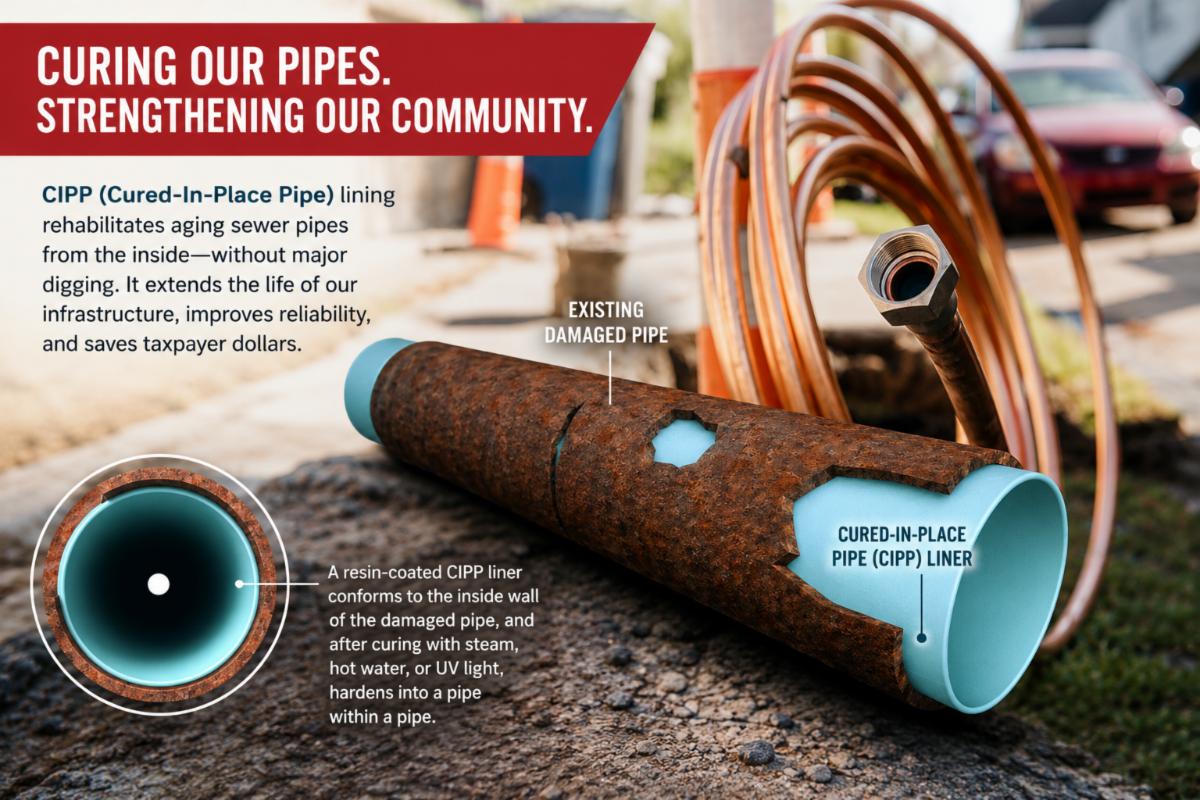
The City authorized financing for several sanitary sewer infrastructure projects beginning later this year and continuing into 2027. The largest investment is the City's annual cured-in-place pipe (CIPP) lining program, which rehabilitates aging sewer mains from the inside without the need for extensive excavation.


This cost-effective approach extends the life of existing sewer pipes, improves reliability, and helps avoid far more expensive emergency repairs or complete pipe replacement in the future. Approximately 12,000 feet of sanitary sewer main will be rehabilitated, benefiting roughly 200 homes when construction begins later this fall and into early winter.


The project also includes replacing sanitary sewer laterals alongside the City's Lead Service Line replacement work. Completing these projects together minimizes future disruption to neighborhoods by avoiding the need to excavate the same streets multiple times.


Water System Improvements – $1.96 Million


Council also approved financing for the City's 2026-2027 water infrastructure program, including replacement of approximately 500 lead service lines next year. This is double the City's typical annual pace.


By the end of 2027, Two Rivers is expected to have replaced approximately 85% of all lead service lines citywide, placing the community well ahead of schedule before the federal 10-year replacement timeline begins under updated EPA Lead and Copper regulations.


Accelerating this work allows the City to take advantage of significant funding currently available through the Wisconsin Department of Natural Resources. Much of this assistance comes in the form of principal forgiveness, which currently covers the private-side replacement costs, resulting in no cost to participating property owners while the program remains available. Principal forgiveness is essentially DNR grant funding that does not have to be repaid.


The financing also supports replacement of approximately 2,200 feet of aging water main along Lincoln Avenue near Rita's Supper Club, addressing one of the City's most frequent locations for water main breaks and improving long-term system reliability.


Investing in our Foundations


Projects like these represent the type of investment residents consistently identify as a priority: maintaining and modernizing the community's core infrastructure.


Every community has aging water mains, sewer pipes, streets, sidewalks, and public buildings that require ongoing maintenance and replacement. Although infrastructure needs will always outpace what can be completed in a single year, the City continues to make steady progress.


Neither of these financings relies on General Fund property taxes. Instead, both projects are financed through the State of Wisconsin's Clean Water Fund and Safe Drinking Water Loan Programs using Water Utility and Wastewater Utility revenue bonds, which are repaid through utility user fees rather than property taxes.


Both loans carry a favorable 2.36% interest rate over a 20-year repayment period, with final maturity in 2046.


Utilizing these low-interest state financing programs helps reduce the overall cost of these critical infrastructure improvements while allowing the City to continue modernizing the systems we depend on every day.

Two Rivers Frequently Asked Questions on the WPPI Energy Contract Extension

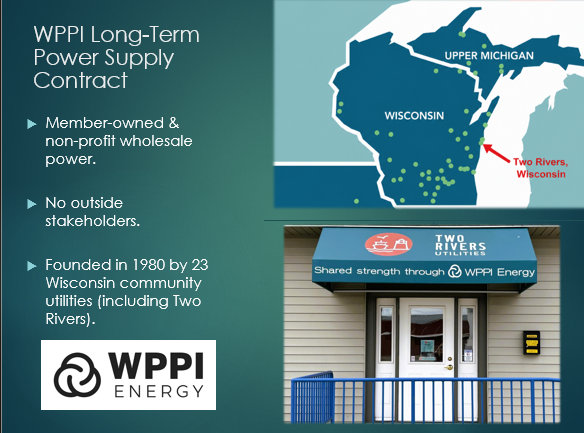
The City of Two Rivers is considering whether to approve an 18-year extension of the City's wholesale power supply agreement with WPPI Energy, extending the current contract from 2055 to 2073. Here are some common questions City Hall is receiving from the community on this topic.


Frequently Asked Questions

1. What is the City considering?


The City is considering whether to extend its wholesale electric power supply agreement with WPPI Energy from 2055 to 2073.


This decision does not change who provides electricity today. Two Rivers will continue receiving electricity from WPPI through 2055 under the existing contract. The question is whether the City wants to preserve its guaranteed opportunity to continue that relationship beyond 2055 while that opportunity is available.


2. Why is this decision being made almost 30 years before the current contract expires?


Electric generation and transmission infrastructure are among the most expensive investments any utility makes. These projects often take decades to plan, finance, construct, and pay off.


Long-term contracts allow organizations like WPPI to borrow money over longer periods, lowering financing costs and providing greater certainty when planning major investments.


A helpful analogy is refinancing a mortgage. Most homeowners don't wait until their mortgage expires before arranging future financing. Instead, they secure favorable terms while they are available.


3. Does Two Rivers have to decide now?


No, but the current opportunity will not remain available indefinitely. WPPI's offer to extend contracts to its 51 members is available only during a defined extension period. If Two Rivers declines, there is no contractual guarantee another opportunity will be offered later.


Future participation would depend entirely on whether a future WPPI Board decides to offer another extension and that would likely come with a high cost to buy back in, which in turn would result in higher electricity rates.


4. What happens if the City decides not to extend?


The current contract would remain in effect through 2055. However, declining the extension today means:


  • The City gives up its guaranteed right to continue purchasing power from WPPI after 2055.
  • WPPI must begin planning as though Two Rivers' future electric load may leave the system.
  • Future borrowing and long-term planning become more complicated.
  • Financing costs for future infrastructure projects could increase.


In other words, declining today doesn't simply delay the decision but it begins affecting long-term planning immediately.


5. Is this just about one power plant?

No. The extension supports financing for an entire portfolio of long-lived infrastructure, including:


  • New electric generation resources
  • High-voltage transmission projects
  • Regional electric grid improvements
  • Future transmission investments through American Transmission Company (ATC)
  • Ongoing refinancing of long-term electric infrastructure


The contract provides financial certainty that allows these investments to be financed at lower borrowing costs.


6. What projects is WPPI investing in?


Recent and planned investments include:


  • Approximately $100 million for WPPI's share of a new natural gas combustion turbine expected to come online in late 2027.
  • Approximately $28 million for transmission infrastructure associated with the Grid Forward Project and other regional transmission improvements.
  • Approximately $54 million in bonds issued to fund 2026–2027 American Transmission Company (ATC) capital investments, with additional investments anticipated in future years.


These projects are intended to improve long-term electric reliability and strengthen the regional power grid serving communities like Two Rivers.


7. Does WPPI provide more than wholesale electricity?


Yes. WPPI provides a variety of shared services that support the City's electric utility, including:


  • Rate studies
  • Utility billing support
  • Meter data management
  • Joint purchasing
  • Information technology assistance
  • Customer information systems
  • Economic development assistance
  • Energy efficiency programs
  • Technical training
  • Key account management


If Two Rivers were ever to leave WPPI, the City would need to replace these services independently by adding additional City staff or paying outside consultants.


8. Will this affect my electric bill?


The contract itself does not immediately change electric rates.


However, one reason for extending the contract is to help finance major infrastructure projects at lower borrowing costs. Lower financing costs help reduce long-term wholesale power costs compared to financing similar projects over shorter periods.


The City has also noted that Two Rivers' residential electric rates remain among the lowest in the region and approximately 21% below the Wisconsin average, according to Public Service Commission comparisons. Manitowoc is slightly lower because they supplment their electric supply with their own power plant.


9. Has the City discussed this publicly?


Yes. Before any Council vote, the proposal was discussed over several weeks through:


  • A 40-minute public presentation by WPPI's President and CEO.
  • Public question-and-answer sessions.
  • Council Utility Committee discussions.


The City has continued providing information as Council evaluates the proposal.


10. Has another community faced this situation?


Yes. The example of Preston, Iowa, provides a cautionary tale for Two Rivers. That small rural community chose not to extend its contract during an earlier WPPI extension period over ten years ago. Because its contract expires earlier than other WPPI members, Preston is not part of the current extension offer and they now have no wholesale power supply secured once their current contract expires.


This is a good example to illustrate that future extension opportunities are not guaranteed.


11. Why does the City Staff recommend approval?


The professional analysis concludes that extending the contract:


  • Preserves the City's guaranteed opportunity to continue purchasing power after 2055.
  • Helps keep financing costs lower for future infrastructure.
  • Supports continued access to regional generation and transmission resources.
  • Maintains access to the operational support services provided through WPPI.
  • Provides long-term planning certainty for the City's electric utility.


The recommendation is based on preserving future options and maintaining financial stability rather than making a decision about how electricity will be generated decades from now.


12. How are electric utility rates set in Wisconsin?


Municipal electric utilities like Two Rivers do not simply choose electric rates at will. Rates are based on the actual cost of providing electric service and are intended to recover the utility's operating expenses, wholesale power costs, maintenance, and necessary investments in the electric system.


Unlike investor-owned utilities, municipal electric utilities like WPPI are owned by the communities they serve and operate on a not-for-profit basis. Any revenues collected remain within the utility to maintain and improve the electric system rather than being distributed to outside shareholders.


Before changing rates, utilities typically complete a professional cost-of-service and rate study. These studies evaluate:


  • The cost of purchasing wholesale electricity.
  • Operation and maintenance expenses.
  • Investments in poles, wires, substations, and other infrastructure.
  • Debt repayment.
  • Future capital improvements.
  • Fair allocation of costs among residential, commercial, and industrial customers.


The goal is to ensure each customer pays a fair share of the actual cost of providing electric service.


Two Rivers also compares its electric rates against other Wisconsin utilities. According to recent Public Service Commission comparisons, Two Rivers' residential electric rates remain among the lowest in the region and approximately 21% below the Wisconsin average.


Ultimately, the City Council approves electric rate changes after reviewing the utility's financial condition and recommendations from utility staff and professional rate consultants.

2025 Annual Audit Presented to City Council

Clean Audit, Strong Results, Continued Progress


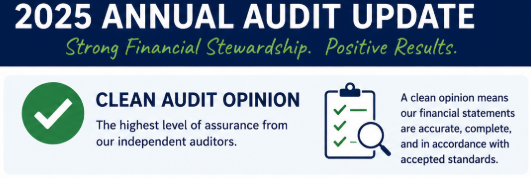
This week, independent auditors presented the City's 2025 annual audit to the City Council, and we are happy to report that the City has received a clean audit opinion. That's the best opinion an outside auditor can give, meaning our financial statements are accurate, complete, and prepared according to professional accounting standards.


The audit also showed some encouraging news. Looking at the City as a whole (not just the General Fund) our overall financial position improved by about $2.6 million during 2025, bringing the City's total net position to $66.3 million. Now here is the important context: this increase is almost entirely due to grant funding and capital investment.  


Council also received an update on the City's mid-year financial performance, which shows the General Fund operating approximately $370,000 ahead of where it was at the same point last year, reflecting continued progress. That's another sign that our work to strengthen the City's finances is moving us in the right direction.


The annual audit is an important accountability tool. It gives both the City Council and the public an independent outside review of how taxpayer dollars are being managed, and we're pleased with the results presented this week.

-Recreation Economy for Rural Communities-Community Workshop

Help Shape the Future of Outdoor Recreation and Community Development


We are excited to invite you to participate in an important community planning initiative that will help shape the future of Two Rivers.


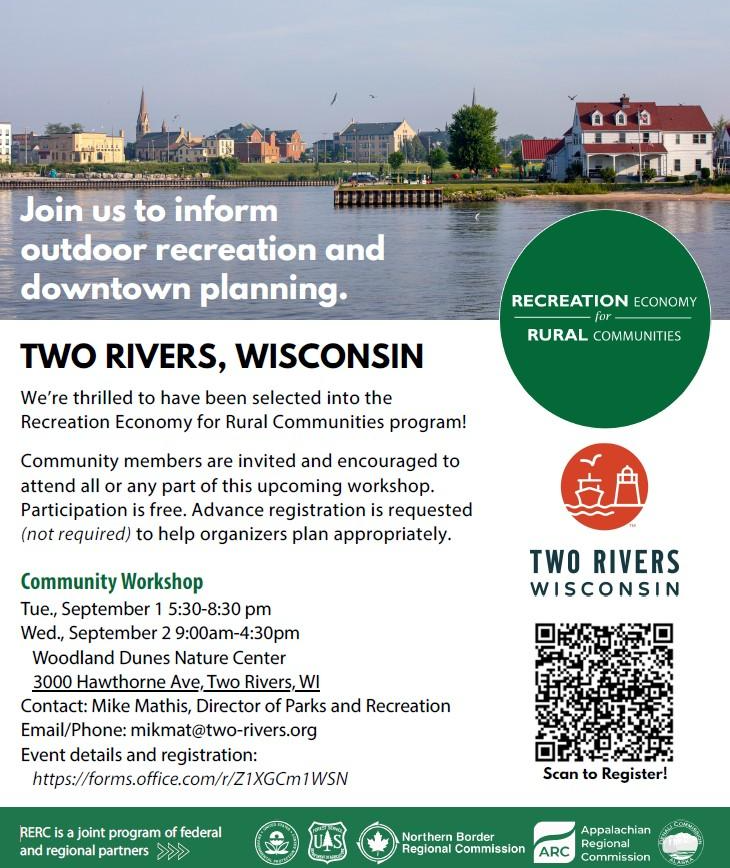
The City of Two Rivers was selected as one of only 15 communities nationwide to participate in the U.S. Environmental Protection Agency's Recreation Economy for Rural Communities (RERC) program. This nationally recognized planning assistance program helps rural communities identify strategies to strengthen their outdoor recreation economy, revitalize downtowns and neighborhoods, improve quality of life, and create new opportunities for economic development.


Rather than providing grant funding, the program brings together a team of national experts, federal agency partners, and community stakeholders to develop a locally driven action plan that can guide future investments and position communities for future funding opportunities.


Two Rivers has incredible assets, including Lake Michigan, our rivers, trails, parks, beaches, harbor, historic downtown, and growing outdoor recreation opportunities. This planning process is an opportunity to identify how these assets can better support residents, attract visitors, strengthen local businesses, improve community connections, and enhance our quality of life for years to come.


Your ideas, experience, and perspective are important. Whether your interests are economic development, tourism, conservation, recreation, public health, business, education, neighborhood development, or simply making Two Rivers an even better place to live, work, and visit, we hope you will join the conversation.


Participation is free. You are welcome to attend one or both sessions, although attending both is encouraged to get the most from the planning process. Advance registration is appreciated, but not required, to help us plan for meals and workshop materials.


We hope you'll join us as we work together to develop a shared vision and practical action plan that will help guide the future of outdoor recreation, economic vitality, and community development in Two Rivers.

Donations Needed

School Supply Drive for Two Rivers Students


Help local students start the school year prepared by donating to the Back to School, School Supply Drive. Donations of new school supplies will be distributed to students in the Two Rivers community.


Residents can drop off donations at the Two Rivers Senior Center or Two Rivers City Hall from July 24 through August 10.


Every donation, big or small, helps ensure local students have the tools they need for a successful school year.


For more information, please contact Heather at 920-793-5590.

Upcoming Events

For more events and things to do in Two Rivers, click the link below.

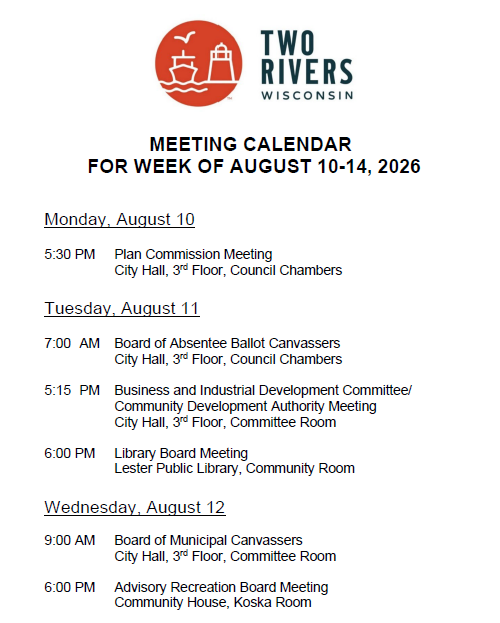
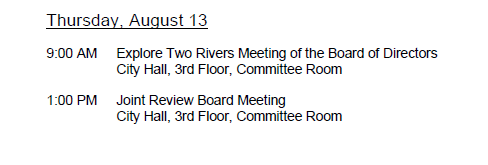
Public Meetings Next Week

Agendas are available for public meetings at least 24 hours prior to meeting times. Click Here