|
Bluff Heights Believes In The Easter Bunny!
Article on January 24, 2024, Terri Robertson, Senior Editor, Digital, at Country Living magazine.
Not often can we suspend belief for a day or two about something that brings such joy and happiness to millions, especially children; however, there will come a time when you’ll need to know the real story, the real facts. We’ll that time has come. Please check the following article first published in Country Living magazine for the real skinny on a rabbit that lays eggs, or should I say, “Golden Eggs” considering their current price.
The Real Story of the Easter Bunny: Origin, Myths, and Fun Facts
The Easter Bunny reminds us of another magical gift-bearer; he's a bit like Santa Claus: a benevolent bearer of gifts for good children and a star of posed holiday pictures (sometimes including crying children!)—with an origin story that can be fuzzier than a bunny rabbit’s tail.
Perhaps your little one is beginning to ask questions and you want to give them an informed answer. Or, maybe you are wondering if there is a dark history behind the Easter Bunny. After all, adorable bunny cakes and Easter Baskets are a lot of fun, but they don’t have a lot to do with why Christians celebrate Easter Sunday. Whatever reason brought you here, you’ve come to the right place, because we’re answering the most-asked questions about the Easter Bunny’s origins.
From the mythical creature’s European roots to its arrival in Colonial America to relatively recent origin tales that date back to the 19th century, we’ve gone down the rabbit hole to separate fact from fiction and bust a few myths. (By the way, the Easter bunny began as a hare, not a rabbit, but when it comes to ole E.B., it’s best not to get too bogged down in technicalities.) Read on for the true story of the Easter Bunny.
Where Did the Easter Bunny Originate?
The bunny, originally called "Oschter Haws," or Easter Hare, who lays a nest of colorful eggs for well-behaved children, hails from Germany. The earliest known mention, according to A Dictionary of English Folklore, is a German text from 1572, which translated reads:
“Do not worry if the Easter Bunny escapes you; should we miss his eggs, we will cook the nest.”
When Did the Easter Bunny Come to America?
E.B.’s legend hopped continents, landing in Pennsylvania Dutch communities in Colonial America no later than 1757 (and possibly earlier), according Stephen Winick, PhD, of the Library of Congress’s American Folklife Center, in his article “On the Bunny Trail: In Search of the Easter Bunny.”
The scholar bases that date on the year a young artist named Johann Conrad Gilbert immigrated to Pennsylvania from Germany. Later in his life, Gilbert would produce two famous drawings of the Easter Bunny—our earliest hard evidence of an American E.B. Since the artist must have known the German tradition from his youth, writes Winick, he would have carried it with him across the Atlantic (though it's possible the E.B. preceded him).
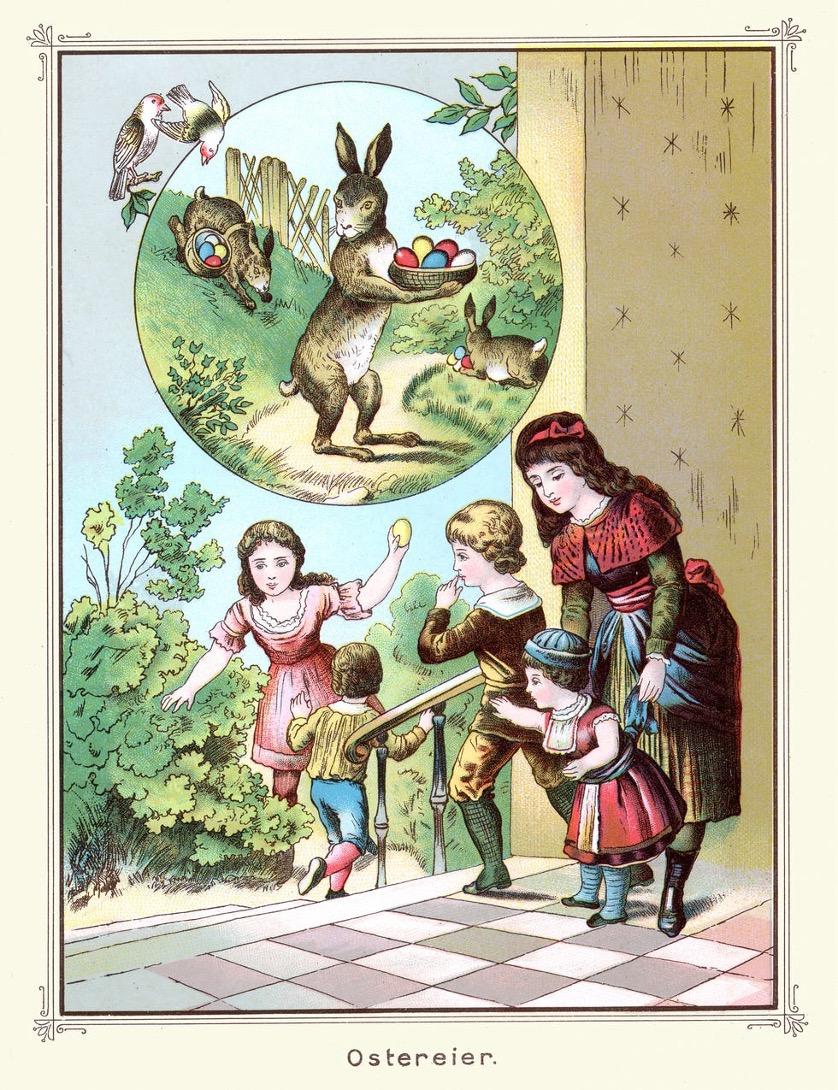
Writings from the 1800s begin to show us a more complete picture of the Pennsylvania Dutch traditions, with recollections of children building nests, sometimes using their bonnets or caps (the predecessor to our Easter baskets), and leaving edible flowers to encourage the Easter Bunny to lay colorful eggs. After church on Easter Sunday, children participated in egg hunts and other games.
What Does the Easter Bunny Have to Do with Jesus?
The Easter Bunny is not in the bible and is not related to the resurrection story of Jesus that Christians celebrate on Easter Sunday. Rabbits and hares, along with eggs, are general symbols of spring and renewal that have become integrated into the holiday’s celebration through the centuries.
These symbols do have some ties to Christian art and traditions, though. Rabbits and hares have long been associated with Jesus's mother, Mary, reports Scientific American. The 16th-century painting The Madonna of the Rabbit by Italian artist Titian, for instance, shows Mary with a white rabbit by her side.
And as for the E.B.’s eggs? Traditionally, eggs were not eaten during the Christian observance of Lent, according to A Dictionary of English Folklore. Instead, they were preserved or hardboiled to save for Easter. The result: an abundance of eggs for decorating, egg hunts, and other Easter traditions. In some traditions, the eggs used in these activities were imbued with religious meaning.
Is the Easter Bunny Pagan?
Bottom line: There is not a definitive link in recorded history between the Easter Bunny and ancient paganism. Is it possible there is some aspect of the legend that pre-dates Christianity? Yes, but the following story is not it:
A popular (and often reported) tale goes that the Anglo-Saxon goddess of spring, Eostre (or the Germanic goddess Ostara, depending on the version), transformed a bird into a hare, after which, the grateful hare laid colorful eggs in thanks. While this story seems to provide an answer to that often-pondered question—"Why isn’t the Easter Bunny a chicken?"—here’s where it gets hare-y: The legend appears to only date back to the 19th century.
Stephen Winick, PhD, of the Library of Congress’s American Folklife Center, pretty handily takes the myth apart in his article “Ostara and the Hare” by tracing the legend to its roots. The earliest connection between the hare and Ostara he could find only dates back to 1874 when the German professor and philologist Adolf Holtzmann mused, “The Easter Hare is inexplicable to me, but probably the hare was the sacred animal of Ostara; just as there is a hare on the statue of [the Celtic goddess] Abnoba,” later adding, “… the hare must once have been a bird, because it lays eggs. …”
From there you might say that journalists of the era, penning holiday content for newspaper and magazines in the late 19th and early 20th centuries, got a wild hare, and the so-called “pagan” legends proliferated.
Wild bunny tales aside, it is in the realm of possibility that hares were revered in pagan cultures. British archaeologist Nina Crummy has suggested that “hare-motif” brooches from the Late Iron Age and Late Roman Period, found clustered in areas associated with Eostre, might indicate the existence of a Celtic hare deity.
Additionally, reports The Guardian, ancient skeletons of hares and chickens that were buried with care in Britain, with no marks of butchering, indicate the animals' special status—and lends credence to Julius Caesar’s account that “the Britons consider it contrary to divine law to eat the hare, the chicken or the goose. They raise these, however, for their own amusement or pleasure.”
|