Utilizing Video, Photos and Multi-Media in the Employment Search for People With Disabilities
The Pros, Cons and How Much It Costs
You probably clicked on this link with some skepticism in your mind. But let me assure you, this is not a sales pitch. This is simply an article written by a person with multiple disabilities, who also happens to be an employer, and my observations of what tools are out there that enhance or supplement traditional job search tools, such as a paper resume, the pros and cons and cost of each.
First, here’s a little background about myself and the evolution of job searches for people with disabilities over time. My name is Justin and I’m a person with disabilities. My disabilities really run the gamut, from physical to cognitive, awareness to memory and vision. I also have an undiagnosed, but very apparent case of ADHD. This all, or mostly, stems from a cancerous brain tumor hemorrhage I had in 1993.
If this would have happened to me before the 1970’s I would have been in trouble. If I would have survived, they would have likely institutionalized me, as I would be perceived as broken and of no value to society. I would then stay institutionalized until I died, with no contact with my family. However, I was lucky enough to hemorrhage in a time when their was enough knowledge of modern medicine to save me, and enough knowledge of people with disabilities and human decency to keep me from suffering the above mentioned fate.
The rest of my story from there to here is long and winding and in the interest of time, I will spare you the details and just say, that today, I am a husband and father of two, business owner, philanthropist and athlete.
It is my belief that everyone with a disability should be afforded the same amount of opportunities, if not more, as I have received and are available to me today. However, my story and path should not be the one and only blue print for anyone either. Humans are as diverse as they come. Everyone has their own goals, desires and passions. There is no, one size fits all, so that’s why I believe it is important to share some tools out there that people with disabilities and really anyone else, too, can use, to give them a leg up, when seeking the opportunity to work.
|
|
 |
MSU Student, Isabella Hoeppner, speaking with Paul Schmidt, owner of Uno Deuce MultiMedia during a job shadow.
|
|
|
|
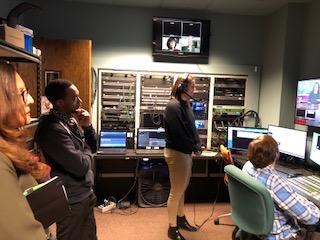
MSU student, Lily Chatterjee, observing a live production during a job shadow with HOMTV.
|
|
|
|
Photos in the Job Search Process
As time has gone on, studies have shown that a simple photo or photos, coupled with text, can bring a feeling of trust and comfort to a consumer of the content. It’s an additional stimulus, which adds to the narration with another layer of understanding to a document.
Benefits:
Photos are usually easy to come by. Nearly everyone has a cell phone that contains a high quality camera. Getting them off your phone to someone else’s eyes or onto your computer is also a breeze with bluetooth, a text or an e-mail.
Disadvantages:
A picture is worth a thousand words, but without any text, a photo is left to interpretation from the viewer, which can sometimes miss the mark or have unintended consequences. Also, photos alone can be quite inaccessible for people with visual impairments. At a minimum, the inclusion of Alt-Text is a must for true accessibility.
Things to Consider:
It’s not necessary, but definitely beneficial to understand what goes into a good picture. Things such as composition, lighting, stabilization, focus and timing can make a big difference in a picture.
|
|
|
MSU Student, Sailesh Gundepudi, observing during a job shadow with NuWave Technology partners.
|
|
|
|
MSU Student, Jack Burbank during a job shadow with the Michigan Department of Agriculture & Rural Development.
|
|
|
|
Video in the Job Search Process
Video is a powerful tool, combining pictures, audio and even text all together to allow the viewer to not only see, but experience what they’re watching. Video is an excellent tool for educating and ultimately, inspiring action.
Benefits:
Like photos, video has become much easier to come by. With proper knowledge, a person has the ability to create high quality video from their smart phone.
Disadvantages:
Though the above mentioned benefit is true, the biggest differentiator between video and photos is audio. To get the ideal audio, one will likely need to use an external microphone or audio recording device. Stabilization is also very important for video.
Things to Consider:
As with photos, understanding what goes into a good video is important. Things such as composition, lighting, stabilization, focus and timing can make a big difference in a video. Also, the knowledge of video editing is key. Video editing can be the difference between and effective and ineffective video. From removing unnecessary audio, such as “um”s and “ah”s, long pauses and repetitions to properly utilizing complimentary video, pictures, graphics and text, to color correcting and grading, a concise and aesthetically pleasing video is key to being effective. It may be important to create a second version with audio descriptors for viewers with visual impairments as well.
|
|
|
|
Detroit Public Schools Student
Na'Aubin Lattimore's Video Portfolio
|
Na'Aubin is a young lady with a Cognitive Disability. However, she has been working with Project SEARCH and has excelled at her internship at DTE and is an excellent worker! She is seeking a position as a medical office assistant or In Human Resources. Visit her page on Beyond Our Barriers (bob4mi.com) to learn more about Na'Aubin!
|
|
|
|
St. Claire High School Student
Jacob Wesley's Video Portfolio
|
Jacob is a young man with a visual Impairment, but it doesn't stop him from doing many things people without Visual Impairments can do, such as chop wood and drive an ATV! He is seeking a job with some flexibility where he can work with his hands. Visit his page on Beyond Our Barriers (bob4mi.com) to learn more about Jacob!
|
|
|
|
|
Multi-Media Use in the Job Search Process
Pictures and video are great, but if left alone, they may not provide everything an individual needs to go from prospect to employee. Coupling text, along with your pictures or video, whether it’s in a PowerPoint or other presentation software, alongside a paper resume or on a web page, the use of multiple media resources helps bring it all together.
Benefits:
Including text with further detail on experiences, education and training, contact information and more, helps give a full, 360 degree understanding of the prospect and gives the employer everything they need to take the next step, whether that's requesting and interview or making the hire.
Disadvantages:
We live in a world of instant gratification. All of this can be great, but if an employer can’t go from learning about a prospect to contacting that prospect easily, within a few minutes, it may be enough to deter the employer from taking the next step in the employment process. Also, if an employer is stuck in the ways of traditional hiring practices, this may not be a good fit.
Things to Consider:
The average time an employer spends looking at a resume is
six seconds
. Utilizing photos and video coupled with additional media and text will help you get past that six second threshold, but it’s likely not going to turn into 6 minutes. Being concise is the key. Make sure that the information shared at that time is absolutely a need to know, then and there. Remember, if you get hired or get an interview, you’ll have time to share further information later.
|
|
|
|
David Shachar-Hill's Digital Portfolio
|
David is about to graduate from Michigan State University. He recently completed a series of job shadows and is now seeking an internship for the summer of 2019. This animated slideshow is coupled with other tools will help him secure the internship.
|
|
|
|
How Much Will This Cost:
The cost for photos and/or video, along with whatever additional resource(s) you choose, will vary immensely. If you have the knowledge and ability to do it yourself, it will cost you your time, whatever equipment you use and the insurance for the equipment. If you’re hiring someone to do it for you, it would probably run anywhere between a few hundred dollars to multiple thousands of dollars. However, remember, the financial cost does not automatically dictate value. If this multi-media package is meant to assist you or someone you know, to secure a job, the level of quality of it should reflect the quality of job you are seeking.
Think of it this way, talent agencies normally charge about 10% of a person’s starting salary to help them find a job. If you are seeking a job that will pay $25,000 per year, the amount of money you want to put into resources may be around $2,500 at maximum. If you are seeking a position that pays six figures with benefits, then your budget could reasonably expand to up to and beyond $10,000. Ultimately, it’s up to you and your goals.
Final Thoughts
Since the 1970s, the world has slowly, but surely started to recognize people with disabilities, not as broken, but as members of society, with unique abilities and perspectives that can benefit the world. The flood gates have not busted open, however. It’s been a long and winding road to get here and there’s still a ways to go until we are truly utilizing everyone on our planet to the best of their abilities, skills and desires. But we’re heading in the right direction and that’s a good thing.
I hope you found this article helpful and learned a little about the use of multi-media when seeking employment.
If you would like to try to produce video or take pictures on your own to help with your job search,
click this link
for some guidelines. If you are interested in , we’d be happy to consult with you as well. Thanks!
Justin Caine
President & CEO
Beyond Our Barriers
www.bob4mi.com
|
|
|
|
|
|
|