Welcome to the Smart City Initiative Newsletter, the central hub for news and updates on pilot programs, partnership opportunities, events, and upcoming challenges! | |
The Long Beach Technology and Innovation Department (TID) wants to hear from you! | |
|
TID is pleased to announce the release of a community survey and workshops as part of our efforts to develop the department's short-term information technology strategic plan, TID 26.
We are excited to announce a community survey and workshops as part of our efforts to develop the TID 26 plan to have in place by the end of 2026 to achieve the City's 2030 Strategic Vision. TID 26 aims to build and protect our communities' trust in the City, provide the City with data for technology service improvement, and improve equitable access to technology for Long Beach's diverse communities.
We value your feedback and want to hear from you!
Register for a TID 26 community workshop!
- Mon, May. 13, (5 - 7 PM) - Houghton Park Community Center, 6301 Myrtle Ave
- Tues, May. 14, (5 - 7 PM) - Recreation Park Community Center, 4900 E. 7th St
Complete the TID 26 survey today!
| |
Community-Driven City Program Helps Participants Learn Technology, Address Neighborhood Challenges | |
|
"LB Co-Lab is great for getting the community involved and interacting with the government. It's great for these four communities to feel like their voice is heard, and have an opportunity to solve a problem in their community."
- Gillian Doplemore, LB Co-Lab Community Participant
| |
|
The Long Beach Collaboratory (LB Co-Lab) is an immersive framework to engage community members in a collaborative engagement and training process to scope, prototype, and implement a civic technology infrastructure solution in four Long Beach neighborhoods, Hamilton, Westside, Ramona Park, and Willmore. This program prepared and engaged members of the community to ensure emerging technology is an asset and improves their day-to-day lives rather than complicates it. Participants also learned skills in personal and professional development to better navigate our new digital world.
Learn more about the impact of LB Co-Lab by reading this story by Inside LB, the official blog for the City of Long Beach. The story highlights the hard work and dedication of resident participants throughout the program.
| |
New Digital Rights Platform Launch + Data Walks Update | |
Improved Digital Rights Platform Now Live! | |
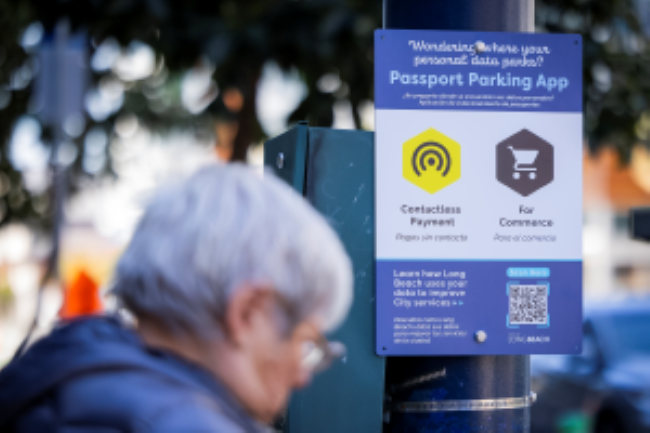
In an ongoing effort to enhance data privacy, digital rights, and transparency, the City partnered with California State University, Long Beach (CSULB), to launch the enhanced Digital Rights Platform. Through a second round of mobile community workshops that we call data walks, residents had the opportunity to test the platform's new features and learn about the technologies the City deploys and the data it collects. 77 Long Beach residents participated in the data walks last month! Big shoutout to the residents that engaged with us. The physical signage is available in English, Spanish, Tagalog and Khmer and is installed in the public right-of-way adjacent to select City technologies in Downtown, Central, and North Long Beach with QR codes to direct viewers to the new platform.
The enhanced digital rights platform includes a redesigned webpage with details about the City's data collection and usage practices for smart city technologies such as public wi-fi, security cameras, the Go Long Beach application, and public computers and stations at public libraries. There are 20 civic technologies currently listed on the new platform.
|
|
Help Improve Long Beach's Digital Services! | |
Fill out an interest form today! | |
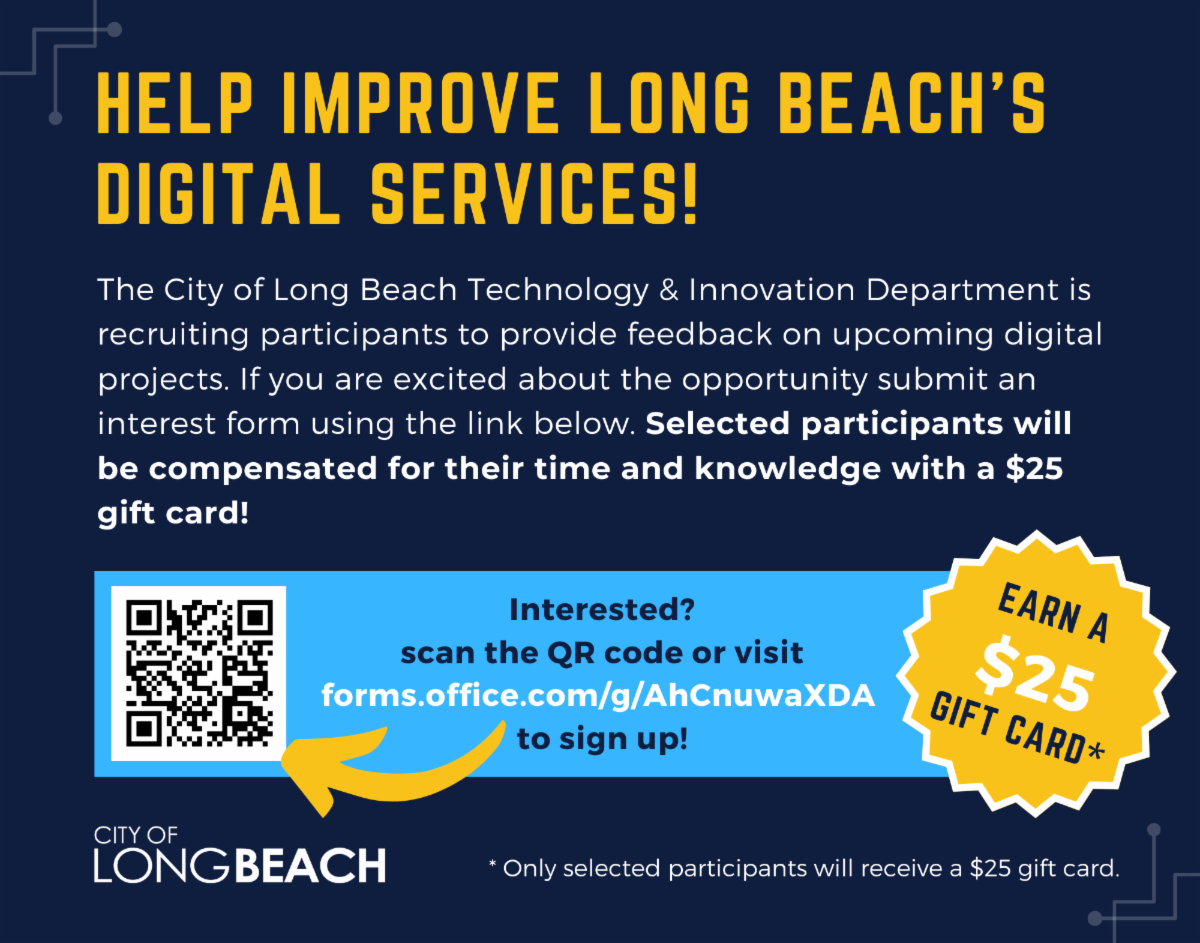
The City of Long Beach Technology & Innovation Department is recruiting Long Beach community members to provide feedback on upcoming digital projects. This recruitment is ongoing, sign ups are still accepted!
Thank you to the community members who signed up and participated in our previous sessions. We're grateful for your time and feedback to ensure our digital services are created with members of the community in mind.
If you are interested in this opportunity, fill out an interest form using the link below. Selected participants will receive a $25 gift card for their time and knowledge!
Learn more about Civic User Research here.
| |
|
The Emerging Use of Generative AI in City Government | |
|
Technology is changing how we navigate our everyday lives. Tools like Generative Artificial Intelligence or Generative AI are becoming more popular among various common job industries like entertainment, education, and even city government. Most people want to live in safe, dynamic, and enjoyable cities. The introduction of modern technology poses the question to government officials, “How do we implement the responsible and ethical use of technology in the city?” This digital revolution presents an opportunity for city government to dive into the world of innovation and welcome tools like Generative AI as an approach that can assist city staff in their jobs – rather than replace their jobs or make their skills obsolete.
What is Generative Artificial Intelligence? It is a new branch of AI technology commonly known as Generative AI with the ability to generate content requested by the user such as memos, emails, report summaries, outlines and more. It can also answer questions and deliver information to the user from immense amounts of datasets, known as large language models (LLMs). LLM-based applications like Chat GPT, Google Bard, and Co-Pilot to name a few are some of the top Generative AI tools out there at the moment. These language models use machine learning to adapt and learn how to complete wide range of tasks as specified by the user. However, the drawback and largest concern with these models are their inability to deliver human emotion and whether they introduce bias or ethical issues. The risk of dishonest responses and the spread of misinformation is a real concern that city governments need to address.
For many, tools like Generative AI can sound scary and dystopian, particularly because it’s emerging technology in uncharted territory. But like all new things, it requires some testing, responsible policies, and critical decision-making to better understand if the tool is a right fit for your needs. It can be seen as a choice, an option, or supplemental tool that gathers and analyses immense data sets to deliver results to the questions you’re asking. Cities are recognizing this opportunity and developing a responsible approach for the use of Generative AI while also recognizing the risks it poses in practice. Generative AI tools can help you identify and analyze trends from large data sets, write code in various programming languages, or draft a report you might need a little boost getting started with.
For example, a city employee could ask a system like Chat GPT, “Draft a memo to the city council on the issue of traffic collisions and more stop lights in downtown Long Beach. Include traffic collision data from 2020-2023.” This would generate a memo with the data and information the user asked for. The challenge is that it will require editing and verifying the information delivered by ChatGPT is accurate and makes sense. Users cannot rely on Generative AI with unquestioning trust and should be used as a tool, not a flawless product. Governments like the City of Long Beach are recognizing the popularity of Generative AI systems in the workplace and encourage the responsible use of it to support the work of city staff while also acknowledging we must not rely heavily on this type of technology. The City created an interim guidance to educate staff how to use it and inform about the risks around AI bias, data privacy, and cybersecurity. This level of information for employees helps protect community data and displays an effort to use tools like Generative AI responsibly and ethically.
Using Generative AI is a choice and must be a responsible one. Our work with the Smart City Initiative communicates critical information to residents, staff, and partners about emerging technology and best practices to empower users to use critical thinking skills to evaluate technology and know when it’s best to use it and when not to. Our use of technology is developing and adapting every day. It is our duty to continue to learn and approach technology and innovation with curiosity—not fear. The urge to fear the unknown is inevitable but with the appropriate guidance, education, and collaboration, technology does not have to be scary and can be a partner in solving some of the most pressing issues of our time.
| |
Generative AI: Generative AI (genAI) is a broad label describing any type of artificial intelligence (AI) that can produce new text, images, video, or audio clips. Technically, this type of AI learns patterns from training data and generates new, unique outputs with the same statistical properties.
Artificial Intelligence (AI) : AI refers to the development of computer systems that can perform tasks that previously required human intelligence. Typically, such tasks involve perception, logical reasoning, decision-making, and natural language understanding (NLU).
Machine learning: Machine learning is a subset of AI that focuses on discriminative tasks. It involves the development of algorithms that enable computers to make predictions or decisions based on data without being explicitly programmed how to do so.
Large Language Models (LLM): Large language models are very large deep learning models that are pre-trained on vast amounts of data.
User: a person who uses or operates something, especially a computer or other machine.
Chat GPT/Open AI: ChatGPT is a chatbot developed by OpenAI and launched on November 30, 2022. Based on a large language model, it enables users to refine and steer a conversation towards a desired length, format, style, level of detail, and language.
Sources:
https://www.techopedia.com/definition/34633/generative-ai
https://aws.amazon.com/what-is/large-language-model/
|
|
|
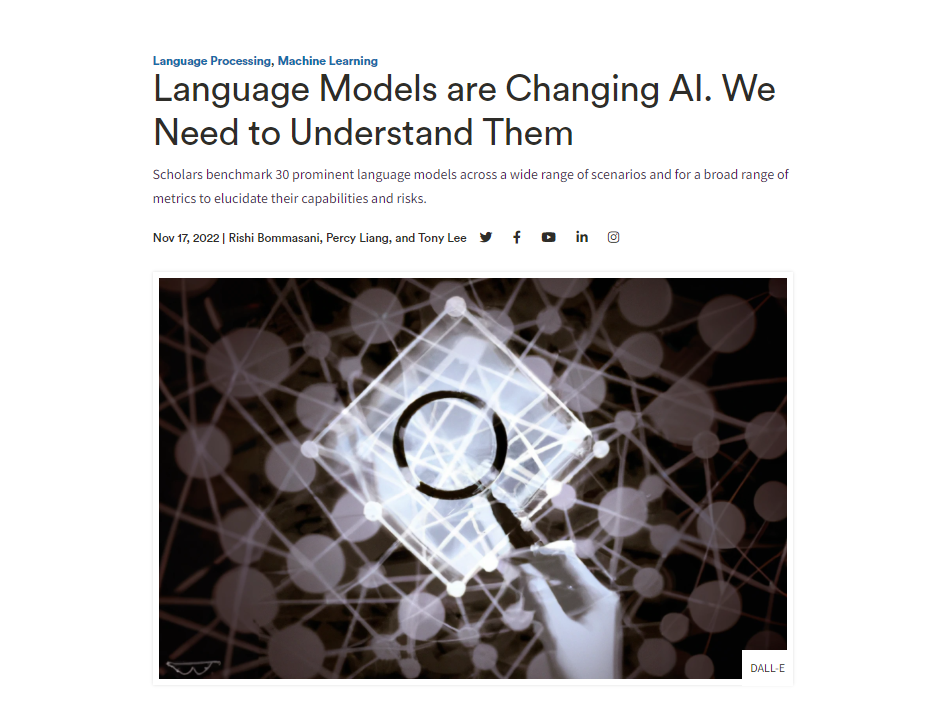
Language plays a central role in how we communicate, how we learn and teach, how we organize and take political action, and how we convey the emotions and complexities of our lives. Language models, which derive their power from colossal amounts of language data, epitomize the broader paradigm shift toward foundation models, machine learning models that can be adapted to an impressively wide range of tasks. Organizations such as Google, Microsoft, and OpenAI expend extraordinary capital to build these models (sometimes millions of dollars for a single model), which then power products that impact billions of people.
-Rishi Bommasani, Percy Liang, and Tony Lee, Standford University Human-Centered Artificial intelligence
| |
|
Long Beach is excited to join the GovAI Coalition, a network of over 400 public servants from over 150 local, county, and state governments committed to responsible and purposeful artificial intelligence (AI) in the public sector.
The Coalition has released an open letter and a toolkit to help public agencies adopt and implement responsible AI practices. The GovAI Coalition created this toolkit to support alignment with emerging national standards and to unify the needs of many local governments. With the continued access and use of AI, City of Long Beach and the GovAI Coalition welcomes agencies, civil society, universities, and industry to join our efforts of bringing a voice in shaping the future of artificial intelligence. Open letter and toolkit are available here.
| |
What are Broadband Nutrition Labels? | |
|
On January 27, 2022, the FCC voted unanimously to approve a Notice of Proposed Rulemaking requiring internet service providers (ISPs) to provide customers with a broadband consumer label, also known as “Broadband Nutrition Labels.” The purpose of these new labels is to provide clear and accurate information on the cost and internet service plan information to help consumers compare and shop internet service options that meet their needs.
Broadband Nutritional Labels will include the following information:
- Broadband pricing
- Introductory rates
- Data allowances
- Broadband speeds
Internet service providers that offer home or fixed internet services, or mobile broadband plans will need to provide broadband nutritional labels starting April 10, 2024. Providers with less than 100,000 subscribers have until October 10, 2024, to comply with the new FCC rules.
Learn more about digital inclusion in the City of Long Beach, here.
| |
Risks of Connecting to Public Wi-Fi | |
|
In today's digital age, where accessing the internet on the go is often the norm, it's crucial to understand its potential risks. Whether at a coffee shop, airport, or hotel, connecting to public Wi-Fi without proper precautions can expose you to cybersecurity threats. Here are helpful precautions to take into account to protect yourself when connecting to public Wi-Fi.
Malware distribution: Cybercriminals seek unsecured public Wi-Fi to spread malicious software. Connecting to these networks might unknowingly invite these threats onto your device, jeopardizing your privacy and security.
Spoofing: Cybercriminals may set up fake Wi-Fi networks with names similar to legitimate ones, tricking users into connecting and exposing their data.
Unencrypted connections: Most public Wi-Fi networks lack encryption, leaving your personal data vulnerable to interception by cyber criminals. If you don't have the proper encryption, your sensitive information, such as your passwords and credit card information, could be transmitted over these fake networks and easily intercepted and exploited.
Phishing Attacks: Not using safe public Wi-Fi can be a platform for phishing attacks. Cybercriminals love to create fake websites or emails to trick users into divulging sensitive information. Unsuspecting users may become victims of these attacks, which can compromise their data.
Although public Wi-Fi provides us with convenience and accessibility, it comes with significant risks to your cybersecurity. It's vitally important to practice caution when connecting to any network and take aggressive measures to protect your data. It’s recommended to use a VPN or virtual private network, keep all your devices updated with the proper security patches, and avoiding sensitive transactions on public Wi-Fi; you can decrease the possibility of becoming a victim of cyber threats.
Stay informed on the latest cybersecurity news. For more information about cybersecurity in the City of Long Beach, visit the Technology and Innovation Department's website.
| | | | |