|
"With the GCI Advisory Board, we have a whole bunch of amazing experts who actually listen to each other. There's real power in that."
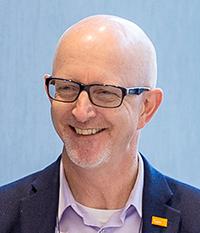
In this newsletter issue, we feature Chris Hewitt, Senior Manager Public Funding at BASF, Global CO2 Initiative Advisory Board Member
With over 35 years of experience in commercial management, Research and Development (R&D), marketing and technology development, Chris leads BASF's engagement with internal and external stakeholders in North America to support publicly funded partnerships for technology development, translation and investment, largely in pursuit of BASF's commitments to achieving a net zero carbon footprint. He earned a PhD in chemistry from Durham University in the United Kingdom and is a Fellow of the Royal Society of Chemistry.
| |
|
Can you explain what you do?
My job is to support and enable conversations to bring those in government, our partners, and my colleagues in research and manufacturing together, so that we can collaborate on making the best investments between our company, the federal government, our customers, and often universities like the University of Michigan. Together we can develop and implement new technologies, usually targeted around areas associated with sustainability, particularly carbon footprint reduction.
| |
|
Could you describe your career journey?
I did a PhD in chemistry and always wanted to use science to solve problems and grow business as a result of solving those problems. I had roles in sales and procurement, supply chain management, quality management, marketing, and setting up new business. My work brought me to the US, where I was granted a great opportunity to grow into larger roles and ended up with global responsibility for a bunch of functions, the core being marketing and R&D. I left my original company, joined BASF, ran a chemistry technology producing chemical reagents serving pharmaceutical and agricultural active molecules, and then moved into collaboration management. I spent quite a few years leading engagement with universities, national labs, and research collaborations in North America.
| |
|
A little under a year ago, I stepped into this role, with the recognition that some of the challenges that we're facing really are national and global. If we think about the stakeholders involved in solving those challenges, historically, it's been companies and universities. Now it's really this triple helix approach where federal and state governments are also involved in those conversations as stakeholders, both in terms of investment and outcomes. My role is to make more of these conversations and collaborations happen and support the outcomes we all need through public funding of supported projects and investments.
I love what I do. I've been really privileged to work with so many smart, talented people–within the companies I've worked for, the partners that we've had, and the federal government. I spend all day every day working with people who are smarter than me, which is a great inspiration and challenge.
| |
Can you tell me a little bit more about the idea of creating value through collaboration?
I am passionate about using science to solve important problems in a way that can generate a solution which individuals–either in companies or in the community–clearly see the value of, and they can understand the potential for that solution to make a difference in their lives. Of course, if a solution is truly going to deliver a sustainable impact that continues over time, then a company typically has to also be able to make money. Even with a company the size of BASF, with 10,000 people around the world working in R&D, that's a fraction of one percent of the best minds that can come into play in solving these problems. The best solutions and the solutions we need to find for some of these big challenges are going to come from collaboration.
| |
So, my job is getting the right folks together, helping facilitate those conversations and sometimes asking the stupid questions that lead to consensus around an action plan. The action plan delivers value in terms of helping all the stakeholders meet their objectives. The projects and investments should create value by delivering a product for our customers who in turn create the sustainable products that we, our family, neighbors, or friends need. Of course, in order to keep making and supplying those products it’s important to deliver commercial value to our company to support the necessary investments and the profits needed to make them.
How did you become connected to the Global CO2 Initiative (GCI)?
My former boss was on the initial advisory board for GCI when it was founded, so I got involved in some of the conversations with Volker and others at that time. Of course, I also had the connection to the University of Michigan as a result of living here in Michigan. Being local and having that connection opportunity meant that I was part of the conversation with GCI from the early days. Eventually, Volker (Sick) and Susan (Fancy) asked me if I would officially join the Advisory Board.
| |
How would you describe your role on the Advisory Board?
I think there are a couple of areas where I felt like I've been able to help. For one thing, help in making connections, both to BASF and also other similar sized companies. It’s important to stay focused on how approaches or collaborations deliver value. In the context of a university, the focus on value and importance might typically be finding amazing new breakthrough technologies; for the board it’s also important to consider scaling technologies and delivering commercial value, as well as training and workforce development. We need to ask questions like “How can this technology be scaled quickly using existing assets in the industry?” or “What do young adults feel about this?” and “How can we prepare them to be contributors in the future?”
Additionally, I help by asking questions and being a sounding board for new ideas and plans. In my experience, getting feedback from others greatly improves clarity. Bringing the right voices to the table is extremely helpful in convening collaboration.
| |
Any final comments?
With the GCI Advisory Board, we have a whole bunch of amazing experts who actually listen to each other. There's real power in that. I don’t have deep technical domain expertise, so I always learn a lot and am always blown away by the ideas, progress and global impact achieved by the GCI.
| |
|
Catalysing Change – Smart CO₂-Solutions Wanted for the “Best CO₂Utilisation 2024” Innovation Award
Submissions due Feb 4, 2024
This event will feature a series of presentations, discussions, and workshops designed to inform and engage the local public on the topic of carbon management, and to spur collaboration in project planning and development across stakeholder groups.
| |
AirMiners Launchpad Batch 9
Applications due Oct 13, 2023
XPRIZE and Creative Destruction Lab's 6-week Launchpad helps founders with engaging carbon removal credit buyers and markets, understanding fundraising and investor dynamics, value proposition development, customer discovery efforts and techno-Economic assessment capabilities.
| |
|
Keep in touch
We want to hear from you! Is there something or someone that you would like to see featured in a future issue? Let us know!
| | | | |