Weekly update from the National Housing Conference | |
News from Washington | By Brittany Webb
| | |
House Financial Services hearing discusses housing innovation
The House Financial Services Subcommittee on Housing and Insurance held a hearing discussing innovative practices to help expand housing supply entitled Expanding Choice and Increasing Supply: Housing Innovation in America. Witnesses included Bill Boor, President & CEO, Cavco Industries, and Chairman, Manufactured Housing Institute; Eric Schaefer, Chief Business Development Officer at Fading West; Dr. Andrew P. McCoy, Director of the Virginia Center for Housing Research, Professor in the Department of Building Construction, and Associate Director of the Myers Lawson School of Construction at Virginia Tech; and Colten Lewis Fleu, Senior Attorney at Mountain State Justice, Inc.
Chairman Mike Flood (R-Neb.) emphasized the need for more workforce housing in his opening remarks. “We have government programs that focus on housing subsidies for low and very low-income people, we have market rate developments that are able to meet some of the demand for higher income people. What we need is housing that can meet the needs of all the people that fall somewhere in between those two worlds,” he stated.
Much of the discussion focused on the potential to expand the use of manufactured housing. During his testimony, Boor emphasized the need of clarifying HUD as the sole regulator for manufactured housing, working with localities to overcome local zoning and regulatory barriers, and modernizing the chassis requirement for manufactured homes. Other witnesses highlighted the production timelines for manufactured homes and modular construction, 3D printing technology, and difficulties with securing loan financing.
| | | |
HUD invests over $1 billion in Native American housing
The U.S. Department of Housing and Urban Development (HUD) announced $1.1 billion for the Indian Housing Block Grant (IHBG) to help develop affordable housing for Native American Tribes, Alaska Native Villages, and Tribally Designated Housing Entities (TDHEs). The IHBG program provides flexible formula grants that can be used for a range of housing-related activities, including new housing construction and modernization, housing services, and safety initiatives. The announcement marks the most robust housing funding initiative by the new administration. The largest grant will go to the Navajo Nation in Arizona amounting to $1,126,425.
“From day one, HUD has been engaged on alleviating affordable housing challenges facing urban, rural, and Tribal communities. Today’s announcement reaffirms our commitment to serve Tribal communities while working towards meeting Indian Country’s housing needs,” said HUD Secretary Scott Turner. “HUD has a strong partnership with Tribal nations, and I look forward to collaborating directly with Tribal leaders to expand housing opportunities and remove burdensome regulatory barriers that impede progress.”
A full list of grantees is available here.
| | | |
Emergency voucher funding to lapse years early
HUD has notified public housing authorities across the country that funding for the Emergency Housing Vouchers (EHV) program—a pandemic-era initiative that provided rental assistance to 70,000 households—will run out sooner than expected. All but 10,000 of these vouchers are now at risk of ending in 2026 rather than the planned end date of 2030, stoking concerns of increased evictions and homelessness for vulnerable families. EHVs were designed to target people who were at risk of homelessness, fleeing domestic violence or stalking, or recently became homeless. HUD informed public housing authorities via a March letter not to expect any further payments.
According to HUD, increasing inflation and overall housing costs caused the funding to be depleted more quickly than expected, leaving an estimated 18 months of funding remaining. States like California and New York have higher concentrations of EHV usage, with states like Texas and Florida also among the top users. While some housing authorities can sustain the program for shorter periods of time, they cannot guarantee funding for families using the EHVs through 2030 as originally planned.
The revelation comes during a period of intense uncertainty for housing assistance programs. Members of Congress can maintain the program funding through Congressional action; however, no additional funds are anticipated as the Trump administration continues to downsize the federal government.
| | | |
Lawmakers urge reinstatement of disaster resilience program
A bipartisan, bicameral coalition over 80 lawmakers sent a letter urging the Trump administration to reinstate a federal disaster mitigation initiative that helped local communities prepare for extreme weather events. Addressed to Department of Homeland Security (DHS) Secretary Kristi Noem and Senior Official Performing the Duties as FEMA Administrator David Richardson, the letter calls for the return of FEMA’s Building Resilient Infrastructure and Communities (BRIC) Direct Technical Assistance program. The program provides necessary funding to complete mitigation programs like upgrading and protecting wastewater and drinking water plants, upgrading bridges and road drainage, and strengthening infrastructure in rural and Tribal communities. The effort was led by Sens. Patty Murray (D-Wash.), Chris Van Hollen (D-Md.), Thom Tillis (R-N.C.), and Lisa Murkowski (R-Alaska).
“BRIC funds are spurring communities across the country to strengthen their resilience to extreme weather, and forgoing these critical investments will only make it harder and more expensive for communities to recover from the next storm,” the letter reads.
The lawmakers warned that halting the program undermines national resilience efforts and leaves vulnerable areas without the tools to prepare for increasingly frequent and severe natural disasters, and iterated that every dollar of investment in disaster mitigation saves up to $18 in response and recovery expenditures.
| | | |
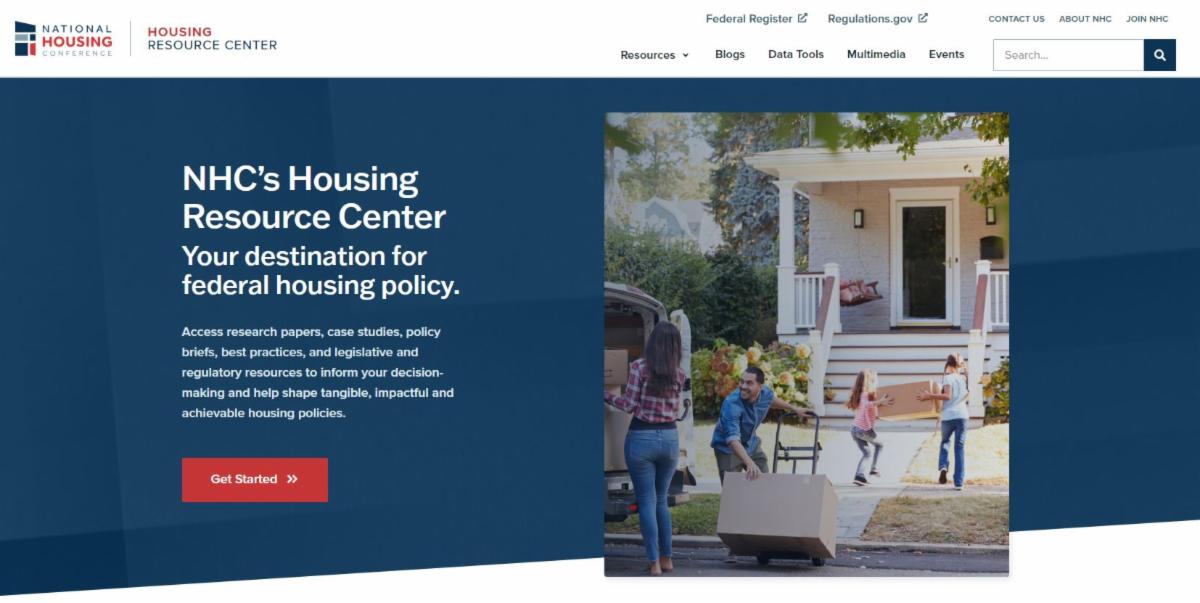
Explore NHC’s Housing Resource Center
for up-to-date federal policy news and resources
NHC’s Housing Resource Center (HRC) is the definitive destination for all your federal policy needs in housing. We update the platform at least every week and have already included a host of information on the latest administrative actions.
The HRC provides access to a growing collection of over 2,000 resources, offering an unparalleled wealth of knowledge in an easily searchable, centralized repository. Resources include news articles, toolkits, issue papers, research, and congressional actions, all searchable by topic and resource type. The HRC also provides comprehensive collections of housing-related blogs, podcasts, and data tools on their current events and shared knowledge of housing and community development best practices.
With new developments happening daily, the HRC is your trusted source for staying informed and navigating the ever-changing federal housing policy landscape.
| | |
Freddie Mac announces new machine learning tool
Freddie Mac announced the implementation of a new automated process in its Loan Product Advisor ® underwriting tool that uses machine learning to improve efficiency for borrowers and lenders. The innovation is expected to reduce costs by $1,500 per loan, and Federal Housing Finance Agency Director and Chairman of Freddie Mac William Pulte encouraged lenders to pass those savings on to customers.
“It’s the year 2025, and the time to streamline the homebuying experience is now… we expedited this version of LPA® to increase efficiency and further lower costs,” said Sonu Mittal, Freddie Mac’s Executive Vice President and Head of Single-Family Acquisitions.
The announcement also includes a new income calculator tool to help potential homebuyers who work in the gig economy determine their income.
| | | |
Housing affordability crisis persists despite inventory gains
The National Association of REALTORS® published a new report, "Housing Affordability and Supply", analyzing inventory gaps and affordability. The report shows that while housing inventory has increased nearly 20% from last year, it remains insufficient to meet demand, especially for middle-and lower-income buyers. Affordability remains a major challenge, with only about 21% of homes being affordable to households earning $75,000 annually, far below pre-pandemic levels. To reach a balanced market, nearly 416,000 more listings priced at or below $255,000 are needed. Additional layers of regional disparities persist, and rising home prices and mortgage rates limit access for many buyers.
| | |
HUD Secretary Scott Turner wrote in The Gazette that HUD is ending what he calls “the war on America’s towns” by repealing the Affirmatively Furthering Fair Housing (AFFH) rule. Turner argues that the Obama-era AFFH rule imposed burdensome federal oversight on local housing decisions. He contends that eliminating this rule will restore authority to local communities while maintaining protections against housing discrimination under the Fair Housing Act.
California Governor Gavin Newsom called on cities and counties to ban homeless encampments, unveiling an announcement of $3 billion in grants to support mental health and substance use disorders. The move follows the Grants Pass v. Johnson Supreme Court decision, which allows for stricter enforcement against homelessness encampments. The proposal aims to balance public safety and investment in resources for homelessness. Although, local officials argue that consistent and long-term funding is necessary to create lasting solutions.
An op-ed penned by members of the Trump administration for The New York Times declares the need for work requirements in order for at-risk individuals to receive welfare assistance. Written by Health and Human Services Secretary Robert F. Kennedy Jr., Agriculture Secretary Brooke Rollins, HUD Secretary Scott Turner, and Administrator of the Centers for Medicare & Medicaid Services Mehmet Oz, the essay contends that welfare spending on able-bodied adults distracts from helping the “truly needy” and argues welfare benefits have become a “lifelong trap of dependency.” It ultimately calls for universal work requirements for able-bodied adults across the programs they each manage.
| | Renew your NHC membership today! | | Watch this video to learn more about how NHC represents diverse leaders across the housing spectrum, including lenders, homebuilders, affordable housing advocates, real estate professionals, housing development corporations, housing finance agencies, and more, to address today's pressing housing issues. | | |
Your involvement is essential to addressing today’s housing challenges, and NHC relies on active members to maximize our impact and remain a leader in tackling today’s housing issues.
NHC membership offers exclusive networking opportunities, access to our weekly Member Brief, and other key housing resources such as our Housing Resource Center, Paycheck to Paycheck database, and Employer Assisted Housing Toolkit. We look forward to working with you to address America's housing challenges.
| | |
Sunday, May 18
Commercial/Multifamily Finance Servicing and Technology Conference | MBA, May 18-May 21
Secondary & Capital Markets Conference | MBA, May 18 – May 21 EDT
Monday, May 19
Regional Connect 2025 | NAHREP, 12:30 – 2:00 PM PT
Tuesday, May 20
No events listed
Wednesday, May 21
Rural Rental Housing Preservation Academy | Enterprise, 10:00 – 11:00 AM EDT
Unlocked: Opening the Door to Housing Access Through Tenant Screening Protections | NextCity, 1:00 PM EDT
Thursday, May 22
No events listed
Friday, May 23
No events listed
| | The National Housing Conference is a diverse continuum of affordable housing stakeholders that convene and collaborate through dialogue, advocacy, research, and education, to develop equitable solutions that serve our common interest. | | Defending Our American Home since 1931 | | Copyright © 2024. All Rights Reserved. | | | | |