|
Apologies for the tardiness today: The Cloudflare web outage affected Constant Contact.
Quotes of the Day:
"The real power of propaganda is not to convince or even confuse: it's to give you a sense of belonging."
– Peter Pomerantsev, How to Win an Information War: The Propagandist Who Outwitted Hitler
"Moral indignation is jealousy with a halo."
– H. G. Wells
"I am not in this world to live up to other people's expectations, nor do I feel that the world must live up to mine."
– Frederick Perls
1. What ‘east-up’ map really means for future role of USFK
2. N. Korea slams S. Korea-U.S. fact sheet as formalizing confrontational stance against Pyongyang
3. Pompeo says N.K. denuclearization will only happen with Xi's 'permission,' no carrots to convince it
4. N. Korea says U.S. approval of S. Korea's nuclear subs drive will spark 'nuclear domino'
5. Presidential office says S. Korea has no hostile intent toward N. Korea
6. FM Cho calls nuclear-free Korean Peninsula 'imperative' never to be abandoned
7. Defense ministry to create deputy minister post overseeing AI policy
8. PM says task force to probe officials' involvement in martial law 'inevitable'
8. Tariff deal with U.S. 'significantly' reduces economic uncertainty for S. Korea: BOK chief
9. Construction of world's 1st CVD graphene film plant completed in S. Korea
11. Officials to visit wartime coal mine in Japan to help recover remains of Korean forced laborers
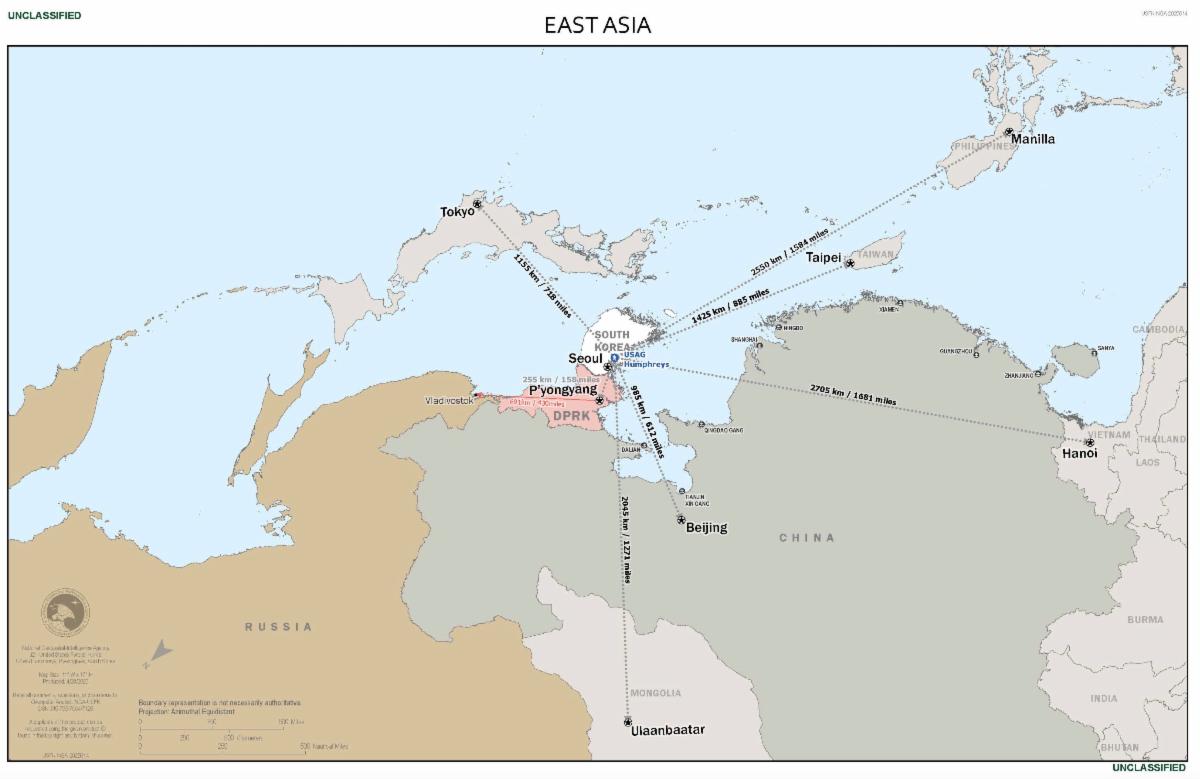
12. USFK 'east-up' map
13. N. Korea unlikely to respond to S. Korea's proposal for military talks: experts
1. What ‘east-up’ map really means for future role of USFK
Summary:
GEN Brunson’s “east-up” map reframes South Korea from a distant outpost to “decisive space” inside a wider Indo-Pacific defensive perimeter. Analysts say it signals using USFK against regional threats that include China and Russia, aligned with Washington’s drive for “strategic flexibility” and the emerging triangle linking South Korea, Japan and the Philippines. Rather than diluting North Korea deterrence, experts argue it underlines how tightly China and the North are linked and strengthens arguments against reducing US forces. Seoul stays publicly cautious, but the map reflects a broader trend placing the peninsula at the center of a connected regional architecture.
Excerpt:
The debate over the map is likely to intensify as Washington updates its National Defense Strategy and reevaluates its military presence across the region. Experts say that for now, Brunson’s map has achieved what few conceptual tools have managed to do: place South Korea not on the edge of the map, but at the center of the chessboard.
Comment: This is probably one of the most important strategic actions taken by a CINCUNC/CFC, Commander of USFK, and the Senior MIlitary Officer in Korea (SUSMOAK). This single map may do more to educate the policymakers, press, pundits, and the public about the geostrategic importance, complexity, and proximity of strategic challenges. Geography matters. It should drive alliance modernization.
To think that this effort was initiated by a CINC's article published by the PAO on the command web page. It is generating important discussion and analysis (at least in Korea).
My recommendation remains the most important alliance modernization action is the establishment of a Northeast Asia Combatant Command (NEACOM). This must be done through reallocating existing headquarters assets and eliminating or combining headquarters in the region.
Strategic Concept: Establishing a Combined Northeast Asia Combatant Command (NEACOM) in Seoul
https://nationalsecurityjournal.org/strategic-concept-establishing-a-combined-northeast-asia-combatant-command-neacom-in-seoul/
What ‘east-up’ map really means for future role of USFK - The Korea Times
The Korea Times · ListenListenText SizePrint
By Bahk Eun-ji
- Published Nov 18, 2025 4:00 pm KST
- Updated Nov 18, 2025 5:43 pm KST
https://www.koreatimes.co.kr/southkorea/defense/20251118/what-east-up-map-really-means-for-future-role-of-usfk
The introduction of an “east-up” map by the commander of U.S. Forces Korea (USFK) has stirred fresh debate over whether Washington is positioning itself to expand the mission of American troops stationed on the Korean Peninsula.
Although Gen. Xavier Brunson framed the concept as a tool to improve geographic visualization, experts say the map offers clues as to how the allied posture may evolve — shifting from a South Korea-centric deterrence model to one that situates China and Russia within a broader Indo-Pacific framework.
Brunson recently described South Korea not as a forward outpost on the periphery of American power, but as a “decisive space inside the defensive perimeter.” Analysts say that reframing alters how the peninsula is positioned within the region’s broader strategic landscape.
Yang Moo-jin, a professor and former president of the University of North Korean Studies, said the map signals a shift in how the U.S. positions its forces.
“This is not just a rotated map,” he said. “It shows the U.S. widening the strategic utility of USFK. The east-up view puts the peninsula at the center of an axis that runs through the U.S., China, Russia and North Korea, and it aligns with the emerging security triangle linking the Philippines, Japan and South Korea.”
Retired Lt. Gen. Chun In-bum, former commander of Korea’s Special Warfare Command, noted that the concept is closely tied to Washington’s long-standing emphasis on strategic flexibility.
“Strategic flexibility means USFK can move if a regional threat emerges,” he said. “This is not a new idea — it’s been part of U.S. strategy for years.”
He rejected the notion that prioritizing China means diluting North Korea deterrence.
“That interpretation is wrong. China and North Korea cannot be separated. They share the same operational environment.”
Chun also dismissed concerns that South Korea could be exposed to greater risks.
“The idea that South Korea would become a bullet-catcher is exaggerated,” he said. “If anything, the east-up concept reinforces arguments in the U.S. against reducing troop levels. It helps explain South Korea’s strategic value to the American audience.”
Kim Yeoul-soo, national security director at the Korea Institute for Military Affairs, said that the concept aligns with broader adjustments to U.S. defense strategies.
“U.S. Secretary of Defense Pete Hegseth already said at the Security Consultative Meeting that USFK must retain strategic flexibility in order to respond to threats not only on the peninsula, but across the region as well,” he said.
“The map visually shows that South Korea sits at the center of a theater that includes China. It’s not just a symbolic gesture — it reflects how the U.S. now views the Indo-Pacific region.”
Kim added that South Korea’s location gives it leverage over China’s Northern Theater Command and Russia’s Pacific assets.
“If you look at the operational range of the Russian Northern Fleet or China’s northern forces, the peninsula is a decisive point. Their sea and air movements are naturally constrained by geography.”
South Korean defense officials, however, remain cautious regarding the rotated map.
A senior military official said it would be inappropriate for Seoul to comment on specific remarks made by U.S. officials, adding that the map should be interpreted “as the U.S. describes it, nothing more.”
He also stressed that scenarios involving direct confrontation between South Korea and China or Russia are “not realistic” and that Seoul does not endorse interpretations implying a regionwide mission shift.
Despite their differing views, experts agree on one point: The east-up map does not immediately change the mission of the USFK, but it does reflect a wider strategic trend. As the Indo-Pacific security architecture becomes more interconnected, linking Northeast Asia with the Philippines, Guam and Japan, the peninsula’s strategic importance is expected to increase.
The debate over the map is likely to intensify as Washington updates its National Defense Strategy and reevaluates its military presence across the region. Experts say that for now, Brunson’s map has achieved what few conceptual tools have managed to do: place South Korea not on the edge of the map, but at the center of the chessboard.
The Korea Times · ListenListenText SizePrint
2. N. Korea slams S. Korea-U.S. fact sheet as formalizing confrontational stance against Pyongyang
Summary:
North Korea condemned the ROK-US joint fact sheet as formalizing hostile policy, denouncing commitments to its “complete denuclearization” and backing for South Korean nuclear submarines, enrichment and reprocessing. It warned these steps risk a nuclear domino and vowed “justified, realistic countermeasures,” while conditioning talks with Trump on dropping denuclearization demands.
Comment: It seems that the regime (and the Propaganda and Agitation Department) needed some time to analyze and assess the statements and generate a response. But it is not an unexpected response. We should note that even without our deterrence statement (if KJU uses nuclear weapons the regime will cease to exist) the regime still calls the statements hostile. Toning down or eliminating deterrence language does nothing to change regime behavior.
(LEAD) N. Korea slams S. Korea-U.S. fact sheet as formalizing confrontational stance against Pyongyang | Yonhap News Agency
en.yna.co.kr · Kim Soo-yeon · November 18, 2025
https://en.yna.co.kr/view/AEN20251118000851315
(ATTN: UPDATES with more details throughout; RECASTS headline; ADDS photo)
By Kim Soo-yeon
SEOUL, Nov. 18 (Yonhap) -- North Korea on Tuesday denounced the release of a joint fact sheet between South Korea and the United States on their trade and security agreements as "formulating" as policy their confrontational stance against Pyongyang, warning that the North will take countermeasures.
The North's warning came after Seoul and Washington released the document on Friday outlining the outcomes of two summits between President Lee Jae Myung and U.S. President Donald Trump in August and October. On the same day, the allies also issued a joint communique following their annual defense talks held in early November.
In a lengthy commentary carried by state media, North Korea denounced details of the joint fact sheet, particularly Seoul and Washington's commitment to completing denuclearization of the North and the U.S.' formal approval of South Korea's push to build nuclear-powered submarines.
President Lee Jae Myung (R) shakes hands with U.S. President Donald Trump in Gyeongju, southeastern South Korea, ahead of their special banquet, in this file photo taken Oct. 29, 2025. (Yonhap)
"The DPRK will take more justified and realistic countermeasures to defend the sovereignty and security interests of the state and regional peace, corresponding to the fact that the confrontational intention of the U.S. and the ROK to remain hostile towards the DPRK was formulated as their policy once again," the Korean Central News Agency (KCNA) said.
DPRK stands for North Korea's official name, the Democratic People's Republic of Korea, and ROK is the acronym of South Korea's formal name, the Republic of Korea.
North Korea claimed the announcement of the summit agreements was "the most vivid manifestation" of the Trump administration's policy toward North Korea and denounced the U.S. commitment with South Korea to achieving "complete denuclearization" of the North.
"This is an intensive expression of their confrontational will to deny the constitution of the DPRK to the last. It proves that their only option is confrontation with the DPRK," the North said.
North Korea also criticized Washington's approval of Seoul's push to acquire nuclear submarines as a "serious development" that destabilizes the security situation in the Asia-Pacific region and "causes the situation of impossible nuclear control in the global sphere."
"The ROK's possession of nuclear submarine is a strategic move for 'its own nuclear weaponization' and this is bound to cause a 'nuclear domino phenomenon' in the region and spark a hot arms race," the KCNA said.
On the U.S. expressing its support for South Korea's move to secure uranium enrichment and spent nuclear fuel reprocessing capabilities, North Korea denounced it as "laying a springboard for" Seoul to develop into a "quasi-nuclear weapons state."
The North's warning came as it has not responded to Trump's repeated proposal to meet with North Korean leader Kim Jong-un to resume stalled diplomacy with Pyongyang. Kim earlier said the North remains open to talks with the U.S. if Washington does not demand North Korea's denuclearization as precondition for dialogue.
This file photo, taken Aug. 25, 2025, shows South Korean President Lee Jae Myung (L) holding talks with U.S. President Donald Trump in the Oval Office of the White House in Washington, D.C. (Yonhap)
sooyeon@yna.co.kr
(END)
en.yna.co.kr · Kim Soo-yeon · November 18, 2025
3. Pompeo says N.K. denuclearization will only happen with Xi's 'permission,' no carrots to convince it
Summary:
Mr. Pompeo said North Korean denuclearization would occur only with Xi Jinping’s “permission,” arguing Beijing uses Pyongyang as a strategic tool. He saw few remaining “carrots” or “sticks,” urged focusing pressure on China, doubted Trump would recognize North Korea as a nuclear state, and backed bipartisan support for ROK nuclear-powered submarine cooperation.
Comment: With all due respect to Mr. Pompeo, I disagree with some of his assessment that China has very much control over the regime though I agree that XI does try to use nK for its purposes, parimarly to create dilemmas for the US. We have long assumed that pressure on China would cause it to pressure the Kim family regime. There is no evidence of that over the past four decades that I can see.
(LEAD) Pompeo says N.K. denuclearization will only happen with Xi's 'permission,' no carrots to convince it | Yonhap News Agency
en.yna.co.kr · Song Sang-ho · November 18, 2025
https://en.yna.co.kr/view/AEN20251118002051315
(ATTN: RECASTS 3rd para; ADDS photo, more remarks in paras 7-8, 11-16)
By Song Sang-ho
WASHINGTON, Nov. 17 (Yonhap) -- Former U.S. Secretary of State Mike Pompeo said Monday that North Korea's denuclearization will happen only with Chinese President Xi Jinping's "permission" and "direction," underlining the need to focus on deterring Beijing from using Pyongyang as a "strategic tool."
During a forum, Pompeo, the chief diplomat during President Donald Trump's first administration, recounted his nuclear negotiations with the North in 2018 and 2019, claiming there is not much freedom for North Korean leader Kim Jong-un on the nuclear issue as Beijing and Pyongyang are "deeply intertwined."
He also pointed out that there are currently "no carrots" to convince the recalcitrant regime to renounce its nuclear program and the number of "sticks" available is low, while noting that Kim may want to get economic sanctions relief if talks with the United States resume.
"If the idea is to get the nuclear weapons moved out of North Korea, it's only going to happen with the permission and the direction of Xi Jinping. Talking to Chairman Kim is interesting but not that instructive," Pompeo said during a fireside chat hosted by D&A LLC, a South Korean law firm.
"If you said what would you do differently, it would be to focus on Beijing and deterring it from using North Korea as a strategic tool," he added.
Former U.S. Secretary of State Mike Pompeo speaks during a forum hosted by D&A LLC, a South Korean law firm, in Fairfax County, Virginia, on Nov. 17, 2025. (Yonhap)
The former top diplomat was responding to a question about what he would do to make progress should diplomacy resume with Pyongyang, while acknowledging that the nuclear negotiations during his time in office were ultimately "unsuccessful."
His remarks came as Trump has repeatedly expressed his openness to reengaging with Kim, adding to speculation that he would seek to rekindle his personal diplomacy that led to three in-person meetings with Kim during his first term -- the first in Singapore in June 2018, the second in Hanoi in February and the third at the inter-Korean border village of Panmunjom in June 2019.
Pointing to China's influence over the North, Pompeo recalled Kim's interactions with Xi before and after the top-level negotiations with the U.S.
"(Kim) traveled to Singapore, to Hanoi and then the third summit actually on the border. Each time, he reported back to Beijing, both before and after the meetings. This was really Xi Jinping with whom we were negotiating," he said.
"So when I think about those nuclear arsenals, I think about them not as a single enterprise ... not a great deal of freedom or agency for Chairman Kim ... This is not just a Chairman Kim problem. This is a China problem there. They are deeply intertwined."
Pompeo also raised the possibility that Xi might be behind Pyongyang's decision to send troops to Russia in its war against Ukraine.
"No one should be under any illusions that they did not go there without the direction of Xi Jinping," he said. "Now, I don't have the orders that were issued, but I am intensely confident that there was no chance that would happen."
He anticipated that Kim would want to secure sanctions relief if a summit with Trump materializes, as the impoverished country has long been struggling under the biting sanctions imposed for its nuclear and ballistic missile programs.
"What Chairman Kim would love is to get economic relief. What he would love is to be brought back into the fold of a more normal nation," he said.
But he pointed out that Kim has proffered "nothing" to convince the international community, including South Korea, Japan and the U.S., to allow for that relief, and that he does not have any tool to achieve it.
"It seems to me the likelihood of that being successful for him is very low," he said.
This AFP photo shows U.S. President Donald Trump (R) shaking hands with North Korean leader Kim Jong-un after signing a joint statement at the Capella Hotel on Sentosa Island in Singapore on June 12, 2018. (Yonhap)
Touching on his in-person encounter with Kim, the former secretary called the dynastic ruler a "nasty" man and "evil."
"I don't mean he's rude ... He believes that the Korean Peninsula is his. They have been wronged, and he's determined to find a methodology (to) get it back," he said. "He has a buddy in Beijing that would just love to see that as well."
He expressed skepticism that the second Trump administration would formally recognize North Korea as a nuclear-armed state, amid lingering speculation that Trump could pursue a reduction of threats rather than the long-elusive objective of denuclearization.
"I would be very surprised if there would be a formal statement accepting North Korea as a nuclear nation," he said. "When we say threat reduction, what you are really saying is a recognition of them as a proper nuclear state. That would surprise me a whole lot that that would come out of the Trump administration."
Asked if he sees the possibility of Trump using the negotiations with the North as a means to secure a Nobel Peace Prize, Pompeo said, "That's not the avenue."
Noting that there is not much leverage to use against North Korea, he proposed continuing to tighten the screw on the regime through efforts including preventing its revenue generation.
"My view is we should make things as difficult as possible for the regime. Starve them of as much resources we can because those resources don't go to feed the North Korean people," he said. "Those resources go to fuel his military capability, and we ought to try and make that as small and as limited as possible."
Commenting on Trump's recent approval for South Korea's push to acquire nuclear-powered submarines, he struck a positive note, particularly regarding the prospects of the U.S. Congress backing it.
"Yes, I think it's absolutely possible that you could get bipartisan congressional approval for further cooperation on this file from Capitol Hill. I don't think it's remote," he said.
sshluck@yna.co.kr
(END)
en.yna.co.kr · Song Sang-ho · November 18, 2025
4. N. Korea says U.S. approval of S. Korea's nuclear subs drive will spark 'nuclear domino'
Summary:
North Korea condemned a new ROK US fact sheet, warning US backed South Korean nuclear powered submarines and fuel cycle capabilities will trigger a regional nuclear domino and arms race. Pyongyang said reaffirmed goals for complete DPRK denuclearization deny its sovereignty and vowed “justified, realistic countermeasures” while keeping rhetoric restrained.
Comment: Isn't nK the number one "nuclear domino" today? Regardless of what we put in our statements the Propaganda and Agitation department will spin them to suit the regime's objectives. Assessing the regime's propaganda can help us better understand the regime.
(3rd LD) N. Korea says U.S. approval of S. Korea's nuclear subs drive will spark 'nuclear domino' | Yonhap News Agency
en.yna.co.kr · Park Boram · November 18, 2025
https://en.yna.co.kr/view/AEN20251118000853315
(ATTN: UPDATES with more details throughout; ADDS byline)
By Kim Soo-yeon and Park Boram
SEOUL, Nov. 18 (Yonhap) -- North Korea said Tuesday that the United States' approval of South Korea's push to build nuclear-powered submarines will lead to a "nuclear domino" phenomenon in the region as it denounced the allies' joint fact sheet on trade and security agreements.
The North issued its first reaction to the document that Seoul and Washington released Friday over the outcomes of two summits between President Lee Jae Myung and U.S. President Donald Trump in August and October. On the same day, the allies also issued a joint communique following their annual defense talks held in early November.
In a lengthy commentary carried by the Korean Central News Agency (KCNA), North Korea denounced the joint fact sheet as formalizing Seoul and Washington's confrontational stance toward Pyongyang.
The North, in particular, took issue with the U.S.' formal approval of South Korea's push to build nuclear-powered submarines and the allies' commitment to completing denuclearization of the North.
President Lee Jae Myung (R) shakes hands with U.S. President Donald Trump in Gyeongju, southeastern South Korea, ahead of their special banquet, in this file photo taken Oct. 29, 2025. (Yonhap)
North Korea denounced Washington's approval of Seoul's nuclear submarines drive as a "serious development" that destabilizes the security situation in the Asia-Pacific region and "causes the situation of impossible nuclear control in the global sphere."
"The ROK's possession of nuclear submarine is a strategic move for 'its own nuclear weaponization' and this is bound to cause a 'nuclear domino phenomenon' in the region and spark a hot arms race," the KCNA said, using the acronym of South Korea's formal name, the Republic of Korea.
On the U.S. expressing its support for South Korea's move to secure uranium enrichment and spent nuclear fuel reprocessing capabilities, North Korea denounced it as "laying a springboard for" Seoul to develop into a "quasi-nuclear weapons state."
The joint sheet's commitment to the "complete denuclearization of the DPRK," instead of the Korean Peninsula, is unanimously interpreted as denying "the entity and the existence of the DPRK," the commentary also claimed.
DPRK stands for North Korea's official name, the Democratic People's Republic of Korea.
In such a circumstance, it said, the U.S. talking about implementing the past DPRK-U.S. agreement constitutes the height of "shamelessness and the way of thinking of Yankees," referring to the agreement to improve ties that was reached between Trump and North Korean leader Kim Jong-un following their first summit in Singapore in 2018.
The North also lashed out at the U.S. expressing its commitment with South Korea to achieving "complete denuclearization" of the North, insisting the announcement of the summit agreements was "the most vivid manifestation" of the Trump administration's policy toward North Korea.
"This is an intensive expression of their confrontational will to deny the constitution of the DPRK to the last. It proves that their only option is confrontation with the DPRK," the North said.
North Korea said the joint fact sheet showed the Washington and Seoul's confrontational intention to remain hostile toward the North was "formulated as their policy" once again.
"The DPRK will take more justified and realistic countermeasures to defend the sovereignty and security interests of the state and regional peace," the KCNA said.
North Korea appears to show a measured response to the summit document and the joint communique of the Security Consultative Meeting, given that it did not issue an official statement in the name of government officials. The North also did not directly criticize Trump or President Lee by name.
The North's warning came as it has not responded to Trump's repeated proposal to meet with Kim to resume stalled diplomacy with Pyongyang. Kim earlier said the North remains open to talks with the U.S. if Washington does not demand North Korea's denuclearization as a precondition for dialogue.
A unification ministry official in Seoul assessed the KCNA commentary is in a rather "calm and restrained" tone, reiterating its previous positions on denuclearization, South Korea-U.S. military drills or other security issues.
Earlier this month, South Korea's spy agency raised the "high possibility" of North Korea engaging in a summit with the U.S. after the biggest annual military exercise between Seoul and Washington in March next year.
As of Tuesday morning, Pyongyang had shown no reaction to the South Korean defense ministry's offer the previous day for military talks to discuss issues involving the Military Demarcation Line, officials said.
This file photo, taken Aug. 25, 2025, shows South Korean President Lee Jae Myung (L) holding talks with U.S. President Donald Trump in the Oval Office of the White House in Washington, D.C. (Yonhap)
sooyeon@yna.co.kr
pbr@yna.co.kr
(END)
en.yna.co.kr · Park Boram · November 18, 2025
5. Presidential office says S. Korea has no hostile intent toward N. Korea
Summary:
South Korea’s presidential office rejected North Korea’s claim that a ROK US fact sheet formalizes hostility, insisting Seoul has no confrontational intent toward Pyongyang. Spokesperson Kang Yu jung said security cooperation with Washington protects national interests and regional stability, and vowed efforts to ease tensions and rebuild inter Korean trust.
Comment: Omitted were the necessary statements of supporting the Korean people in the north, advocating for their human rights, to include the right of self determination of government (Article 21 of the UDHR), and seeking peaceful resolution to the "Korea question."
(LEAD) Presidential office says S. Korea has no hostile intent toward N. Korea | Yonhap News Agency
en.yna.co.kr · Yi Wonju · November 18, 2025
https://en.yna.co.kr/view/AEN20251118004851315?section=national/politics
(ATTN: UPDATES throughout; CHANGES headline)
By Yi Wonju
SEOUL, Nov. 18 (Yonhap) -- The presidential office said Tuesday that South Korea has no hostile intent toward North Korea, hours after the North denounced the release of a joint fact sheet on recent South Korea-U.S. trade and security agreements amounted to "formalizing" a confrontational policy toward Pyongyang.
Earlier in the day, North Korea issued a lengthy commentary carried by the Korean Central News Agency (KCNA), arguing that the U.S. approval of South Korea's push to build nuclear-powered submarines will lead to a "nuclear domino" phenomenon in the region.
"We will continue to work consistently toward easing inter-Korean tensions and restoring trust between the two Koreas," presidential spokesperson Kang Yu-jung said in a press notice.
"Contrary to the commentary carried by the KCNA, the government has no hostile or confrontational intent toward the North," she added.
Kang stressed that South Korea's security cooperation with the United States is aimed at safeguarding national interests and safeguarding national defense.
"The government will continue efforts to ensure the South Korea-U.S. alliance contributes to peace and stability on the Korean Peninsula and in the region," she said.
In the commentary, the North also took issue with the U.S.' formal approval of South Korea's push to build nuclear-powered submarines and the allies' commitment to completing denuclearization of the North.
It marked Pyongyang's first reaction to the document that Seoul and Washington released Friday over the outcomes of two summits between President Lee Jae Myung and U.S. President Donald Trump in August and October.
The North's warning came as it has not responded to Trump's repeated proposal to meet with North Korean leader Kim Jong-un to resume stalled diplomacy with Pyongyang. Kim earlier said the North remains open to talks with the U.S. if Washington does not demand North Korea's denuclearization as a precondition for dialogue.
Presidential spokesperson Kang Yu-jung attends a press conference at the presidential office in Seoul on Nov. 11, 2025. (Yonhap)
julesyi@yna.co.kr
(END)
en.yna.co.kr · Yi Wonju · November 18, 2025
6. FM Cho calls nuclear-free Korean Peninsula 'imperative' never to be abandoned
Summary:
Foreign Minister Cho Hyun told the Seoul Diplomacy Forum a nuclear free Korean Peninsula is imperative, vowing to prevent war while pursuing phased denuclearization, deterrence and dialogue. He urged avoiding hardened blocs through trilateral cooperation with the US and Japan, plus China and Japan, as ambassadors echoed broader regional views.
Comment: There is only one way to have a nuclear free peninsula: To solve the Korea question which of course is the unnatural division of the peninsula. The solution is in fourteen words: "Unification first, then denuclearization' the path to unification is through information and human rights."
(LEAD) FM Cho calls nuclear-free Korean Peninsula 'imperative' never to be abandoned | Yonhap News Agency
en.yna.co.kr · Park Boram · November 18, 2025
https://en.yna.co.kr/view/AEN20251118006651315?section=national/diplomacy
(ATTN: UPDATES with remarks by China, Japan's ambassadors in last 5 paras)
SEOUL, Nov. 18 (Yonhap) -- Foreign Minister Cho Hyun said Tuesday a Korean Peninsula without nuclear weapons is an "imperative" that should not be abandoned, committing to ensure the peninsula does not become a flashpoint of armed conflict.
Cho made the remarks in his keynote speech to the Seoul Diplomacy Forum 2025, hosted by the Korea National Diplomatic Academy. The speech was read out by Youn Jong-kwon, ambassador for international cyberaffairs, as the minister is currently on an overseas trip.
"Korea's top priority on the security front is to prevent war and ensure that the Korean Peninsula does not become a flashpoint of armed conflict," Cho said, calling a "nuclear-free" Korean Peninsula an "imperative we must never abandon."
Foreign Minister Cho Hyun (Yonhap)
The minister referred to the government's goal of the phased denuclearization of the peninsula -- first stopping North Korea's nuclear arsenals, then reducing and ultimately dismantling them.
Seoul will solidify its defense capabilities against North Korean threats, but such measures should also be "accompanied by efforts to prevent inadvertent conflicts, deescalate tensions and restore dialogue with Pyongyang," he said.
Now, South Korea faces "ever more complex strategic calculations," Cho noted, citing increasing geopolitical and geoeconomic competition, and growing nuclear and missile threats from North Korea.
"The quest for peaceful coexistence should not be limited to the Korean Peninsula, but we must seek to prevent the hardening of confrontational blocs in our region as well," he also said, pledging efforts to trilateral cooperation among Korea, the United States and Japan, as well as among Korea, China and Japan, to promote regional stability.
In a subsequent discussion session, Japanese Ambassador to South Korea Koichi Mizushima emphasized the growing importance of South Korea-Japan cooperation against the backdrop of declining multilateralism on the international stage.
"Minilateralism" is now one of the potential choices when "we see the global multilateral system does not work as effectively as before," Mizushima said, pointing to the situation as an opportunity for the two countries to deepen their cooperative relations.
During the session, Chinese Ambassador Dai Bing emphasized that China has no intention to challenge anyone but is seeking only to fulfill the heavy task of improving the livelihoods of its 1.4 billion people.
"But if you think China's development is a challenge, a threat to some country, we have no choice ... (but) to defend our core interests and our dignity," the ambassador warned.
Touching on U.S.-China relations, Dai said Beijing does not want any war on tariffs, trade or technology with Washington, casting a "cautiously positive" outlook for bilateral relations.
pbr@yna.co.kr
(END)
en.yna.co.kr · Park Boram · November 18, 2025
7. Defense ministry to create deputy minister post overseeing AI policy
Summary:
South Korea’s defense ministry plans a deputy minister for AI, overseeing four bureaus and 220 staff, centralizing AI policy amid organizational reforms and personnel shortages.
Comment: Wise move? You would think with AI you could have less bureaucracy. (note attempt at humor).
(LEAD) Defense ministry to create deputy minister post overseeing AI policy | Yonhap News Agency
en.yna.co.kr · Kim Hyun-soo · November 18, 2025
https://en.yna.co.kr/view/AEN20251118005451315?section=national/defense
(ATTN: ADDS more info in last 2 paras; CHANGES photo)
SEOUL, Nov. 18 (Yonhap) -- The defense ministry is pushing to establish a new deputy minister post in charge of artificial intelligence (AI) policy to bolster the use of AI in the military, according to a report submitted to an opposition lawmaker Tuesday.
Under the reform plan, the ministry will create the new position to oversee all AI-related functions, including logistics, information and military assets, according to Rep. Kang Dae-sik of the main opposition People Power Party.
It is part of the ministry's plan to execute an organizational overhaul in January.
The move reflects the growing importance of AI technology in future warfare as the military is seeking to embrace more high-tech systems to sharpen its capabilities.
If realized, the deputy minister will oversee four bureaus concerned with AI tasks, comprising around 220 personnel. The post of deputy defense minister will be revived for the first time since 2006.
This photo, provided by the defense ministry, shows Defense Minister Ahn Gyu-back chairing a meeting to assess the adoption of artificial intelligence in the defense sector on Nov. 18, 2025. (PHOTO NOT FOR SALE) (Yonhap)
Meanwhile, the defense ministry convened a meeting Tuesday to review progress in adopting AI technology across the defense sector, chaired by Defense Minister Ahn Gyu-back.
"To address the challenge of a declining pool of military personnel, overhaul of military units, force and capability structures must proceed in tandem," Ahn said, emphasizing that now is the "golden time" for advancing AI technology in the defense sector.
sookim@yna.co.kr
(END)
en.yna.co.kr · Kim Hyun-soo · November 18, 2025
8. PM says task force to probe officials' involvement in martial law 'inevitable'
Summary:
Prime Minister Kim defends a new cross-government task force probing officials’ roles in ex-President Yoon’s martial law attempt, calling it essential for restoring constitutional order.
Comment: To my Korean friends, beware of witch hunts and "McCarthyism." Focus on making democracy strong and making it work correctly.
(LEAD) PM says task force to probe officials' involvement in martial law 'inevitable' | Yonhap News Agency
en.yna.co.kr · Kim Seung-yeon · November 18, 2025
https://en.yna.co.kr/view/AEN20251118004051315
(ATTN: ADDS details on appointment of task force chief for police probe in last 4 paras)
By Lee Haye-ah
SEOUL, Nov. 18 (Yonhap) -- Prime Minister Kim Min-seok said Tuesday the formation of a government task force to investigate public officials' involvement in former President Yoon Suk Yeol's martial law attempt was an "inevitable" measure aimed at stabilizing state affairs.
Kim made the remark during a Cabinet meeting as critics have raised concerns the body, named the "task force to respect the Constitution and innovate the government," will effectively be used as a tool to ferret out dissenting civil servants.
"The task force is an inevitable measure for stabilizing state affairs aimed at swiftly restoring the constitutional order and uniting the public sector," the prime minister said. "The various investigations will be conducted and concluded swiftly in accordance with the Constitution and lawful procedures, within a scope that is absolutely necessary without being excessive or lacking."
The task force was proposed by Kim during a Cabinet meeting led by President Lee Jae Myung last week. Lee expressed his enthusiasm for the idea, saying the government should conduct an investigation separate from that of a special counsel team to hold public officials accountable for their role in the martial law bid.
"The task force will demonstrate the wisdom of concentration and restraint for the stable innovation of the executive branch in order to uphold the people's call to swiftly and firmly clean up the insurrection and focus on people's livelihoods," Kim said at Tuesday's meeting.
The task force will be set up at each of 49 central government agencies, excluding the National Intelligence Service and bodies under the presidential office.
Prime Minister Kim Min-seok presides over a Cabinet meeting at the government complex in Seoul on Nov. 18, 2025. (Yonhap)
As for the police probe, Senior Superintendent Hwang Jeong-in will lead the sectoral task force, according to police officers familiar with the matter.
Hwang, currently chief of a provincial police precinct, will be in charge of delving into allegations of any acts within the police organization that involved plotting, carrying out, justifying or covering up the botched martial law bid.
Hwang is known for having opposed the Yoon government's push in 2022 to establish a "police bureau" within the interior ministry -- a move widely viewed as an attempt to weaken the police force.
At the time, Hwang was serving as chief of the narcotics division at the Seoul Metropolitan Police Agency, but was reassigned to a post at the police training institute, a transfer that was effectively seen as a demotion.
hague@yna.co.kr
elly@yna.co.kr
(END)
en.yna.co.kr · Kim Seung-yeon · November 18, 2025
9. Tariff deal with U.S. 'significantly' reduces economic uncertainty for S. Korea: BOK chief
Summary:
BOK Governor Rhee says Seoul’s tariff deal with Washington, trading $350 billion in U.S. investments for tariffs, eases uncertainty but pressures and supply-chain shifts persist.
Comment: It is not over. Korea must avoid another 1997 IMF crisis. (And the US must not cause one).
Tariff deal with U.S. 'significantly' reduces economic uncertainty for S. Korea: BOK chief | Yonhap News Agency
en.yna.co.kr · Oh Seok-min · November 18, 2025
https://en.yna.co.kr/view/AEN20251118005900320
SEOUL, Nov. 18 (Yonhap) -- The recent tariff agreement with the United States has substantially reduced economic uncertainty for South Korea, though the country is expected to face a greater tariff impact on exports in the second half, the chief of the South Korean central bank has said.
"We believe that the trade deal between Korea and the United States has significantly reduced uncertainties," Bank of Korea (BOK) Gov. Rhee Chang-yong told the BBC in an interview aired Tuesday.
"It would be very positive if we could develop joint ventures that combine the U.S.' strengths in basic science with Korea's strengths in manufacturing and applied technologies," he added.
After monthslong negotiations over the Donald Trump administration's aggressive tariff policies, Seoul and Washington finalized a deal and released a joint fact sheet last week outlining South Korea's US$350 billion investment plans in the U.S., in exchange for a reduction of U.S. tariffs from 25 percent to 15 percent.
This file photo taken Oct. 29, 2025, shows Bank of Korea Gov. Rhee Chang-yong speaking during a parliamentary audit in Seoul. (Yonhap)
Exports remained solid in the first half of this year thanks to proactive responses by Korean companies, but a more significant impact is expected in the second half, Rhee warned.
The top central banker noted that South Korea had been preparing for changes in global supply chains even before global trade tensions arose, diversifying markets and adjusting business operations, and the adjustments are necessary not due to tariffs but because of China's rapidly growing competitiveness in certain industries.
"Luckily, I think Korea is in a good position for the new technology, especially artificial intelligence, because our AI industry is very strong not only in software but also in the hardware," Rhee said.
Addressing concerns about an AI bubble, he expressed optimism by saying that the technology will drive demand for smaller, everyday products, which will sustain demand for traditional legacy chips as well.
"Regardless of who's going to be winners in this big AI race, definitely the AI boom will continue," Rhee said.
Nvidia CEO Jensen Huang (R), Samsung Electronics Chairman Lee Jae-yong (L) and Hyundai Motor Group Executive Chair Euisun Chung drink beer at a fried chicken restaurant in southern Seoul on Oct. 30, 2025. (Yonhap)
graceoh@yna.co.kr
(END)
en.yna.co.kr · Oh Seok-min · November 18, 2025
10. Construction of world's 1st CVD graphene film plant completed in S. Korea
Summary:
South Korea’s Graphene Square completed the world’s first CVD graphene film plant in Pohang, boosting flexible electronics and battery industries and creating new growth engines.
Comment: perhaps one of the most important technologies for the future?
Construction of world's 1st CVD graphene film plant completed in S. Korea | Yonhap News Agency
en.yna.co.kr · Kim Na-young · November 18, 2025
SEJONG, Nov. 18 (Yonhap) -- The construction of the world's first mass production facility for chemical vapor deposition (CVD) graphene film, a key component used in advanced electronics and batteries, has been completed in South Korea, the industry ministry said Tuesday.
A completion ceremony for the plant owned by Graphene Square Inc., a domestic graphene film manufacturer, was held in the country's southeastern city of Pohang, according to the Ministry of Trade, Industry and Resources.
A graphene film is an ultrathin, continuous layer used in flexible displays, wearable electronics and advanced batteries, and known for its flexibility, transparency and high-quality electrical and thermal conductivity.
The plant is expected to help Pohang, a South Korean steel industry hub about 270 kilometers southeast of Seoul, find new growth engines for the region, the ministry said.
"Graphene is a key material that will determine the competitiveness of advanced industries," a ministry official said, while pledging to introduce measures to foster growth of the industry.
A captured image of Graphene Square Inc.'s official website. (PHOTO NOT FOR SALE) (Yonhap)
nyway@yna.co.kr
(END)
en.yna.co.kr · Kim Na-young · November 18, 2025
11. Officials to visit wartime coal mine in Japan to help recover remains of Korean forced laborers
Summary:
South Korean officials will visit Japan’s Chosei coal mine to inspect sites and support recovery of Korean forced laborers’ remains killed in a 1942 flood.
Comment: So much tragedy from 1910 (1905) through 1945.
Officials to visit wartime coal mine in Japan to help recover remains of Korean forced laborers | Yonhap News Agency
en.yna.co.kr · Yi Wonju · November 18, 2025
https://en.yna.co.kr/view/AEN20251118008000315
By Yi Wonju
SEOUL, Nov. 18 (Yonhap) -- South Korean officials will visit a wartime coal mine in Japan this week to explore ways to better assist recovery efforts of the remains of Korean forced laborers, the interior ministry said Tuesday.
In 1942, a devastating flood at the Chosei coal mine in western Yamaguchi Prefecture killed 183 workers, among which 136 were Koreans who had been forcibly mobilized.
Four human bone fragments, including parts of a skull, were recovered at the now-defunct mine in August, renewing interest in recovery efforts.
The officials plan to inspect the mine entrances and other key areas during the visit, scheduled for Thursday, and review ways to support the collection of the remains.
"We will actively provide support, including coming up with systematic cooperation measures on the recovery of the remains," Vice Interior Minister Kim Min-jae said.
This image shows a map of the Chosei coal mine in Japan's Yamaguchi Prefecture released by a Japanese civic organization during a press conference on Feb. 28, 2025. (Yonhap)
julesyi@yna.co.kr
(END)
en.yna.co.kr · Yi Wonju · November 18, 2025
12. USFK 'east-up' map
Summary:
GEN Brunson’s “east-up” map reframes USFK as a regional hub, with Korea a strategic pivot in a triangle with Japan and the Philippines. His concept supports U.S. demands for strategic flexibility and higher burden sharing, deepening Seoul’s regional role while heightening tensions with North Korea, China, and over Taiwan crisis.
Comment: Again, this action by GEN Brunson is probably the most important one of his tenure as this is going to shape the future of the alliance.
USFK 'east-up' map - The Korea Times
The Korea Times · ListenListenText SizePrint
- Published Nov 18, 2025 2:51 pm KST
- Updated Nov 18, 2025 3:33 pm KST
USFK commander's explainer essay gets more specific on 'strategic flexibility'
Gen. Xavier Brunson, commander of the 28,500 U.S. Forces Korea (USFK), explained his training method for his troops that expands upon and describes in detail what strategic military flexibility and alliance modernization would mean for South Korea.
In an essay posted on the USFK website and in written responses from Korean defense press corps, Brunson reorients Northeast Asia's map east-up, reframing it so that U.S. forces already "positioned on the Korean Peninsula are revealed not as distant assets requiring reinforcement but as troops already positioned inside the bubble perimeter that the U.S. would need to penetrate in the event of crisis or contingency."
This shift in view "illuminates Korea's role as a natural strategic pivot," the commander noted. He focuses specifically on the distances between major cities when the map is east-up. Camp Humphreys in Pyeongtaek, Gyeonggi Province, is 158 miles (254 kilometers) from Pyongyang, 612 miles from Beijing and approximately 500 miles from Vladivostok. Thus, South Korea is "positioned to address northern threats from Russia while simultaneously providing western reach against Chinese activities in the waters between Korea and China," he wrote.
He also lays out the strategic triangle connecting South Korea, Japan and the Philippines as the "most significant" part of the east-up map orientation. The triangle framework would offer "complementary capabilities," he wrote, delegating South Korea to "provide strategic depth and central positioning within the regional structure with the added advantage of cost-imposition capabilities against both Russian and Chinese forces."
Through methodical, step-by-step reasoning, Brunson painstakingly explains the “strategic flexibility” of U.S. troops stationed in South Korea — a phrase that once sounded like an abstract, long-term goal for USFK, implying the forces could be repositioned during a regional contingency. In doing so, Brunson increases the pressure on South Korea to accept this strategic flexibility and even go further to consider a more heightened role.
His insights seem genuinely innovative, especially as he highlights the strategic military importance of the Korean Peninsula. A region that once sat at a geographical disadvantage in the previous century no longer lies on the peripheries or functions as a distant post. Instead, Brunson's argument positions South Korea as a regional military hub, adding new security and diplomatic burdens for its ally.
As the world moves into a new 21st century global order — one that is increasingly shaped by the rivalry between the United States and China — and as South Korea rises to no longer be just a small shrimp squeezed between two whales, but an economic powerhouse — the pressure on the alliance is growing.
The recent tariff agreement between the U.S. and South Korea, formalized in the written joint fact sheet on trade and security issues, has been criticized for giving up much in defense in order to close the deal. South Korea agreed to raise the defense budget to 3.5 percent of GDP and pledged 47 trillion won ($33 billion) for USFK through 2035, essentially acquiescing to U.S. President Donald Trump's demand that ally nations shoulder more of the burden of defense cost sharing. The continuing push from the U.S. for South Korea to play a central role in the Northeast Asian region is an added bill that could have real repercussions. Immediately, North Korea on Tuesday denounced the Seoul-Washington joint fact sheet as "formulating" policy to remain hostile toward Pyongyang. In addition, it said the South's push to build nuclear submarines could spur a "nuclear domino" effect in the region.
More broadly, the recent flare-up in tensions between Japan and China over Japanese Prime Minister Sanae Takaichi's comments on Taiwan is growing. Firmly protesting Takaichi's statement that an attack on Taiwan could trigger the deployment of her country’s self-defense forces if the conflict posed an existential threat, China has also recommended that its citizens do not travel to Japan or plan studies there.
China has also expressed concern over South Korea's plan to build a nuclear-powered submarine, which President Lee Jae Myung successfully requested during his summit with Trump on the sidelines of the Asia-Pacific Economic Cooperation events in late October.
A deeper role for South Korea in the region's defense is not likely to unfold quietly. The region, while volatile at times, has managed security risks through a mix of diplomatic efforts and economic interdependence. South Korea can pursue modernization and strategic flexibility, but it also must navigate the balance and counterbalance dynamics that underpin regional stability and its own interests. The United States, as its strongest ally, should realize that.
The Korea Times · ListenListenText SizePrint
13. N. Korea unlikely to respond to S. Korea's proposal for military talks: experts
Summary:
Analysts say North Korea is unlikely to accept Seoul’s proposal for military talks to clarify the DMZ boundary, citing Pyongyang’s hardened doctrine labeling the South its primary enemy, dismantled inter-Korean institutions, and focus on condemning U.S.-backed nuclear submarine plans instead of dialogue, despite Seoul’s assurances it has no hostile intent.
Comment: We must ask what will cause KJU to respond? It will be good to have such talks. Military to military talks are one of the best ways to prevent misunderstanding. It would be good to have routine meetings and discussions. But why would Kim respond to this? What incentive does he have? How can he benefit (that is the question KJU is likely trying to answer for himself).
N. Korea unlikely to respond to S. Korea's proposal for military talks: experts - The Korea Times
The Korea Times · ListenListenText SizePrint
By Lee Hyo-jin
- Published Nov 18, 2025 4:23 pm KST
https://www.koreatimes.co.kr/foreignaffairs/northkorea/20251118/n-korea-unlikely-to-respond-to-s-koreas-proposal-for-military-talks-experts
North Korea is unlikely to respond to South Korea's proposal for military talks, analysts said Tuesday, undercutting the Lee Jae Myung administration's latest attempt at easing tensions on the Korean Peninsula.
The proposal, announced Monday, is widely seen as South Korea's most assertive bid to revive inter-Korean dialogue since the president took office in June. But analysts said that Pyongyang has little incentive to treat Seoul as a serious negotiating partner, noting that the North’s policy toward the South remains unsettled.
The Ministry of National Defense formally proposed that military authorities from both sides meet to establish a mutually recognized baseline for the Military Demarcation Line (MDL) to prevent unintended clashes near the border. The offer follows several incidents in recent months in which North Korean soldiers crossed over to the southern side of the Demilitarized Zone.
This marks South Korea's first formal request for military talks with the North in seven years.
The Ministry of Unification confirmed Tuesday that North Korea has not responded to the hotline, often referred to as the "pink phone," which connects the United Nations Command with the North Korean military.
"We will not prejudge the outcome. We hope for a positive response from the North," a ministry official said during a closed-door briefing.
While officials in Seoul hope that military talks, if they take place, could ease tensions and reopen communication channels, analysts say Pyongyang shows few indications of engaging.
"There is no sign that the Kim Jong-un regime will change its policy of defining South Korea as its No. 1 enemy. Under these circumstances, the likelihood of Pyongyang engaging in military talks is very low," said Park Won-gon, a professor of North Korean studies at Ewha Womans University.
"Moreover, with North Korean soldiers reinforcing barriers and barbed wire on their side of the DMZ, the North does not appear to have any intention of formally discussing boundary arrangements with the South," he added.
Kaepung County in North Korea's North Hwanghae Province is seen from a South Korean observatory in Paju, Gyeonggi Province, Oct. 28. Yonhap
Another sign of Pyongyang's unresponsiveness is that, after adopting an explicitly hostile policy toward the South in 2024, the Kim regime has abolished or downsized departments responsible for inter-Korean affairs.
"The North may also want to avoid unnecessary military clashes along the border. But with no functioning department or personnel left to manage relations with the South, it is difficult for Pyongyang to swiftly take action on South Korea's proposal for talks," said Cho Han-bum, a senior researcher at the Korean Institute for National Unification.
Instead of responding to the proposal for talks, North Korea lashed out at Washington's recent approval of South Korea's plan to build nuclear-powered submarines, warning Tuesday that it could trigger a "nuclear domino" effect in the region.
"The ROK's possession of a nuclear submarine is a strategic move toward its own nuclear weaponization, and this is bound to cause a 'nuclear domino phenomenon' in the region and spark a hot arms race,” read commentary carried by the North's official Korean Central News Agency (KCNA). ROK is short for "Republic of Korea," South Korea's official name.
The statement marked Pyongyang's first reaction to a joint fact sheet summarizing the trade and security outcomes of two summits between Lee and U.S. President Donald Trump in August and October. The fact sheet was released on Friday.
The unification ministry said the North's statement appeared relatively toned-down compared with its usual inflammatory rhetoric, with no direct comments targeting South Korean or U.S. leaders. It also cautioned against linking the statement to Seoul's proposal for military talks.
"Unlike the commentary released by KCNA, the [South Korean] government has no hostile or confrontational intentions toward the North and remains committed to easing tensions and rebuilding trust on the Korean Peninsula," Seoul's presidential office said in a statement. "Our security cooperation with the U.S. is aimed at strengthening defense and protecting national interests."
The Korea Times · ListenListenText SizePrint
De Oppresso Liber,
David Maxwell
Vice President, Center for Asia Pacific Strategy
Senior Fellow, Global Peace Foundation
Editor, Small Wars Journal
Twitter: @davidmaxwell161
Phone: 202-573-8647
email: david.maxwell161@gmail.com
|