|
118th Anniversary of the Great San Francisco Quake of 1906
| |
|
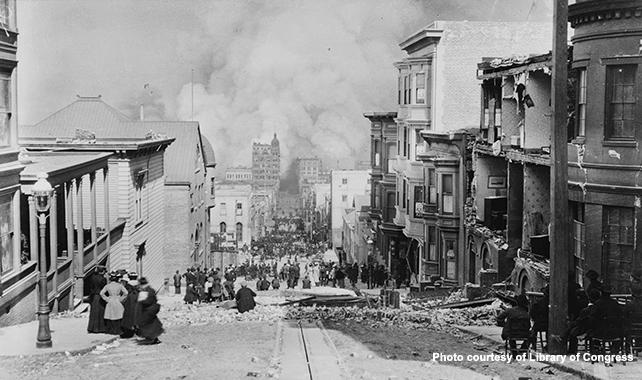
Crowds watching the fires set off by the 1906 earthquake in San Francisco.
| |
|
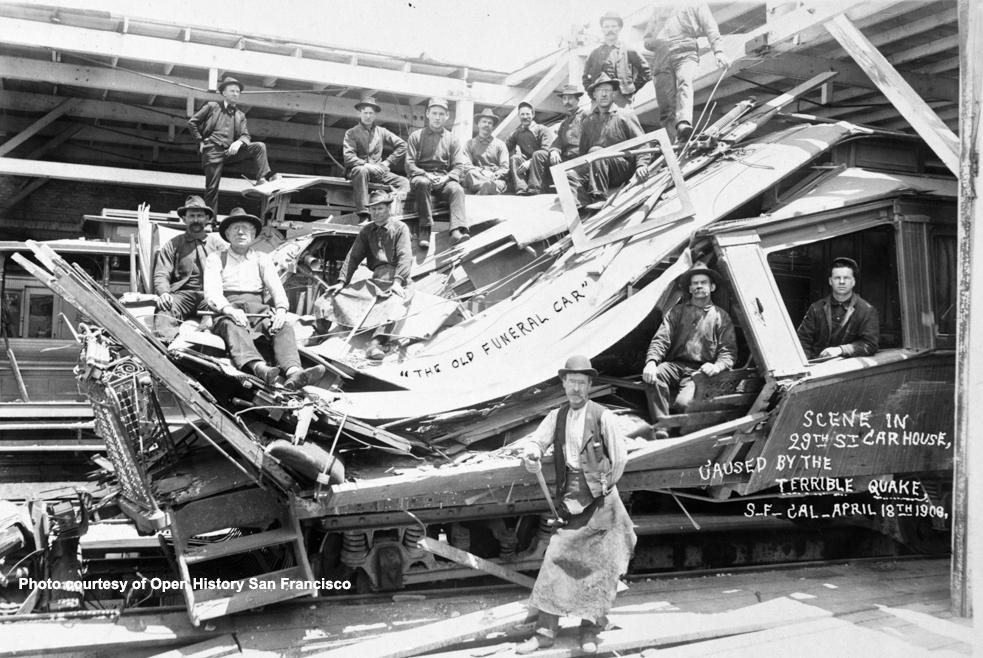
The Great Quake struck 118 years ago on Wednesday, April 18, 1906, at 5:12 a.m. The San Andreas Fault ruptured over a length of 300 miles from San Juan Bautista to Eureka. The Quake lasted for only 47 seconds but caused one of the worst natural disasters in our nation's history. Seismologists estimate the magnitude at 7.8, releasing approximately 30 times more energy than the 6.9 Loma Prieta earthquake of 1989. The earthquake was felt from Oregon to south of Los Angeles and inland as far as central Nevada. The violent earth movement toppled towers and chimneys, crumbled rows of simple frame houses and brick buildings, threw whole walls into the streets and twisted steel railroad track, pipelines, and roadways.
| |
|
29th Street Car House after the 1906 San Francisco earthquake.
| |
|
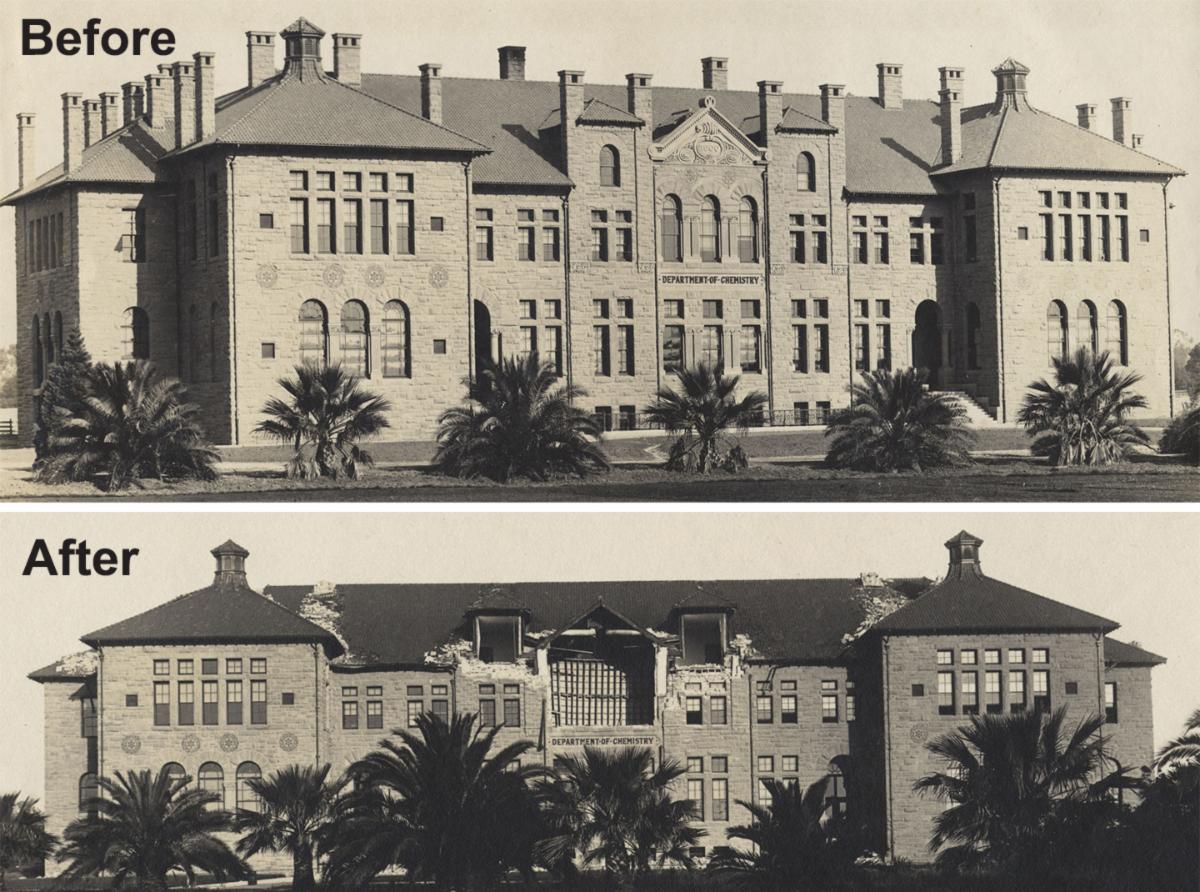
The destruction was spread over a thousand square miles. At Agnew's State Hospital near San Jose, fifty miles south of San Francisco, structures collapsed killing more than one hundred patients and attendants. A third of San Jose's 25,000 residences were left homeless, and 19 people were killed. Fourteen buildings collapsed at the Leland Stanford Junior Memorial University, located approximately four miles from the San Andreas Fault. Santa Rosa, fifty miles to the north of San Francisco, was also devastated as every brick building collapsed.
| |
|
Stanford University chemistry building before and after the Great Quake.
| |
|
However, San Francisco bore the brunt of the damage. Streets were filled with dust and debris produced by falling walls and chimneys. Building after un-reinforced building came crashing down, hurling brickwork by the thousands of tons onto the streets. At least ninety five percent of San Francisco's chimneys collapsed. All public transportation and telephone facilities were disrupted. Within the City, all communication had to be made in person, on foot, by auto, or horse. Jack London wrote: "Not in history has a modern imperial city been so completely destroyed. San Francisco is gone!"
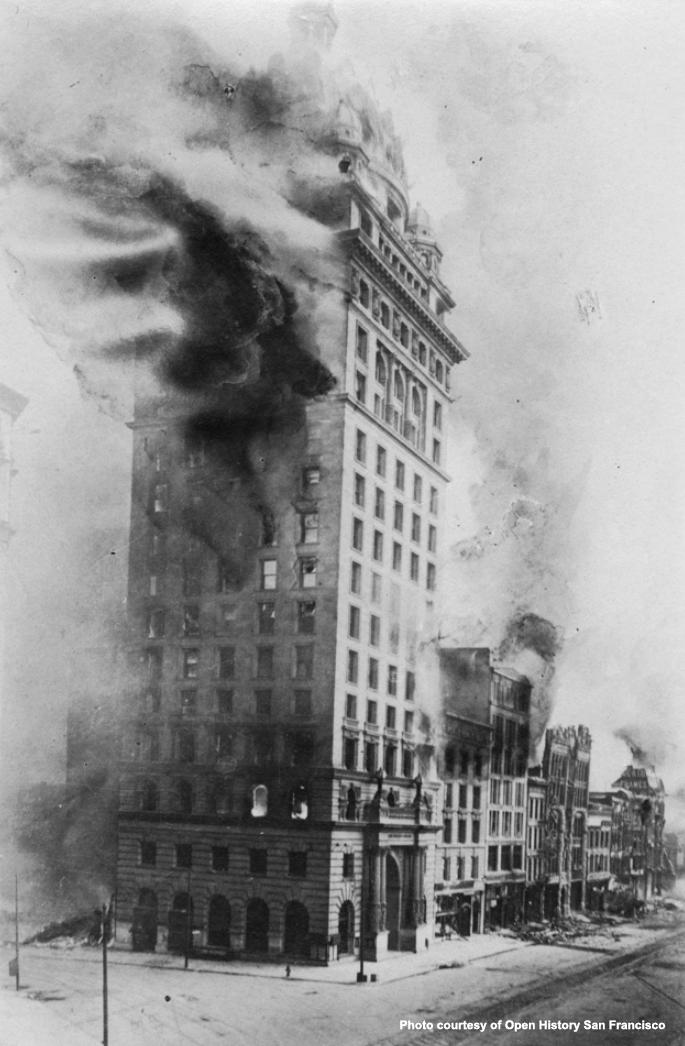
Fires caused by broken gas pipes and overturned coals burned for three days after the earthquake. The fires raged across thousands of acres, destroying San Francisco's entire business district and three fifths of the homes and lodgings. Water mains ran dry due to broken lines. Without water, the only way to stop the fire's advance was to create firebreaks by employing dynamite to knock down surrounding buildings. Eventually more than 490 city blocks burned.
| |
|
A view of the burning San Francisco Call building at Market and Kearny after the 1906 earthquake.
| |
|
The Quake and fires killed a total of at least 3,000 people. In an area of four square miles within San Francisco, 26,000 buildings were destroyed and nearly half of the City's 400,000 residents were left homeless. Government buildings and most archives were lost. Twenty-nine schools were destroyed and 44 damaged. Hospitals and churches were in ruins. Most foundries and factories on the waterfront were destroyed. The only remnants of many homes were partial brick chimneys that poked out of the rubble. The grand homes on Nob Hill were in ruins and the great hotels were in ashes. Theaters and opera houses were flattened and streets were covered with debris. Property loss in San Francisco was estimated at $400 million in 1906 dollars.
| |
|
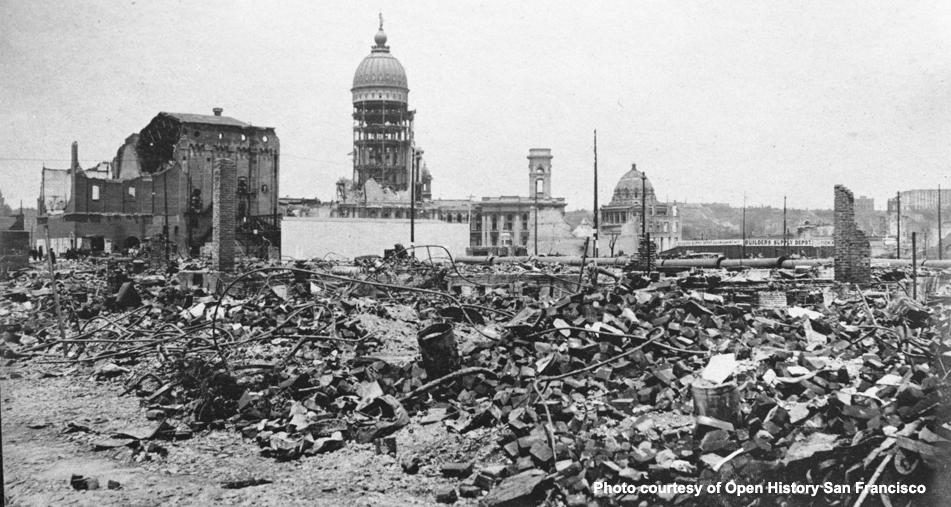
View from 10th & Mission over 1906 San Francisco earthquake ruins to City Hall and the Hall of Records. The Fairmont Hotel is seen in the distance on the right. Ruins of the Majestic Theater, on 9th & Market, are on the left.
| |
|
The 1906 Quake marked the beginnings of modem scientific study of earthquakes, faults, and the geologic and engineering properties of soil and rock. Before 1906, earthquake study had advanced slowly. After the 1906 Quake scientists in California began to assemble observations of the Quake and its effects. Governor George C. Pardee appointed a State Earthquake Investigation Commission to unify the work of the scientific investigations. Professor Andrew C. Lawson of the University of California, Berkeley, headed the Commission, and its final report (published in 1908 and known as the Lawson Report) was a compilation of detailed reports from contributing scientists on the Quake's damage, movement on the San Andreas Fault, the seismograph records, and the geology of California.
| |
|
Look for our newsletter, CORNERSTONE NEWS, coming to your inbox this summer, featuring articles about seismic activity in relation to Geotechnical and Environmental Engineering and Construction Services.
| |
|
Cornerstone Earth Group, Inc. provides Geotechnical and Environmental Engineering and Construction Services. We are detail-oriented and thorough; our solutions are implemented with a practical, real-world approach and are fully dedicated to providing value-added and responsive consulting services. For every dollar you spend on our services, our goal is to save you ten dollars in construction.
For more information, please contact Ron Helm, P.G., C.E.G., C.HG.
rhelm@cornerstoneearth.com
| |
|
Cornerstone Earth Group integrates geotechnical engineering, environmental services, engineering geology, and construction services into a single, client-focused team to facilitate cost-effective site selection, project design, and site development. Our technical capabilities and construction and remediation expertise allow us to develop creative yet practical solutions to meet your project requirements.
1259 Oakmead Parkway, Sunnyvale, CA 94085
408.245.4600
3697 Mt. Diablo Boulevard, Suite 310, Lafayette, CA 94549
925.988.9500
www.cornerstoneearth.com
| | | | |