|
|
|
|
Christ is born, glorify him. Christ is from heaven, go to meet him. Christ is on earth, be lifted up. Sing to the Lord, all the earth. Sing out with gladness, all you people. For He is glorified.
'To the Son begotten of the Father without change before the ages, and in these last times without seed made flesh from a Virgin, to Christ God let us cry aloud: You have exalted our horn. Holy are You, O Lord!'
Rod of the root of Jesse, and flower that blossomed from his stem, O Christ, You have sprung from the Virgin. From the Mountain overshadowed by the forest You have come, made flesh from her that knew not wedlock, O God who are not formed from matter. Glory to Your power, O Lord.
'As You are God of peace and Father of mercies, You have sent us Your Angel of great counsel, Who grants us peace; so we are guided by the knowledge of God, watching before dawn we glorify Your, only Lover of mankind'.
'The monster from the deep spat Jonas from its bowels like a new born babe, just as it had received him; while the Word having dwelt in the Virgin and taken flesh, came forth, yet kept her incorrupt, for being Himself not subject to decay, he preserved his mother free from harm'.
'The Youths brought up together in godliness, scorning the impious decree, feared not the threat of fire, but standing in the midst of the flame they sang: God of our Fathers, blessed are You!'
'The furnace moist with dew was the image and the figure of a wonder past nature; for it did not burn those it had received; even as the fire of the Godhead did not consume the Virgin's womb into which it has descended. Therefore in praise let us sing: Let all creation bless the Lord, and highly exalt Him to all the ages'.
Magnify, O my soul, the most glorious Theotokos, more honorable and more glorious than the hosts on high. 'I behold a strange and wonderful mystery, heaven is the Cave, the Cherubim thrown -- Virgin, the Manger the Place in which Christ lay, the God whom nothing can contain. Whom we praise and magnify.
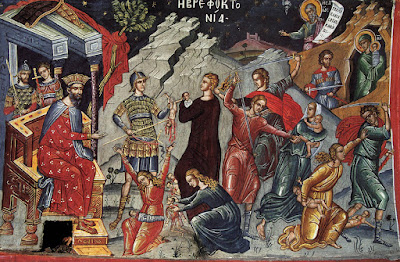
When the King was born in Bethlehem, the Magi came from the east. Having been guided by the star on high, they brought Him gifts. But in his exceeding wrath, Herod mowed down the infants as wheat; lamenting that the rule of his kingdom had come to an end.
As acceptable victims and freshly plucked flowers, as divine first-fruits and newborn lambs, you were offered to Christ who was born as a child, holy innocents. You mocked Herod's wickedness; now we beseech you: "Unceasingly pray for our souls." Amen.
|
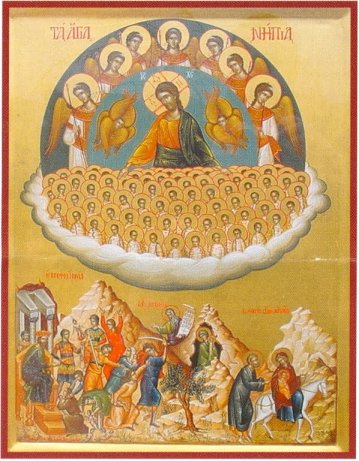
14,000 infants (Holy Innocents)
slain by Herod in Bethlehem
|
|
|
St. Paul's Letter to the
Hebrews 2:11-18
Prokeimenon. Grave Mode. Psalm 98.9,1
Exalt the Lord our God.
Verse: The Lord reigns; let the people tremble.
BRETHREN, he who sanctifies and those who are sanctified have all one origin. That is why he is not ashamed to call them brethren, saying, "I will proclaim thy name to my brethren, in the midst of the congregation I will praise thee." And again, "I will put my trust in him." And again, "Here am I, and the children God has given me. Since therefore the children share in flesh and blood, he himself likewise partook of the same nature, that through death he might destroy him who has the power of death, that is, the devil, and deliver all those who through fear of death were subject to lifelong bondage. For surely it is not with angels that he is concerned but with the descendants of Abraham. Therefore he had to be made like his brethren in every respect, so that he might become a merciful and faithful high priest in the service of God, to make expiation for the sins of the people. For because he himself has suffered and been tempted, he is able to help those who are tempted.
|
The Gospel according to
Matthew 2:13-23
When the wise men departed, behold, an angel of the Lord appeared to Joseph in a dream and said, "Rise, take the child and his mother, and flee to Egypt, and remain there till I tell you; for Herod is about to search for the child, to destroy him." And he rose and took the child and his mother by night, and departed to Egypt, and remained there until the death of Herod. This was to fulfill what the Lord had spoken by the prophet, "Out of Egypt have I called my son."
Then Herod, when he saw that he had been tricked by the wise men, was in a furious rage, and he sent and killed all the male children in Bethlehem and in all that region who were two years old or under, according to the time which he had ascertained from the wise men. Then was fulfilled what was spoken by the prophet Jeremiah: "A voice was heard in Ramah, wailing and loud lamentation, Rachel weeping for her children; she refused to be consoled, because they were no more." But when Herod died, behold, an angel of the Lord appeared in a dream to Joseph in Egypt, saying, "Rise, take the child and his mother, and go to the land of Israel, for those who sought the child's life are dead." And he rose and took the child and his mother, and went to the land of Israel. But when he heard that Archelaos reigned over Judea in place of his father Herod, he was afraid to go there, and being warned in a dream he withdrew to the district of Galilee. And he went and dwelt in a city called Nazareth, that what was spoken by the prophets might be fulfilled, "He shall be called a Nazarene."
|
|
In
the name of the Father and the Son and the Holy Spirit. Amen.
Glory to You, O Lord, glory to You. O heavenly King, 0 Comforter, the Spirit of truth, who are in all places and fill all things; Treasury of good things and Giver of life: Come and dwell in us and cleanse us from every stain, and save our souls, 0 gracious Lord. Holy God, Holy Mighty, Holy Immortal: have mercy on us. Holy God, Holy Mighty, Holy Immortal: have mercy on us. Holy God, Holy Mighty, Holy Immortal: have mercy on us. Glory to the Father, and to the Son, and to the Holy Spirit: both now and ever, and unto ages of ages. Amen. All-holy Trinity, have mercy on us. Lord, cleanse us from our sins. Master, pardon our iniquities. Holy God visit and heal our infirmities for thy Name's sake.
Lord, have mercy. Lord, have mercy. Lord, have mercy.
Glory to the Father, and to the Son, and to the Holy Spirit: both now and ever, and unto ages of ages. Amen.
Our Father, who art in heaven, hallowed be thy Name; thy kingdom come; thy will be done on earth, as it is in heaven. Give us this day our daily bread; and forgive us our trespasses, as we forgive those who trespass against us; and lead us not into temptation, but deliver us from evil. For thine is the kingdom, and the power, and the glory, of the Father, and of the Son, and of the Holy Spirit: now and ever, and unto ages of ages. Amen.
|
December 29
Afterfeast of the Nativity
The Holy Infants Killed for Christ's Sake in Bethlehem
Although St Stephan is generally recognised as the first martyr, he was preceded by a host of innocent babes slaughtered by the infamous Herod whose fearful uncertainty drove him in panic to commit the most heinous of crimes.
It is not generally known that the barbarous Herod, who reigned over the Jews at the time when Christ was born, was not by descent a Jew himself, but a member of a tribe that had been absorbed into Judaism.
Hence, he zealously relished his role as king of the Jews under the Roman Empire. The news of the coming of a Messiah, so alarmed Herod that he hastily assembled about him his close associates, including priest and scribes from whom it was ascertained that the newborn king was coming into the world in the obscure village of Bethlehem.
Still sceptical, he consulted the wise men of the East and asked them to seek out this Christ child. However, these Magi, from various countries, not only venerated the Messiah and bestowed gifts upon them, but returned to their homelands rather than betray Him Who was the King of Kings.
Up to this point Herod had been guilty of atrocities of such vile nature that it came as no surprise that, in order to protect his position, he ordered the massacre of every Jewish male infant under the age of two not only in Bethlehem but for miles around. It is estimated that 14,000 infants were put to the sword. T
hese holy innocents were the first victims of a persecution that proved itself relentless for centuries.
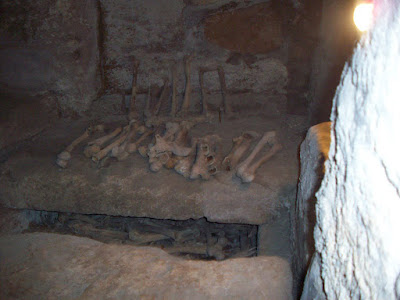
Pilgrims to the Holy Land discover that entombed deep in the grotto of the Church of the Nativity are many of these Innocents, appropriately enough, beneath the now vanished stable where Christ was born.
At this sacred spot the Patriarch of Jerusalem conducts special commemorative services each year on the 29th of December, a day in which Christians of all denominations can- not fail to pause in respect, in whatever part of the world they might be.
In our own day, the icon of "Rachel weeping for her children" (Matthew 2:18) has come to commemorate also the tens of millions of children who have died through abortion.
Our Venerable Father Marcellus, Abbot of the Monastery of the Unsleeping Ones (485)
He was born to a wealthy family in Syria at the beginning of the fifth century. Early in life he saw the futility of worldly things, gave away all of his wealth, and went to Ephesus, where he earned his living as a scribe. There he was schooled in the virtues by his fellow-worker Promotus, a slave who distributed most of his earnings to the poor; after the day's work was done, Promotus would take Marcellus to pray all night in the churches and monasteries.
Marcellus heard of the Saint Alexander the Unsleeping (February 25), who had settled near Constantinople with about thirty disciples, who made it their discipline to send up prayer and praise to God at every hour of the day and night. The monastery aroused the resentment of some more worldly monasteries, and the brethren were forced to flee to Bithynia. It was there that Marcellus joined them and took the monastic habit.
After the death of St Alexander and his successor, Marcellus was elected Abbot of the monastery against his will. Under his direction the Monastery of the Unsleeping Ones became a beacon of sanctity, with monks flocking to it from every corner of the Empire. The practice of never-ceasing service to God spread throughout the Empire, in both the West and the East. The monks were divided into three companies according to the language they spoke: Greek, Latin, or Syriac; each company took its turn celebrating the services in its particular language, and thus every hour of the day was given over to God's glory. The monastery not only grew but give birth to others: The famed Studion Monastery in Constantinople was founded by monks from Marcellus' monastery.
Saint Marcellus took part in the Council of Chalcedon, defending Orthodoxy against the Monophysite heresy both at the Council and in the years that followed. His generosity and contempt for worldly wealth were known to all: anyone who came to the monastery in need received alms, but God always replenished the funds so that more could be given. When Marcellus inherited his family's fortune upon his brother's death, he kept none of it either for himself or even for his monastery, but distributed it to poorer communities and to the needy.
Saint Marcellus reposed in peace around 484, having lived the ascetical life for some sixty years.
Our Righteous Father Thaddeus the Confessor
Saint Thaddeus the Confessor, a disciple of Theodore the Studite, was a defender of the veneration of holy icons. He was brought to trial and suffered during the reign of Leo V (813-820). The heretics, mocking Saint Thaddeus, put an icon of the Savior on the ground, picked the saint up, and stood him upon it.
After this the judge said, "You have trampled upon the icon of Christ. There is no point in further resistance, so join us." Thaddeus replied that he had been placed upon the icon involuntarily, and he cursed the impiety of the iconoclasts. Enraged by his bold words, they beat him with cudgels. Then they dragged the martyr by the legs and threw him outside the city walls. He appeared to be dead, but he was still alive. A certain Christian took him into his own home and washed his wounds. Saint Thaddeus lived another three days, and then surrendered his soul to God.
George, Bishop of Nicomedia, Poet of Asmatikons, Kanons, and Troparia
Commemoration of all the Christians who have died of starvation, of thirst, of cold, by the sword and by every other kind of violent death.
|
Prayer of Saint Symeon
Now let Your servant depart in peace, O Master, according to Your word. For my eyes have seen Your salvation, which You have prepared before the face of all people: the Light of revelation for the Gentiles, and the glory of Your people Israel.
|
Regarding the Gosp
el of
Babylon and Egypt.
St. Chrysostom
: But why was the Christ child sent into Egypt? The text makes this clear: he was to fulfill what the Lord had spoken by the prophet, "Out of Egypt have I called my son." From that point onward we see that the hope of salvation would be proclaimed to the whole world. Babylon and Egypt represent the whole world. Even when they were engulfed in ungodliness, God signified that he intended to correct and amend both Babylon and Egypt. God wanted humanity to expect his bounteous gifts the world over. So he called from Babylon the wise men and sent to Egypt the holy family. Besides what I have said, there is another lesson also to be learned, which tends powerfully toward true self-constraint in us. We are warned from the beginning to look out for temptations and plots. And we see this even when he came in swaddling clothes. Thus you see even at his birth a tyrant raging, a flight ensuing and a departure beyond the border. For it was because of no crime that his family was exiled into the land of Egypt. Similarly, you yourself need not be troubled if you are suffering countless dangers. Do not expect to be celebrated or crowned promptly for your troubles. Instead you may keep in mind the long-suffering example of the mother of the Child, bearing all things nobly, knowing that such a fugitive life is consistent with the ordering of spiritual things. You are sharing the kind of labor Mary herself shared. So did the magi. They both were willing to retire secretly in the humiliating role of fugitive. The Gospel of Matthew, Homily 8.2
Why Christ Fled.
St. Peter Chrysologus
: His flight then was not occasioned by fear but by what had come through the mystery of prophecy. The Evangelist planted the seed when he thus spoke: "Take the boy and his mother and flee into Egypt." And later, "that what was written might be fulfilled: 'From Egypt have I summoned my son.' " Christ fled so that he might establish the truth of the law, faith in prophecy and the testimony of the psalter. The Lord himself says, "It was needful that what was written in the law and the prophets and the psalms be fulfilled by me." Christ fled for us, not for himself. Christ fled so that at the right time he might serve as a steward of the sacraments [the divine mysteries]. Christ fled so that by granting absolution he might take away the source of abuses to come and that he might give proof of faith to those who would believe. And finally, Christ fled so that he might bestow on us faith even when we have to flee, because in the face of persecution it is better to flee than to deny the faith. For Peter, because he was unwilling to flee, denied the Lord. John, lest he deny the Lord, fled. Sermons 150.11
The Devil Foresaw the Future of Christ.
St. Peter Chrysologus
: Was it Herod seeking the child, or the devil working through Herod? When Herod saw the magi for himself, he imagined in his fantasy that they had fled their governors. For Christ, though bound in swaddling clothes, though busy at his mother's breast, though keeping quiet, concealing his words, unable to walk, nevertheless transformed the magi (who had been standard-bearers of the devil) into his most faithful servants. The devil instantly realized what Christ could do when he came of age. So he spurred the Jews against him and, clever contriver that he was, impelled Herod that he might get the jump on Christ in his infancy. He hoped to deprive him of the coming emblem of his virtue, the cross, the banner of the greatest victory for us. The devil perceived that Christ would soon be restoring life to all the world with his teaching and his virtue. Even while still whimpering as a baby, Jesus was taking possession of this world from top to bottom. It was as the prophet said: "Before the child knows to cry to his father and mother he shall take the pride of Damascus and the spoils of Samaria." The Jews themselves attest to this when they say, "You see how the whole world hastens after him." Sermons 150.9
While Palestine Plots, Egypt Receives.
St. Chrysostom
: Mary, who had never even passed beyond the threshold of her own house, was commanded to undergo this long ordeal of adversity for the sake of this wonderful birth and for her own spiritual labor and development. Isn't this remarkable: While Palestine plots, it is Egypt that receives and preserves the One for whom the plots are designed! This is reminiscent of the patriarch Jacob, who also sought succor in Egypt, anticipating the coming of our Lord. The Gospel of Matthew, Homily 8.2
As a Man Christ Would Not Flee Death.
St. Peter Chrysologus
: Christ promised that he would come incarnate, that he would go through the phases of life, that he would announce the glory of the kingdom of heaven, that he would proclaim the way of faith and that by the power of his word alone he would put demons to flight. He promised that he would give sight to the blind, gait to the lame, speech to the mute, hearing to the deaf, remission for sinners and life to the dead. All these things he promised through the law and the prophets. Thus it was that Christ, when he was to become a man, was not to flee the death he escaped as an infant. Sermons 150.10
Fugitives East and West.
St. Chrysostom
: There is something else here worth noticing, one touching the magi and the other touching the Child. The issue is why didn't the magi remain with the Child? And why didn't the Child remain in Bethlehem? Both had to escape as fugitives shortly after they were received with joy: the magi to Persia and the holy family to Egypt. Why? This is worthy of close examination. The magnificence of God's plan of salvation would not have been believed if he had not come in the flesh. If Jesus had fallen into the hands of Herod, his life in the flesh might have been cut off. Many circumstances were quietly ordered providentially within human history. Even while the flesh of the Christ child was in danger, some dared to imagine that he never assumed our common human flesh, that his coming was like that of a ghost. These impious ideas will ultimately destroy those who do not confess that God has come to us in the flesh in a way becoming to his deity. As to the wise men, they were sent off quickly, commissioned to teach in the land of the Persians, having thwarted the madness of the king. Herod was allowed the opportunity to learn that he was attempting things impossible, against prophecy, and that there was still time to quench his wrath and desist from his demented plot. It is fitting to God's power not only to subdue his enemies but to do so with ease, deceiving the deceivers in a way fitting to God's almighty power. In the same way the Egyptians had earlier been deceived, their wealth transferred secretly and with craft and God's power made awesome to them. The Gospel of Matthew, Homily 8.1
Whether Christ Abandoned the Little Soldiers.
St. Peter Chrysologus
: Why did Christ do this? Christ is the judge of thoughts and the examiner of minds. Why did he desert those whom he knew were being sought because of himself and whom he knew would be killed for his sake? He was born a king, the king of heaven-why did he neglect the standard-bearers of his own innocence? Why did he disdain an army of the same age as himself? Why did he thus abandon those who were cut down as plunder from the same cradle as himself? Was it so that he, who would become the one king, might proceed against the forces of all his enemies? Brothers, Christ did not despise his own soldiers but promoted them and granted that they might walk in victory before they lived. He enabled them to participate in a victory without struggle. He gave to them the gift of the crown even before their bodies had grown. It was Christ's will that they pass over vice for virtue, attain heaven before earth and share in the divine life immediately. Thus it was that Christ sent his soldiers ahead. He did not abandon them. He gathered up his ranks. He did not leave them behind. Sermons 152.7
How Joseph Prefigured the Apostolate.
St. Hilary
: After the death of Herod, Joseph was advised by the angel to return to Judea with the boy and his mother. When he returned he heard that Archelaeus, son of Herod, was king. So he was afraid to go, but the angel admonished him to cross over into the region of Galilee, and they lived in the city of Nazareth. ... Joseph resembles the apostles to whom Christ entrusted the spreading of the news about him. Similar to what happened with Joseph after the death of Herod, they must deal with the same people who caused the Lord to suffer. The apostles are commanded to preach to the Jews, for they were sent to the lost sheep of the house of Israel. But when they saw that the power remained in the hands of inherited faithlessness, they became afraid and retreated. On Matthew 2.1
In Place of His Father Herod.
St. Chrysostom
: Do you perceive the alternation between relief and danger? Joseph left foreign territory and returned to his ancestral land, discovering the slaughter of the children in the process. Having left his household in Bethlehem, he again discovers remnants of his first dangers. He finds that the son of the tyrant is alive and ruling as king. And how was it possible that Archelaus should be king of Judea, when Pontius Pilate was in charge? Herod's death had recently occurred, and the kingdom had not yet been divided. But no sooner had Herod died than his son took power in his father's place. ... But if Joseph had feared to make his way to Judea, they say, on account of Archelaus, he ought to have been equally wary of Galilee on account of Herod Antipas. But let us leave unexamined for now the rest of the question as to whether he changed his place of residence, for his every impulse led away from Bethlehem and its confines. The Gospel of Matthew, Homily 9.4
Joseph Withdrew to Galilee.
St. Chrysostom
: After the slaughter of the children occurred, the young Archelaus was under the impression that everything else had been taken care of. Both the children in Bethlehem had been eliminated and the one they were seeking to kill. But once he saw how his father had lost his life, Archelaus became most conscious of the precedent and much more diligent in contending with lawlessness. Therefore Joseph left Judea for Nazareth, both in flight from the danger and at the same time out of love for his home country. And that he might be more confident, he received a divine pronouncement from the messenger about it. The Gospel of Matthew, Homily 9.4
The Sense of Prophetic Scriptures Summarized.
St. Jerome
: If this could have been found in the Scriptures, he never would have said, "Because it has been spoken by the prophets," but he would rather have spoken more plainly: "Because it has been spoken by a prophet." As it is now, in speaking of prophets in general he has shown that he has not taken the specific words but rather the sense from the Scriptures. "Nazarene" is understood as "holy." Every Scripture attests that the Lord was to be holy. We can also speak in another way of what was written ... in Hebrew in Isaiah: "A branch will blossom from the root of Jesse, a Nazarene from his root." Commentary on Matthew 1.2.23
Blooming in Holiness.
St. Cyril of Alexandria
: But if "the Nazarene" is interpreted to mean "holy" or, according to some, as "flower," this is the designation found in many instances. For Daniel calls him "holy" or "of the holy ones." Likewise we find in Isaiah: "A branch from the stock of Jesse and its flower." Even the Lord says of himself in the Song of Songs, "I am the bloom of the plain, the lily of the valleys." Fragment 16.
|
When the time came for the Incarnation of the Son of God and His Birth of the Most Holy Virgin Mary, Magi in the East beheld a new star in the heavens, foretelling the Nativity of the King of the Jews. They journeyed immediately to Jerusalem to worship the Child, and the star showed them the way. Having worshipped the divine Infant, they did not return to Jerusalem to Herod, as he had ordered them, but being warned by God in a dream, they went back to their country by another way. Herod finally realized that his scheme to find the Child would not be successful, and he ordered that all the male children two years old and younger at Bethlehem and its surroundings be killed. He thought that the divine Infant, Whom he considered a rival, would be among the dead children.
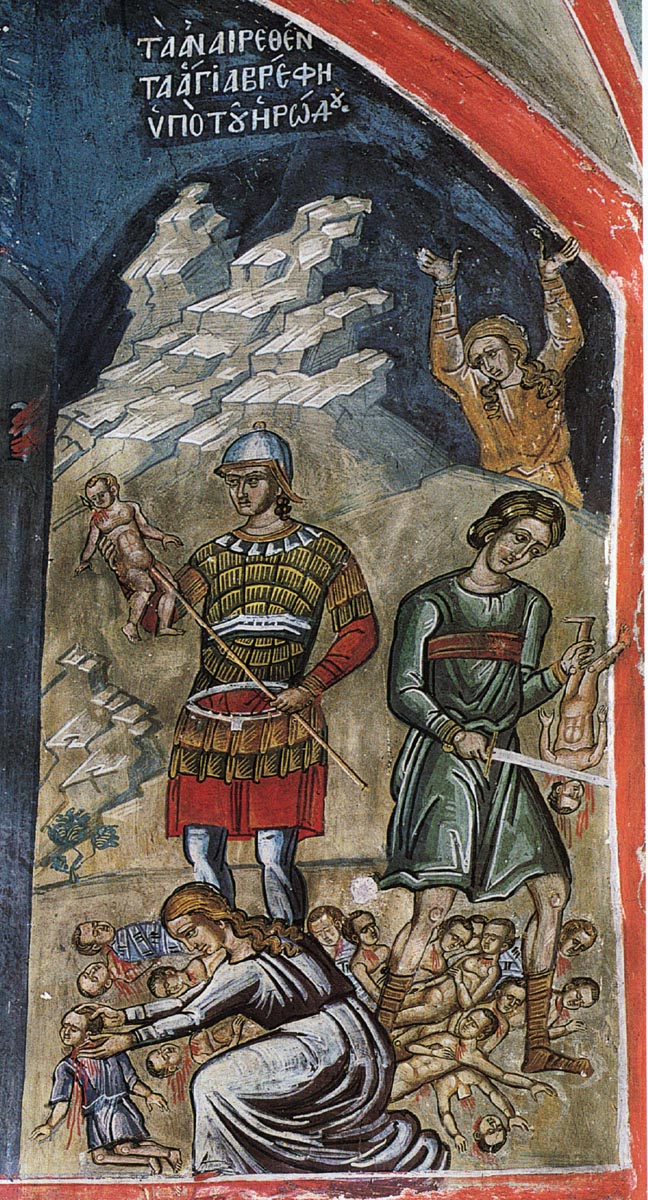
The murdered infants thus became the first martyrs for Christ. The rage of Herod fell also on Simeon the God-Receiver (February 3), who declared before everyone in the Temple that the Messiah had been born. When the holy Elder died, Herod would not give permission for him to be properly buried. On the orders of King Herod, the holy prophet and priest Zachariah was also killed. He was murdered in Jerusalem between the Temple and the altar (Mt. 23:35) because he would not tell the whereabouts of his son John, the future Baptist of the Lord Jesus Christ.
The wrath of God soon fell upon Herod himself: a horrid condition struck him down and he died, eaten by worms while still alive. Before his death, the impious king murdered the chief priests and scribes of the Jews, and also his brother, and his sister and her husband, and also his own wife Mariam, and three of his sons, and seventy men of wisdom who were members of the Sanhedrin. He initiated this bloodbath so that the day of his death would not be one of rejoicing, but one of mourning.
Troparion - Tone 1
As acceptable victims and freshly plucked flowers, as divine first-fruits and newborn lambs, you were offered to Christ who was born as a child, holy innocents. You mocked Herod's wickedness; now we beseech you: "Unceasingly pray for our souls."
Kontakion - Tone 6
When the King was born in Bethlehem, the Magi came from the east. Having been guided by the star on high, they brought Him gifts. But in his exceeding wrath, Herod mowed down the infants as wheat; lamenting that the rule of his kingdom had come to an end.
full-of-grace-and-truth.blogspot.com
|
Κύριε Ιησού Χριστέ, Υιέ του Θεού,
ελέησόν με τον αμαρτωλόν.
Lord Jesus Christ, Son of God,
have mercy on me the sinner!
|
|
Please "LIKE"
Feed the Souls
on facebook.
Thank you.
|
|
|
|
|