|
|
The voice for pharmacy compounding | October 23, 2020
|
From the President
|  Shawn Hodges
APC President |
Dear ,
Because it's budget time at APC, I've been thinking about how far the alliance has come this year. And I've been comparing our considerable success against the continuing challenge of growing our membership -- so that we have the voices and funding we need to confront the challenges ahead.
Consider this: APC has just four staffers and a budget of about $1 million. We've gained 140 new members so far this year alone. Great! Except: 231 existing members have failed to renew this year.
I'm not the best at math, but I can tell you that when the number of folks going out the door exceeds the number coming in the door, well ... that's not a formula for success.
Thing is, I suspect the majority of those 231 "dearly departed" members don't even know they're no longer members. In their busy-ness, they've missed our emails, letters, and phone calls.
So do me a favor: There's a good chance you work with or know a compounder who should be -- maybe even used to be -- an APC member. This week, ask them about it. If they're not a member, no need to shame them (well, don't shame them much). Just direct them to A4PC.org/join, and nudge them to join or renew. We need those folks -- and we need you, too -- so we can keep doing what we're doing.
Yours In Health,
Shawn
|
 |  |
Sharpening saws:
APC prepares to fight for cBHT
Town hall meeting set the stage for the coming battle to protect millions of Americans' access to these meds
Yesterday afternoon -- Thursday the 22nd -- APC held an open Town Hall on the threat to cBHT. The purpose was to brief members on how, in the words of CEO Scott Brunner, we're "sharpening our saws" for when there's a regulatory tree to cut down.
The briefing included a recap by APC President-Elect Michael Blaire on FDA's long antipathy for compounded hormones. Gina Besteman, chair of APC's cBHT Task Force, explained the major issues with the NASEM study of cBHT on which FDA says it may base restrictions -- the lack of experts, the willful exclusion of hundreds of studies, and the eventual misguided (but not unexpected) conclusion that cBHT is unsafe.
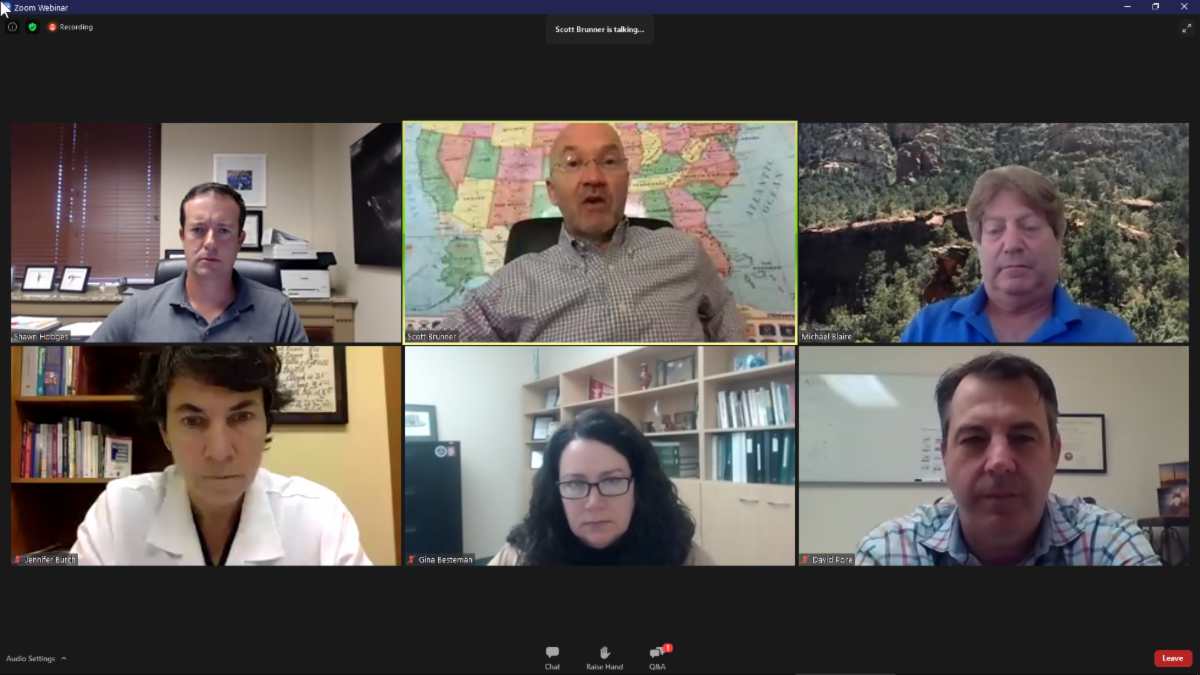 Clockwise from top left: APC President Shawn Hodges, APC CEO Scott Brunner, APC President-Elect Michael Blaire, APC Board Chair Jennifer Burch, cBHT Task Force Chair Gina Besteman, APC lobbyist David Pore APC CEO Scott Brunner explained what APC is doing and planning. At the moment, all we have is FDA's statement that it will use that NASEM study to "consider restrictions" on cBHT. "No one really knows when FDA will tackle this issue," Scott said. "We could be talking six months, nine months, or a year or more." ' That's where sharpening the saws comes in.
The teeth:
- APC has created a cBHT task force to guide our overall efforts.
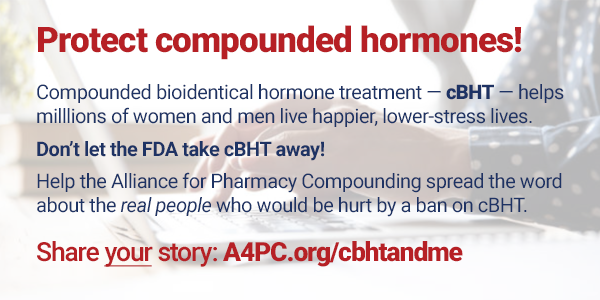
- We've created a cBHT testimonial portal (A4PC.org/cbhtandme) - to collect the kind of real-world, real-people stories from cBHT patients and prescribers that NASEM failed to consider. We have about 1,700 so far; we need several times that many so we can drop a stack of testimonials from constituents on the desk of every member of Congress.
- The Pharmacy Compounding Foundation is considering a proposal to fund a proper, neutral-party analysis of cBHT to provide a counterweight to the NASEM study.
- We helped spur creation of a joint congressional letter to FDA in the U.S. House of Representatives. Seventeen members of Congress have already agreed to sign it. (Please encourage your representative to sign on!)
- The APC Board of Directors will soon consider a consumer media campaign to spread the word about the threat to cBHT.
- We're helping lead a loose coalition of cBHT compounders, patients, and prescribers, to coordinate efforts to protect cBHT for the millions of Americans who rely on it.
"For many pharmacies, this threat to cBHT is an existential issue," Brunner said, citing research showing that 83 percent of compounders, cBHT accounts for 20 percent or more of their business. But the bigger issue is the idea that millions of patients could lose access to this this life-changing treatment. "We owe it to them to be in this fight," he said.
|
Animal compounding: a House joint letter to FDA
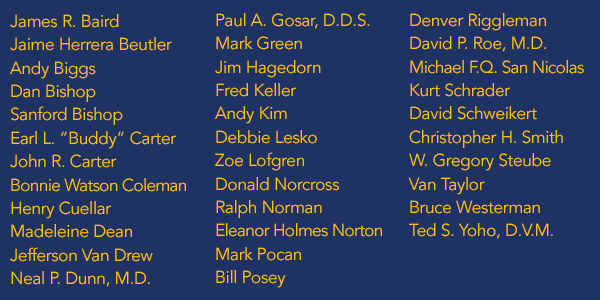
A big thank you to all the members of Congress who signed onto the joint letter to FDA - led by Reps. Norcross, Pocan, and Yoho - asking that the agency withdraw GFI #256 on animal compounding.
|
Griffith says MOU is all stick, no carrot
Maybe you don't read Roll Call, but members of Congress do. That's why APC assisted Cong. Morgan Griffith (VA-9) with this opinion piece that ran in that publication last Friday. Griffith takes FDA to task for not listening to the concerns of pharmacy groups and state regulators, and he spells out the access issues the MOU will create for patients and the likely negative economic consequences for states that don't sign. It's worth your time. |
Official recoupment victory news release
Last week we shared the news that Tricare had ended its recoupment effort against hundreds of compounders across the country. With our friends at NCPA we put out a press release about that victory and explaining the issue - click here to read it. |
Coming up
October 23 -- APC Board of Directors ballots sent. APC voting members: Look for your ballot and instructions by email.
October 28 -- APC President Shawn Hodges will present " Much More Than Selling Compounds!" from 1:00 to 2:00pm EDT. All APC members are invited, free - and it's worth 1 CE credit hour.
November 13 -- Board of Directors balloting closes.
|
|
|
|
|
|
|
|
|
|
|
|