IDEAS, NEWS AND RESOURCES
|
May 2020
The Taos Institute's mission is to bring together scholars and practitioners concerned with the social processes essential for the construction of reason, knowledge, and human value, and their application in relational, collaborative and appreciative practices around the world.
|
|
The Many Ways to Get Involved!
|
|
Brief Encounter with The Taos Institute
|
|
"
If together we create the meaning of our worlds, what happens when the process of meaning making is eroding?
"
|
"There is even reason to hope for a new movement toward global community.
"
|
|
Covid, Communication and Creativity
By
Mary Gergen, Taos co-founder and Board Member
|
For most of us, the corona virus has brought about radical changes in our life-ways. Among the most striking changes is the way we have been cut away from our social worlds. Families are often split apart, with work places, schools, places of worship all locked down. Common gathering places - restaurants, cafes, playing fields, parks, and beaches have not permitted our gathering. From a social constructionist perspective, however, the situation is quite fascinating. If together we create the meaning of our worlds, what happens when the process of meaning making is eroding?
Most of us have experienced one major effect, that is, to find each other again. Many have commented on the lengths they have gone to restore communication. Without others, what are we to make of our world, what is happening, what does it mean? Most interesting for me has been the way in which many of us have found ourselves restoring relations sub-merged in the past. Old friends and acquaintances suddenly enter our lives again. My feeling is that this phenomenon represents an emerging consciousness of the significance of our relational life. As many on the Taos networks have mentioned, there is even reason to hope for a new movement toward global community.
On the lighter side, I have also been struck by the challenges to creativity. So many of our daily habits, rituals, and activities have been curtailed. We spend enormous amounts of time, day after day, living in delimited spaces. Our constructions of the world are closely tied to these ways of life. So, if these ways of life and their supporting constructions are disrupted, what happens next? To gain some insight, I sent emails to friends asking about their creative solutions. These are some slightly edited responses to what they came up with:
- We realized that we have the perfect quarantine room — our sunroom which is sealed off from our dining room by a glass door. The sunroom also has a separate entrance from outside. So we purchased a special table and set of chairs and arranged micro-phones and speakers so we could sit at our dining room table and friends (singles or couples only!) could sit in the sunroom and we could dine together, have a drink, talk… We have named it the Quarantine Cafe.
- Greta (8 years old) is very involved with baking and watches bake-off shows on TV. On Saturday she came up with the idea that she would have a bake-off competition with her father. The challenge was to make a cupcake with filling and a different topping and a cookie to go with it. She spent a whole day reading cookbooks and online recipes in preparation. The contest was on Sunday and Greta was declared the winner!
- My husband uses my mascara on his eyebrows any time he goes on Zoom.
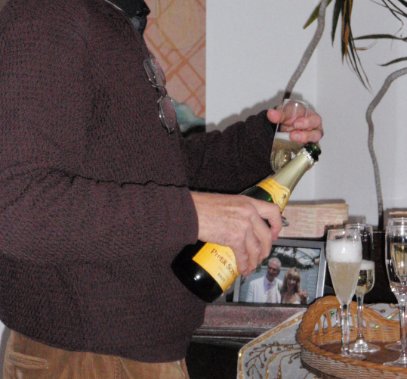
- We have had several patio happy hours sitting at a safe distance. One evening it went from 5pm to 10pm on a 30 degree night. We had the fire pit going and blankets on our laps. Both couples had their own bottles, snacks and wine glasses.
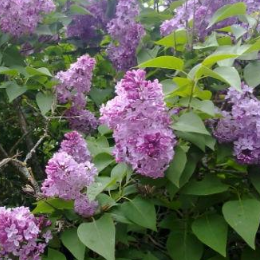
- I realized I’ve done something terrible only my wife knows about: This week I stole delicious lilac blossoms from a nearby arboretum. The horticultural police would put my head on a pike if they’d caught me, but I was an artful robber. Now my wife’s home office smells divine. And she loves it.
My hope is that these will inspire others to find creative new ways of relating, now and in the future.
|
|
A beautiful collaboration between the Taos Institute and Positivity Strategist has emerged to create this podcast series
– a first for the Taos Institute!
We invite you to listen to authors of the forthcoming
Sage Handbook of Social Constructionist Practice
as
they share stories of innovation in their respective fields across the world: education, healthcare, therapy and more.
To ensure you receive notifications of these shows as they go live every two weeks, please visit
Season 5 Podcast
and sign on.
|
|
In this is the introductory episode the guests are Sheila McNamee and Celiane Camargo-Borges. Their conversation addresses three points: the work of Taos Institute, what social construction is, and the intention of The Sage Handbook of Social Constructionist Practice to be published late 2020.
Over the years, more and more people have been embracing the ideas of social construction and using them in all sorts of practical domains. This has produced a blossoming of constructionist ideas and practices which in turn has pushed forward our ways of thinking about social construction itself. It serves to demonstrate that there is no static theory of social construction, but that it's continually evolving.
|
|
|
May 26, 2020 - 11:00 am - 12:30 pm, New York time time
by Wynn Schwartz, Ph.D.
Lecturer at Harvard Medical School, Associate Professor at William James College,
Editorial Board at The American Journal of Psychotherapy
|
|
About the book
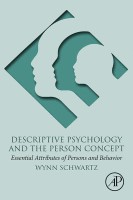
Descriptive Psychology and the Person Concept maps the common ground of behavioral science and offers a set of reminders for its continued sound construction. The Person Concept is a unified concept of interdependent component concepts: Individual Persons; Behavior as Intentional Action; Language as Verbal Behavior; Community and Culture; and World and Reality. The orienting second chapter in Kenneth Gergen’s and Keith Davis’ classic 1985 volume, The Social Construction of the Person, was Peter Ossorio’s “An Overview of Descriptive Psychology”. There, Ossorio identified a budget of problems that continue to this day. Then and now, the absence of a shared foundation haunts the behavioral and social sciences providing fragmentation and a siloed state of theory and practice. And the science? The integrity of choice, accountability, reason, and intention –– necessary commitments at the cornerstone of civilization, social practice, and any person-centered psychotherapy, when taught along with a requirement for reductionism and determinism, reside in contradictory intellectual universes. Descriptive Psychology was developed to remedy these problems. Ossorio offered these maxims that capture the discipline’s spirit:
|
|
1. The world makes sense, and so do people. They make sense to begin with.
2. It’s one world. Everything fits together. Everything is related to everything else.
3. Things are what they are and not something else instead.
4. Don’t count on the world being simpler than it has to be.
Descriptive Psychology and The Person Concept is an introduction to Ossorio’s work, and the community of scientists, scholars, and practitioners engaged in the project of identifying the conceptual elements and behavioral logic for a coherent construction of persons and our ways.
In this webinar, the author will give a brief overview of the Person Concept and its use negotiating dilemmas and questions that are muddled in the absence of a coherent framework. We will consider questions such as: What actually counts as a person and a paradigm case methodology for negotiating competent agreement and disagreement? This concern spans issues from abortion to nonhuman personhood, sentient artificial intelligence, and animal rights. The author will talk about the use of these concepts in developing or restoring understanding and empathy when it is absent or very difficult.
|
|
Professional Development Opportunities
|
|
Do you want to expand your professional potential, explore a vision, follow your curiosity, bring about an innovation for a more promising future? Would you like a mentor, coach and conversation partners who will support, inspire, and challenge you to reach your goals? Would you like to work from the comfort of your own office, home or work environment and be part of a global community of learners?
At the Taos Institute, we support and mentor creative practitioners to form the future through relationship, collaboration, and ethical action. The International Diploma in Social Construction and Professional Practices exposes you to expertise from multiple disciplines, all focused on collaborative and relational approaches to generating meaning, values, and practices of significance. Your advisor, mentor or coach works with you to design a learning plan that addresses your goals, with feedback and learning tailored to your situation and project. You will receive support and inspiration from a broad network of conversation partners.
- There are no grades.
- You create your own deadlines.
- You design your own learning goals.
- You work virtually with scholars/practitioners around the world.
- You join a cohort of learners who support each other.
- You participate in a learning relationship with an advisor, mentor, coach.
|
|
Taos Institute Conference - November 2021
|
|
|
|
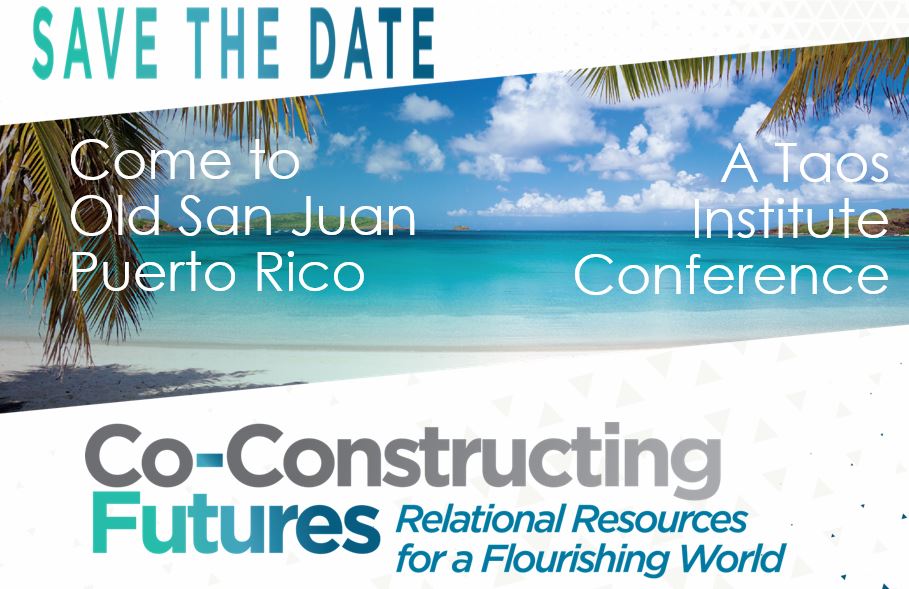
After careful consideration of the global impact and official recommendations related to COVID-19, The Taos Institute Board Members and Planning Committee are saddened to postpone the Taos conference originally scheduled for November 2020. We believe it is the best decision in the interest of the health and safety of our community.
However, it is with great enthusiasm and a spirit of resilience that we invite you to save the date for next year's event in November 11-13, 2021 in Puerto Rico. We believe that at that time, more than ever, we will want to come together to nurture our relationships, reflect on our learnings, and co-create new theories and practices to move on together into an even better future.
|
|
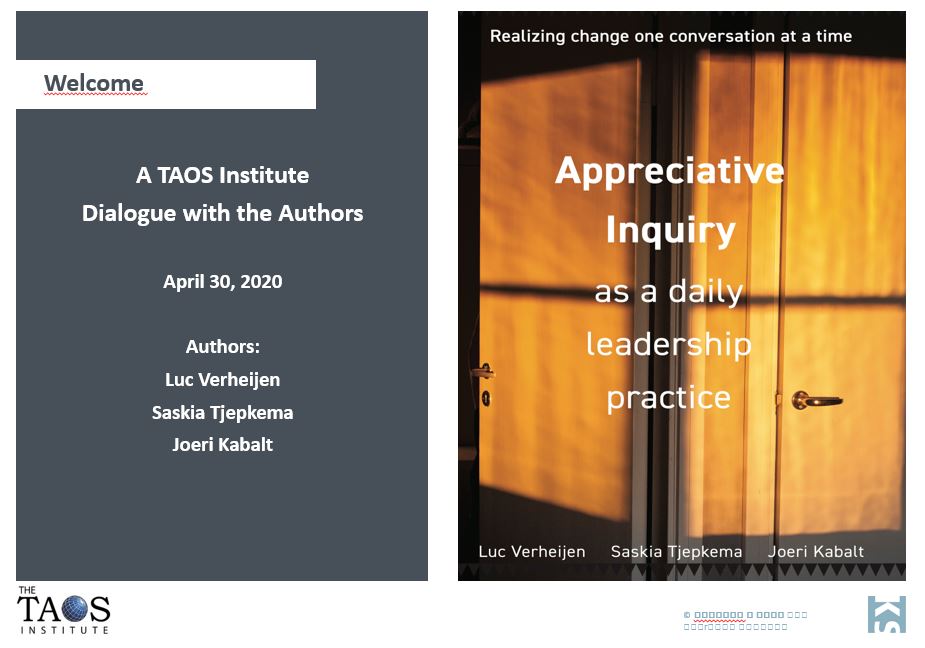
Authors - Luc Verheijen,
Saskia Tjepkema, Joeri Kabalt
In their book
Appreciative Inquiry as a Daily Leadership Practice,
the authors explore how we can make choices in how we enter our everyday relationships that lead to more connected, more rewarding collaborations whether they are linked to a specific change process, or to everyday working life. The book, a collection of shorter chapters, is filled with stories and helpful principles or models, both from people who have been interviewed, as examples from the authors’ experiences. These illustrate how, especially with small gestures, we can take our part in establishing generative connections. All these stories show that the ‘leadership’ in the books’ title not only refers to those in a formal leadership position, but invites all of us to contemplate on how we can be leaders that help realizing change in our contexts, one conversation at a time.
During the webinar, the authors shared some of their favorite stories and anecdotes from the book. The ones that they enjoyed most, or that they learned the most from when writing. They also shared some of the experiences that shaped their understanding of Appreciative Inquiry and the way in which they practice it. The webinar was a sharing of their personal perspective on both AI and the book from the viewpoint of the authors.
|
|
Featured Book - Free Download
This book is a compilation of contributions from participants and presenters who attended the Taos Institute’s 25th Anniversary Conference in Cancún, Mexico, November 7-10, 2018. With pre-conference and conference sessions taking place over four days, the conference was full of dialogue, conversation, sharing, exploring, relationship building, and celebration. As the Taos Institute celebrated 25 years since its founding, we remembered its beginnings, acknowledged the founders, met new participants, and welcomed all to share in the learning.
We invite you to enjoy the ongoing flourishing and abundance of practices described in the pages of this book. We are both delighted and humbled to bear witness to the emergent insights, expanding activity, and diverse relational collaborations that point to an unending stream of creative possibilities for social construction that we can imagine and work toward, together.
|
|
 |
International Journal of Collaborative-Dialogic Practices
This free journal brings together members of a growing international community of practitioners, scholars, educators, researchers, and consultants interested in postmodern collaborative practices. Issue 8 is now available.
.
|
|
|
|
WorldShare Books
FREE downloadable books in 12 different languages.
With over 30 books in English and many more from around the world, you will enjoy reading about education, spirituality, organizational life, community building, group dynamics, leadership and more.
Order your free book today!
|
|
|
|
|
Positive Aging Newsletter
FREE
newsletter
in 9 languages sent right to your email.
By focusing on the positive aspects of aging, and the availability of resources, skills, and resiliencies, research not only brings useful insights into the realm of practice but creates hope and empowers action among older people. By moving beyond practices of repair and prevention, to emphasize growth-enhancing activities, practitioners also contribute more effectively to the societal reconstruction of aging.
|
|
|
|
Manuscripts for Downloading
Access hundreds of articles and papers on topics such as:
- Appreciative Inquiry
- Collaborative Practices
- Dialogue
- Appreciative Cultures
- Creativity and Improve
- Narrative Practices
- Relational Learning
- Relational Research
- Qualitative Research
- and so much more!
|
|
|
|
|
Donate to the Taos Institute
Given the current global context into which we are moving, the work in which we are engaged is more important than ever. We invite you support the work of institute.
Read more
|
|
|
|
John Shotter Memorial Fund
John Shotter's death on December 8, 2016, was a profound loss for the scholarly world, for the Taos Institute, and for many of us personally.
Read more
|
|
|
|
|
Jane Magruder Watkins Memorial Fund
We remember Jane as an avid educator. This fund will support students who apply for a need-based scholarship to attend the various Taos programs.
Read more
|
|
|
|
Peggy Penn WorldShare Fund
Supports the publication of new WorldShare Books on topics related to the work and interests of Peggy Penn, Ph.D.
Read more
|
|
|
|
|
|
|
|
|