1245 Sunday
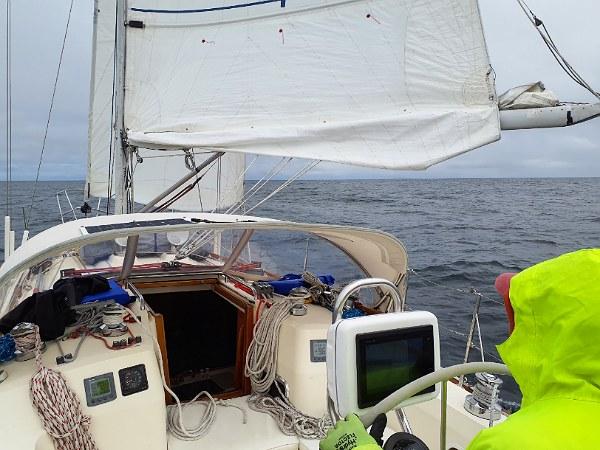
Upon leaving Manchester, winds rapidly built. By the afternoon and through the night we were sailing in 25 to 30 knots of breeze from the northwest, slowly shifting north. Sometimes gusting to 34 knots with seas building to 5 to 7 feet. We ended up with two reefs in the main and two in the roller furling genoa. In the wee hours of the night, we shifted down to just the double reefed main as we stood our one person watches. The good thing about northwest winds is that they blow all the fog away, so, visibility has been good. Only one fishing trawler, the 100-foot Gladys Elaine came close to our rhumb line course to Brazil Rock off of Cape Sable.
At the helm in the night, through breaks in the cloud cover I could see the constellation of the summer triangle, composed of Altair, Vega and Deneb. Deneb seemed to dance in
the night sky just above the mast. Deneb is part of Cygnus the Swan. Familiar stars on a dark night. Phosphorescence glimmered in the sea around us as Tazzarin roared along in the black of night like a freight train.
The heavier weather has been tiring us all out a bit; but, we are making good time. With dawn we were circled by Wilson's storm petrels, fulmars and shearwaters. These birds are a sign we have left behind the coastal waters of seagulls and moved to the community of pelagic, offshore birds. Storm petrels are among the most numerous birds in the world, spending much of their life at sea plucking tiny plankton from the surface.
Today, by noon, conditions have become a bit friendlier. The wind is down to 20 knots and seas have calmed considerably. Right now we have another 80 miles to Brazil Rock, then 120 miles along the Nova Scotian coast to Halifax. Bill