2100 Tuesday, June 28
We all needed and deserved a little time exploring around the St. John's area. I truly wanted a chance for Carl and Greg to get more of a flavor of this place before they both fly home on Thursday morning at the crack of dawn. Thus, we put some of the diesel work on temporary hold. At the same time I want to thank all of you who have been suggesting engine fixes. I do have a diesel mechanic meeting me at the boat Wednesday morning. I feel confident that with all of your input and some tips from Dion's Yacht Yard in Salem where Tazzarin spends her winters, we will get things sorted out tomorrow.
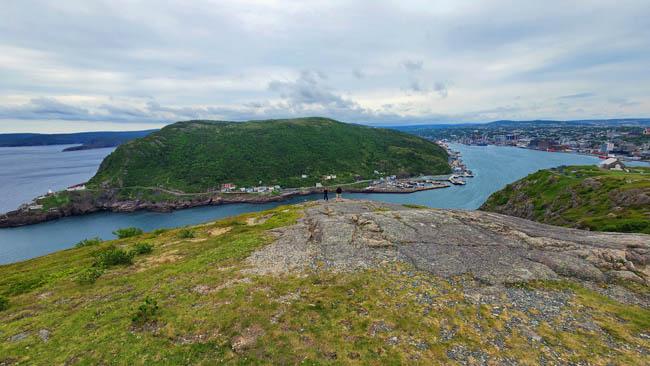
So, instead, I picked up the rental car I had reserved (rental cars are almost impossible to get in the province because the companies sold off their fleet during COVID). I need it for getting food, provisions, doing laundry, washing sleeping bags, getting propane cooking fuel and a variety of other items. By late morning we were headed out to Signal Hill perched high above the entrance narrows of St. John's Harbour. The views from up there are stunning. On the left in the photo above is the entrance to the harbor, called the narrows. To the right in the photo is the inner, deep water port of St. John's. It is truly one of the most amazing natural harbors of the world. This port city vies with Trinidad, Cuba as one of the two oldest port towns in North America. The name and port appear on a Portuguese chat of 1519.
The long, narrow entrance has made this a defensible port through the centuries. It generally remains ice free in winter and is the closest major port to Europe. Few natural harbors have such a configuration. The proximity to Europe, combined with ample room, deep water and the ability to place dual submarine nets across the entrance made St. John's the port of choice for allied supply ships from North America to gather in safety and then depart as a convoy with naval corvette escort vessels to make the mad dash across the Atlantic during World War II.
Signal Hill is also famous for being the point at which Guglielmo Marconi received the first trans-Atlantic wireless communication from England. His technology, on December 12, 1901 would change world communications in the most incomprehensible way. Suddenly, instead of news taking weeks to cross the Atlantic aboard a ship, global messaging could be instantaneous. I think of cell phones, the Internet and other technologies of my life as being significant advances. But, they are nothing compared to the change ushered in on that cold December day atop Signal Hill in St. John's - that was a communication revolution!