2100 Monday, August 15
Today was a stellar day, everything I think of when I think of a perfect day cruising in Newfoundland.
We left Bay De Verde early, slipping our lines from the wharf at the fish proccesing plant shortly after 0800 and headed out. We rounded Bay De Verde Head, passing trap skiffs tending their cod traps along the shore, each fisherman has a "trap berth" that is their own where they can set a cod trap of nets.
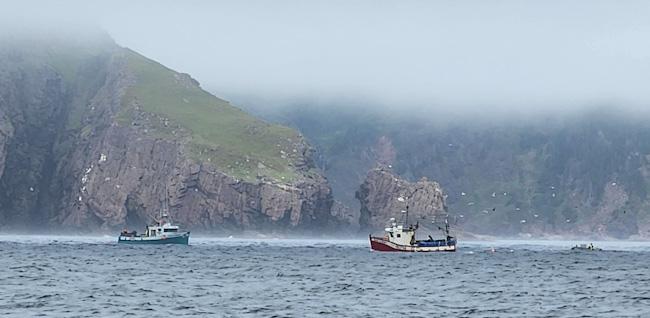
Soon we entered Baccalieu Tickle, between the end of the peninsula and the offshore island of Baccalieu. Baccalieu takes its name from the French for cod. The tickle, the narrow passage between the island and the mainland of Newfoundland, is renowned as one of the most productive and wildlife filled stretches of water on this coast. Currents run swiftly here. Small fish like capelin school in large numbers providing food for birds and whales.
Baccalieu island is the largest and most diverse bird colony in the province. Puffins by the thousands inhabit their nest burrows on the western shore. The eastern shore, facing the Atlantic, hosts gannets, kittiwakes, murres, terns and others. We marveled as the surface of the sea was strewn with puffins, diving and swimming under the sea with capelin in their mouths to then fly back to their burrows. Small flocks of puffins zipped about as if it were rush hour. Higher up, graceful gannets soared and dove. Baccalieu is also the largest colony of Leach's Storm Petrels in the world - which is saying a lot because storm petrels are the most numerous birds in the world, spending most of their life at sea.
We were lucky to be able to see both sides of the tickle at once; it is often dense with fog. But, today we could see from one side clear to the other. The breeze was favorable and we tacked downwind from one side to the other with hundreds, thousands of birds everywhere. It was dazzling. All the fish drew dozens of fishing vessels that crisscrossed the tickle. The top of the cliffs on Baccalieu and Newfoundland were shrouded in fog; while down below the visibility was good. Breathtaking.
From the Tickle we angled off and headed for our afternoon destination, the island of Ireland's Eye. At first the wind was on the nose; but, it then backed and we had a close reach with nothing but a refeed jib in 25-30 knots of breeze that carried us clear across Trinity Bay to Ireland's Eye.
I have sailed to the island of Ireland's Eye two or three times in the past. It is among the most memorable anchorages I know. I wanted to share it with Annie. The island was a fishing outport prior to Newfoundland becoming part of Canada. After confederation, the Newfoundland government decided it was to expensive to support remote outports. The residents were all moved to larger cities in Canada and a way of life of Ireland's Eye came to a close. The village became a ghost town with houses and a church, slowly eroding with time.
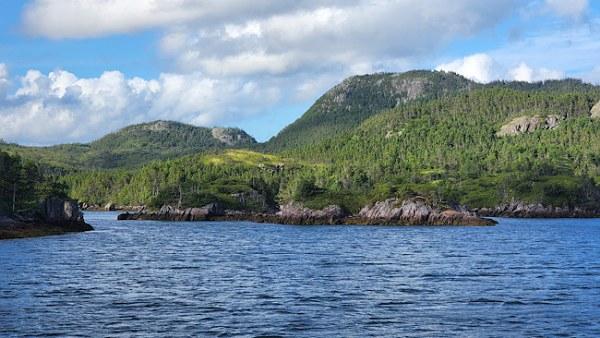
Traytown Harbor on Ireland's Eye is a long winding channel that leads into the island's interior, passing amongst islets and ledges, sometimes no more than 30 or 40 feet on either side of the boat. Three bald eagles circled above the steep hillsides as we weaved our way deeper into the harbor. A few ramshackle houses remain along one section. Finally we came to the furthest section, a landlocked basin surrounded by stunning hills, cliffs, scented pines and mosses. We dropped anchor and enjoyed and evening in the cockpit, soaking in the unique charm of this special place.
The photo below is in our anchorage at Ireland`s Eye. To get a feel for this unusual harbor, use the Find Tazzarin link at the bottom of this email and zoom in on the satellite view, pretty cool!
Bill