|
On Sunday, February 2nd, Governor Ron DeSantis released his recommended budget, Focus on Fiscal Responsibility Budget, for the 2025-26 State Fiscal Year (SFY). The Governor’s recommended budget serves as an important starting point for both the Florida House of Representatives and the Florida Senate as they begin work on developing their own proposed state budgets. The Florida Legislature is constitutionally required to pass a state budget, officially titled as the General Appropriations Act, during the annual regular session.
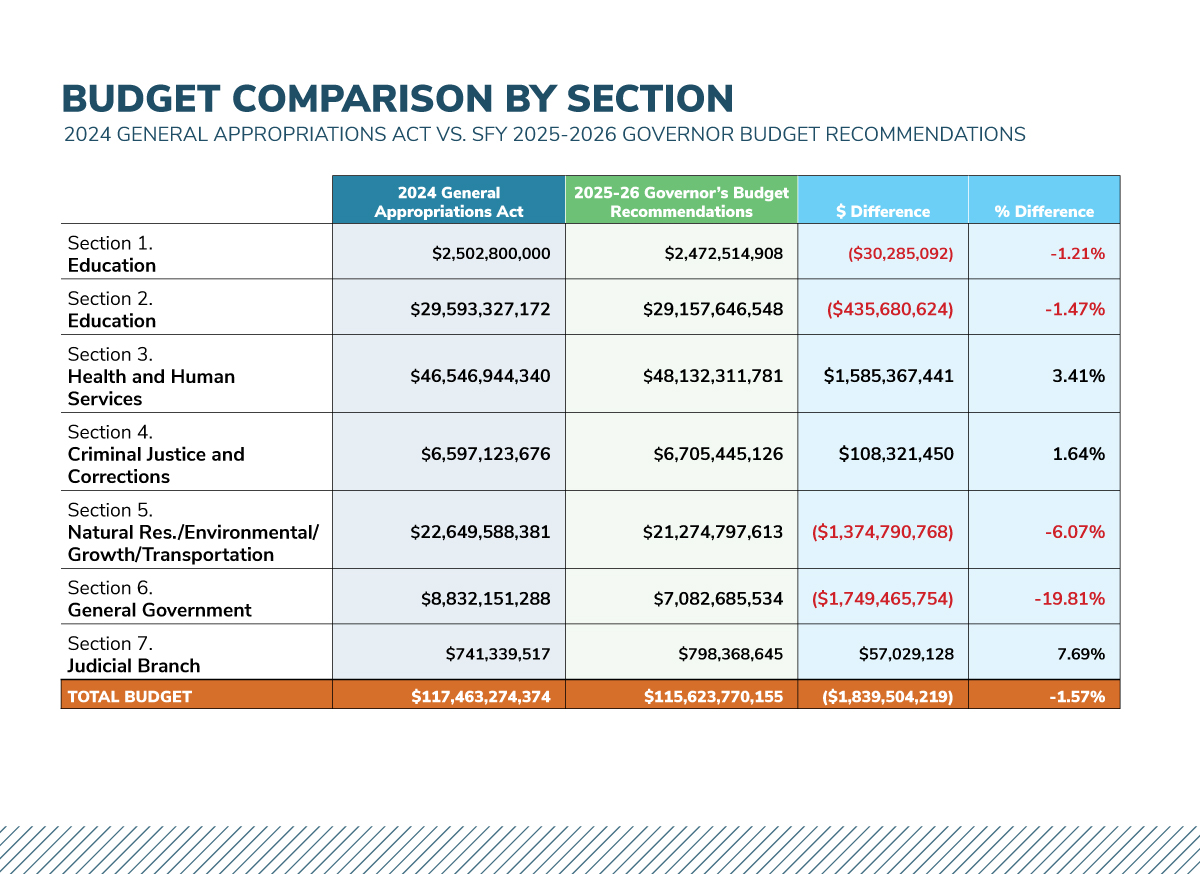
The Governor’s Budget Recommendations for SFY 2025-26 total approximately $115.6 billion, which represents a 1.57% decrease from the 2024 General Appropriations Act, the current state budget for SFY 2024-25.
The chart below summarizes a comparison of the 2024 General Appropriations Act and the Governor’s Budget Recommendations for SFY 2025-26. The budget totals do not reflect the Governor’s vetoes from the 2024 General Appropriations Act. The Governor vetoed $57 million from the 2024 General Appropriations Act.
| |
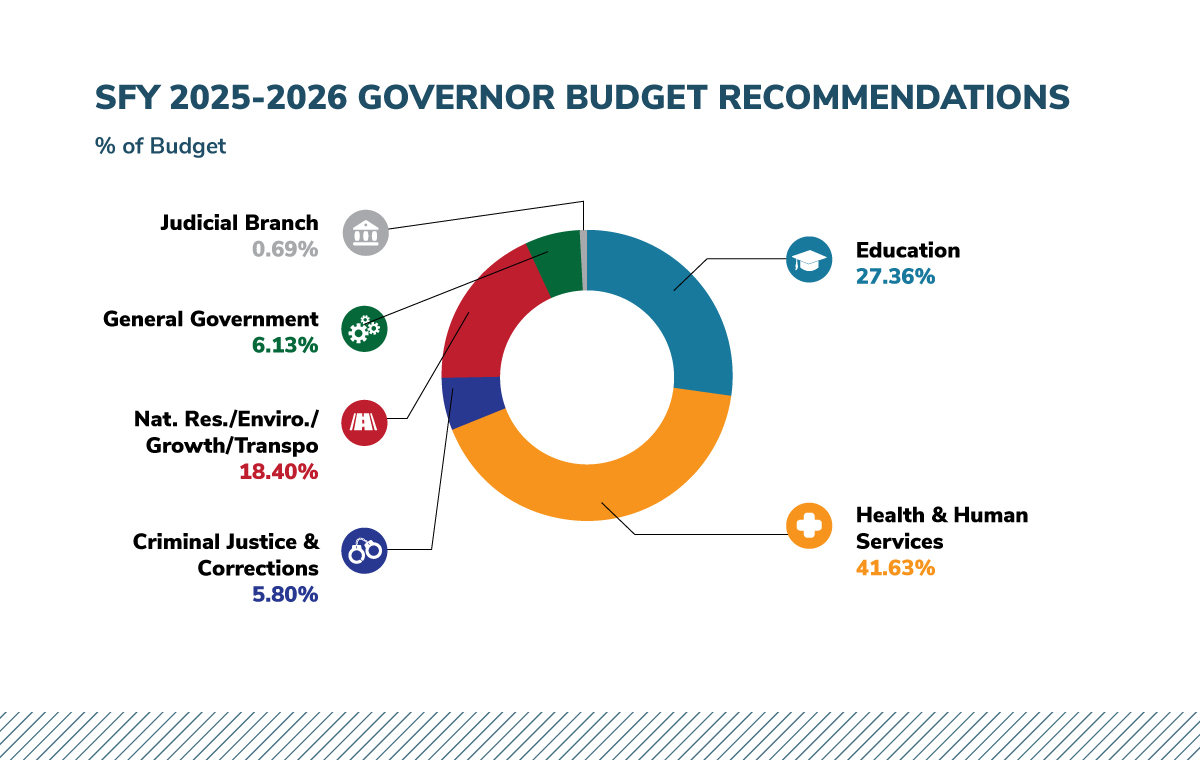
Health and Human Services received the largest portion of the proposed budget, totaling approximately $48.1 billion; this represents a 3.41% increase from the current fiscal year. All educational programs and services combined received the next largest portion of the proposal, totaling approximately $31.6 billion; a decrease of approximately 1.47% from the current fiscal year.
Natural Resources, Environmental Issues, Growth Management and Transportation Expenditures represent the third largest portion of the proposed SFY 2025-26 budget with funding equaling $21.3 billion, which represents a 6.07% decrease from the current fiscal year.
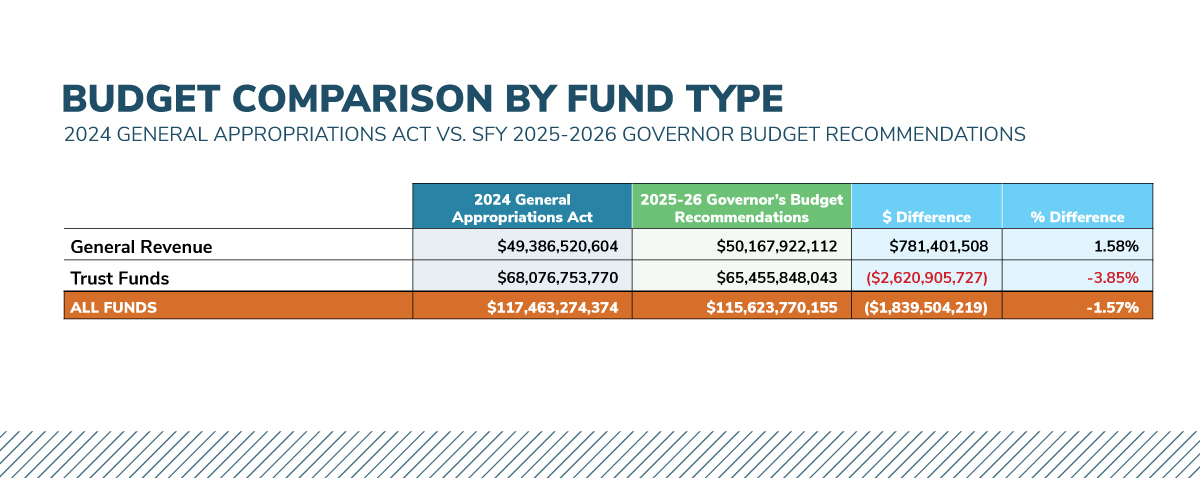
Proposed general revenue expenditures for SFY 2025-26 equal approximately $50.2 billion and trust fund expenditures total approximately $65.5 billion. The chart below compares expenditures between the 2024 General Appropriations Act and the Governor’s proposed SFY 2025-26 budget by fund type.
| |
County Funding Highlights | |
Natural Resources, Environment, Growth & Transportation
| |
|
Agricultural & Environment
Water Quality Highlights
-
Septic-to-Sewer Improvements: $500 million to the Wastewater Grant program.
- From the funds in Specific Appropriation 1555, $275,000,000 in nonrecurring funds from the Water Protection and Sustainability Program Trust Fund is provided for the water quality improvement grant program as established in section 403.0673, Florida Statutes.
- From the funds in Specific Appropriation 1555, $100,000,000 in nonrecurring funds from the Water Protection and Sustainability Program Trust Fund is provided to implement section 373.469, Florida Statutes, and for water quality improvement projects within the proximity of the Indian River Lagoon.
- From the funds in Specific Appropriation 1555, $80,000,000 in nonrecurring funds from the Water Protection and Sustainability Program Trust Fund is provided to support the construction of the Lower Kissimmee Basin Stormwater Treatment Area Project (LKBSTA). LKBSTA will clean water along with the Kissimmee River and the Lake Okeechobee Watershed to remove nutrient loads prior to depositing into Lake Okeechobee.
- From the funds in Specific Appropriation 1555, $25,000,000 in nonrecurring funds from the Water Protection and Sustainability Program Trust Fund is provided for water quality improvement projects within the Caloosahatchee River Watershed.
- From the funds in Specific Appropriation 1555, $20,000,000 in nonrecurring funds from the Water Protection and Sustainability Program Trust Fund is provided for projects, including septic to sewer and wastewater projects, that will improve the water quality of Biscayne Bay.
-
Small County Wastewater Treatment: $8 million to the small county wastewater treatment grant program.
-
Water Quality Improvement Grant Programs: $50 million recommended for planning, design, engineering, and construction of the specific project components designed to achieve the greatest reductions in harmful discharges to the Caloosahatchee and St. Lucie Estuaries as identified in the Comprehensive Everglades Restoration Plan Lake Okeechobee Watershed Restoration Project. $100 million for water quality improvements within the Indian River Lagoon. And an additional $20 million for water quality improvement projects in Biscayne Bay.
-
Total Maximum Daily Loads: $50 million recommended to monitor and assess water quality, set scientific water quality restoration goals (Total Maximum Daily Loads), and accelerate the implementation of the projects and actions set forth in restoration plans, such as Basin Management Action Plans (BMAPs) to address nutrient pollution, including green infrastructure and land acquisition projects. This program supports the efforts of the Blue-Green Algae Task Force consensus findings to address nutrient loads to impaired waterbodies affected by blue-green algae. The department may also provide cost-share funding for innovative nutrient removal projects.
-
Harmful Algal Blooms: $15 million to improve water quality and combat the effects and impacts of harmful algal blooms, including blue-green algae and red tide. The Focus on Fiscal Responsibility Budget includes the following:
- $10 million for supporting the evaluation and implementation of innovative technologies and short-term solutions to combat or clean up harmful algal blooms and nutrient enrichment of Florida’s fresh waterbodies, including lakes, rivers, estuaries, and canals. Funds may be used for the Department’s red tide emergency grant program to support local governments in cleaning beaches and coastal areas to minimize the impacts of red tide to residents and visitors. Funds may also be used to implement water quality treatment technologies, identified by the Department, near water control structures in Lake Okeechobee.
- $5 million to assist county governments with their responses to emergency conditions associated with harmful algal blooms and red tide events that may impact public health, Florida’s environment, and fragile ecosystems, including beaches and wildlife.
-
Springs Restoration: $50 million from the Land Acquisition Trust Fund for springs restoration projects and land acquisitions to protect springs.
Resilient Florida program: $200 million toward the Statewide Flooding and Sea Level Rise Resilience Plan projects, as well as $20 million toward Resilient Florida Planning Grants. In the event that projects included in the plan are unable to continue or if excess funds are identified by completed projects or ineligible activities proposed in applications, the department may reallocate funds to projects on its Statewide Flooding and Sea Level Rise Resilience Plan to the next project on the ranked list or to projects already funded in year one that have identified funding needs in subsequent years.
Alternative Water Supply Grant Program: $60 million to help communities plan for and implement vital conservation, reuse and other alternative water supply projects.
Florida Forever: $100 million recommended for the acquisition of environmentally endangered, unique, or irreplaceable lands.
Rural and Family Lands Protection Program: $100 million for conservation and rural land protection easements and agreements.
Trail Management: $4 million to the Local Trail Management Grant Program and $2.73 million to National Recreational Trail Funding projects.
Beach Management Projects: $100 million for beach management projects.
- From the funds in Specific Appropriation 1661, $50,000,000 in recurring funds from the Land Acquisition Trust Fund is provided to the Department of Environmental Protection to renourish and fortify Florida’s beaches and coastal shorelines consistent with any component of the comprehensive long-term management plan developed in accordance with section 161.161, Florida Statutes. Funds may be used in accordance with section 161.101, Florida Statutes, for projects on annual ranked lists, storm repair projects, or projects on lands managed by the state.
- From the funds in Specific Appropriation 1661, an additional $50,000,000 in nonrecurring funds from the General Revenue Fund is provided to the Department of Environmental Protection to renourish and fortify Florida’s beaches and coastal shorelines with impacts resulting from the 2024 hurricane season.
Solid Waste Management: $3 million to solid waste management grants for local government entities.
Mosquito control programs: $3.1 million, which is a $500 thousand decrease over the current FY funding.
Derelict Vessels: $2.9 million recommended to remove, store, destroy, and dispose of, derelict vessels or vessels declared a public nuisance.
| |
|
Transportation and Economic Development
Affordable Housing:
-
State Housing Initiatives Partnership (SHIP) program: $178.5 million.
- State Apartment Incentive Loan Program (SAIL): $227.7 million.
Florida Hometown Heroes Housing Program: $100 million for the Hometown Heroes Program to provide down payment assistance and closing cost assistance to Florida homebuyers.
Low-Income Home Energy Assistance Program (LIHEAP): $16 million for additional funding in partnership with local agencies.
Job Growth Grant Fund: $75 million to support workforce and infrastructure projects across the state.
Visit Florida: $80 million
Small County Outreach Program (SCOP): $91.9 million
Small County Road Assistance Program (SCRAP): $27.5 million
Fiscally Constrained Counties: $72.2 million for the purpose of mitigating deficits in the Fiscally Constrained Counties and Fiscally Constrained Counties Conservation Lands distributions.
Rural Economic Development: $25 million toward the Rural Infrastructure Fund to support infrastructure projects such as broadband, roads, stormwater and wastewater systems, and telecommunications facilities.
| |
Health and Human Services | |
|
Shared County/State Juvenile Detention: The proposed budget estimates the counties’ portion of total Shared County/State Juvenile Detention to be $82.1 million an increase of $8.5 million over the current year amount.
Community Substance Abuse and Mental Health Services: Funded at approximately $1.3 billion for all programs.
Community Action Treatment (CAT) Teams: $41.5 million, directed to DCF to contract with providers throughout the state for operation of CAT teams, which provide community-based services for children (aged 11 to 21) with mental health and/or substance abuse diagnoses.
Public Safety, Mental Health, and Substance Abuse Local Matching Grant Program: $9 million for the program, which supports county programs that serve adults or youth who are in behavioral crisis and at risk of entering the criminal justice system.
Crime Labs: $82 million for crime lab services.
Homeless Programs Challenge Grants: Approximately $20 million respectively, to DCF for challenge grants, which are awarded to lead agencies of homeless assistance continuums of care a decrease of $10 million under the current year funding. Support the Challenge and Homeless Housing Assistance Grants to provide rapid rehousing and homelessness prevention to vulnerable populations.
| |
|
Library Grants and Library Cooperatives: $21.4 million
Fiscally Constrained County Funding: $72.2 million, to offset the impacts of previously approved constitutional amendments.
Cybersecurity: $10 million to assist fiscally constrained with the development and enhancement of cybersecurity risk management programs.
Back of the Bill
The Focus on Fiscal Responsibility Budget also proposes a number of additional appropriations for the 2024-25 Budget Year:
Section 124
For 2024-2025, appropriates $339.5 million in nonrecurring funds from the Wastewater Treatment and Stormwater Management Revolving Loan Trust Fund to the Department of Environmental Protection for the Wastewater and Stormwater Treatment Facility Construction Loan Program related to Hurricane Ian.
Section 166
For 2024-2025, appropriates $4.7 million in nonrecurring funds from the General Revenue Fund to the Department of Revenue for the purpose of mitigating deficits in the Fiscally Constrained Counties and Fiscally Constrained Counties Conservation Lands distributions as determined by the August 7th, 2024, Revenue Estimating Conference.
Section 195
For 2024-2025, appropriates $25 million recurring funds from the General Revenue Fund to the Department of Commerce for supply chain capacity expansion and innovation grants. The grant program shall support increased energy storage and distribution at airports, inland ports, intermodal logistics centers, and seaports. The funds shall also provide for a matching grant program for vertiport development. The grant program shall be developed in partnership with the Department of Transportation and grant recipients shall be jointly selected by the Department of Commerce and the Department of Transportation. The unexpended balance of funds remaining on June 30, 2025, shall revert and is appropriated to the Department of Commerce for Fiscal Year 2025-2026 for the same purpose. This section is effective upon becoming law.
| |
Implementing and Conforming Bill | |
|
Appropriations Implementing and Conforming Bills make certain changes to substantive law in order to implement the proposed General Appropriations Act.
Implementing and Conforming Bill issues include:
Tax Breaks:
The Focus on Fiscal Responsibility Budget includes an additional $2.2 billion in tax relief, including:
- Repeal of the Business Rent Tax: $1.6 billion, A one percent reduction effective 1/1/26, and another one percent reduction effective 1/1/27
- One-year exemption of the Nonrecurring Intangibles Tax; $170 million, exemption of intangibles tax for the first $500,000 of residential mortgages for the purchase of a primary (owner-occupied) residence effective 7/1/25, through 6/30/26.
- Creation of the Research, Innovation, Science, and Engineering (RISE) Tax Credit: $100 million corporate income tax credit incentivizing investments in new ventures
- Data Center Exemption Expiration Repeal: $3 million, permanent extension of the sales tax exemption for Data Center Property to incentivize artificial intelligence infrastructure growth that will create jobs and strategically place Florida at the forefront of research and technology
- “Freedom Month” sales tax holiday in July: $82 million, sales tax exemption on various outdoor recreational purchases
- 14-day Back-to-School sales tax holiday: $87 million
- Two 14-day Disaster Preparedness sales tax holidays: $72 million
- 7-day Tool Time sales tax holiday: $18 million
- “Second Amendment Summer sales tax holiday: $8 million, exempts ammunition, firearms, and related accessories from Memorial Day to Fourth of July 2025
- Two-month Marine Fuel Tax Holiday: $27 million
- 2-year delay of the imposition of natural gas fuel taxes that would otherwise go into effect 1/1/26, $2 million
-
The Proposed Tax Relief Legislation is available here.
Department of State:
Confirming bill that modifies Department of state grants for library and cultural grants available here.
Debt Reduction:
The Governor’s Budget Recommendations include a goal to pay down 50 percent of the state’s tax-supported debt by FY 2027-28. The Focus on Fiscal Responsibility Budget provides $830 million, including $600 million to support tax-supported debt across government and an additional $230 million to pay off all outstanding Florida Forever and Everglades bonds. With this investment, Florida will have paid down 48.7 percent of the total tax-supported debt by the end of FY 2025-26.
Florida Hometown Hero Program:
The Governor’s Budget Recommendations include conforming legislation to modify the eligible recipients of the Florida Hometown Hero Program for the first 6 months of the state fiscal year July 1st through December 31st. The program would be limited to teachers, first responders, US uniformed servicemembers, Florida National Guard servicemembers and Florida State Guard servicemembers. A list of eligible occupations shall be created, approved, and published by the corporation for each fiscal year that funding is available.
Cybersecurity Incident Response Trust Fund and Authorized Balances:
The Governor’s Budget Recommendations include conforming bills creating the Cybersecurity Incident Response Trust Fund within Department of Management Services (DMS) and transfer $10 million to the newly created Trust Fund. DMS is authorized to submit budget amendments requesting funds to respond to cybersecurity incidents.
Department of Transportation:
The Governor’s Budget Recommendations include a conforming bill impacting local infrastructure programs. This includes requirements on seaport cargo capacity and funding inconsistent with the state’s energy policies.
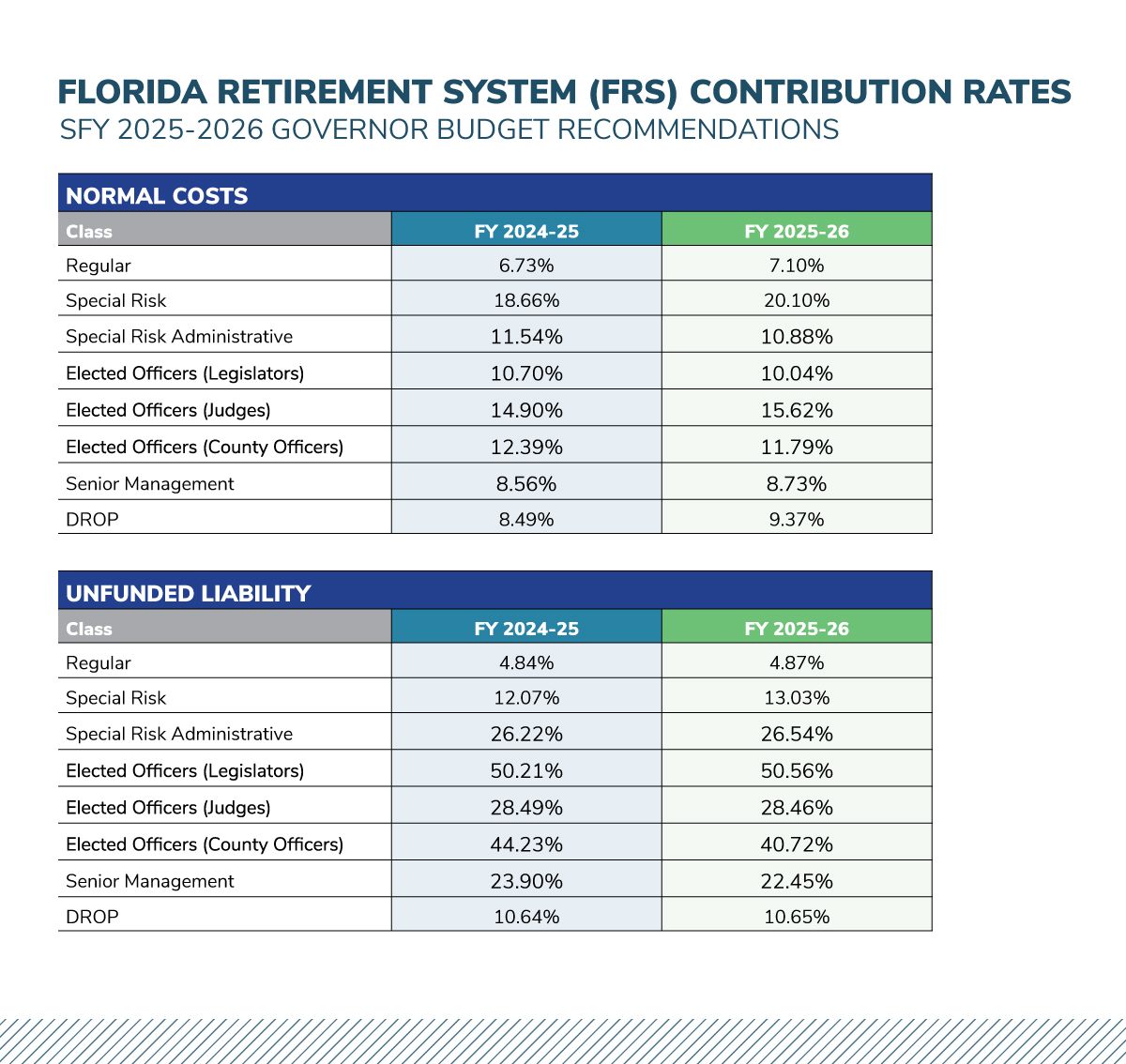
FRS Contribution Rates
The Governor’s Budget Recommendation include fully funding the required contributions for Florida Retirement System (FRS) employers to ensure the long-term solvency of retirement benefits for state employees, including law enforcement officers and teachers. Please see below for a comparison of the FY 2025-26 contribution rates along with the Governor’s recommended changes:
| |
The Governor’s proposed FRS bill is available here.
Governor’s Proposed Implementing Bill
Section 18 – Proposes to continue the provision first included in the 2023-24 Implementing bill that excluded Hospital Directed Payment Program funds from the calculation of the county contribution to Medicaid. This provision saved counties approximately $18 million in 2023-24.
The full text of the Governor’s Implementing bill is available here.
Florida Reserves
- $4.2 billion in unallocated General Revenue
- $4.9 billion in the Budget Stabilization Fund
- $2.3 billion in unallocated Trust Funds
- $1.0 billion in the Emergency Preparedness and Response Fund
- $2.2 billion in the Reinsurance Assistance and the Florida Optional Reinsurance Assistance Programs
-
$14.6 billion in Total Reserves
| | | | |