|
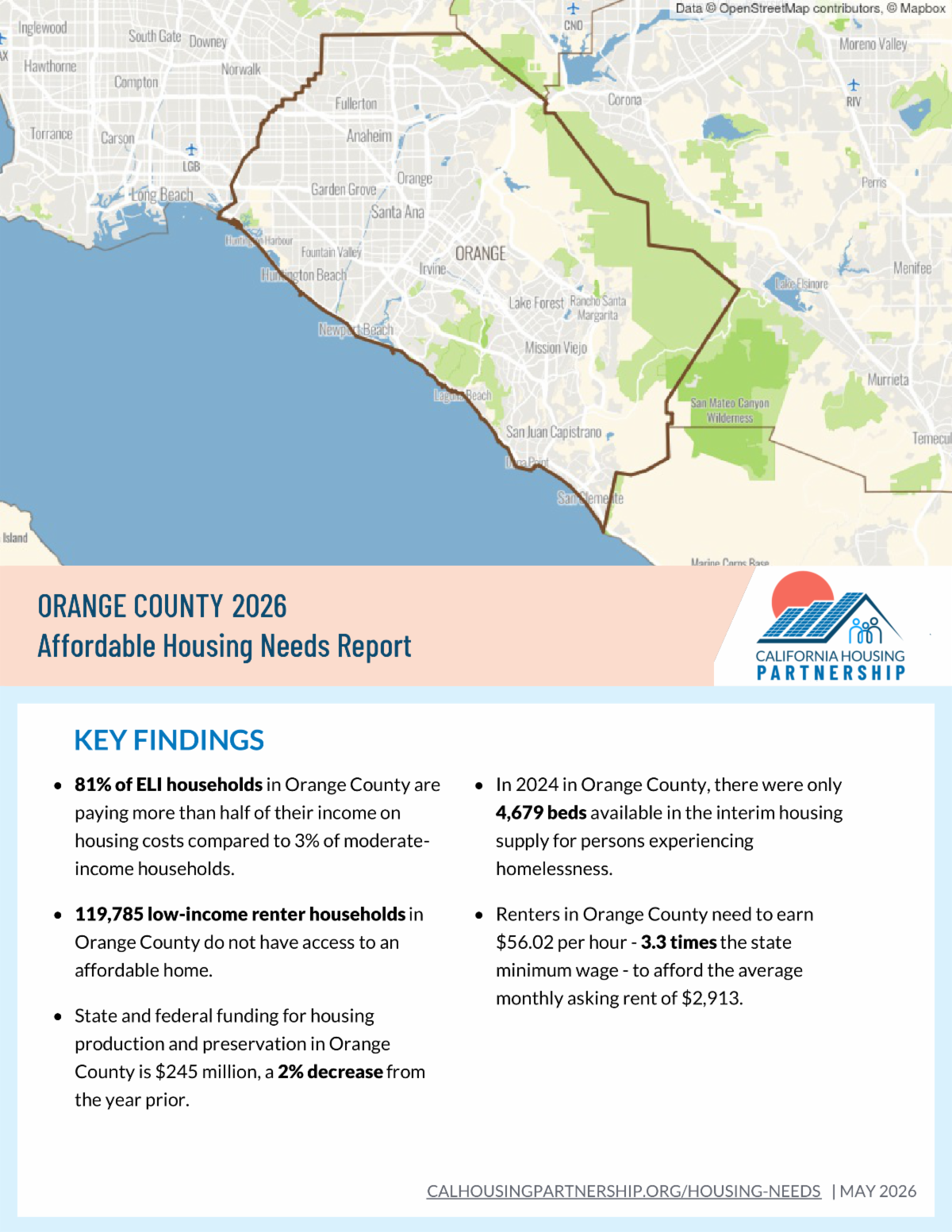
These county-level assessments track the progress of local and state leaders' initiatives to alleviate the housing instability faced by low-income Californians in all regions of the state. The challenging housing market trends causing the instability are documented in these reports and in our state-level 2026 Housing Needs Report.
What Can Be Done?
The Partnership urges state leaders to:
- Develop an on-going revenue source to fund affordable housing production and preservation at the scale needed to meet state goals over 10 years.
- Place a $10 billion affordable housing bond (AB 736 Wicks or SB 417 Cabaldon) on the 2026 ballot and actively support its passage.
- Expand and make permanent the enhanced state Low-Income Housing Tax Credits.
- Make funding the Multifamily Housing Program part of the baseline state budget and increase the amount incrementally each year.
- Pass a state Community Reinvestment Act to create a level playing field between federally regulated banks and currently unregulated financial institutions so that all are reinvesting in California communities equitably.
- Reduce the cost of developing affordable homes by $42,000 per unit by implementing the Governor’s plan for the new Housing Development Finance Committee to act as a single funding table where all needed state resources are awarded at one point in time.
- Advance preservation of existing affordable homes by (a) investing in rehabilitation, (b) strengthening enforcement of the state Preservation Notice Law, and (c) acquiring unsubsidized apartments occupied by low-income households and restricting them for long-term affordability
|