MoIP Vision: Missouri is committed to reducing the impact of invasive plants through early detection and control.
MoIP Mission: To benefit Missouri, MoIP advances efforts to reduce the impact of invasive plants.
| | Summer 2026 • State of Invasives | | |
The Missouri Invasive Plant Council (MoIP) is pleased to announce its Invasive Plant Action Awardees for 2026.
Initiated in 2019, the MoIP Invasive Plant Action Award program recognizes outstanding work in Missouri to control invasive plants. Not only do these awards celebrate hard work and leadership, but they also demonstrate to Missourians that control of invasive plants is possible and essential to overall land stewardship efforts.
| | |
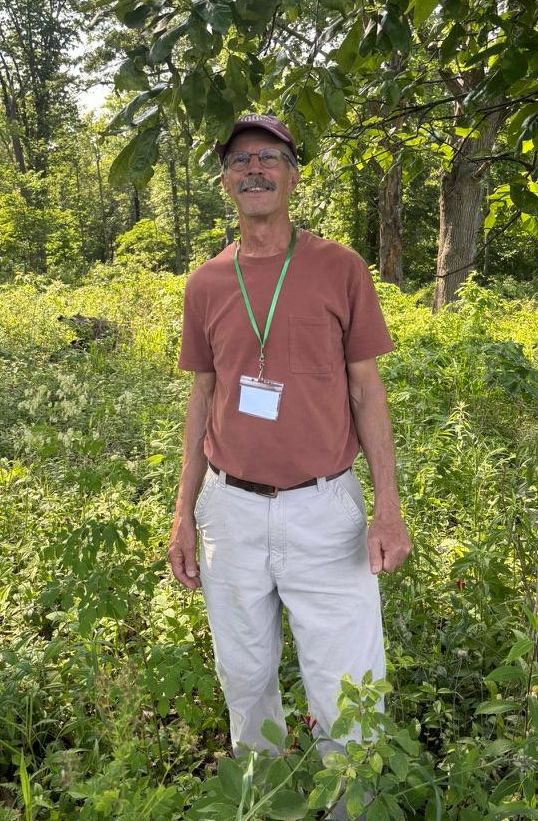
Mike Smith is the awardee in the Individual Citizen category, awarded to a private individual who has demonstrated progress in reducing invasive plants over at least two years. A retired high school shop teacher, Mike began volunteering in March 2015 at Shaw Nature Reserve (SNR) in Gray Summit, Missouri, and quickly became a regular.
Mike became SNR’s first volunteer land steward in March 2018, leading workdays in 16 acres of SNR’s Brush Creek corridor. At the time, this area was classified as a high-priority restoration site with at least 10 invasive plant species identified as targets. Through this project, Mike became a highly skilled and capable land manager. His educational background is apparent in his work, keeping everyone eager and engaged.
| | |
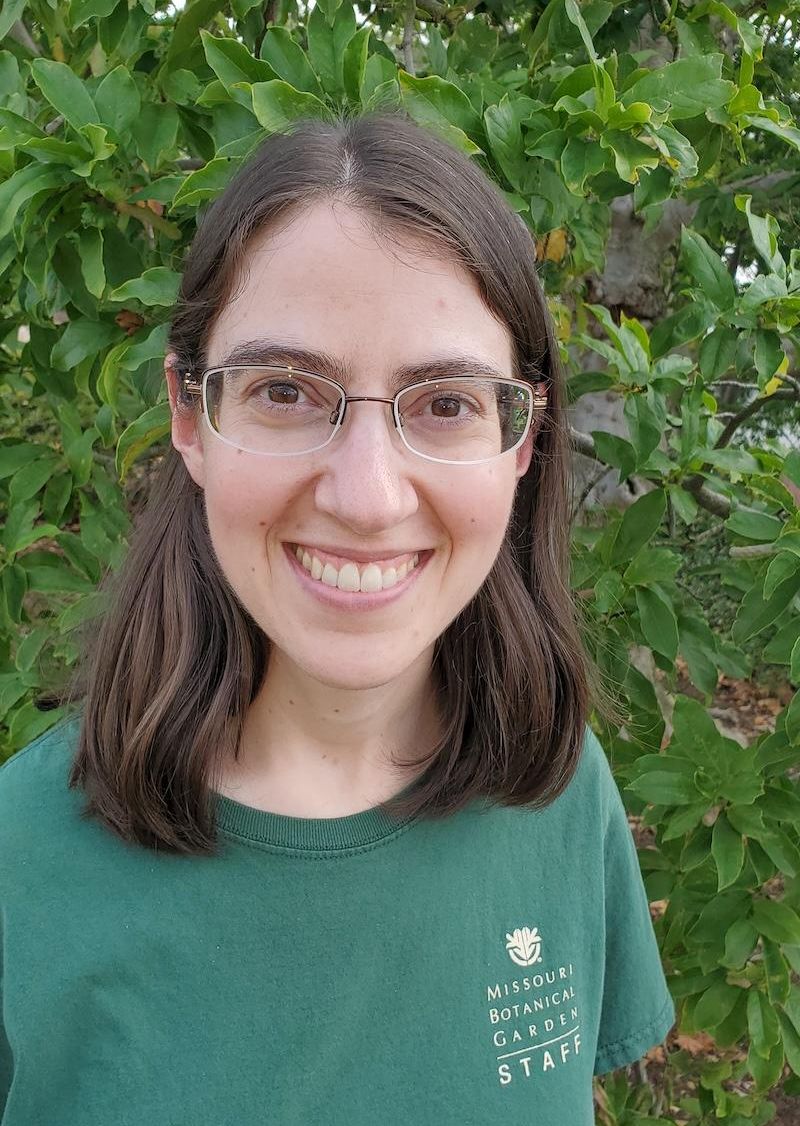
Brittany Shultz is the awardee in the Individual Professional category, awarded to a natural resources professional who has demonstrated progress in reducing invasive plants for at least two years. She is the Living Collections Data Specialist at the Missouri Botanical Garden (MBG). Brittany co-authored “The potential role of public gardens as sentinels of plant invasion” (2022) in the Invasive Plant Science and Management Journal.
Brittany played a central role in developing and implementing the Weed Risk Assessment (WRA), a tool to systematically categorize the likelihood that a plant in botanical collections may escape cultivation. She compiled and organized diverse invasive plant data sources for integration into the Garden's Living Collections Management System (LCMS). She collaborated with database developers to build and refine the assessment framework, then tested and validated the scoring methodology, enabling the automated evaluation of more than 7,600 species for invasive potential.
Through this work, Brittany helped create a scalable decision-support tool that continues to guide responsible plant acquisition and collections management at MBG. This work minimizes the ecological risk of plants newly introduced to Missouri. Her participation in Public Gardens as Sentinels against Invasive Plants (PGSIP), a database for public gardens in North America to share information about plant taxa that they are observing escaping from cultivation on site, ensures best practices are shared with public gardens on a national level.
Read more about the 2026 awardees here. Congratulations, Mike and Brittany, and thank you for your important work!
| | |
In this summer 2026 issue of State of Invasives, please find more news and resources, summarized here with details that follow:
–Upcoming Invasive Plant Control Workdays in St. Louis, Central Missouri, and Kansas City
–September 24: Missouri University Extension & Scenic Rivers Invasive Species Partnership Workshop in Houston, Missouri
–Emerging Threats: Kochia, Cephalaria transylvanica
–Reports on MoIP Spring Events: Callery Pear Buyback Event & Doniphan Workshop
–Success Story: Preserving the Scenic Rivers Region Through Partnerships for Forest Health
–Missourians Making a Difference: College Interns at Rockbridge State Park
–MoIP at the 2026 Missouri State Fair
–Invasives to Treat in September: Johnson grass, Sericea lespedeza, Japanese stiltgrass, and Sweet autumn virgin's bower
And, here is a sampling of recent invasive plant stories from around the country:
–MoDOT Spends $2.6 Million Controlling Invasives
–Mile-A-Minute-Weed Detected in Michigan
–Invasives removal in Ohio improves freshwater wetlands and habitat
Please read and share this issue of State of Invasives, and, as always, let us know if you have questions and ideas about invasive plant early detection and control.
Thank you for taking action to identify and control invasive plants!
On behalf of the Missouri Invasive Plant Council,
Carol Davit, MoIP Chair
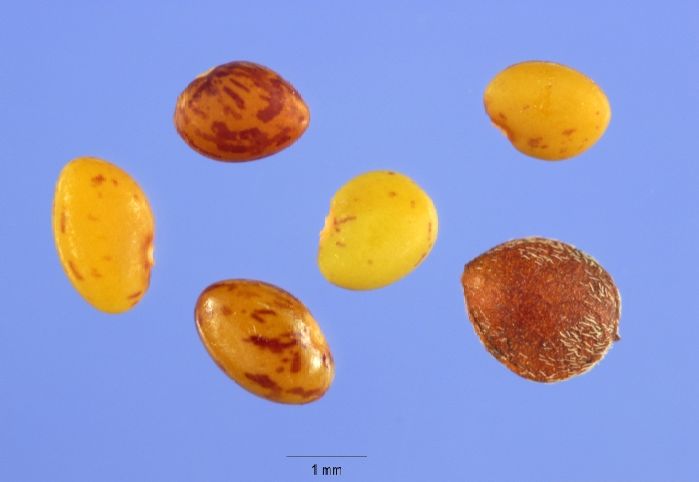
Pictured above are seeds of sericea lespedeza (Lespedeza cuneata). A single sericea lespedeza plant can produce more than 1,000 seeds in a single year, and the seed remains viable in the seed bank for many years. To prevent more sericea seeds from developing, treat as many of the plants as possible before summer is over. It isn't too late! Some plants are still in flower and haven't yet gone to seed. Read more below. Photo by Steve Hurst, USDA NRCS PLANTS Database, Bugwood.org
| | By September 18: MoIP Wants Your Opinion! | | |
In the latter part of 2026, its 11th year, MoIP will write its second strategic plan to guide its work over the next several years. To this end, MoIP seeks input from organizational stakeholders—conservation and municipal professionals, horticulturists, landowners, farmers, researchers, vegetation managers, educators, and others—about MoIP's mission, priorities, and activities to inform the development of this strategic plan.
You are one of MoIP's important stakeholders! We invite you to complete a survey to share your input by September 18. Your responses will populate a spreadsheet without your name, assuring anonymity. Your candor is valued!
Your survey responses will help ensure that MoIP's next strategic plan is developed as thoughtfully as possible, with multiple viewpoints in mind. The survey should take no more than 10 minutes to complete.
| | Upcoming Invasive Plant Control Work Days:
Register Now | | |
Central Missouri:
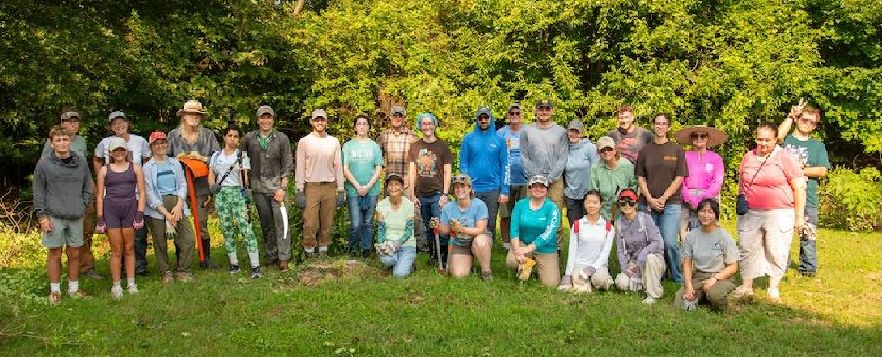
The Missouri Conservation Corps (MCC) has organized an event at Again Park in Columbia, Missouri: Habitat Restoration and Food Drive on Saturday, September 26th, 10 a.m. to Noon, 1200 Again Street. Volunteers will participate in honeysuckle removal and a canned protein/food drive for the Food Bank for Central and Northeast Missouri. Learn more and register here.
MCC is offering additional events in Columbia this fall, as well as one in partnership with the Missouri River Bird Observatory in Arrow Rock on November 7. Watch for details here. Also, Visit the MCC booth at the Conservation Expo at Cooper's Landing on September 12 and 13. Details here.
St. Louis Area:
Check out events organized by Open Space St. Louis, including invasive honeysuckle removal days at Castlewood State Park on October 15 and Creve Coeur Park on December 5, as well as an invasive species removal day at Laumeier Sculpture Park on November 14. Learn more and register here.
Kansas City Area:
Kansas City WildLands has organized an invasive plant control workday on November 7. Learn more and register here. Learn more about the work of Kansas City WildLands here.
Photo of participants who took part in the SCC event at Again Park on August 8, by Stephen Bybee
| | Register for this free Missouri Extension and Scenic Rivers Invasive Species Partnership workshop here. | | Spring 2026 MoIP Callery Pear Buyback Event & Doniphan Workshop Reports | | |
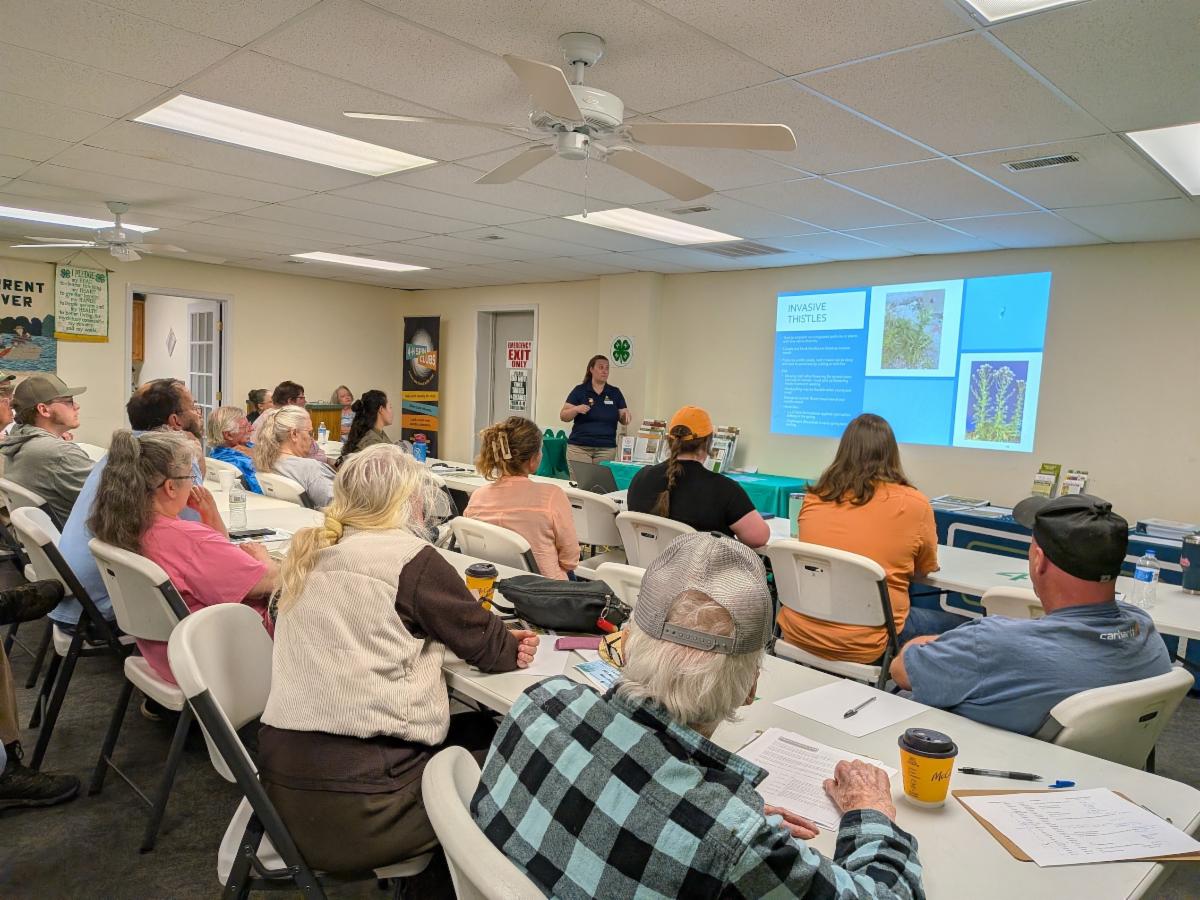
On April 10, 37 attendees, including private landowners, agency professionals, and students, gathered at the Ripley County Fairgrounds near Doniphan, Missouri, for a MoIP workshop to learn about invasive plants, how to manage them, and resources available for invasive plant control assistance through Missouri Department of Conservation (MDC) Private Lands Conservationists.
The training, which included both classroom and in-field instruction, was conducted by Valarie Kurre, MoIP Council member and Executive Director of the Scenic Rivers Invasive Species Partnership; Julie Norris, Priority Habitat Specialist with MDC; and Kirby VanDover, Ripley County MDC Private Lands Conservationist. The training was facilitated by Lilly Germeroth of the Missouri Prairie Foundation and its Grow Native! program, through which MoIP is administered. This training was organized with funding support from the L-A-D Foundation.
| | |
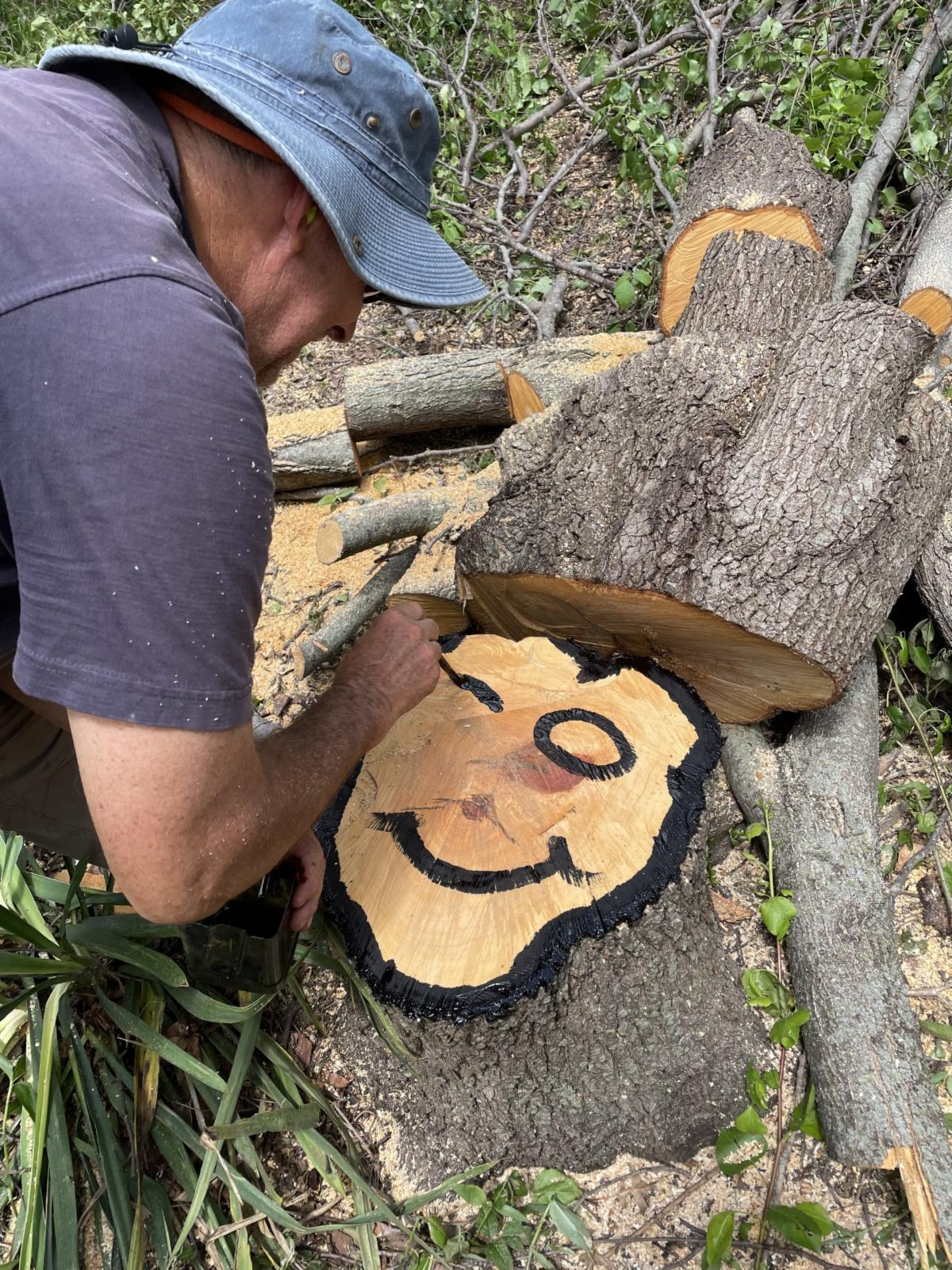
MoIP's Annual Callery Pear Buyback event has grown each year since the first one in 2019, reaching more Missourians with the important message about control of Callery pears and other non-native, invasive plants. The event not only inspires individuals to participate in the Buyback by controlling Callery pears on their own property, but the media attention generated by the event also informs exponentially more Missourians about how important invasive plant prevention, early detection, and control are to all Missourians.
MoIP's 2026 Callery Pear BuyBack event was held at 23 locations across the state on April 21. Through tree donations and financial support to purchase trees, MoIP was able to give away 1,200 native trees of numerous species, yard signs to participants to promote the importance of their Callery pear removal, and fact sheets about native tree care and invasive control.
MoIP is grateful to the Missouri Community Forestry Council, the L-A-D Foundation, and Magnificent Missouri for their financial support of the 2026 Callery Pear Buyback Program, as well as to Forrest Keeling Nursery and Forest ReLeaf of Missouri for tree donations. The Missouri Prairie Foundation and the Missouri Department of Conservation also provided financial and administrative support. Read more here.
Photo at top of the indoor portion of the MoIP workshop on April 10 by Lilly Germeroth; photo above from a creative Callery Pear Buyback participant, whose registration photo of his cut-down Callery pear tree put a smile on our faces!
| | Invasive Plant Success Story: Preserving the Scenic Rivers Region Through Partnerships for Forest Health | | |
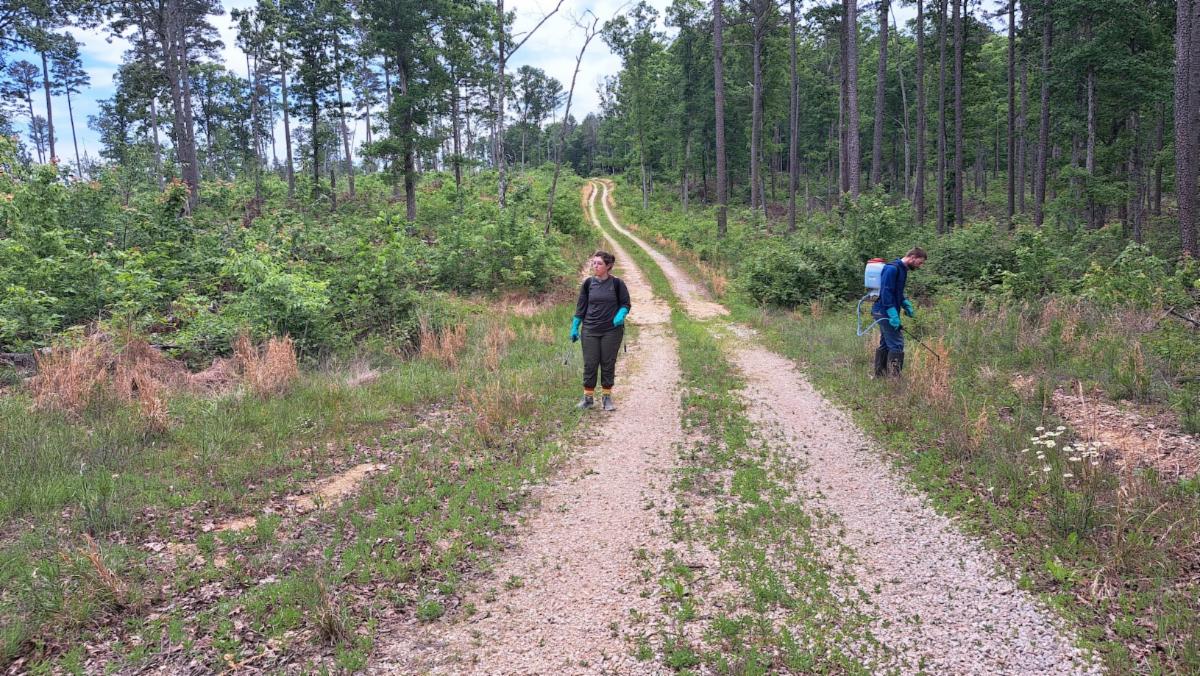
The Scenic Rivers Invasive Species Partnership (SRISP) and the U.S Forest Service's Mark Twain National Forest (MTNF) in Missouri worked together this summer in the Eleven Point Ranger District to inventory and treat invasive species.
This District has several priority working areas, including the Missouri Pine-Oak Woodlands Restoration Collaborative Forest Landscape Restoration (CFLR). Over the last 15 years, restoration work in the CFLR has included selective tree removal, prescribed burning, and invasive species control. As the project has neared its end, MTNF personnel identified ways to sustain the work they completed in the CFLR over the years, one being to work with the SRISP on aspects of invasive plant control in the CFLR.
To that end, this summer, the SRISP assisted the MTNF by updating invasive plant inventories, providing a fresh look at which species remain in the CFLR project area, which areas should receive priority attention, and whether any new species have appeared. In their first month of work this summer, the SRISP’s seasonal technicians, Kayla Adams and Jon Petroski, mapped nearly 100 miles of MTNF roads and provided updated invasive inventories that can guide future planning. While inventorying, if weather permitted, the technicians also treated the invasives they found, making this seek-and-treat method highly cost-effective and time-efficient. Read more.
—By Valarie Kurre, MoIP Council member and SRISP Executive Director
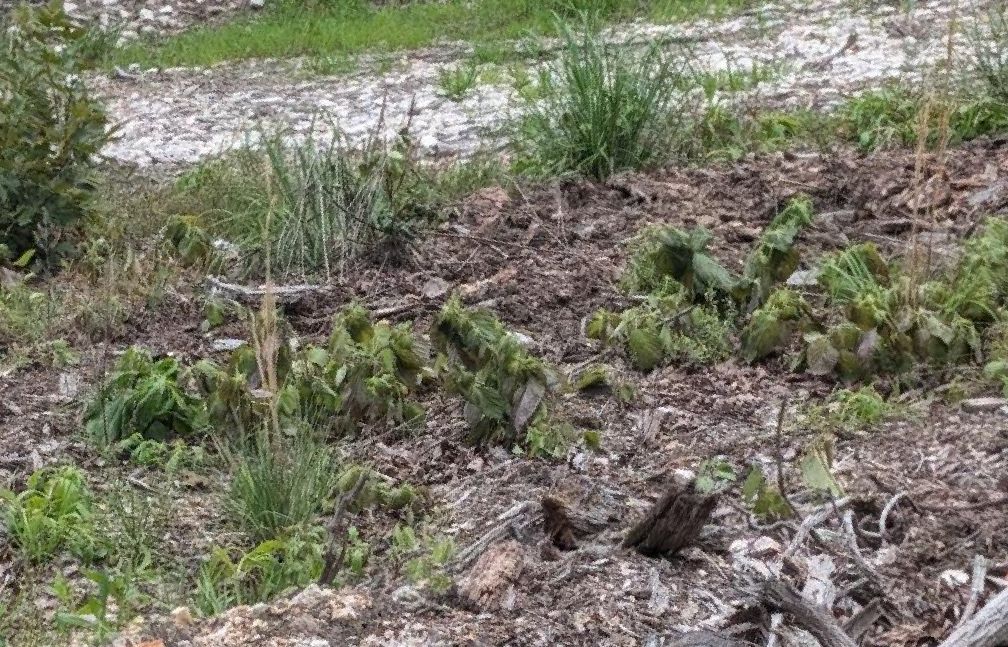
Top, SRISP Seasonal Technicians Kayla Adams and Jon Petroski controlling invasives with backpack sprayers in a recently completed timber sale area in the MTNF, to prevent their spread. Above, beefsteak plant (Perilla fructescens) wilting after herbicide treatment.
| | Missourians Making a Difference: College Interns Control Invasives at Rock Bridge State Park | | |
This summer, seasonal employees of the Missouri Department of Natural Resources, whose positions are funded by the recently renewed Parks, Soils, and Water Sales Tax, controlled invasive plants within Rock Bridge Memorial State Park in Columbia, Missouri.
Their work supported the mission of Missouri State Parks, which includes protecting ecosystem health, and this work in turn enhanced opportunities for people to learn about and enjoy native plants and animals while hiking in the park’s 2,273 acres.
| | |
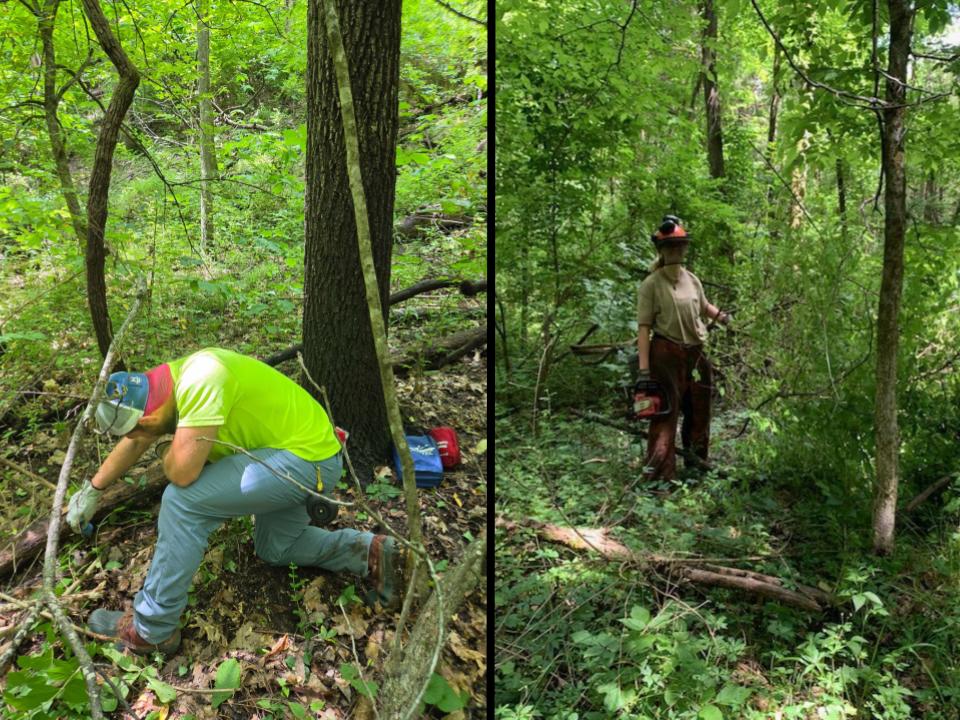
The seasonal employees were also college students, and their work not only benefited the park ecosystem and visitors but also provided them with valuable training in invasive and native plant identification, as well as techniques used to control invasive plants.
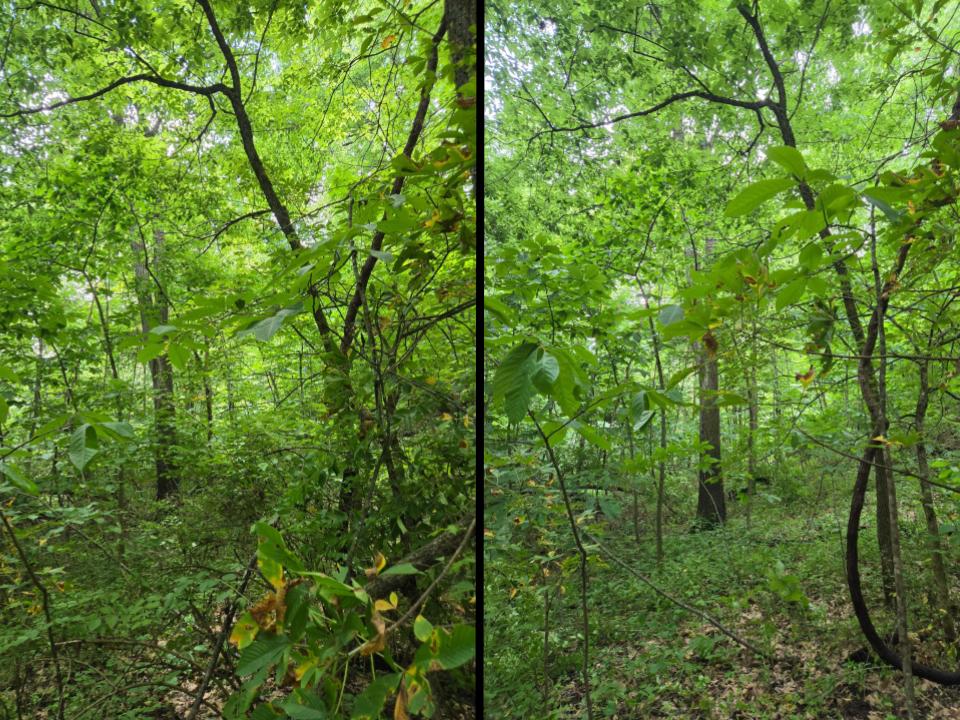
Pictured above are two of the interns at work, and at right, before and after they cleared an area of invasives.
–Roxie Campbell, MoIP Council member and Rock Bridge Memorial State Park Naturalist
Top, Rock Bridge State Park seasonal employees Isaiah Merry (left) uses a dauber to apply herbicide to cut stumps, and Audrey Coorts (right) operates an electric chainsaw to cut
larger bush honeysuckle. Above, before-and-after photos show that invasive plants were removed to free up space for native plants such as the Ohio buckeye tree (bent over in photo on right) that is now is upright. Photos by Roxie Campbell
| |
Emerging Threats: Kochia and Cephalaria transylvanica
| | |
While Missouri has plenty of well-established invasive plant species, unfortunately, additional ones continue to be documented as well.
This summer, Ian Thomas, the Missouri Department of Transportation Roadside Manager for the Kansas City District, reported finding kochia (Bassia scoparia) plants along urban roadsides. Ian and MoDOT crew members are treating kochia when found, as well as keeping their eyes open for new areas of emergence.
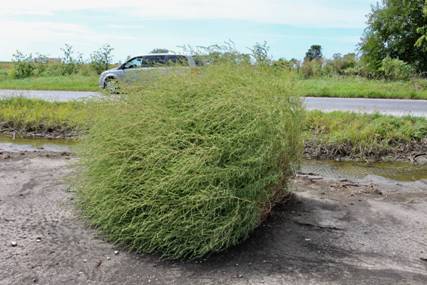
Kochia is highly branched and up to 5 ft tall. Blue-to gray-green, linear, hairy leaves are 1 inch long when mature and longer on younger plants. Kochia is one of the earliest emerging summer annuals in Iowa, which limits its occurrence in corn and soybean since the majority of plants emerge prior to planting. It was introduced to the U.S. as an ornamental because of its red fall color. Kochia is a major weed problem in the Great Plains. Kochia is a "tumbleweed," which is an adaptation for seed dispersal. Learn more from this Iowa State University webpage.
Photo above from Iowa State University of a kochia plant ready to roll across the landscape. See more images of this plant at the link above.
| | |
We featured another emerging threat, Cephalaria transylvanica (no common name), in a previous issue of this newsletter, but mention it again here to continue to spread the word (and not the plant!).
According to biologists in southwestern Missouri, Cephalaria transylvanica is aggressively spreading in many locations, including along the Frisco Highline trail from Springfield to Bolivar, and along Highway 123 in Polk County and Highway 245 in Cedar and Dade Counties. How this rapidly spreading plant was introduced here is unknown.
As documented in Missouriensis, the publication of the Missouri Native Plant Society (2024, V. 42, pages 1–16), author Nathan Aaron reported on the presence of Cephalaria transylvanica, a tall, annual wildflower in the Caprifoliaceae family and native to the Old World, from roadsides in southwestern Missouri and northwestern Arkansas. This is the first report of the species growing wild in North America—aren't we lucky??
Control: Because this is an annual plant, well-timed mowings (before it blooms in mid-summer) could greatly reduce seed production, minimize spread, and begin to reduce populations, but mowings after the plant has set seed will continue to spread the infestation. If you are aware of any populations where it is feasible to remove the plants (with the seeds, if they haven't already shattered), doing so will help slow its spread. Learn more about ID and control of this species and read Nathan Aaron's article here.
Photo above of Cephalaria transylvanica plant blooming in mid-summer along a roadside by Nathan Aaron
| | MoIP at the 2026 Missouri State Fair | | |
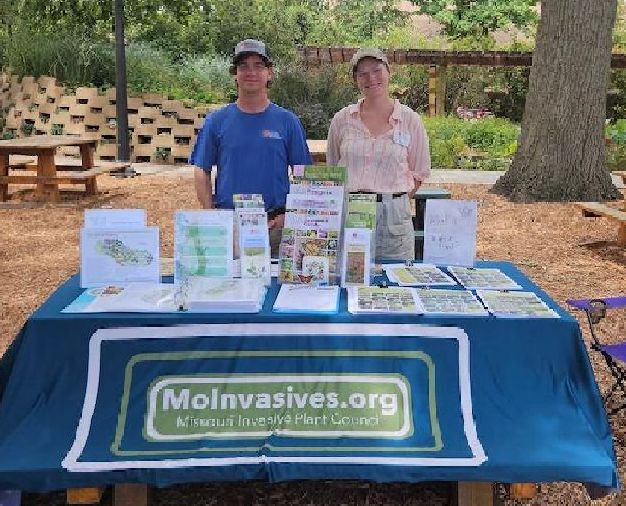
Many thanks to Prairie Stewardship Assistant Clifford Barratt and Conservation Projects Coordinator Lilly Germeroth, both with the Missouri Prairie Foundation, for staffing a MoIP booth at the Missouri State Fair on August 14, which was Missouri Invasive Species Day at the fair.
Along with representatives from other agencies and groups working to control invasive plant and animal species in Missouri, Lilly and Clifford answered questions about invasive plant identification and control. They also shared MoIP fact sheets with Missouri State Fair visitors; several hundred thousand people attend the Missouri State Fair each year.
| | Invasive Plants to Treat in Late Summer | | |
Not all invasive plants are most effectively treated at the same time of year, and treatment methods can vary by season. Here, we highlight several species to treat in late summer. You can find treatment guidelines for many invasive plants other than those highlighted below at moinvasives.org.
Note: Treatment methods may differ considerably if invasives are found in otherwise intact, highly biologically diverse areas, in disturbed areas/altered landscapes, or if invasives are found in or near water. When using chemicals to treat invasives, always read label instructions.
| | |
Johnson grass (Sorghum halepense) may have gone to seed in many parts of Missouri as of late August, but it is still flowering in some areas, for example, where it had been mowed earlier in the season. Either way, dense patches can be controlled by spraying the foliage with 2% glyphosate. Alternatively, sulfosulfuon (Outrider), at a rate of 1 oz per 100 gallons of water, can be applied via foliar spray before flower stalks set seed. Consult this Missouri Department of Conservation Johnson Grass page for more information.
Johnson grass is a coarse, warm-season, perennial that can reach 7 feet tall. It grows in dense clumps or nearly solid stands. Johnson grass was introduced into the United States as a forage crop, but became problematic not only to natural communities but also to agriculture. It invades riverbank communities and disturbed sites, particularly fallow fields and wooded edges, as well as native grasslands, where it can crowd out native species. Johnson grass is on the Missouri Noxious Weed List.
Johnson grass has a prominent white leaf mid-vein, a rounded stem base, and is virtually hairless. (Eastern gama grass [Tripsacum dactyloides], a native grass found on prairies and sometimes along roadsides, also has a white leaf mid-vein, but its stem bases are flattened). Also, eastern gama grass flowerheads are spikelike, whereas those of Johnson grass are in large, loosely branched panicles, as shown above. Consult this Johnson grass vs native look-alikes document for more ID tips.
| |
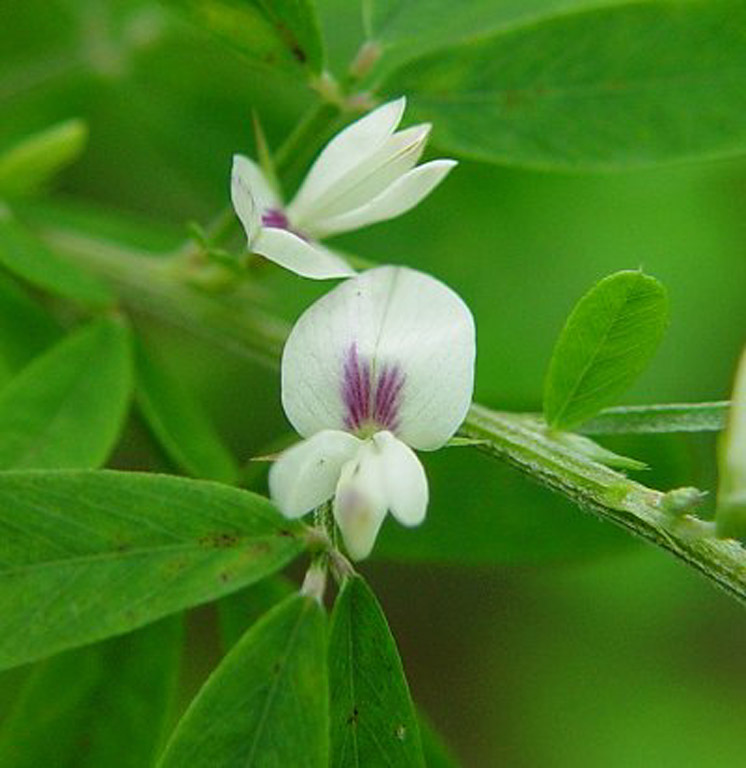
Sericea lespedeza (Lespedeza cuneata) is a perennial legume with herbaceous to somewhat woody stems, growing 3 to 6 feet tall, with many erect, leafy branches. Flowers are ¼ to ⅜ inch long and in clusters, the petals cream colored with purple or pink markings. Blooms July–October. Its myriads of seeds are borne in small oval pods that are up to ⅛ inch wide.
Leaves are green to ashy green with densely flattened hairs, compound with 3 leaflets each ¼ to 1 inch long.
A single sericea lespedeza plant can produce more than 1,000 seeds in a single year, and the seed remains viable in the seed bank for many years. If you have a small amount of sericea that has set seed, cut and remove it to avoid adding more sericea seeds to your seed bank. You can still treat the foliage and stems with herbicide to reduce or prevent future regrowth of individual plants.
Prescribed burning stimulates sericea seed to sprout, and following up with a chemical treatment may speed up ridding soil of the seed. The most commonly used chemicals are a mixture of triclopyr and fluroxypyr (PastureGard) or triclopyr (Remedy) once plants are at least 12 inches tall. Later in the growing season, when plants are flowering until seed set, use metsulfuron (e.g., Ally, Escort, Cimarron).
Labeled use rates for the chemicals below can change as the growing season progresses, but are commonly applied at the following rates with surfactant added at .25-.5% solution: PastureGard - Spot spray at .5 oz per gallon of water or broadcast spray at .75 pints per acre / Remedy Ultra - Spot spray at 1.25 oz per gallon of water or broadcast spray at 1-2 pints per acre / Escort XP - Spot spray at 1 oz per 100 gallons of water or broadcast spray at .5-1 oz per acre. Always read and follow chemical labels.
Read more in this Missouri Department of Conservation Sericea Lespedeza Fact Sheet.
| |
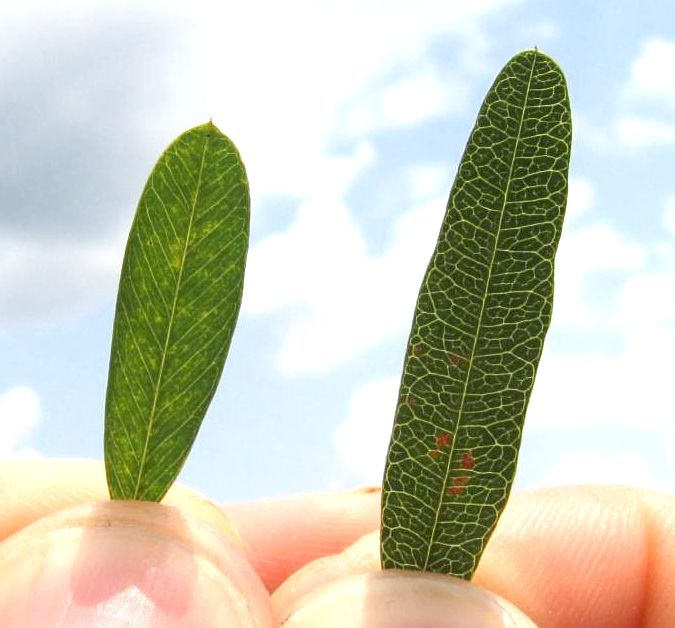
Note: Do not confuse sericea lespedeza with native slender lespedeza (Lespedeza virginiana):
–Sericea lespedeza leaflets (left, in the photo at right) have a “fishbone-like” venation pattern. Slender lespedeza leaflets have netted venation (right, in the photo at right).
| | | | |
–Sericea lespedeza flowers have cream-colored petals with purplish markings, shown at left. Slender lespedeza has solid, light lavender flowers.
| | |
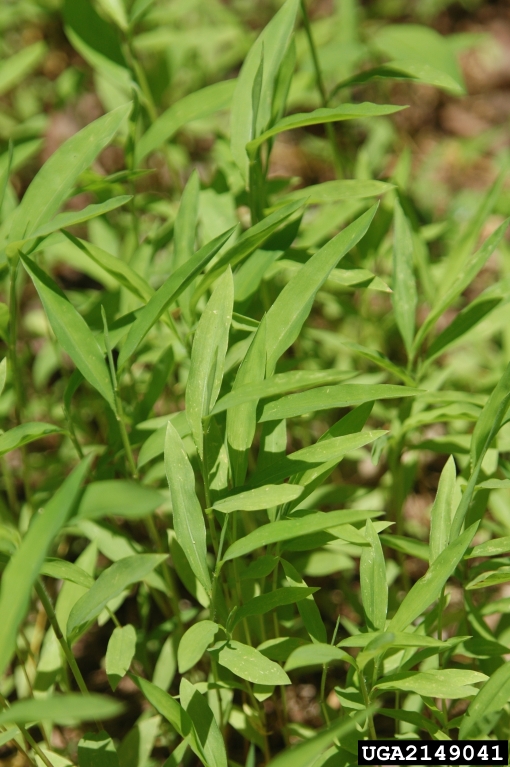
Japanese stiltgrass (Microstegium vimineum) is an annual grass native to eastern and central Asia. First discovered in Tennessee in 1919, stiltgrass may have accidentally escaped as a result of its use as packing material for Chinese porcelain. This invasive grass grows in moist, disturbed areas including stream banks, river bluffs, floodplains, forest wetlands, moist woodlands, old fields, uplands, thickets, roadside ditches, and utility rights-of-way.
Growing to about 3.5 feet tall, it has alternate, thin, pale-green, lance-shaped, 3-inch-long leaves. It has a distinct silvery stripe of reflective hairs running down the center of the upper leaf surface. Flower spikes form at the tips of slender stems from late August through early October.
Japanese stiltgrass occurs in a wide variety of habitats, tolerates shade, and seems to prefer acidic to neutral soils that are high in nitrogen.
Hand-pulling Japanese stiltgrass can damage native plants and disturb the soil, which provides opportunities for other invasive plants. To minimize damage to native broadleaf plants, use grass-selective herbicides with active ingredients fluazifop-p-butyl (such as Fusilade) or sethoxydim (such as Poast) before seed is produced. Annual herbicide applications will be necessary to control plants that germinate from seed that remains in the soil from past years. If treating the plants near water, use water-safe glyphosate.
See this MDC Japanese Stiltgrass page for more details.
| | |
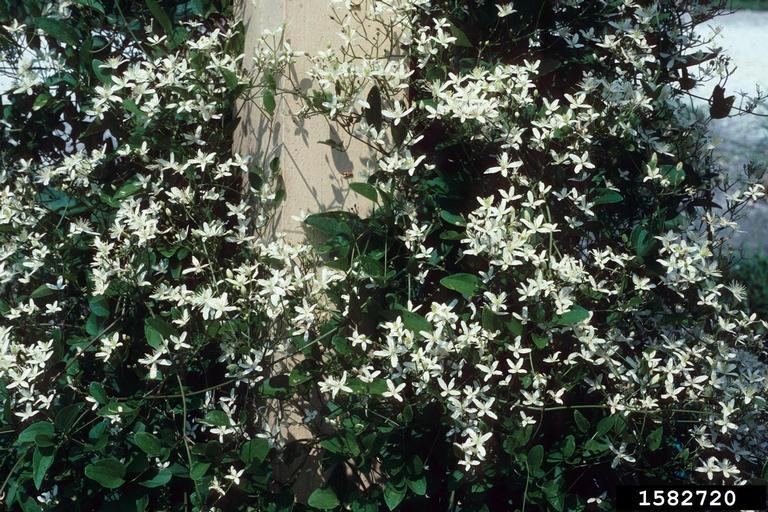
Sweet autumn virginsbower (Clematis terniflora) is a climbing, semi-evergreen, ornamental vine with opposite, compound leaves (3 to 5 leaflets) with entire (smooth) leaf edges. White, fragrant, four-petaled flowers appear in late summer through fall. Seedheads are showy with long, silvery-gray, feather-like hairs attached. Seed production is prolific.
The native species (Clematis virginiana) is very similar (margins of leaves of the native tend to be toothed), but not as prone to self-seeding and spreading.
The non-native, invasive Clematis terniflora prefers sun to partial shade and is found invading forest edges, rights of way, and urban green spaces, especially near creeks. It can create sprawling mats that choke out native vegetation. Clematis terniflora is native to Japan and China and was introduced into the United States as an ornamental plant. See its range in Missouri here.
Treatment in spring, before the vine sprawls, is ideal, but it may be harder to see. In late summer, its abundant flowers make it highly visible. Treat with a foliar spray of 3% triclopyr with surfactant. Avoid overspray to prevent impacting desirable plants.
Photo above by John Ruter, bugwood.org.
| | |
State of Invasives aims to:
• Provide useful information to you/the leaders of your organization, agency, or business to help you recognize and control invasive plants and reduce their negative impacts, introduce you to our work, explain the challenges of invasive plants, and make the case for bold action and how this will benefit Missouri and Missourians.
• Share talking points that you can use when communicating about invasive plant detection and control within your agency, business, or organization, and to your customers or stakeholders.
• Empower you and your audiences to recognize invasive plants and take action—around your office building, behind your parking lot, on your back 40, right of way, back yard, around your crop field, or on any other land you or your group owns or manages. Our MoIP Video: A Landowner Tour is one of MoIP's many useful resources at moinvasives.org.
We hope the information in this enewsletter is helpful, and we’d like to hear from you. What questions or ideas do you have? Would you like to share with us the invasive plant action you or your organization or business are taking? If so, contact us at info@moinvasives.org.
| | |
In 2015, Grow Native!, the native plant education and marketing program of the Missouri Prairie Foundation, spearheaded the formation of MoIP—a multi-agency, multi-industry networking and advocacy group to bolster statewide efforts to identify and control the invasive plant species that severely impact several sectors of the Missouri economy and native biodiversity. The purpose of MoIP—working as a united, supportive front—is to review, discuss, and recommend educational and regulatory action related to managing known and potential non-native invasive plants. Representatives from the fields of conservation, agriculture, botanical science, ecological restoration, transportation, horticulture, landscape services and design, and forestry make up the council membership, volunteering their time at quarterly meetings and small work groups. MoIP associates help disseminate MoIP information to various groups. Emily Render works on contract to coordinate MoIP activities.
In 2022, MoIP completed a framework for our work for the next five years—the MoIP Strategic Plan for 2022-2026 guides MoIP's current work.
Learn more about MoIP and find many invasive plant ID and control resources at moinvasives.org.
| | | |
Newsletter content ownership: Missouri Prairie Foundation.
You are receiving this message because you a subscriber to this enewsletter, which provides news and information about invasives in Missouri and the actions the Missouri Invasive Plant Council and our partners around the state are taking to control and reduce the impact of invasive plants. You can play an important role in statewide efforts to control invasive plants by reading, learning, and sharing the information within this enewsletter with others who deal with vegetation management.
E-mail us at info@moinvasives.org, call us at 1-888-843-6739, or visit us at www.moinvasives.org. If you do not wish to receive these periodic messages, please unsubscribe below.
Carol Davit
MoIP Chair & Missouri Prairie Foundation Executive Director
| | | |
Missouri Prairie Foundation
PO Box 200
Columbia, MO 65205
(888) 843-6739
| |
| | | |