Facebook  X  Instagram  TikTok  Youtube  Email  Web
Monthly news & updates

November 2026 | Issue


Upcoming Event


Thursday, November 5, 2026 @ 6 p.m. - Estate Planning Presentation- via IN PERSON or ONLINE with Lauren Jones.


-this is a registered event

Save the Date


Thursday, December 3, 2026 @ 6 p.m. -ONLINE Estate Planning Presentation- with Lauren Jones.


-this is a registered event

Thanksgiving...

“As we express our gratitude, we must never forget that the highest appreciation is not to utter words, but to live by them.."

-John F. Kennedy


NOVEMBER IS...


Daylight Savings Ends

An added hour for Halloween night this year!

Make sure to turn your clocks back an hour on November 1st!


We LOVE our Lawyer!

A great way to start the weekend! 
Friday, November 6th is Love Your Lawyer Day!


Please note our office will be closed this day. We will resume regular office hours on Monday, November 9th.


Thank You for Your Service

The courts will be closed in Observance of Veterans Day, Wednesday, November 11th.


Our office will be open regular hours this day.


Turkey Day is Here

May you and your love ones have a wonderful holiday weekend!


Our office will be closing at 12pm on Wednesday, November 25th.


The courts and our office will be closed Thanksgiving Day and the Day After. We will resume regular office hours on Monday, November 30th.


NATIVE AMERICAN HERITAGE MONTH


Do You Know?

Do you know November is Native American Heritage Month?


Join us as we continue to celebrate prominent leaders within the legal community who brought significant changes in American history.


Stay tuned!


YOUTUBE


YouTube Channel!

Are you up to date on our videos and playlists?


Our own YouTube channel is growing!

Check out this great source for added information about Estate Planning and Business Law!


#subscribe #like #share


GOOGLE REVIEWS & FEEDBACK
 
 
How Are We Doing?

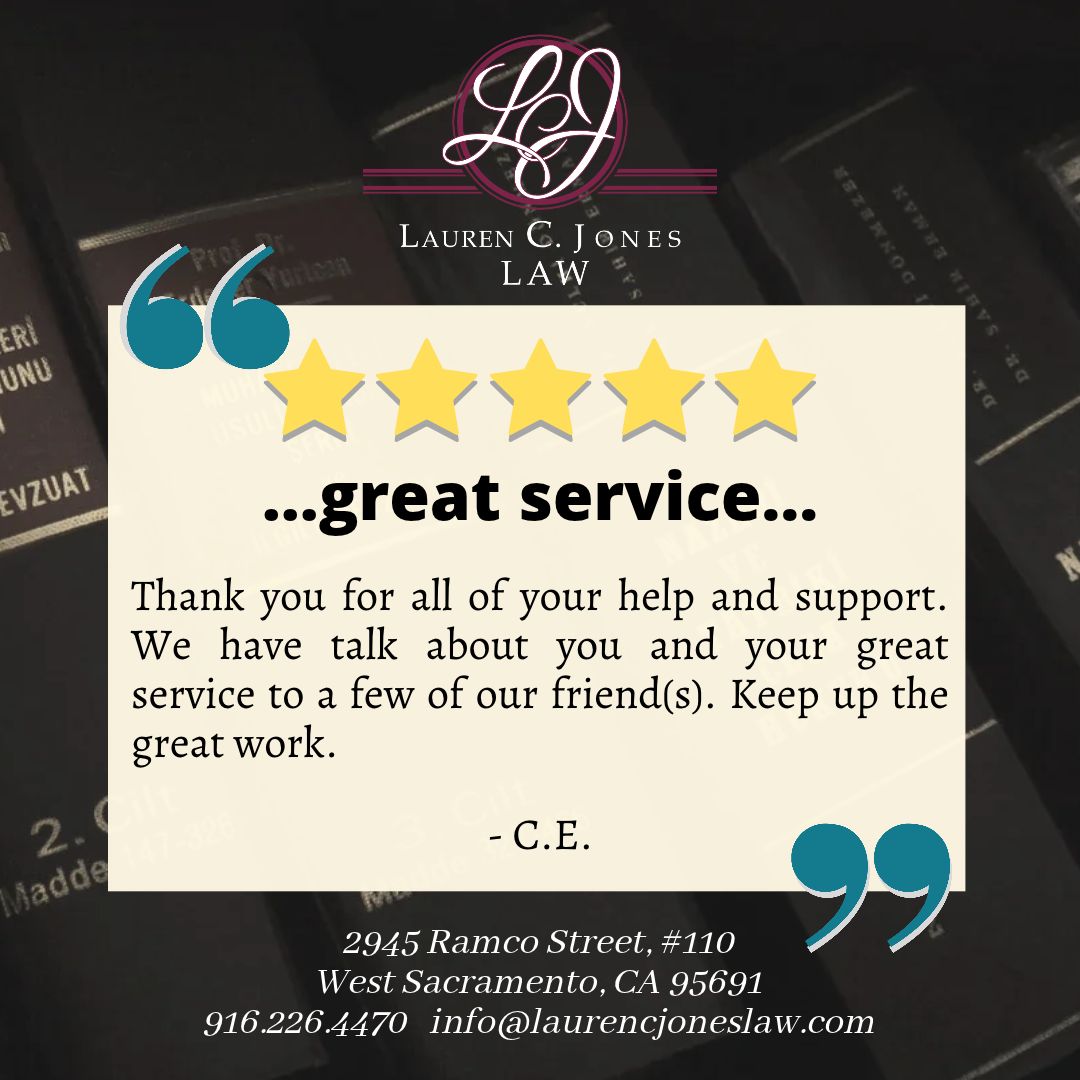
Did you know you can leave us Google reviews? We would love to hear from you how we are doing!


Please consider leaving your review online and “liking” us and on our firm’s Facebook page: https://www.facebook.com/laurencjoneslaw,  as well as leaving a review on Google https://g.page/lcjlaw/review?gm.


Online reviews on these platforms immensely help more clients like yourself find our firm! 


LAUREN'S CORNER


Tales of the SCARY

Estate Planning

Another year and the tales of estate planning snafus just get scarier. To get you in the spooky spirit and maybe motivate you to take next steps for yourself, we are going to share some of our most scary stories about estate planning.


Click the link to read the full article.


Office Shenanigans and Adventures


Buddy Won So Many Awards!!


How do you Surprise your Assistant on her 50th Birthday?


Happy Birthday Deb!!


Estate Planning and Business Law Topics of Discussion


Adjusting Your Estate Planning Documents When Moving to a New State

Moving to a new state may impact your legal status in a number of ways, including how your property is held and how your marriage and family matters are handled. Upon relocation, it is likely that your estate planning documents will need to be reviewed and revised. Each state has its own laws governing the creation and administration of wills, trusts, powers of attorney and health care directives. While these documents are still lawful if created in accordance with the laws of the state in which they were formed, their applicability in a new state may be uncertain and may require a court ruling.


Wills. Each state has a particular set of rules relating to various aspects of will formation and administration. While your will is probably valid in a new state, there are some areas of will construction that can present a problem. For example, inheritance rules, the laws of intestate succession, estate or inheritance taxes, and the criteria to serve as an executor vary from state to state. One area that likely needs to be addressed concerns marital property rules. Married individuals who move between community property and common law states face different laws regarding ownership rights over property. It is advisable to make new wills so the property you own and/or share with your spouse is treated as you intended.   


Trusts. Like wills, trusts are governed by laws that differ among states. In addition, each state may adopt its own version of the Uniform Trust Code, a set of model laws on trusts, which does not provide uniformity among states. Updating your trust to reflect and incorporate the laws of your new home state is a sensible idea, particularly if you purchase property in the new state that you intend to include in the trust.


Powers of attorney and health care directives. States maintain their own powers of attorney and health care directive forms that often differ in terminology and format. For example, California uses a single form known as an advance health care directive that combines a power of attorney for health care and a living will, while other states do not. To avoid uncertainty as to whether these forms will be accepted in the new state of residence, it is important to review these documents with an attorney and re-execute them if necessary.  

Converting Your Business to a Different Structure


Over time a business may need to alter its structure to conform to different needs or an evolving business environment. In some cases, you may decide that a different structure offers certain advantages that will be beneficial to the growth of your business. The business structure you choose will determine several key features of your operations including regulatory requirements, liability protection and taxation matters. 


A business that elects to form a limited liability company (LLC) has certain administrative and financial obligations. As an LLC, the business is required to draft and submit articles of formation and an operating agreement.  LLCs must also elect their management structure, namely choosing between either a member-managed or manager-managed LLC. Whether it will be taxed as a partnership or a corporation is another important consideration for LLCs. One of the greatest benefits of LLC status is the personal limited liability protection afforded to its members.  


If a business converts from a corporation to an LLC in California, it can take advantage of the streamlined procedure known as statutory conversion. This process allows a business to change its structure automatically to an LLC by filing a document with the Secretary of State. This process concurrently transfers the corporate assets and liabilities into the LLC. A business owner can avoid numerous administrative filings and actions, including dissolving the corporation separately, by employing this process.  


Alternatively, a business may choose to convert from an LLC to a corporation to obtain more capital by attracting new investors and revenue sources. The process of transforming an LLC into a corporation in California entails several simple administrative actions. First, LLC members or owners must vote to approve the conversion. This includes authorizing the terms of the business conversion, the content of the formation documents and the process of conversion of ownership rights. Then the LLC must file articles of incorporation with a statement of conversion that conforms to specific requirements under the California Corporations Code.  The articles must be filed with the Secretary of State. The business must also modify its classification with the IRS to ensure proper tax status.  


Facebook  Instagram  X  TikTok  Youtube  Email  Web