|
In This Issue:
- Market Update: U.S. Rice Farmers Sort Out 2026 Supply Situation
- Washington, D.C. Update
- Domestic News: Rice Delphacid Update Program in Texas
- RMTC 2026 Networking Reception
- RMTC Speaker Highlight: Dr. Rafael Hernandez Lozano, Sandra Avellaneda, Lic. Ricardo Lozano Forero
- Photo from Rice Country
| |
| U.S. Rice Farmers Sort Out 2026 Supply Situation | |
| |
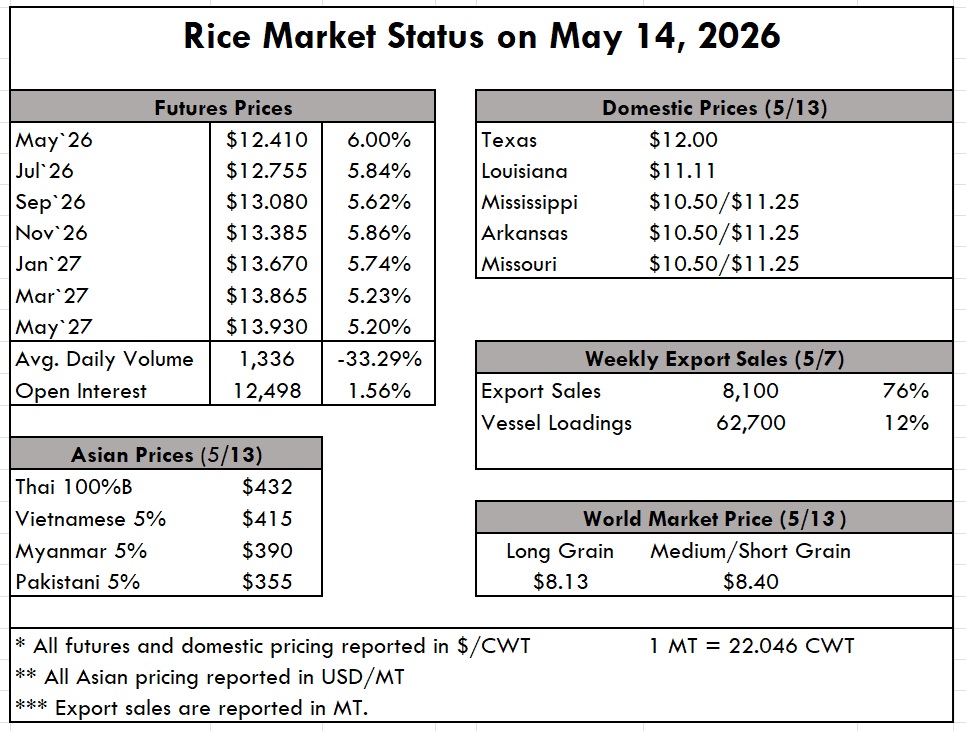
With actual crop size coming into focus, futures are finally starting to respond with the first positive notes we’ve seen in a long time. The WASDE published this week dropped production significantly across the states, but we would argue it’s still not quite low enough. From surveys we have taken, our best estimate for long grain is approximately 1.45 million acres, and medium grain at about 700,000 acres total. This would be the lowest long grain acreage in the modern era. This would have an even more significant impact if there weren’t at least 300,000 acres worth of carry over stock still waiting to be procured. Farmers in NE Arkansas and Missouri are in the final phase of planting.
There has been plenty of consternation about the drop in exports from last year to this year, so let’s put that into some context. In 2024/25, the U. S. exported a total of 2.7 million metric tons, where 2025/26 is at 2.26 million metric tons, or a net decrease of 16.1%. The largest drop is long grain rough rice, which has fallen to 785,000 metric tons, or a 32% decrease from this time last year. Medium Grain rough rice has dropped 14% in the same period. Long grain milled rice has dropped from 749,000mt down to 652,000mt, or 13%. The lone gainer of the group is medium grain milled rice, up 5% year over year, on account of an increased trading relationship with Japan.
In diving deeper into the long grain trade, it’s not all bad news. Colombia has increased its procurements by 139,000 metric tons, but that’s not enough to offset Mexico, Nicaragua, Guatemala, and Honduras that have a net loss of 448,000 metric tons. Venezuela is currently off by 48,000 metric ton as well. While these numbers are dreary, it’s likely there are some timing constraints involved, as El Salvador, Honduras, and Guatemala import U. S. long grain rice almost exclusively. Therefore, it’s likely their reductions are timing related and will balance out in the coming months. Government policies regarding quotas, licenses and tariffs influence decisions of course. Strong competition from Mercosur exporters due to ample stocks, particularly in Brazil is anticipated.
Now looking at the global environment, India is still the juggernaut. However, their rice production machine may be hampered in the coming crop cycles, on both the production and the logistical fronts as high fuel costs strain the entire rice export ecosystem. Reports from the trade show Indian exporters and supply companies are appealing the government for even greater subsidies. India is now responsible for over 40% of the global rice trade, and China now accounts for more than 50% of global rice stocks. At the moment, the USDA expects global rice production to drop 5 million tons this year, with consumption set to increase 3.8 million tons. This would reduce global stocks by 3.6 million tons, down to 192.7 million tons (108 million tons of which belong to China).
To sum it up, the pain will remain through this crop year until the supply situation is truly sorted for U. S. rice producers. Even then, we will need to see the two vessels booked to Iraq actually discharged and exported; not just continue to sit in country as “sold.” Futures are already climbing, and the cash price should too. Now let’s hope for excellent milling quality that is essential for gaining back market share.
| |
| |
EPA Administrator Testifies Before Senate Interior Appropriations: On Wednesday, May 13, the Senate Appropriations Subcommittee on Interior, Environment, and Related Agencies called in U.S. Environmental Protection Agency (EPA) Administrator Lee Zeldin to testify regarding the President’s Fiscal Year 2027 (FY27) EPA Budget Request. During the hearing, members of the Committee discussed the importance of clean water, environmental protection, and supporting vulnerable communities. Republicans focused on regulatory clarity, energy costs, and ensuring EPA funding supports infrastructure and local needs, particularly in rural areas. Democrats emphasized concerns over proposed EPA budget cuts, impacts on environmental justice, research, and public health, and questioned the elimination or reduction of key programs. Other topics discussed included Superfund and brownfield redevelopment, air quality standards, plastics and pharmaceuticals in water, per- and polyfluoroalkyl substances (PFAS) regulation, and EPA’s collaboration with state and local partners. You can watch a recording of the hearing here.
House Advances Year-Round Ethanol Bill: On Wednesday, May 13, the House of Representatives passed H.R.1346, a measure that would allow the year-round sale of increased ethanol-blend fuel by a 218-203 vote. In total, 122 Republicans, 95 Democrats, and 1 Independent joined ranks to pass the bill. This vote and ultimate passage come after the initial rule to consider the measure alongside the House farm bill was sidelined during the week of April 27. Agriculture groups, particularly those with stakes in the corn ethanol market, have spent years urging Congress to approve the year-round sales of E15 fuel blend, while stakeholders involved in the oil refinery supply chain have been the loudest voices of opposition when it comes to expanding E15 sales. Now the bill heads to the Senate for another uphill battle before it can make it to the President’s desk for final passage. Senate Agriculture Committee Chairman John Boozman (R-AR) and other lawmakers have publicly voiced concern over the E15 bill in its current form, citing issues with the blending requirement for small and medium-sized refiners.
Senate Ag Holds Hearing on the Fertilizer Supply and Affordability: On Tuesday, May 12, the Senate Committee on Agriculture, Nutrition, and Forestry held a hearing titled, “Perspectives on the Fertilizer Industry: Ensuring a Stable and Affordable Supply for American Producers." Witnesses included various stakeholders involved throughout the fertilizer supply chain, and they testified to the urgent need to address high fertilizer prices and their impact on U.S. farmers. Republicans focused on reducing regulatory barriers, increasing domestic fertilizer production, and providing immediate assistance to farmers, often highlighting supply chain disruptions and the need for market-driven solutions. Democrats emphasized market concentration, transparency, and the need for stronger competition and oversight to prevent price gouging and support small and specialty crop farmers. Other topics discussed included the agricultural impact of geopolitical conflicts, the role of tariffs, precision agriculture, research and development, and bipartisan legislative efforts to improve market transparency and resilience. You can find more information about the witness list and watch a recording of the hearing here.
| | Rice Delphacid Update Program in Texas | |
Hear directly from leading experts on the latest rice delphacid developments, scouting techniques, and management strategies impacting Texas fields. Free to attend and includes 2 CEUs. | |
| RMTC 2026 Networking Reception | |
| |
One of the anticipated highlights at RMTC will be an evening dedicated to bringing together rice industry leaders, partners, and colleagues from across the Americas. The gathering will provide a dynamic setting for strengthening relationships, exchanging perspectives, and reinforcing the collaborative spirit that defines the industry.
A key feature of the evening will be a curated culinary experience showcasing the versatility and quality of U.S. rice. Guests will enjoy traditional Colombian dishes thoughtfully prepared with U.S. rice, demonstrating how it can be seamlessly incorporated into local cuisine while enhancing flavor and presentation.
The evening will not only highlight the adaptability of U.S. rice across diverse culinary traditions but also celebrate the rich cultural heritage of Colombia—creating a memorable experience centered on food, connection, and shared industry values.
| | |
RMTC Speaker: Dr. Rafael Hernandez Lozano
| |
| |
Dr. Hernandez Lozano is the General Manager of Fedearroz.
With more than 54 years dedicated to Colombia’s rice sector and 36 years leading Fedearroz, Dr. Hernández Lozano is recognized as one of the most influential leaders in Colombian agriculture. Throughout his career, he has helped advance rice innovation, sustainability, research, and competitiveness across Colombia and Latin America, including playing a key role in the creation of FLAR.
His leadership has strengthened technology adoption, infrastructure, and international representation for the rice industry.
| |
|
RMTC Speaker: Sandra Avellaneda
| |
|
Sandra Avellaneda serves as Executive Director of the Cámara Induarroz de la ANDI, the leading organization representing Colombia’s rice industry. She is an economist with a specialization in marketing and market research, and has completed studies in agricultural hedging and grain purchasing at the University of North Dakota.
With more than 23 years of experience in the agricultural sector, she has represented the rice industry both nationally and internationally, becoming a respected voice within the sector.
| |
RMTC Speaker: Lic. Ricardo Lozano Forero
| |
| |
Lic. Lozano Forero is an attorney specializing in Administrative Public Law with more than 35 years of experience across both the public and private sectors, with expertise in public administration, foreign trade, and international business development. Since 2020, he has served as President of the Board of Directors of the Induarroz Chamber.
Throughout his distinguished career, Lozano has held several high-level leadership positions, including Colombia’s Vice Minister of the Interior, Ambassador to Ecuador, Venezuela, and Costa Rica, and Director of ProColombia in both Ecuador and Spain. He has also chaired prominent industry organizations such as ANATO and SAYCO, further strengthening his reputation as a respected leader in trade, diplomacy, and institutional development.
| | |
Congratulations to 2023 Stoesser Scholarship Scholar, Gayla Rose, on graduating from Texas A&M University! Your hard work and dedication have paid off, and the USRPA family couldn’t be prouder. Wishing you continued success in this next chapter. Gig ’em!
Send us your rice country photos by email, or via Facebook or Instagram!
| |
| |
FAO Rice Price
Update
| |  |
Food & Agriculture
Regulatory & Policy Roundup
| | | | | | Inter-Rice World Rice Market Report | | | |
May 26 - 28, 2026
Rice Market & Technology Convention
Cartagena, Colombia
More Information
| |
| |
June 6, 2026
LSU AgCenter South Farm Rice Field Day
Crowley, LA
More Information
| | |
June 23, 2026
RiceTec Louisiana Field Day
More details to come
| |
June 24, 2026
2026 H. Rouse Caffey Rice Research Station Field Day
Rayne, LA
More Information
| | |
June 30, 2026
Texas A&M AgriLife Research & Extension 52nd Eagle Lake Field Day
Eagle Lake, TX
More details to come
| |
July 9, 2026
Texas A&M AgriLife Research & Extension 78th Beaumont Field Day
Beaumont, TX
More details to come
| |
July 29, 2026
RiceTec Arkansas Field Day
Beaumont, TX
More details to come
| |
July 30, 2026
University of Arkansas Field Day
More details to come
| |
August 18, 2026
Missouri Rice Research & Merchandising Council Field Day
Glennonville, MO
More details to come
| | |
USRPA does not discriminate in its programs on the basis of race, color, national origin, gender identity, sexual orientation, religion, age, disability, political beliefs, or marital/family status. Persons who require alternative means for communication of information (such as Braille, large print, sign language interpreter or translation) should contact USRPA at 713-974-7423. |
| | | |