Weekly update from the National Housing Conference | | News from Washington | By Brittany Webb | | |
Senate introduces combined housing legislation
Senate leadership unveiled the 21st Century ROAD to Housing Act, a housing bill that combines provisions of the Senate’s existing ROAD to Housing Act, the House’s Housing for the 21st Century Act, and White House priorities. The latest legislative package includes new language seeking to limit the purchase of single-family homes by large institutional investors, a priority of the White House. However, the language requires build-to-rent (BTR) properties, which are multifamily developments made up of detached or semi-detached homes, to be sold to individual buyers within seven years. BTR has become an important source of new housing construction, and communities of 50+ units delivered nearly 47,000 units in 2025 alone. Several prominent housing industry groups have raised concerns over the impact of this element of the investor ban provision, which they are concerned would effectively eliminate BTR and reduce new housing supply. A group of housing organizations, led by the National Housing Conference, sent a letter to congressional leadership noting concerns with the impact that the new provision would have. NHC remains a strong supporter of the bill overall but continues to urge the White House and Senate to include a fix to ensure the bill maintains widespread support and delivers the intended impact of increasing housing supply and affordability.
“Rental housing remains a critical part of our national housing needs. BTR homes meet families where they are and play a key role in expanding supply, lowering costs, and broadening opportunity. We respectfully request that Section 901 be amended to fully exempt BTR so we can maximize new housing production nationwide,” the letter reads.
Some members of the House of Representatives have expressed hesitation about the package, preferring instead to reconcile the two competing housing bills in conference; however, the Senate is strongly advocating for the bill to pass without further negotiations.
“The 21st Century ROAD to Housing Act will boost housing supply and bring down costs,” said Ranking Member Elizabeth Warren (D-Mass.). “The package includes the vast majority of the Senate’s unanimously supported ROAD to Housing Act, incorporates bipartisan ideas from the House, and takes a good first step to rein in corporate landlords that are squeezing families out of homeownership.”
“Not only is this bill about cutting regulatory red tape, lowering costs, and expanding housing supply while generating no new spending, but it’s about making sure people like the single mom who raised me in North Charleston, South Carolina, have even greater access to economic opportunity and the American dream of homeownership,” said Chairman Tim Scott (R-S.C.).
| | | |
Only One Month Until the Must-Attend Event
for Housing Communicators
On April 8, the National Housing Conference will convene housing communications leaders from across the country for Solutions for Housing Communications at the National Press Club in Washington, D.C.
This one-of-a-kind event is the only national convening dedicated exclusively to housing communications, bringing together housing experts, thought leaders, policymakers, and journalists for a full day of dynamic discussions. Attendees will explore proven and emerging communications and messaging strategies to elevate public understanding of the importance of affordable housing—both nationally and within local communities.
Panel discussions will spotlight strategies for clearly communicating complex and technical housing issues, working effectively with housing reporters, and understanding how technology and AI are reshaping public discourse. Sessions will also highlight the power of intergenerational storytelling, best practices for communicating before, during, and after natural disasters, and practical tools to help participants engage confidently across media platforms. Panelists and speakers include:
Whether you’re shaping narratives, influencing policy, or engaging the media, this convening offers practical insights and valuable connections to strengthen housing advocacy through effective communications.
Sponsorships Available
Elevate your organization's profile and actively participate in the conversations that are shaping the future of housing by sponsoring NHC’s Solutions for Housing Communications convening. We offer sponsorship levels tailored to fit every organization’s needs, starting at $1,000. Click here to learn more.
| | |
In-Person Tickets
$200
(Non Member Rate $250)
*Use Code: Member2026
| |  | |
Virtual Tickets
$150
(Non Member Rate $175)
*Use Code: MemberVirtual2026
| | | |
OCC rescinds fair lending data rule
The Office of the Comptroller of the Currency (OCC) issued a final rule rescinding its “Fair Housing Home Loan Data System” rule as part of its stated effort to roll back regulations and tailor bank supervision to risk profiles. Since 1979, the rule had been in place to more effectively monitor fair housing in home lending decisions. OCC determined that the rule is “obsolete because it is largely duplicative of and inconsistent with revisions to other legal authorities that require national banks to collect and retain certain information on applications for home loans.” Specifically, the rule cites the Home Mortgage Disclosure Act, or HMDA data.
“Community banks serve critical constituencies and lend to Main Street businesses, that in turn support vibrant local economies,” said Comptroller of the Currency Jonathan Gould. “Unfortunately, over the last couple of decades, regulatory burdens coupled with the proliferation of a one-size-fits-all supervisory framework have cut the number of community banks across our nation in half. As Comptroller, I’ve prioritized addressing the challenges of community banks by streamlining regulation and tailoring supervision. Today’s actions execute on meaningful reforms as we continue working to help these institutions best serve the American people on a level playing field.”
The rule is effective 30 days after publication in the Federal Register.
| | | |
Warsh nomination sent to Senate
The White House has formally submitted the nomination of Kevin Warsh to serve as chair of the Federal Reserve, sending the nomination to the Senate for confirmation. Warsh, who served as a member of the Federal Reserve’s Board of Governors from 2006 to 2011 and played a role in the central bank’s response to the 2008 financial crisis, would succeed current Chair Jerome Powell when Powell’s term ends in May if confirmed. His nomination was initially announced on January 30.
The nomination now moves to the Senate Banking Committee for consideration before a potential vote by the full Senate. Warsh has been a vocal critic of the Fed’s low-interest-rate policies following the pandemic, arguing they contributed to the surge in inflation, while also suggesting that productivity gains from emerging technologies such as artificial intelligence could allow economic growth without reigniting inflation.
| | | |
U.S. action in Iran nudges mortgage rates higher
Mortgage rates have climbed back above 6% following recent U.S. military action in Iran, reversing a short-lived dip that had brought rates to their lowest level in over three years. Freddie Mac reported that its Primary Mortgage Market Survey rate rose to 6% just a week after dipping to 5.98%, the lowest level since 2022. The reversal comes amid geopolitical tensions in the Middle East and investor reactions to missile strikes that rattled the market. That change accompanied a spike in oil prices and volatility in the Treasury market, where yields help set the baseline for mortgage pricing.
Analysts note that geopolitical crisis can sometimes push mortgage rates down if investors flee to U.S. government bonds, but this conflict is different because of its potential to drive inflation higher. Higher expected inflation, in turn, tends to push long-term interest rates upward, offsetting any “flight to safety” effects and leaving borrowers facing more expensive loans.
| | | |
Extremely low-income renters face severe shortages in every state
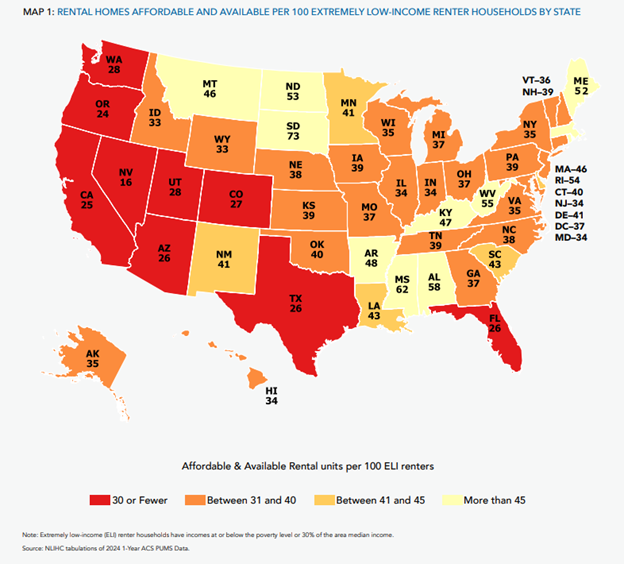
The National Low Income Housing Coalition released its annual report, The Gap 2026: A Shortage of Affordable Homes, emphasizing a stark reality for availability of homes affordable to extremely low-income (ELI) renters. The map shows that nationally there are only 35 affordable homes for every 100 ELI renter households, and no state reaches one-to-one match between units and need. States shaded in dark red, including Nevada, California, Arizona, Texas, and Florida, have 30 or fewer affordable and available homes, meaning at least two-thirds of their lowest-income renters cannot find housing that is both within their budget and not already occupied by higher-income households. Orange states such as New York, Wyoming, and Georgia have only 31 to 40 homes per 100 ELI renters, while yellow states like South Carolina and Louisiana fall roughly in the low-40s, still leaving the majority of ELI renters without appropriate options. Only a small group of light-yellow states, including South Dakota, North Dakota, West Virginia, and Maine exceed 45 homes per 100 ELI renters. Even there the map makes clear that need far outstrips supply, underscoring that the shortage of deeply affordable rentals is national in scope.
| | |
A NPR story explores the rapid growth of build-to-rent single-family homes and what they mean for families priced out of homeownership. The piece describes how investors are buying land and constructing entire subdivisions of homes intended to be rented rather than sold, offering more space and stability than typical apartments without the sometimes costly ties of homeownership. It highlights how these rentable homes can help address cost gaps between renting and owning, while simultaneously increasing the supply of homes in general without facing the zoning barriers of multifamily development.
A new analysis from Realtor.com quantifies the nation’s widening housing supply gap at 4.03 million homes, with the South accounting for the largest shortfall. The gap has widened due to slowdowns in housing completions largely in the multifamily space, resulting in an estimated missing 1.8 million potential Gen Z and millennial households forming as the younger generations contend with high cost and debt burdens. The Northeast showed some signs of improvement since 2025, while other regions saw widened housing supply gaps.
An article in Smart Cities Dive highlights how two cities are addressing increases in unsheltered homelessness. Both Oakland, California, and Phoenix, Arizona saw increases in homelessness in recent years and have since established strategic plans to combat and reduce overall homelessness in their communities. The plans seek to give greater emphasis to preventative solutions as well as strengthening pathways from temporary to permanent housing, looking beyond just encampment clearings.
| | The National Housing Conference is a diverse continuum of affordable housing stakeholders that convene and collaborate through dialogue, advocacy, research, and education, to develop equitable solutions that serve our common interest. | | Defending Our American Home since 1931 | | Copyright © 2024. All Rights Reserved. | | | | |