|
All Proposals should:
- Focus on learners (students, residents, and/or fellows) within a UCSF Health Professions field; if a proposal focuses on faculty development for educators, it should be focused on developing educational skills and show how this will directly impact the experience of learners (faculty development on clinical topics is not within the scope of Innovations Funding).
- Include junior faculty as investigators (e.g., Clinical Instructor or Assistant Professor).
- Meet 1-2 of the funding priorities listed below. Proposals should not be excessively tailored or overly broad in an attempt to meet priorities.
-
Document consultation with, and approval from, leaders whose areas are affected. Curricular projects must coordinate with relevant course or program directors and confirm a curricular need and home. Applicants should follow the Project Consultation Requirements and Contacts document for additional required consultations, including Christy Boscardin, PhD, for AI-related projects and Susannah Cornes, MD, for projects proposing to include the Kanbar Center for Simulation and Clinical Skills.
- Include a landscape assessment of, and potentially collaboration with, similar initiatives at UCSF.
- Have the potential to be disseminated and scaled beyond a single program, institution or discipline.
- Have a sustainability plan that allows the work to benefit others after the funding period.
- Have a plan for evaluation, presented in sufficient detail so reviewers can understand specific steps and components of the proposed evaluation approach.
- Adhere to the Innovations Funding program budget guidelines.
- Acknowledge use of AI tools in preparing the proposal, if applicable.
-
Include at least one letter of support if invited to further develop the proposal in the Open Improvement phase. Review the letter of support requirements to be sure you request all the letters you need by the proposal deadline.
Funding Priorities
The Academy of Medical Educators seeks proposals for junior faculty to engage in curricular innovation and scholarship. A list of potential areas for innovation is below.
This list is not in prioritized or ranked order. Applicants are advised that the quality of the proposal and the likelihood of successful outcomes from the innovation are also important factors, whether the proposal addresses these priority topics or other areas.
- Tools or strategies that advance learner assessment, promote learner growth, and/or operationalize a precision education* framework.
- Interprofessional education initiatives, with the goal of improving interprofessional collaboration and the delivery of care, or improving assessment of interprofessional competencies.**
- Faculty educator development, particularly initiatives that use innovative, flexible, and accessible approaches to engage faculty and address emerging needs in health professions education.
- Advance the responsible and ethical integration of technology and AI, including within simulation and experiential learning environments, to support precision education, curriculum design, learner assessment, adaptive feedback, faculty development, and program evaluation.
- Using health systems science, including systems-based practice, patient safety, and quality to deliver safe, equitable, high-value, cost-conscious patient-centered care.
- Enhancing continuity of learner experiences, development, and relationships with supervisors, peers, and patients across the health professions education continuum.
- Strengthening healthcare professional-patient communication skills.
- Working with partners both inside and outside of UCSF (e.g., through community- engaged collaborations) to promote education projects that promote health equity, consider threats to health such as climate change, and address social and structural drivers of health.
- Optimizing learning ecosystems that promote the inclusion of all people and promote dialogue across differences.
*Precision health professions education is a longitudinal, developmental, data-informed approach that supports students’ progression from novice to competent physician prepared to learn throughout their careers. Rooted in the principles of successful achievement of competence, personalization, equity, and systems-based improvement, this approach leverages educational data and technology to enable frequent, timely feedback. It empowers learners to partner with faculty to promote their learning and positions the program to ensure learners’ readiness for advancement in their training.
**Projects involving interprofessional collaboration across the education continuum (e.g., undergraduate and/or graduate education) are highly encouraged. Project teams must include faculty from relevant schools or programs. Interprofessional education involves two or more professions learning with, from, and about each other, e.g., medicine, dentistry, nursing, and physical therapy. Education involving two or more subspecialties within one profession, e.g., cardiology and surgery, is not considered interprofessional.
Principal Investigator Eligibility
- UCSF faculty are eligible to be PIs, and all teams must include junior faculty, as above. Senior faculty who have previously received program funding are encouraged to serve as mentors, with salary support reserved for junior or early-career faculty.
- The PI must have release time sufficient to complete the proposed project in 2027-2028, certified in advance by their department chair or equivalent chief or supervisor.
- Trainees may serve as Co-Investigator with a faculty PI; however, trainees are not eligible to serve as PI.
- For specific salary support guidelines related to faculty, residents, trainees, and staff, see the budget guidelines.
Budget Guidelines
-
Required Budget Documentation: Please follow the instructions on page one of the Budget Template and refer to the Sample Budget and Guidelines.
- Budgets may include: the purchase of faculty effort (max 10% faculty FTE), necessary supplies and expenses, staff salary support, and stipends. Salary and benefit data provided by the PI’s department should be included for all funded team members except those receiving stipends.
- Resident salary support: resident salaries may be supported, in certain cases, such as if a resident is on a research year and needs to secure their own grant funding. Resident salaries are usually fully funded (e.g., through VA or Medicare funding) and do not meet the criteria for AME Innovations grant funding.
- Faculty salary support: Faculty may receive salary support from only one funded project, but may participate as non-funded team members on multiple grants.
- Funds may be used to purchase equipment only if such equipment is an integral part of a substantive curricular development effort and not available from other sources at UCSF (e.g., the Library or Technology Enhanced Education). It is important that the equipment be for educational purposes (clinical equipment cannot be purchased through Innovations Funding), and there should be a clear plan for servicing/maintaining the equipment after the grant funding period.
- Conference-related expenses, travel, and publication fees are not considered within the scope of the Innovations Funding Program.
- Food may be funded if integral to the project and depends on available funds.
Submission Process
Our goal is to help investigators submit the highest quality proposals via a two-phase process:
-
Phase 1: Concept Submission: Investigators submit proposal concepts via survey on the Smartsheet Dashboard (Step 1: Submit Concept) for review by the committee. Preview the survey questions and submission requirements.
-
Phase 2: Open Improvement: Investigators whose concepts are ranked most highly and judged most feasible are invited to develop proposals in the Innovations Funding forum in Smartsheet, where they receive comments and suggestions from the UCSF community. We require an initial draft submission a few weeks prior to the deadline to enable comments and feedback.
We encourage your participation. Please spread the word among your colleagues about this opportunity. Contact Sierra.Niblett@ucsf.edu with questions about the AME Innovations Funding for Education.
UCSF does not use race, gender, sex, or other protected categories or proxies for protected categories in the selection process.
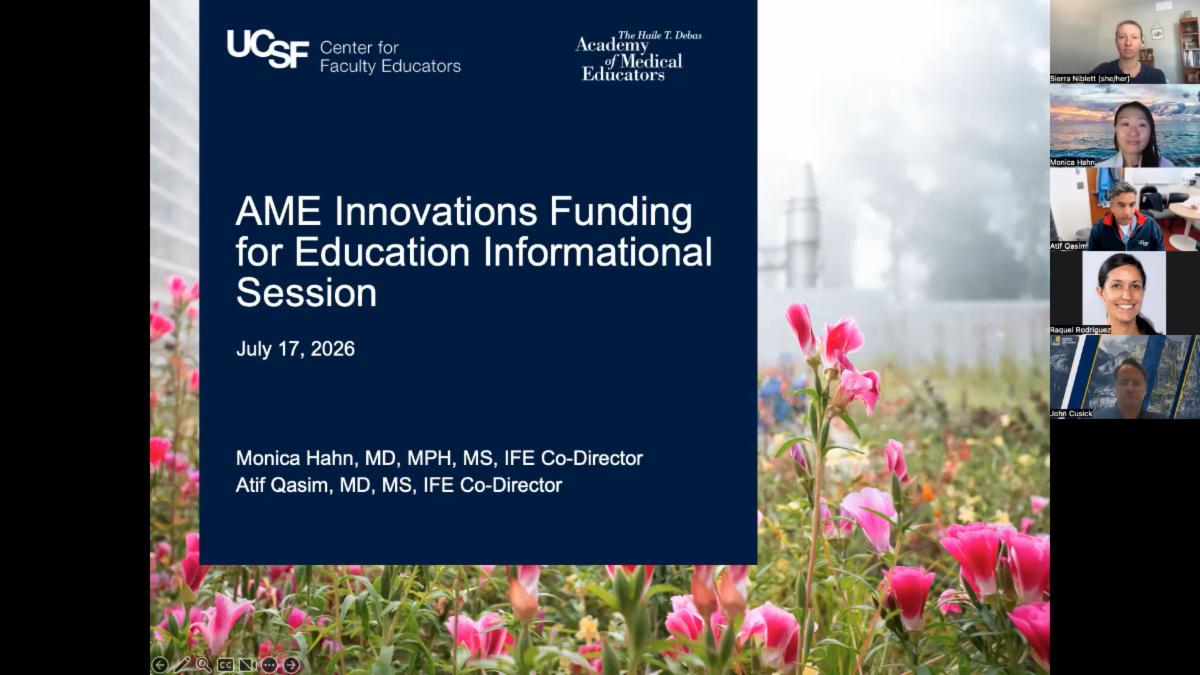
Monica Hahn, MD, MPH, MS, Co-Director, AME Innovations Funding Committee Atif Qasim, MD, MS, Co-Director, AME Innovations Funding Committee
Cindy Lai, MD, Interim Director, The Haile T. Debas Academy of Medical Educators
|